
NEWS
iPhone 18 Pros Face AI Memory Tax and Split Launch
DRAM costs push iPhone 18 Pro memory to 34 percent of BOM and likely $200-plus hikes while Apple delays the base model and steers chips to Pros and the Ultra.

Apple is steering its entire fall iPhone launch toward the expensive models. The iPhone 18 Pro, iPhone 18 Pro Max and the rumored foldable iPhone Ultra are set for September 2026, while the standard iPhone 18 slips to spring 2027. Behind the feature leaks sits a sharper constraint: AI data centers have driven DRAM prices so high that memory now accounts for roughly 34 percent of the Pro’s bill of materials.
That cost shock, confirmed in supply-chain data and Tim Cook’s final months as CEO, explains the split schedule, the expected $200 to $300 starting-price jump, and why scarce chips are flowing first to devices that can absorb higher stickers.
The Pro Models Land First This Fall
Apple will introduce three phones at its traditional September event, most likely Wednesday, September 9. Pre-orders are tipped for September 12 to avoid the anniversary of the 2001 attacks, with devices in stores around September 18 or 19.
- iPhone 18 Pro, 6.3-inch display, A20 Pro on 2nm, smaller Dynamic Island, expected variable-aperture main camera in some reports, dark cherry among the colors.
- iPhone 18 Pro Max, 6.9-inch, larger battery that may add a quarter-millimeter of thickness and about 7 grams, possible exclusive on the variable aperture.
- iPhone Ultra, first foldable, roughly 5.5 inches closed and 7.8 inches open, Touch ID instead of Face ID, two-camera system, multitasking aimed at iPad mini landscape use, price talk of $2,000 to $2,500.
The base iPhone 18, iPhone 18e and next iPhone Air are held for early 2027. Analysts and leakers describe the move as a way to concentrate limited high-end DRAM on the highest-margin units while the company works through the shortage.
OtterBox packaging already lists cases that fit both the 17 Pro and 18 Pro, pointing to near-identical external dimensions. Display sizes stay put. Brightness targets are reportedly higher than usual.
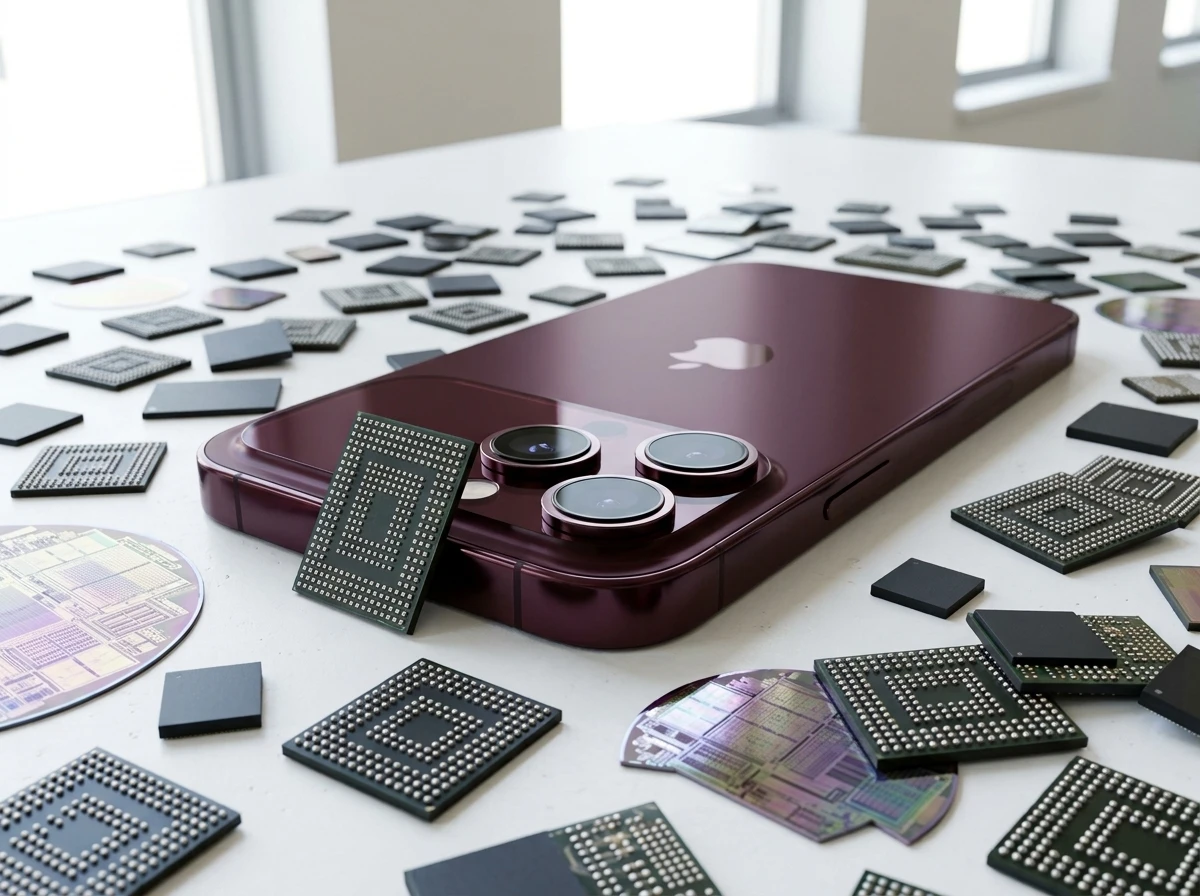
Memory Now Costs More Than the Chip
TechInsights and TrendForce put hard numbers on the squeeze. Memory and storage made up about 9 percent of a 256 GB iPhone 17 Pro’s bill of materials. On the 18 Pro that share is running near 27 to 34 percent in the third quarter of 2026 and is projected above 40 percent in the first half of 2027.
TrendForce’s August analysis estimates the 256 GB iPhone 18 Pro will carry a 38 percent higher bill of materials year over year. One widely cited breakdown shows the 12 GB DRAM package alone jumping from roughly $39 to about $145. Other major line items, processor, display, camera, battery, are largely flat. Memory has overtaken the application processor and OLED panel as the single largest cost category.
| Metric | iPhone 17 Pro (256 GB) | iPhone 18 Pro (256 GB est.) |
|---|---|---|
| Memory share of BOM | ~9-10% | ~27-34% |
| Total BOM change | baseline | +38% |
| Starting retail (recent estimates) | $1,099 | $1,299-$1,399 |
| DRAM package cost (example) | ~$39 | ~$145 |
Tim Cook told the Wall Street Journal in June that price increases were “unavoidable” and that the company was facing a “100-year flood on memory pricing.” On his final earnings call he repeated the point. Apple had already raised Mac and iPad prices. Gross-margin guidance for the September quarter fell to 46.5 percent, with memory explaining more than the entire decline.
We’re in what I would characterize as a 100-year flood on memory pricing with exponential increases in memory prices.
Tim Cook, then Apple CEO, July 2026 earnings call
Roughly a billion dollars of finished A20 Pro silicon sat at TSMC in early August waiting for mobile DRAM that had not arrived. Packaging integrates the processor and memory on the same wafer-level module, so delayed DRAM strands completed chips. Apple still expects to meet first-wave September demand; the risk is inventory and wait times afterward. Attempts to qualify Chinese supplier CXMT as a second source failed on price and capacity. Samsung, SK Hynix and Micron hold the leverage.
On X, market watchers noted the same pattern: other components stay stable while memory explodes, turning the phone into a delivery vehicle for AI-driven scarcity. Some users joked about boycotting AI; others simply said they would keep their iPhone 17.
Why the Base iPhone 18 Waits Until Spring
Holding the standard model until March 2027 or so lets Apple ration the tightest DRAM grades. The Pro and Ultra buyers are less price-sensitive. Financing, trade-ins and carrier deals can soften the monthly hit even if the sticker rises $250 or $300. Older iPhone prices may also climb at launch to protect mix.
Android makers face steeper pass-through because their margins start thinner. Entry-level and mid-range segments are already under pressure; some lines could shrink or disappear. Global smartphone production is expected to stay soft through 2027 as memory costs weigh on demand.
Apple nearly doubled inventory to more than $11 billion ahead of the climb. It is selling more phones than ever and keeping less of each dollar, yet still earns more per unit than rivals. That gap is why the shortage is painful for Apple and existential for smaller brands.
- June 2026, Cook tells the Journal price increases are unavoidable; Mac and iPad prices rise.
- July 2026, Final Cook earnings call flags the “100-year flood”; margin guide drops.
- Early August 2026, Reports of $1 billion in stranded A20 Pro wafers at TSMC.
- August 10 2026, TrendForce publishes 38 percent BOM increase estimate.
- September 1 2026, John Ternus becomes CEO on September 1.
- Early September 2026, Expected iPhone event for Pros and Ultra.
Camera Upgrades Carry Their Own Trade-Offs
Bloomberg’s Mark Gurman has called the camera hardware upgrades among the biggest in the Pro lineup’s history. The main camera is expected to gain a variable aperture, a mechanical iris that can physically adjust the lens opening for different light and depth-of-field needs instead of relying only on software.
Natural bokeh becomes possible in-camera. Low-light and bright scenes can both be optimized at the optical stage. Digital Chat Station and other supply-chain sources have tracked the feature for months; a June leak of Tata Electronics files confirmed a Sony IMX905 sensor with variable-aperture support for the Pro Max.
Leaker Ice Universe claimed in mid-August that the variable aperture would be exclusive to the Pro Max. If true, it would repeat the pattern last seen when the tetraprism telephoto arrived only on the larger model. Buyers who want the best camera would again have to accept the bigger, heavier phone. The Pro Max is already tipped for a larger battery, Chinese filings and leakers have mentioned capacities approaching or exceeding 5,000-5,500 mAh, that could add thickness and weight.
Other camera talk includes a larger-aperture telephoto and continued 48-megapixel main sensors. A 200-megapixel telephoto is more often placed in later years. Software remains iOS 27 with the revamped Siri that acts as a chatbot, understands on-screen content, and helps with writing and image work. The beta is already out for adventurous users.
Dark Cherry and the Familiar Shell
Design is evolutionary. Sizes match the 17 Pro pair. The back glass on the Pro is said to shift to a more unified look instead of the previous two-tone treatment. A smaller Dynamic Island cutout appears in leaked images and leaker notes.
Color lineup for the Pros centers on silver, dark gray, light blue and a wine-like dark cherry that leakers compare to the standout cosmic orange of the prior generation. Black may be absent or represented only by the dark gray that looks nearly black in dummy units. Case makers are already shipping product sized for both generations, another sign that the external mold is stable.
Inside, expect standardized 12 GB RAM across the Pro and base lines (the base previously lagged), the new C2 modem, possible 5G satellite support, and an N2 chip for better Wi-Fi, hotspot and AirDrop. Batteries move toward the 5,000 mAh class that has become the Android flagship norm.
John Ternus Inherits the Price Test
The September event will be the first under new leadership. Ternus, who spent more than two decades in hardware engineering and led the teams behind multiple iPhone, iPad, Mac and AirPods generations, takes over as CEO on September 1. Cook becomes executive chairman.
Ternus brings a hardware engineering background spanning iPhone generations and a reputation for durability, materials and manufacturing focus. The first public test is whether Apple can raise prices enough to protect margins without crushing demand, while still shipping a foldable that must justify a $2,000-plus ticket.
Cook spent his last months preparing the ground. He raised other product prices, stocked inventory, and spoke bluntly about the memory market. Ternus now owns the mix decision: how many scarce DRAM packages go into Pros versus any residual standard units, how aggressive trade-in and installment offers become, and whether the Ultra is positioned as the true halo or a limited experiment.
The Ultra Foldable Joins the Expensive Club
The foldable is the cleanest break from the past. Closed it is pocketable at about 5.5 inches; open it approaches iPad mini territory at 7.8 inches with software for multitasking. Touch ID replaces Face ID, a practical choice for a folding hinge. The camera system is simpler, two lenses, keeping thickness and cost in check. Early accessory leaks show asymmetric corners that match a book-style fold.
Pricing talk clusters between $2,000 and $2,500. At that level the Ultra can absorb expensive memory more easily than a mass-market phone. Volume is expected to stay under 10 percent of the combined Pro-plus-Ultra run. Lifetime production across the three constrained models is projected near 200 million units; the foldable is the smallest slice.
If the DRAM bottleneck eases later, the spring 2027 base iPhone 18, 18e and Air 2 could arrive with more generous allocations and perhaps slightly lower relative pricing pressure. For now the message is clear: if you want a new iPhone in the traditional fall window, you are buying a Pro or the Ultra, and you will pay more for the privilege of memory that AI data centers also want.
The September event will settle the exact numbers. Until then the second-order effect of the AI build-out is already written into the calendar, the BOM and the product mix.

-
 TECH1 year ago
Where Garmin Watches are Made and How They are Assembled
-

 AUTO2 months ago
Tesla’s Roadster Is ‘a Few Weeks Away,’ Says Its Chief Designer
-
 NEWS10 years ago
Samsung Releases Galaxy Note7 TV Ad as Reddit AMA Leaks Specs
-
 NEWS10 years ago
Android 7.0 Nougat Rolls Out To Nexus Devices With New Emoji, Features
-
 FINANCE9 years ago
Cardano Price Surges as ADA Enters the Crypto Top Ten List
-
 NEWS10 years ago
Pre-Order the First Camera Made for Facebook Live Streaming Video
-
 FINANCE1 year ago
Binance Suspends Trading and Withdrawals for a System Upgrade
-
 FINANCE9 years ago
RChain Price Jumps Nearly 150% to a New All-Time High of $2.03