
NEWS
Kyiv Missile Barrage Leaves 13 Dead as Interceptor Stocks Run Dry
Russian ballistic and hypersonic missiles killed at least 13 in Kyiv, damaging a children’s hospital.

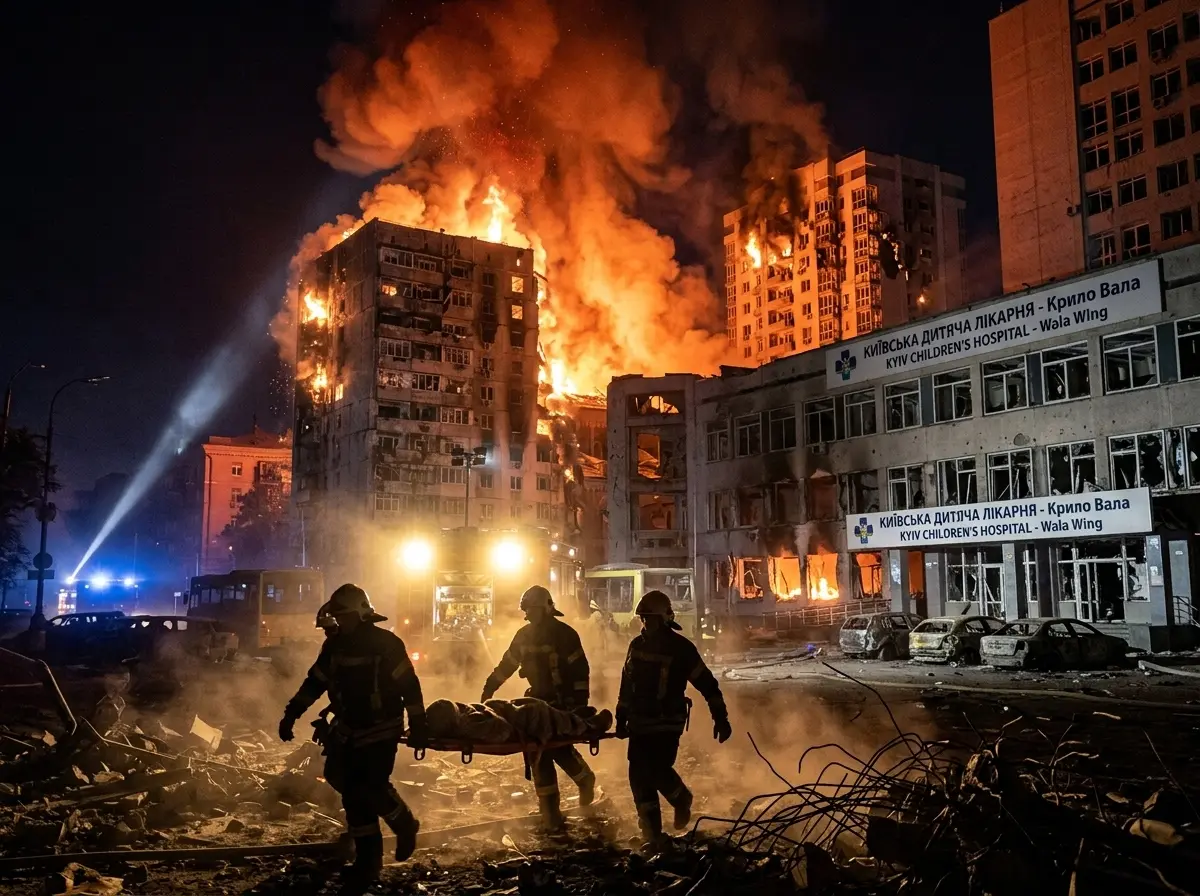
Russian ballistic and hypersonic missiles killed at least 13 people and wounded 33 in Kyiv overnight into Thursday, collapsing a residential building, damaging a children’s hospital and cutting power across districts as air defences failed to stop the wave.
The barrage landed one day after parliament confirmed a new defence minister, handing him a capital already stripped of the interceptors needed to keep the lights and heat on this winter.
What the Overnight Wave Hit in Kyiv
Explosions shook the Sviatoshynskyi, Solomianskyi and Shevchenkivskyi districts after midnight and again before dawn. Mayor Vitali Klitschko said a nine-storey residential block in Solomianskyi collapsed and caught fire. A children’s hospital in the same district lost windows and saw cars burn on its grounds. People remained trapped in at least one other building.
Ukraine’s Emergency Services reported fires in residential blocks and warehouses. Rescuers pulled at least two people from rubble. In Brovary district outside the city one person died and one was wounded at an industrial site. An Al Jazeera correspondent in Kyiv said two fuel facilities were hit and air alarms kept sounding through the morning.
- 13 killed, 33 wounded in the capital and immediate region per city and emergency officials
- Children’s hospital damaged with shattered glass and burning vehicles
- Residential collapse and multiple warehouse fires
- Power outages across parts of two districts; later tallies put roughly 40,000 homes dark
The pattern of damage stretched from the city core to its industrial rim. Residential blocks and warehouses burned inside the capital while a separate industrial site in Brovary added to the toll outside the ring road. Fuel facilities and logistics sites joined the list, tightening pressure on both civilian life and supply lines in a single night.
Ukraine’s air force said Russia fired dozens of ballistic, cruise and hypersonic missiles plus 168 drones. The mix included Kinzhal and Zircon hypersonics, Iskander and North Korean KN-23 ballistics, and Shahed drones. Kalibr cruise missiles were tracked approaching from the Black Sea.
That blend forced defenders to track fast ballistic arcs, low cruise profiles and slow drone swarms at once. The second wave before dawn arrived while crews were still answering the first, stretching radars and crews across hours rather than minutes.
Why Almost Nothing Was Stopped
Ukrainian air defences have struggled for weeks to stop ballistic missiles. Earlier August waves saw zero or near-zero intercepts once Patriot stocks ran low. Deliveries of air-defence missiles this year have fallen to about one-third of 2025 levels, according to President Volodymyr Zelenskyy.
Analysts tracking the systems note intercept rates falling from over 70 percent to none on recent nights. Russia has shifted back to North Korean and imported-component missiles that exploit the gap. The pattern has already produced higher civilian tolls in July and early August strikes on the same city.
| Date | Reported dead | Intercept note |
|---|---|---|
| 5 Aug 2026 | 17 | No ballistic missiles downed |
| Early Aug waves | 14+ | Limited success against ballistics |
| 20 Aug 2026 | 13+ | Massive combined strike; hospital hit |
The table shows a short, grim sequence rather than isolated bad nights. When ballistic intercepts fall to zero or near zero, residential blocks, hospitals and power nodes absorb the cost. Each wave arrives against thinner stocks than the one before.
Zelenskyy said the latest attack showed Moscow investing in escalation while Ukraine still lacks enough anti-ballistic systems. “As long as Ukraine does not have enough anti-ballistic defence, Russia will not consider peace seriously,” he wrote.
Allies face their own shortages after other conflicts, so the pipeline into Ukraine has slowed even as the threat has grown. The result is a capital that must treat massed ballistic attacks as routine while waiting for magazines that have not yet been refilled.
The New Minister Walks Straight Into the Gap
Parliament confirmed Yevhenii Khmara as defence minister on Wednesday by 312 votes confirming Khmara as defence minister, far above the 226 needed. He is a career Security Service of Ukraine officer who led the Alpha special unit and was linked in reporting to last year’s deep-strike drone operation inside Russia. He had been appointed acting defence minister in July after Mykhailo Fedorov’s ouster.
In his first parliamentary remarks Khmara said the aggressor can only be forced into peace through military, technological and asymmetric strength. He listed three priorities:
- Seize strategic initiative on land, sea, air and in information space
- Deliver weapons to the front on time with transparent procurement
- Protect human capital so technology lowers risk to soldiers’ lives
He added that Ukrainian intelligence already knows Russia’s mobilisation plans and strategy for autumn and winter. “We know about Russia’s next steps,” he said. Opposition voices called moving him from intelligence a mistake even while praising him personally.
The vote margin signalled broad formal support. The practical test is narrower: whether procurement and allied deliveries can close the anti-ballistic gap before Russia’s autumn and winter plans mature. Khmara inherits both the intelligence picture he described and the empty magazines that picture now confronts.
NATO Borders Light Up in Response
Poland’s military command mobilised aircraft and activated air defences along the Ukrainian border. Romania’s defence ministry detected aerial targets overnight, scrambled two Spanish NATO jets and a Romanian helicopter, and reported a drone that entered near Galati before crashing in an unpopulated stretch of Tulcea county.
Those moves show how quickly a strike on Kyiv pulls in neighbouring airspace. Aircraft, ground defences and cross-border drone debris turned a Ukrainian air raid into a regional alert within hours.
Russia’s defence ministry claimed it downed 726 Ukrainian drones in the same window across several regions and the Black and Azov seas. Moscow’s mayor said 250 drones headed toward the Moscow region, most destroyed far out.
Both sides described heavy unmanned traffic in the same hours. The claims sit alongside the confirmed damage in Kyiv rather than replacing it, and they underline how wide the night’s air war ran beyond the capital’s districts.
Political Friction Continues Under the Alarms
The confirmation filled the post left by Fedorov, removed in July after a public clash with then-commander Oleksandr Syrskii. Both men were replaced amid pressure. The day before the vote Fedorov released a video calling for wartime elections, arguing Ukraine faces a “systemic crisis of governance.”
Dozens protested in Kyiv in support. One woman who gave only her first name, Emilia, told reporters the country feels trapped because officials know they face no vote. Ukrainian law suspends elections under martial law, and no major figure has publicly challenged that since 2022. Zelenskyy’s own term ended in May 2024; the presidential vote remains postponed.
- May 2024 – Zelenskyy’s term ends; the presidential vote stays postponed under martial law
- July 2026 – Fedorov is removed after clashing with Syrskii; Khmara becomes acting defence minister
- Day before the vote – Fedorov releases a video calling for wartime elections and citing a governance crisis
- Wednesday – Parliament confirms Khmara by 312 votes; overnight missiles hit Kyiv before he can settle in
The sequence ties a leadership change, a public dispute over elections, and a deadly air assault into the same week. Governance arguments and air-defence shortages now share the same news cycle.
The aggressor can only be forced into peace through the strength of our military, technological, and asymmetric solutions, first and foremost, the constant updating and effective application of technology.
Yevhenii Khmara, Defence Minister, address to parliament
Zelenskyy called the appointment a sign Ukraine needs and will have more strength. The overnight missiles arrived before the new minister could even settle into the role.
The Missile Mix That Keeps Getting Through
The overnight wave was not a single weapon type. It stacked systems that stress different layers of the same thin defence network, then repeated the pressure before dawn.
- Hypersonic: Kinzhal and Zircon, built for speed that shrinks reaction time
- Ballistic: Iskander and North Korean KN-23, the class Ukrainian crews have struggled for weeks to stop
- Cruise: Kalibr missiles tracked in from the Black Sea on lower, longer paths
- Drones: 168 Shahed-type aircraft adding volume and duration to the raid
Ballistic and hypersonic shots force the highest-end interceptors into play first. Cruise missiles and drones then keep radars and crews occupied across a wider clock. When Patriot stocks are already low, the opening salvos matter most, and earlier August nights showed what follows once those magazines run short.
Russia’s return to North Korean and imported-component missiles fits that gap. The same city saw higher civilian tolls in July and early August under a similar logic: fewer successful ballistic intercepts, more damage on the ground. Thursday’s hospital damage, residential collapse and power cuts fit the pattern rather than breaking it.
Defenders must still answer every track. Attackers need only a fraction to land. That imbalance widens when deliveries of air-defence missiles sit at about one-third of the prior year’s level and intercept rates on recent nights have fallen from over 70 percent to none.
How the Minister’s Priorities Meet Empty Magazines
Khmara’s three priorities map directly onto the night’s failures. Seizing initiative in the air is harder when ballistic arcs cross the capital unchallenged. Delivering weapons on time with transparent procurement is the test for refilling anti-ballistic stocks. Protecting human capital rings hollow for civilians when a children’s hospital takes shattered glass and burning vehicles on its grounds.
His claim that Ukrainian intelligence already knows Russia’s mobilisation plans and autumn-winter strategy raises the stakes. Knowledge of the next steps does not stop a missile already in flight. It only sharpens the question of whether stocks and production deals arrive before those steps unfold.
Opposition voices that called moving him from intelligence a mistake, even while praising him personally, pointed at the same tension. The job now is less about reading the threat than about closing the material gap the threat exploits. Zelenskyy’s line that Russia will not consider peace seriously without enough anti-ballistic defence sets the political measure for the weeks ahead.
The 312-vote confirmation gave Khmara a strong formal start. The 13 dead, the 33 wounded and the darkened homes gave him an immediate operational one. First weeks in the post will turn on procurement and allied supply, not on parliamentary arithmetic.
Winter Energy Targets Now Look Exposed
Correspondents on the ground noted the shortage will become acute once Russia turns to energy infrastructure that keeps heat and electricity running. Earlier waves already left residential blocks and industrial sites burning. Power cuts hit tens of thousands of homes after this strike alone. Kyiv declared 21 August a day of mourning.
Roughly 40,000 homes went dark after this attack. That figure is a winter warning as much as a summer outage count. Heat and light depend on the same grids and the same thin air-defence umbrella that failed overnight.
Residents described houses shaking and the night as terrible, with the capital treating massed ballistic attacks as a grim routine. Logistics sites outside the city also burned, adding pressure on supply lines. Russia continues to produce and import the missiles that exploit the gap while Ukraine waits for more interceptors that allies themselves are short of after other conflicts.
Khmara’s first weeks will be measured by whether any new stocks or production deals arrive before the heating season. The 13 dead and the damaged children’s hospital are the latest proof that the sky over Kyiv is no longer contested on equal terms.

-
 TECH1 year ago
Where Garmin Watches are Made and How They are Assembled
-

 AUTO3 months ago
Tesla’s Roadster Is ‘a Few Weeks Away,’ Says Its Chief Designer
-
 NEWS10 years ago
Samsung Releases Galaxy Note7 TV Ad as Reddit AMA Leaks Specs
-
 NEWS10 years ago
Android 7.0 Nougat Rolls Out To Nexus Devices With New Emoji, Features
-
 FINANCE9 years ago
Cardano Price Surges as ADA Enters the Crypto Top Ten List
-
 NEWS10 years ago
Pre-Order the First Camera Made for Facebook Live Streaming Video
-
 FINANCE1 year ago
Binance Suspends Trading and Withdrawals for a System Upgrade
-
 FINANCE9 years ago
RChain Price Jumps Nearly 150% to a New All-Time High of $2.03