
NEWS
New Galaxy Phones Break RCS After Smart Switch Transfers
Error 3100 leaves new Android phones stuck without RCS after Smart Switch or carrier ports, forcing SMS fallbacks right when cross-platform features matured.

Google Messages users upgrading to new Android phones, especially Samsung Galaxy models, are hitting error code 3100 that leaves RCS stuck on “Trouble connecting. Awaiting retry.” High-quality photos, typing indicators and read receipts drop back to SMS until the registration clears.
The problem surfaces most often right after Smart Switch data transfers or carrier number ports, turning a routine flagship upgrade into a messaging downgrade just as cross-platform RCS has matured.
Error 3100 Leaves New Phones Waiting on Servers
On Reddit threads tracked by multiple outlets, users who moved from a Galaxy Z Fold 6 to a Z Fold 8 or switched carriers on an S26 Ultra saw RCS refuse to activate. A Google account responding in the forums defined the code as the device failing to finish connecting to messaging servers.
- Error 3100: “Trouble connecting. Awaiting retry.”
- Common triggers: Samsung Smart Switch transfers and incomplete number ports
- Devices hit so far: Galaxy Z Fold 8, S26 Ultra and other recent Galaxy handsets
- Not a full outage: limited to migration cases, not every Google Messages user
PhoneArena first detailed the Gobluin case in which Verizon support could not resolve it after hours of work. Android Authority and 9to5Google independently confirmed the pattern is concentrated on Galaxy devices that used Smart Switch.
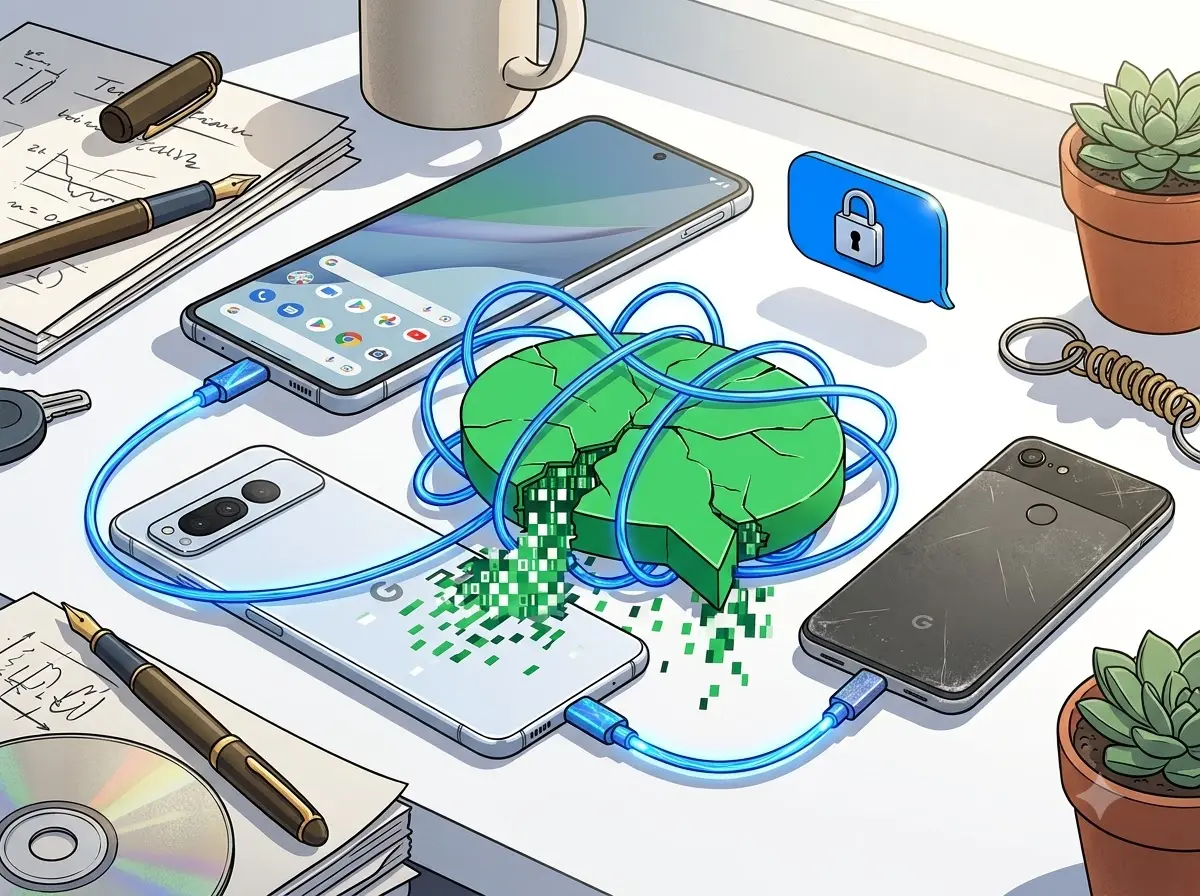
Smart Switch Quietly Delivers Corrupted Cache
Google’s own replies point to two concrete causes. Samsung’s Smart Switch can copy over corrupted cache files from the old phone’s Google Messages or Carrier Services apps. Number ports that finish incompletely leave the new device’s registration half-registered on the backend.
That is the second-order cost. The same one-tap migration tools that make buying a new Galaxy attractive are the ones breaking the rich messaging layer users now expect after Apple added RCS support. Upgraders who once worried only about green bubbles now risk losing RCS entirely for days or longer.
One user recovered only after a factory reset performed without Smart Switch. Others found a fresh eSIM from the carrier cleared the stuck state. The convenience layer is taxing the feature that was supposed to make Android messaging competitive.
What Google Officially Recommends First
Google’s standard path starts with the current app build and a clean Carrier Services slate. Install the latest Google Messages app version, turn RCS off, clear data for Carrier Services, restart, then turn RCS back on.
The company also publishes official RCS chat reset steps that include deactivating on the old device when it is still available. If the old phone is gone, a remote number verification can suspend the prior registration, though group chats drop after 30 days if RCS stays off.
A Google employee warned against downgrading the Messages app in hopes of an older working build. Legacy versions can wipe the local database and permanently erase message history. The same reply urged users still stuck on 3100 to open RCS settings and submit feedback so diagnostics reach engineering directly.
| Fix path | Reported outcome | Risk note |
|---|---|---|
| Official toggle + Carrier Services clear | Works for some, failed for Gobluin | Low |
| Factory reset without Smart Switch | Restored RCS for at least one user | High data effort |
| New eSIM / full port redo | Immediate success after Verizon wait | Carrier dependent |
| Paris VPN toggle | Claimed working by starcowboy26 | Unexplained, temporary |
After any of these, confirm the lock icon appears next to “Encrypted” in active threads for Android-to-Android E2EE.
Crowd Workarounds That Circulated Fast
When official steps stalled, Reddit users shared longer sequences. One six-step process that cleared Play Services data after briefly disabling 2-step verification restored service for a Verizon switcher; security practice requires turning 2FA back on immediately afterward.
The strangest report came from starcowboy26: turn RCS off, connect any VPN server in Paris, turn RCS on until it connects, then drop the VPN. Multiple threads now treat the geo-hop as a last-resort registration nudge, though no one has explained why a French endpoint unblocks a U.S. carrier number.
Pre-emptive advice from users who completed clean moves: disable RCS on the old phone before starting Smart Switch or a carrier port, then re-enable only after the new line is fully active. That sequence avoids the half-registered state Google described.
RCS Finally Worked Across Platforms, Then Migration Broke It
RCS began as a GSMA project in 2007. Google’s 2015 Jibe acquisition and later Universal Profile work turned it into the Android default. Apple’s iOS 18 launch in 2024 closed the largest remaining gap, delivering high-resolution media, typing indicators, read receipts and better groups between green and blue bubbles.
- 2007, GSMA starts RCS concept
- 2015, Google acquires Jibe Mobile for backend scale
- 2016, Universal Profile published
- 2023-24, Apple announces then ships RCS in iOS 18
- 2025-26, Cross-platform E2EE expands with newer iOS builds and carrier support
Google has cited more than a billion RCS messages daily in the U.S. after iPhone adoption. The RCS messaging milestones since 2007 show steady infrastructure progress. Yet device-level registration remains brittle enough that a routine Smart Switch can erase those gains for individual users.
Cross-platform E2EE still needs a recent iOS build (source notes 26.5 or newer), current Google Messages, and carrier support. A recent iOS security update path keeps those builds current, but none of that helps if the Android side never finishes connecting.
Who Pays the Migration Tax
Galaxy buyers who treat Smart Switch as the default path lose RCS features until they troubleshoot. Their iPhone contacts suddenly receive compressed SMS media again. Group chats become unreliable. The green-bubble stigma that RCS was finally shrinking returns for the unlucky subset.
Carriers absorb extra support tickets. Google engineering receives diagnostic dumps via the feedback button. Samsung’s transfer tool keeps its reputation for completeness while quietly carrying the cache problem Google named.
Third-party apps gain a temporary window when frustrated users abandon the native stack. The universal messaging goal that took nearly two decades to approach parity now carries a hidden upgrade fee measured in hours of support chats and lost rich features.
Registration Still Sits on Fragile Backends
The Google RCS chats FAQ details already list “Connecting” or “Trouble connecting. Awaiting retry” as known states that can last beyond 30 minutes when number verification fails. Error 3100 is simply the latest concrete expression of that backend sensitivity during SIM or device changes.
Until Google hardens the registration hand-off against corrupted caches and partial ports, every flagship launch cycle will produce a fresh wave of the same complaint. Users who want the photos, receipts and indicators they paid for will keep clearing Carrier Services, hunting VPN endpoints, or wiping phones that should have worked out of the box.
The next clean transfer that keeps RCS alive from the first boot will be the real test of whether the infrastructure has caught up to the marketing.

-
 TECH1 year ago
Where Garmin Watches are Made and How They are Assembled
-

 AUTO3 months ago
Tesla’s Roadster Is ‘a Few Weeks Away,’ Says Its Chief Designer
-
 NEWS10 years ago
Samsung Releases Galaxy Note7 TV Ad as Reddit AMA Leaks Specs
-
 NEWS10 years ago
Android 7.0 Nougat Rolls Out To Nexus Devices With New Emoji, Features
-
 FINANCE9 years ago
Cardano Price Surges as ADA Enters the Crypto Top Ten List
-
 NEWS10 years ago
Pre-Order the First Camera Made for Facebook Live Streaming Video
-
 FINANCE1 year ago
Binance Suspends Trading and Withdrawals for a System Upgrade
-
 FINANCE9 years ago
RChain Price Jumps Nearly 150% to a New All-Time High of $2.03