
NEWS
Google Data Center Pause Tests Minnesota’s Tech Boom

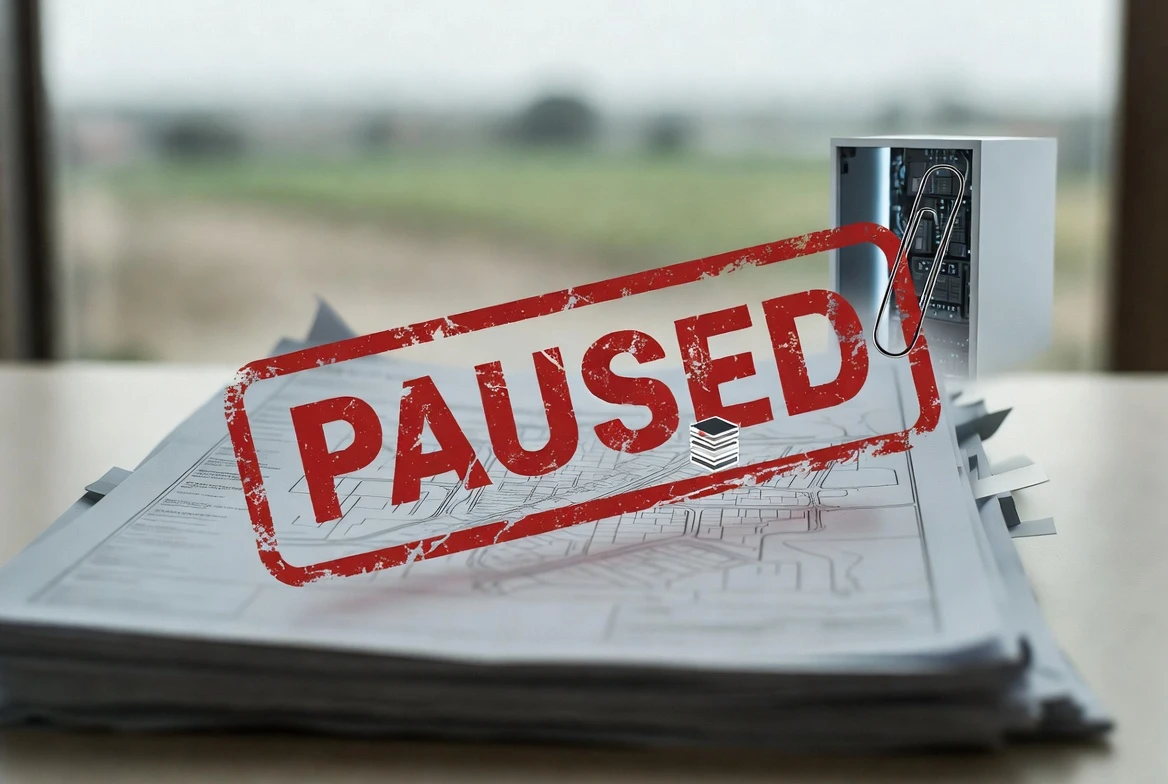
The Google data center pause in Pine Island is a local court order with statewide reach. In the Goodhue County temporary restraining order, Judge Patrick M. Biren halted construction and pre-construction work on Project Skyway on May 22, giving the Minnesota Center for Environmental Advocacy (MCEA, a nonprofit environmental law group) time to challenge the project’s environmental review.
Construction had been expected in July. That timing gives the ruling its power: Minnesota is courting massive computing load while still sorting how to protect water, electric customers, and public records before a project becomes irreversible.
The Court Order Buys Time Before the Merits
The temporary restraining order (TRO, a court order that preserves the status quo before a final ruling) bars Ryan Companies US, Inc., the Minneapolis developer, from beginning or continuing construction or pre-construction activities inside Project Skyway’s Alternative Urban Areawide Review (AUAR, Minnesota’s local environmental study for a defined growth area) study area. Biren also denied summary judgment for the city and Ryan.
The court focused on two linked problems: missing public records and a site review that may have treated a single large data center as a more general development area. It said MCEA had shown irreparable harm if building started before data issues were resolved under the Minnesota Government Data Practices Act (MGDPA, state law that presumes government records are public unless classified otherwise).
The money gap is stark. Ryan told the court a delay could cost as much as, or more than, $5 million. Biren still set the security bond at $2,000, the minimum, because he tied part of the need for the TRO to the city’s response to MCEA’s records request.
Project Snapshot
- 482 acres in and near Pine Island and Pine Island Township.
- 152,000 gallons per day estimated water use for the overall development, according to Project Skyway’s public project page.
- 1,900 megawatts of new clean energy resources in the Google-Xcel power plan.
Project Skyway’s Public File Split in Two
Publicly, Project Skyway moved like a conventional local land-use file. The city and developer held open houses, the AUAR went through public comment, and Pine Island approvals followed through winter. The project website points to infrastructure spending, tax revenue, hundreds of construction jobs, and about 100 permanent operational jobs for the initial project.
Then Google, Alphabet Inc.’s search and cloud company, became public as the first tenant. That disclosure changed the way opponents read the earlier record. A generic technology campus can look like one kind of planning exercise; a data center for one of the world’s largest computing companies looks like another.
Biren’s memorandum gave the opponents their cleanest procedural hook. He cited evidence from data requests that Ryan’s unnamed client intended to be involved in the transaction, that a February communication described the project as serving a single U.S. Fortune 200 company, and that client Skyway was involved in reviewing or approving draft AUAR material before public comment.
That is the single-client problem. If the project was already specific, the public review may have needed to say more about the specific building, tenant, load, water demand, noise, lighting, backup power, and mitigation measures before permits moved forward.
The AUAR Question Has Become the Statewide Test
The Minnesota Environmental Quality Board (EQB, the state body that guides environmental review) says in its data centers environmental review guidance that an AUAR can satisfy review for some later projects that fit the studied scenarios. But the same guidance says new information about a specific project can trigger a fresh look at whether more review is needed.
That distinction matters because an Environmental Impact Statement (EIS, the state’s most intensive environmental review) is built for deeper site-specific analysis. MCEA does not have to prove at the TRO stage that Pine Island must conduct an EIS. It had to show enough risk that the review fight could become meaningless if construction began first.
- Project identity: Google became public after the AUAR process had already closed.
- Project scale: a single large tenant may make general development scenarios less useful to nearby residents.
- Mitigation language: the court noted concerns that some measures appeared as possible future steps rather than firm commitments.
For local governments, that is a harder standard than simply completing the paperwork. If courts treat hyperscale data centers as known projects rather than broad industrial possibilities, the AUAR path becomes slower and more detailed.
The Power Deal Answers One Fight and Starts Another
Xcel Energy Inc., the Minnesota utility, has already tried to solve the ratepayer piece. In the Xcel and Google power supply agreement, the companies describe a Clean Energy Accelerator Charge (CEAC, a contract charge designed to fund new clean energy for a large electric load), with 1,400 megawatts of wind, 200 megawatts of solar, 300 megawatts of long-duration storage, and a $50 million investment in Xcel’s Capacity Connect program.
That is a serious ratepayer answer. It also gives supporters a clean argument: Google would pay for its electric service and associated grid costs, while new energy resources would be added to the system instead of quietly landing on household bills.
Power contracts do not cure every review problem. The Minnesota Public Utilities Commission (PUC, the state regulator for utility service agreements) can test whether a large customer arrangement protects other customers. Environmental review asks a different question: what the project does to land, water, air, light, noise, traffic, and public services at the place where it gets built.
Water shows the gap. The project page lists 152,000 gallons per day for the overall development and says the initial phase would use less than 15 percent of that amount. MCEA has argued that the annual total, roughly 55.5 million gallons if the daily estimate held all year, still deserved fuller analysis because the development would draw from a small city’s municipal system and nearby groundwater context.
Minnesota’s Other Data Center Cases Are Watching
Pine Island is no longer an isolated zoning fight. In MCEA’s data center case update, the group lists active or recent fights in Hermantown, Monticello, Faribault, Lakeville, and North Mankato, with different procedural postures but a common claim: local review has struggled to keep up with hyperscale computing proposals.
| Case | Project at Issue | Status in MCEA Summary |
|---|---|---|
| Pine Island | Google-backed Project Skyway | TRO granted, discovery moving ahead |
| Hermantown | Google-linked data center proposal | Updated AUAR expected after city action |
| Monticello | Three million square-foot data center proposal | Earlier stage, motions expected later |
| Faribault | Archer Datacenters review dispute | Court of Appeals decision pending |
The comparison cuts both ways. Pine Island opponents can point to a first courtroom win in the data center wave. Developers can answer that one trial-court TRO does not decide the legality of every AUAR or block a project that later survives review.
Still, the signal is hard to miss. A small city’s document process has become the place where Minnesota’s data center strategy meets the evidence rules of ordinary civil litigation.
The State Incentive Deal Raises the Stakes
The court fight lands on top of a state policy bargain that is still fresh. A Minnesota House summary of data center rules says the 2025 law created environmental and energy requirements, directed the PUC to oversee arrangements with very large customers, set special conditions for projects exceeding 100 million gallons of consumptive water use per year, and created annual fees tied to peak demand.
The same summary says data centers can claim sales tax exemptions on qualifying enterprise information technology equipment and software for 35 years after the first qualifying purchase, while electricity no longer qualifies for the exemption. That matters because the state is trying to attract capital-heavy projects without letting public subsidies outrun public review.
For Pine Island, the state bargain cuts in both directions. The project promises tax base, construction work, utility upgrades, and clean energy investment. The court order says those benefits do not erase the need to answer who knew what, when they knew it, and whether the public saw the same project the developer was preparing to build.
If the city and Ryan can produce the disputed records and defend the AUAR on the merits, the pause becomes an expensive delay. If the court orders deeper review, a town of a few thousand people will have slowed Minnesota’s data center rush at the one point where public comment can still change the file.

-
 TECH1 year ago
Where Garmin Watches are Made and How They are Assembled
-

 AUTO2 months ago
Tesla’s Roadster Is ‘a Few Weeks Away,’ Says Its Chief Designer
-
 NEWS10 years ago
Samsung Releases Galaxy Note7 TV Ad as Reddit AMA Leaks Specs
-
 NEWS10 years ago
Android 7.0 Nougat Rolls Out To Nexus Devices With New Emoji, Features
-
 FINANCE9 years ago
Cardano Price Surges as ADA Enters the Crypto Top Ten List
-
 NEWS10 years ago
Pre-Order the First Camera Made for Facebook Live Streaming Video
-
 FINANCE1 year ago
Binance Suspends Trading and Withdrawals for a System Upgrade
-
 FINANCE9 years ago
RChain Price Jumps Nearly 150% to a New All-Time High of $2.03