
NEWS
EdgeConneX Cedar Creek Data Center Tests Texas AI Boom

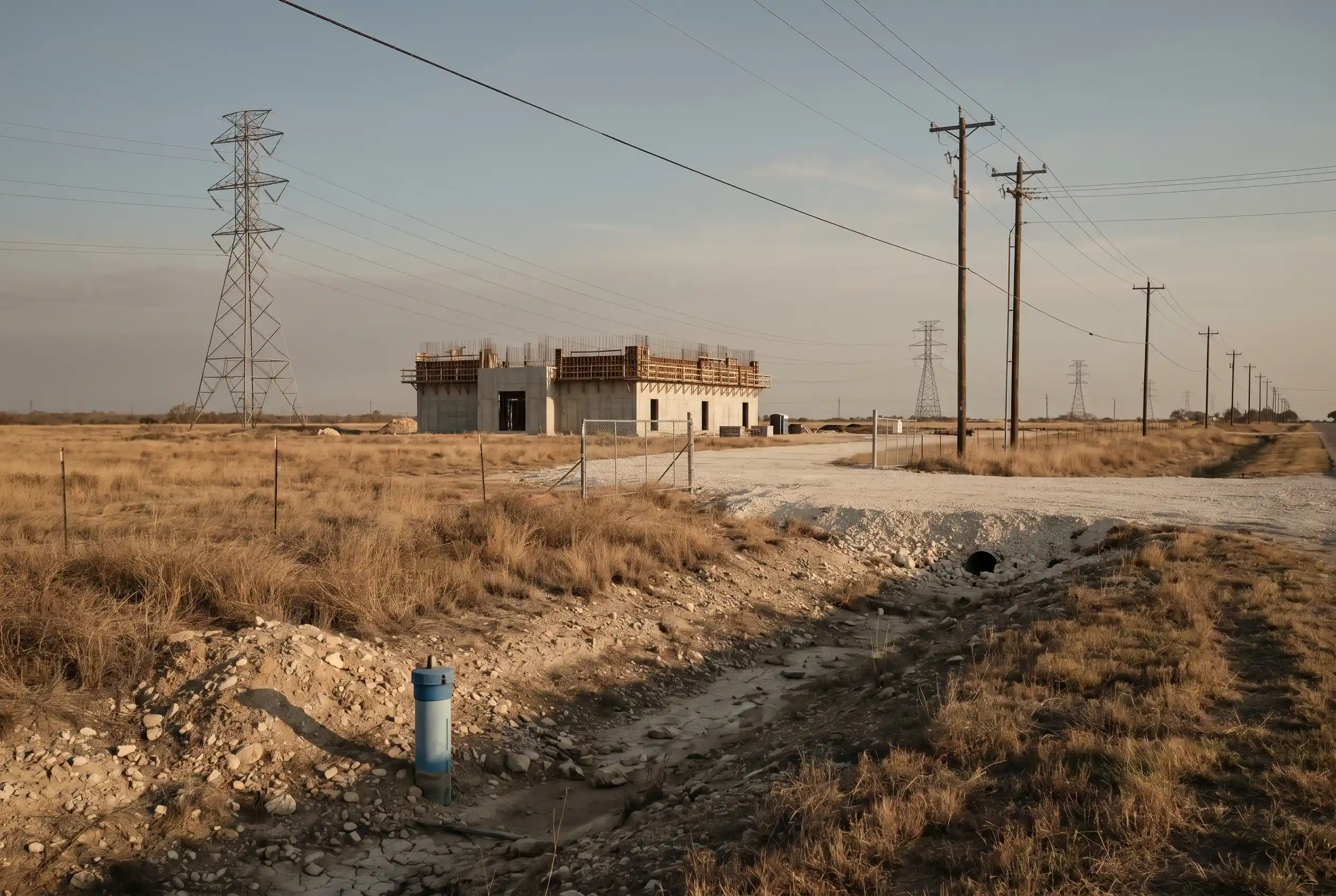
The EdgeConneX Cedar Creek data center plan now totals $1.4 billion across two newly registered Bastrop County buildings, each listed at 730,000 square feet and scheduled to run from June 30, 2026, to Dec. 31, 2028. The construction filings turn a quiet farm-to-market road southeast of Austin into a local test of Texas’ artificial intelligence infrastructure bargain: tax base first, water and power questions close behind.
For Cedar Creek, the promise is unusually concrete: private capital, construction work and a larger taxable property base. The risk is just as plain. A data center cluster does not need a downtown skyline to change a county’s grid planning, water politics and tax incentive math.
Two New Filings Put a Price on Cedar Creek
The Texas Department of Licensing and Regulation (TDLR, the state agency that records certain construction projects) registered two nearly identical records on May 26 for 6682 FM 535 in Cedar Creek. The first, EDCAUS11, carries an estimated cost of $700 million. The second, EDCAUS12, carries the same price, same size and same construction window.
Taken together, the filings describe 1.46 million square feet of one-story data center space, with supporting office areas and site improvements. Each record says the work is privately funded, on private land and for private use. Both list Burr Computer Environment Inc as owner, Gensler Architecture, Design & Planning, P.C. as design firm and the status as project registered.
The EdgeConneX connection sits in the county record around the incentive. A December 2024 Bastrop County public meeting notice said commissioners would consider a property tax abatement agreement with EdgeConneX, Inc., or a wholly owned subsidiary, for a four-building data center campus with estimated improvement costs of about $1.4 billion.
| Project Record | Address | Filed Cost | Filed Size | Schedule |
|---|---|---|---|---|
| EDCAUS11 TDLR construction filing | 6682 FM 535 | $700 million | 730,000 ft2 | June 30, 2026 to Dec. 31, 2028 |
| EDCAUS12 TDLR construction filing | 6682 FM 535 | $700 million | 730,000 ft2 | June 30, 2026 to Dec. 31, 2028 |
| ECX Austin DFW33220N, facility name AUS02 | 8001 Wolf Lane Bldg. 2, 6752 FM 535 | $440 million | 578,000 ft2 | Aug. 1, 2025 to June 14, 2026 |
A Smaller Bastrop Project Shows the Cluster Taking Shape
The two new records do not land in an empty field from a market perspective. A separate TDLR record for ECX Austin DFW33220N, facility name AUS02, lists a two-story, 578,000-square-foot data center at a nearby Wolf Lane and FM 535 address, with an estimated cost of $440 million and a completion date in mid-June 2026.
The company’s own Austin marketing sheet says its Central Texas campus is planned around 920,000 square feet of total build space and a combined 240 megawatts (MW, a unit of electric capacity) across phased buildings. The EdgeConneX Austin campus data sheet pitches the site as close to Austin-Bergstrom International Airport and capable of high cabinet densities for cloud and AI workloads.
That last phrase matters. Artificial intelligence (AI, computing based on machine learning models) changes the load profile of a building. These are not ordinary office parks with server rooms in the back. They are industrial-scale heat and power machines, often designed years before the end customer is public.
- $1.4 billion in newly filed construction costs at 6682 FM 535.
- 240 MW of combined site power listed in the operator’s Austin campus material.
- 6.5 GW of Texas data center capacity under construction, according to Jones Lang LaSalle’s North America market report.
Jones Lang LaSalle (JLL, a commercial real estate services firm) said in its North America data center report that Texas could overtake Northern Virginia as the world’s largest data center market by 2030. That puts Bastrop County inside a much larger land rush, where the winning site is the one with power access, land control and local officials willing to make a deal.
Why Bastrop Wanted the Deal
Bastrop County is not a static rural county waiting for one big project. Its 2024 annual financial report put the population at 110,778 and said the county covers 896 square miles. It also said population rose 43 percent over the previous decade, while Cedar Creek kept growing with new residential development.
That growth cuts both ways. More homes bring more service needs, more road pressure and more taxable value. A data center promises a different mix: heavy capital investment, relatively few permanent jobs and a taxable asset that can be much larger than the pasture or subdivision plan it replaces.
The county’s incentive framework shows the trade. Under Bastrop County’s tax abatement policy, a new business generally must be expected to add at least $5 million in real and personal property value and create 25 full-time jobs, unless commissioners grant a variance. The policy also says abatement agreements cannot run longer than 10 years.
That policy asks for more than a ribbon cutting. It calls for reporting on construction contracts, local hiring, supplier spending, disadvantaged business contracts and environmental mitigation. In plain terms, the bargain is tax base for disclosed performance. The stronger the data center cluster gets, the more valuable that reporting becomes.
- Construction spend can arrive years before a facility has many permanent workers.
- Local supplier commitments matter because hyperscale projects can import specialized contractors.
- Environmental reporting becomes central when cooling systems, backup generation and water sourcing are still not clear to residents.
Water Is the Local Fight
The Missing Site Number
No public filing reviewed for the two new buildings gives a clear gallons-per-day water demand for the Cedar Creek site. That gap is why the argument around data centers has moved from yes-or-no development to disclosure. A closed-loop cooling system can cut potable water demand, but the phrase can also hide a wide range of designs, operating conditions and backup procedures.
The Statewide Range
The University of Texas at Austin’s COMPASS Research Consortium put hard ranges around the issue in a Texas data center water-use white paper. The report estimated average direct and indirect data center water use at 43.5 billion gallons in 2025, 223.6 billion gallons in 2030 and 345.5 billion gallons in 2040. Its high case reached 9.15 percent of statewide water withdrawals by 2040 under a thermal-heavy ERCOT grid mix.
Those numbers include water used at the facility and water consumed to generate the electricity that powers it. That is the part often missed in local debates. Even a low-water cooling design still has a water footprint if its electricity comes from gas, coal or nuclear power plants that use water for cooling.
The Company Pledge
The operator has a global water argument of its own. In a November 2025 blog post, EdgeConneX said more than 92 percent of its portfolio uses dry or no-water cooling and said it is working toward water neutrality by 2030 with Waterplan, a water-risk software company. That is useful context, but it is not a Cedar Creek water budget.
For residents, site-level water use remains undisclosed. The next meaningful public document is not a sustainability slogan. It is a permit, a utility agreement, a groundwater filing or an operator statement that says what the local cooling system uses, where the water comes from and what happens in extreme heat.
Power Is the Statewide Constraint
Electricity may decide the pace before water does. The Electric Reliability Council of Texas (ERCOT, the grid operator for most of the state) said its planning forecast is being driven by strong population and economic growth along with large consumers such as data centers, oil and gas facilities, and cryptocurrency mining operations.
ERCOT’s May 2025 capacity and demand report listed cumulative new planned large loads of 7,627 MW for summer 2026, rising to 47,783 MW by summer 2030 after adjustments. The same report said all new data center load requests were reduced to 49.8 percent of the original request in the forecast, a quiet admission that not every request is expected to materialize as filed.
The key policy word is grid flexibility. ERCOT said there is discussion among policymakers and industry about whether large loads, including data centers, should be able to reduce demand during grid scarcity. A building designed for AI inference may not want to turn off at the same time a crypto mine can, and that difference matters for system planning.
The Texas Senate has already put the issue into its interim workload. In March 2026, Lt. Gov. Dan Patrick’s office released Texas Senate interim charges on data centers asking committees to study large-load interconnection rules, transmission cost allocation, water demands from high-consumption cooling technologies and the cost of the state’s data center sales tax exemptions.
Cedar Creek’s Bargain Runs Through Public Records
What makes the Cedar Creek filings important is not only their size. It is their timing. Texas is courting AI infrastructure at the same moment lawmakers are asking who pays for the power lines, who reports the water use and how much public revenue is being traded away through incentives.
The local record already gives residents a starting map. The TDLR filings give cost, size, schedule, owner and design firm. The county notice ties the broader campus concept to the named developer and a proposed abatement. The policy says what companies receiving abatements can be asked to report. The state and university records show why water and power are no longer background details.
If the June construction start holds, Cedar Creek will see the physical answer before Texas finishes the policy answer. If the filings change, the story shifts back to the paper trail, where every revision says something about the price of building the AI boom outside Austin.

-
 TECH1 year ago
Where Garmin Watches are Made and How They are Assembled
-

 AUTO3 months ago
Tesla’s Roadster Is ‘a Few Weeks Away,’ Says Its Chief Designer
-
 NEWS10 years ago
Samsung Releases Galaxy Note7 TV Ad as Reddit AMA Leaks Specs
-
 NEWS10 years ago
Android 7.0 Nougat Rolls Out To Nexus Devices With New Emoji, Features
-
 FINANCE9 years ago
Cardano Price Surges as ADA Enters the Crypto Top Ten List
-
 NEWS10 years ago
Pre-Order the First Camera Made for Facebook Live Streaming Video
-
 FINANCE1 year ago
Binance Suspends Trading and Withdrawals for a System Upgrade
-
 FINANCE9 years ago
RChain Price Jumps Nearly 150% to a New All-Time High of $2.03