
NEWS
Modix MAMA-1000 Tests the Math of Pellet 3D Printing

The Modix MAMA-1000 is a one-cubic-meter pellet 3D printer from Modix, a large-format 3D printer maker, aimed at shops that need furniture, molds and full-scale prototypes without buying the larger MAMA-1700. Its pitch is simple: a high-flow pellet head for bulk plastic, a filament head for details and a reported $35,000 starting point.
That price is both bait and filter. Modix’s current site directs buyers to request a quote, and the useful comparison is not with desktop 3D printers. It is with a small fabrication cell where material, labor and failed large prints decide whether the machine earns floor space.
A One-Meter Machine With Two Print Modes
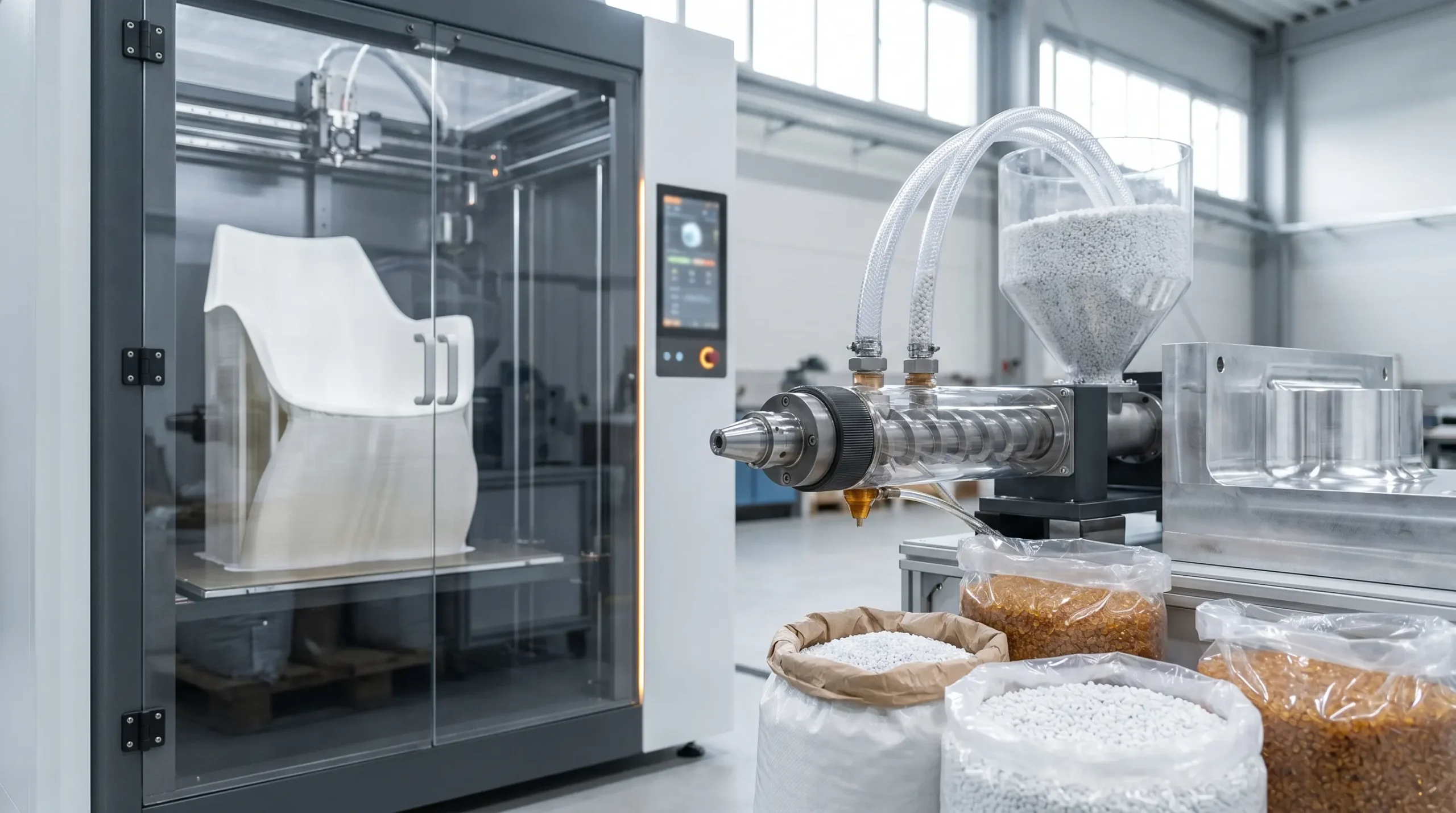
On the MAMA-1000 product specifications, Modix lists a 1,000 by 1,000 by 1,000 mm build volume, an enclosed frame, closed-loop Nema23 stepper motors, a common industrial motor frame size, a Duet 6HC controller and delivery as a fully assembled and tested system. The important line is the toolhead: the machine can switch between Fused Granulate Fabrication (FGF, a pellet extrusion process using plastic granules) and Fused Filament Fabrication (FFF, the spool-fed process familiar to most 3D printer owners).
For bulk work, the DYZE Design Pulsar head processes raw granules through 3 mm and 5 mm nozzles, with a claimed maximum of 3 kg/hr and 500 cubic mm/sec flow. For finer passes, the Griffin Ultra filament head uses 1.75 mm filament and a 1.6 mm nozzle at up to 0.5 kg/hr. That gap tells the story: one head moves mass, the other cleans up interfaces.
- 1 cubic meter: enough build volume for full-scale prototypes, furniture parts and large tools.
- 3 kg/hr: the advertised maximum pellet throughput for bulk deposition.
- $2 to $8/kg: Modix’s listed pellet cost range, compared with $20 to $80/kg for filament.
The mixed setup matters because a one-piece chair shell and a mold insert do not ask the same thing from a printer. Coarse deposition wins on time; fine deposition wins where a bolt hole, mating face or removable support can make the difference between usable and scrap.
That is the product’s clever move. Modix is not asking buyers to abandon filament quality outright. It is asking them to reserve filament for the places where precision pays and use pellets for the kilograms of plastic that nobody should be buying on spools.
The Pellet Math Behind the Price
The reported $35,000 opening price sounds steep against hobby machines and modest against many industrial additive systems. The reason pellet printing keeps getting a hearing is feedstock. At Modix’s listed ranges, a 10 kg job would consume $20 to $80 of pellets before waste and support material, or $200 to $800 of filament at the listed spool range.
Oak Ridge National Laboratory (ORNL, a U.S. Department of Energy lab) made the same economic argument years ago in its BAAM economics paper, which said processing time is often the dominant additive manufacturing cost and that shifting polymer extrusion from wire to pellets can raise deposition speed while lowering material cost.
you go from a limit of one cubic inch an hour to printing as fast as you want
Lonnie Love, ORNL Manufacturing Systems Research Group leader, was describing the jump from wire to pellet feed in an ORNL additive manufacturing article. His point lands on this launch because the limit is no longer only the melt zone. It is the shop’s ability to feed, dry, slice and finish a part that may weigh several kilograms.
Material savings do not arrive automatically. A shop has to print enough heavy parts to make bulk plastic matter, and it has to avoid turning every large job into a finishing marathon. Pellet printing lowers the bill of materials; it does not erase setup labor, failed builds, surface finishing or the engineering time needed to make big parts printable.
Where the Extra Money Goes
If the launch price holds near the reported $35,000 mark, buyers are paying for more than a box frame and a hot end. The base problem with large prints is continuity. A ten-hour part can fail late because the material was damp, the extrusion pressure drifted or the print did not stay flat. The add-on list reads like a map of those failure modes.
- A 25 kg dryer keeps moisture-sensitive pellets stable before extrusion.
- A pigment mixer lets shops blend color and additives instead of buying specialty filament.
- An air filter addresses the ventilation burden that comes with enclosed thermoplastic printing.
- Independent Dual Extruder (IDEX, a system with separate X-carriages for two heads) support can handle soluble supports or multi-material jobs.
Those accessories are not glamorous, but they explain the intended buyer. This is a machine for manufacturers, researchers and fabricators, not a giant toy for a corner makerspace. A pellet line behaves more like a small plastics process than a supersized desktop printer, which means operator habits matter as much as the advertised flow rate.
The comparison with a cheaper filament-only large printer can mislead. If a shop prints occasional display props, the lower machine price may win. If it prints heavy fixtures every week, the dryer, pellet supply and high-flow head become part of the payback rather than extras.
The One-Meter Field Gets Crowded
One cubic meter used to be a bragging right on its own. It no longer separates a machine in this class. Modix already sells the BIG-Meter filament system from $15,000, while the MAMA-1700 pellet platform stretches the bed to 1.7 meters on one axis. BigRep, an industrial 3D printer maker, lists BigRep ONE technical specifications with a slightly larger cubic-meter volume and dual modular extrusion heads.
That leaves the new model in a narrow slot: more industrial than a filament-only cube, smaller and easier to place than the longer pellet platform. The one-meter buyer is not buying the largest print volume in Modix’s catalog. The buyer is trying to keep pellet throughput while avoiding a machine that dominates the room.
| Machine | Build Volume | Feedstock | Best Fit |
|---|---|---|---|
| Modix MAMA-1000 | 1,000 by 1,000 by 1,000 mm | Pellets plus 1.75 mm filament | Bulk parts that still need some detail work |
| Modix BIG-Meter | 1,000 by 1,000 by 1,000 mm | 1.75 mm filament | Lower-cost large-format filament printing |
| Modix MAMA-1700 | 1,700 by 1,000 by 1,000 mm | Pellets plus filament | Larger pellet jobs and long tools |
| BigRep ONE | 1,005 by 1,005 by 1,005 mm | Filament through modular heads | Cubic-meter FFF production with dual heads |
Speed Comes With a Surface-Finish Bill
A 5 mm nozzle can make a part fast, but it also draws thick beads. For furniture cores, props, rough molds and thermoforming tools, that can be acceptable or even helpful. For a customer-facing object with crisp lettering or a sealed joint, it usually means sanding, coating, machining or a second operation.
DYZE Design, a Canadian extrusion hardware maker, says in its Pulsar pellet extruder documentation that nozzle size, screw choice and polymer affect flow, and smaller nozzles raise pressure compared with a 5 mm reference. Modix’s hybrid answer is to let the user swap to the filament head for detailed features. That helps, but it also puts process planning back on the shop: decide which geometry is bulk, which geometry is detail and how much post-processing the part can tolerate.
There is another trade: pellet-fed systems broaden material choices, including recycled polymers and filled composites, but those materials rarely behave the same way across batches. The machine may print polylactic acid (PLA, a common plant-derived plastic) on Monday and nylon later in the week. Each switch asks for drying rules, temperature profiles and purge time.
So the sales number to watch is not only kilograms per hour. It is finished parts per week. A fast head that produces rough parts can still lose to a slower process if the labor bench becomes the bottleneck.
The Buyer Who Makes This Bet
This machine makes most sense for a shop already spending real money on outsourced large prints, computer numerical control (CNC) foam work, sign fabrication, theater or theme props, furniture prototypes, jigs, fixtures or low-temperature molds. It makes less sense for a user whose main pain is desktop print speed. A fast pellet head is wasted if the parts are palm-sized.
The sharper test is utilization. If a team can keep the printer busy with five-kilogram and ten-kilogram jobs, the cheaper feedstock begins to matter. If the printer sits idle between showcase projects, the reported purchase price, accessories, operator training, floor space and finishing labor will swamp the resin or filament savings.
The machine has to stay fed, not just with pellets, but with jobs that are large enough to justify coarse, high-flow extrusion. That is why the $35,000 figure may be less revealing than the workflow around it: material storage, design-for-extrusion skill, finishing capacity and a customer base that accepts visible layer lines or pays to remove them.
If Modix can make that package predictable for small industrial shops, the new one-meter pellet machine becomes a practical bridge between desktop prototyping and factory-scale additive work. If not, it remains a spectacular way to turn cheap pellets into expensive learning curves.

-
 TECH1 year ago
Where Garmin Watches are Made and How They are Assembled
-

 AUTO2 months ago
Tesla’s Roadster Is ‘a Few Weeks Away,’ Says Its Chief Designer
-
 NEWS10 years ago
Samsung Releases Galaxy Note7 TV Ad as Reddit AMA Leaks Specs
-
 NEWS10 years ago
Android 7.0 Nougat Rolls Out To Nexus Devices With New Emoji, Features
-
 FINANCE9 years ago
Cardano Price Surges as ADA Enters the Crypto Top Ten List
-
 NEWS10 years ago
Pre-Order the First Camera Made for Facebook Live Streaming Video
-
 FINANCE1 year ago
Binance Suspends Trading and Withdrawals for a System Upgrade
-
 FINANCE9 years ago
RChain Price Jumps Nearly 150% to a New All-Time High of $2.03