
NEWS
iOS 28 Leak Puts Apple’s iPhone 20 Bet on Software

iOS 28 reportedly carries the codename Bell, while macOS 28 is said to be Poppy, with Apple staff calling the paired work Boppy. Apple has not confirmed the names, and the timing matters because the company’s next public software event is still the Worldwide Developers Conference 26 (WWDC26) on June 8.
The report, attributed to Mark Gurman, Bloomberg’s Apple reporter, lands before iOS 27 has even reached Apple’s stage. Treat the leak cautiously. Apple Inc., the Cupertino consumer technology company, may be shaping a two-release software base for anniversary hardware while the public roadmap still stops at the June 8 keynote.
Bell and Poppy Put the Date in Focus
The new claim says the mobile operating system work carries Bell for both iOS 28 and iPadOS 28, while the Mac side carries Poppy. The combined nickname, Boppy, sounds throwaway. At Apple, that kind of internal shorthand can still point to one useful thing: which teams are expected to move together.
That distinction matters on June 1, 2026. Apple has confirmed Apple’s WWDC26 schedule for June 8 through June 12, with a keynote, a Platforms State of the Union, more than 100 video sessions, Group Labs and developer forums. That event is where iOS 27, rather than iOS 28, should get the public oxygen first.
- 3 codenames – Bell for iOS and iPadOS, Poppy for macOS, and Boppy for the combined program, according to the report.
- 2 platform families – mobile and Mac software are the named pieces; watchOS, tvOS, and visionOS were not named in the current leak.
- 7 days – Apple’s next confirmed software stage is the WWDC26 keynote on June 8.
Early codenames do not guarantee a finished product, a shipping date, or an Apple-approved marketing name. They usually mean teams have begun separating the next cycle from the current one, with enough confidence to name the work and assign ownership.
The Calendar Matters More Than the Codename
Apple’s version numbers changed the way rumors read. iOS 26, iPadOS 26 and macOS Tahoe 26 were announced in 2025 and labeled for the following year. If Apple keeps that convention, iOS 28 would likely be the release announced in 2027 and carried into 2028, which puts it near the anniversary window that hardware leakers have been circling.
| Software Cycle | Status on June 1, 2026 | Main Signal | Reader Takeaway |
|---|---|---|---|
| iOS 26 and macOS Tahoe 26 | Public platform line | Liquid Glass, Apple Intelligence tools, Foundation Models | The common design base is already in place. |
| iOS 27 and macOS 27 | Expected WWDC26 focus, not announced by Apple yet | Near-term developer and system updates | This is the release to judge first. |
| iOS 28 and macOS 28 | Reported early branch only | Bell, Poppy and Boppy codenames | The larger anniversary work may be two cycles out. |
The useful phrase is two-cycle runway. If the leak is right, Apple would not be waiting for iOS 27 to settle before sketching the larger interface and app architecture work that follows. That fits the way platform companies build: public releases trail internal branches, and the most visible design change often lands after years of private tooling.
Liquid Glass Was the First Move
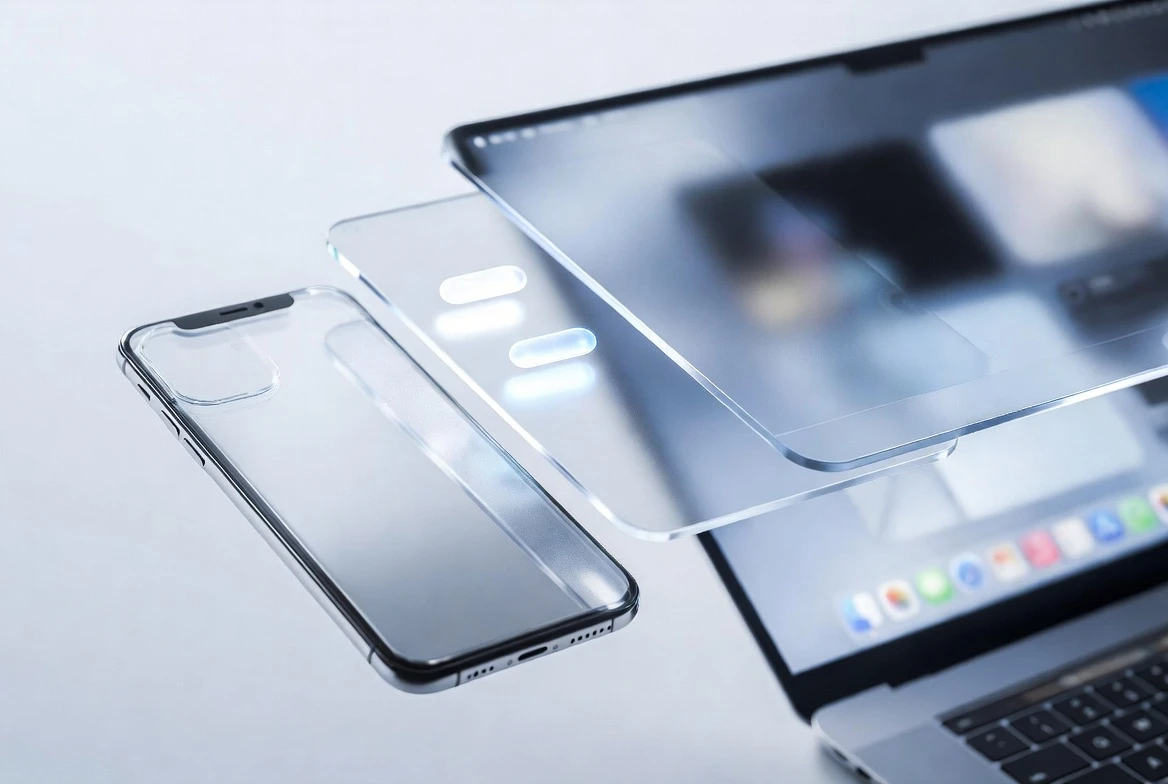
The Bell and Poppy names make more sense when put next to Liquid Glass, the design system Apple introduced across iOS 26, iPadOS 26, macOS Tahoe 26, watchOS 26 and tvOS 26. Apple’s own Liquid Glass design announcement described a translucent material that reflects and refracts its surroundings, then adapts to content and context.
That was a large software reset for developers because it touched controls, tab bars, sidebars, app icons, widgets, the Lock Screen, the Home Screen, desktop and Dock. Apple also told developers that SwiftUI, Apple’s declarative interface framework, UIKit, the iPhone and iPad interface toolkit, and AppKit, the Mac app toolkit, would help apps adopt the new look.
- Design debt: custom app interfaces need review when glass, blur and depth move into system controls.
- Icon work: layered icons and tint options make branding part of the operating system look.
- Cross-device consistency: iPhone, iPad and Mac can share a visual grammar without becoming the same device.
That is why a 2028-labeled cycle can matter before it has user-facing features. The design language is already public; the next question is whether the architecture behind it becomes tighter across devices.
Anniversary Hardware Needs Software First
The anniversary talk has dates that should be kept separate. Apple introduced the first iPhone on January 9, 2007, and said the device would reach the U.S. in June 2007, according to the original iPhone announcement. That makes January 9, 2027 the 20-year mark for the unveiling and June 2027 the 20-year mark for first sales.
Apple has used anniversaries to make sharper product breaks. The company announced the iPhone X launch on September 12, 2017, with an all-glass design, a 5.8-inch Super Retina display, Face ID, the A11 Bionic chip and a November 3 store date. It was the public reset that removed the Home button from the iPhone’s future.
That precedent explains why the iOS 28 leak is being tied to the rumored iPhone 20 label. Apple has not confirmed that name, and the current report does not prove an all-glass phone, a foldable, or the unconfirmed MacBook Ultra label. It says software work has started, and the calendar makes the 20-year iPhone loop hard to ignore.
Software must be ready before a hardware stage demo can look effortless. Gestures, camera flows, widgets, artificial intelligence routing, accessibility, developer frameworks and migration tools all need time. A glassier or more screen-led iPhone would make that pressure worse, because any mismatch between hardware shape and interface behavior becomes visible immediately.
Developers Get the Early Signal
Developers do not build against codenames. They build against application programming interfaces, or APIs, the hooks that let apps call system features, plus design files, betas and App Store rules. Apple’s developer technologies with more than 250,000 APIs show how platform shifts usually arrive as many small switches rather than one public feature.
The artificial intelligence, or AI, side is already moving in that direction. Apple’s Foundation Models framework for developers gives apps access to the on-device large language model at the center of Apple Intelligence, with availability across iOS 26, iPadOS 26 and macOS 26 when Apple Intelligence is enabled. The company said the framework is integrated with Swift and can use guided generation and tool calls.
For developers, the phrase is developer surface area: every new model, control, intent and design material adds another place where apps must match Apple’s direction. That is why an early branch name can matter even if no consumer feature list exists yet.
Money points the same way. In Apple’s March quarter Form 10-Q filing, iPhone net sales were $56.994 billion for the quarter ended March 28, 2026, while research and development, or R&D, spending on future products, was $11.419 billion, up 34 percent from a year earlier. The reported Boppy work would sit inside that broad push: more device intelligence, more private compute, and more platform glue for developers.
The Risk Is Another Overpromised Cycle
The danger for Apple is plain: big software ideas can leak long before they are reliable. Apple Intelligence has already trained users to ask which features work on-device, which need cloud help, which languages are supported, and which devices are left out. Those questions will follow any iOS 28 rumor from now on.
That makes iOS 27 the first test, even though the leak is about the following branch. If WWDC26 brings a cautious iOS 27 focused on AI repairs, developer tools and polish, the Bell and Poppy report will look like Apple clearing space for the larger swing after it. If iOS 27 tries to do everything at once, the longer-range codename chatter starts to look like a warning about unfinished work moving down the line.
For buyers, none of this is a reason to hold a phone purchase for a product Apple has not named. For developers, it is a reason to avoid building apps that fight Liquid Glass, App Intents, the framework that exposes app actions to system features, SwiftUI, Foundation Models or whatever replaces today’s Siri layer. Apple’s platform gravity works slowly, then all at once when the hardware changes.
If the June 8 keynote points beyond iOS 27 with new APIs and cross-device design rules, Boppy will look like the early label on a longer turn. If the keynote stays narrow and the codenames remain gossip, the safer read is simpler: Apple starts big projects early, and early project names do not ship phones.

-
 TECH1 year ago
Where Garmin Watches are Made and How They are Assembled
-

 AUTO3 months ago
Tesla’s Roadster Is ‘a Few Weeks Away,’ Says Its Chief Designer
-
 NEWS10 years ago
Samsung Releases Galaxy Note7 TV Ad as Reddit AMA Leaks Specs
-
 NEWS10 years ago
Android 7.0 Nougat Rolls Out To Nexus Devices With New Emoji, Features
-
 FINANCE9 years ago
Cardano Price Surges as ADA Enters the Crypto Top Ten List
-
 NEWS10 years ago
Pre-Order the First Camera Made for Facebook Live Streaming Video
-
 FINANCE1 year ago
Binance Suspends Trading and Withdrawals for a System Upgrade
-
 FINANCE9 years ago
RChain Price Jumps Nearly 150% to a New All-Time High of $2.03