
NEWS
Altman Invites Musk to GPT-5.5 Party Amid $134B OpenAI Trial

OpenAI CEO Sam Altman publicly invited Elon Musk to the company’s invite-only GPT-5.5 launch party in San Francisco, posting on X that his estranged co-founder “can come if he wants” because “world needs more love.” The peace gesture landed on May 2, 2026, three days after Musk wrapped a combative stint on the witness stand in a federal trial where his lawyers are seeking up to $134 billion from OpenAI and Microsoft. The party itself is set for May 5 at 5:55 p.m. PT.
The contradiction is the story. One side of Altman’s week is a charity-theft jury trial in Oakland. The other side is a rooftop celebration where his coding agent, Codex, picks the guest list off a Google form. Both are real, both are happening this month, and both star the same two men.
The Olive Branch That Landed Mid-Trial
Altman’s invitation went out as a reply, not a press release. After an X user joked that Musk would crash the GPT-5.5 party “as the witch in Sleeping Beauty” and deliver a curse, Altman wrote back: “he can come if he wants. world needs more love.”
The timing is what makes it sting. Musk had spent three days on the stand the previous week telling a federal jury that Altman and Greg Brockman “stole a charity” by converting OpenAI’s nonprofit research lab into a Microsoft-backed commercial juggernaut. The phrase “you can’t just steal a charity” became the line Musk’s lawyers leaned on hardest.
Altman’s reply was the first softening signal from either camp since the trial opened on April 27. Coming from the defendant whose legal team spent the week parrying a $134 billion claim, the four-word kicker reads less like sentiment and more like a calibrated nudge.
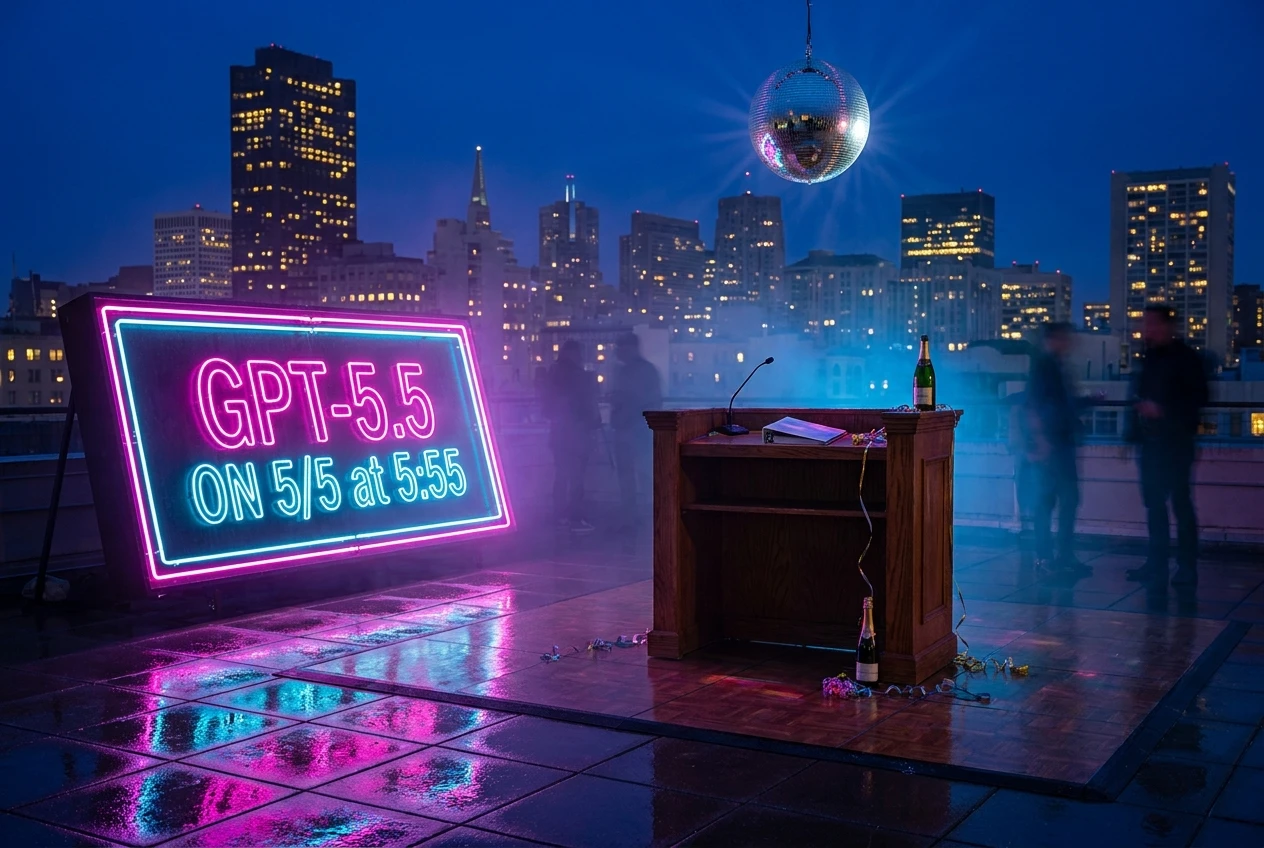
What’s Actually Happening on 5/5 at 5:55
The party is a San Francisco meetup tied to the April 23 release of OpenAI’s GPT-5.5 model family, which the company calls its “smartest and most intuitive” system to date. Registration ran through an online form, and Altman said Codex, OpenAI’s autonomous coding agent, would screen replies and pick attendees.
- Date and time. Tuesday, May 5, 2026, from 5:55 p.m. to 8:55 p.m. PT, an in-joke on the model name.
- Venue. Withheld from the public, disclosed only to confirmed attendees.
- Selection. Codex chooses the guest list from RSVP responses, a publicity move that also stress-tests the agent.
- Travel. Selected attendees receive flights and accommodation, OpenAI confirmed in DMs to early invitees.
- Capacity. Capped tightly. Altman closed registration within hours and posted that he would “plan bigger parties for future releases.”
The $134 Billion Backdrop
Musk filed his original complaint in March 2024, alleging Altman and Brockman lured him into seeding the nonprofit on the promise that AGI research would stay open and humanity-focused, then pivoted into a closed for-profit once the technology started working. Microsoft was added as a defendant in an amended filing.
The damages math has shifted twice. A January 2026 filing from Musk’s attorneys laid out a recovery figure of up to $134 billion, framed as restitution for unjust enrichment rather than a personal payout. Musk’s team has told the court any “ill-gotten gains” should flow back to OpenAI’s nonprofit foundation.
- $38 million. Approximate amount Musk donated to OpenAI between 2015 and 2018, per his own testimony.
- $134 billion. Maximum damages sought from OpenAI and Microsoft, per Musk’s January 2026 filing.
- $1.6 million. Trading volume on the Polymarket contract on GPT-5.5’s release date, which opened April 9.
- May 21, 2026. Date by which Judge Yvonne Gonzalez Rogers expects the liability phase to conclude.
The jury’s verdict is advisory only. Gonzalez Rogers split the case into a liability phase and a remedies phase before opening statements, meaning the judge will issue the binding ruling on whether any wrongdoing occurred, then a separate ruling on what to do about it. Most of the first week’s coverage noted that the structure narrows the trial’s legal scope while widening the political and reputational exposure.
Musk’s remedy ask is broader than money. His complaint demands the court unwind OpenAI’s for-profit conversion and remove Altman and Brockman from the board. That outcome would land squarely in the middle of any commercial timeline OpenAI has plotted for GPT-5.5 and the Codex stack the model now powers.
On day three of cross-examination, Musk also conceded he had “didn’t read” key for-profit conversion documents at the time, a moment OpenAI’s lawyers will revisit when Altman takes the stand later this month.
The Most Carefully Vetted GPT Yet
GPT-5.5 is not just another point release. The model’s system card classifies it as “High capability” in the biological and chemical domain under OpenAI’s Preparedness Framework, the first GPT-5 family member to trigger that tier’s safeguards on launch.
OpenAI says the model went through targeted red-teaming for advanced cybersecurity and biology capabilities, with feedback from nearly 200 early-access partners. The company also delayed API access by a day, until April 24, citing the need for “different safeguards” between the consumer surface and the developer surface.
That High capability bio rating sits awkwardly next to the celebratory mood of a 5:55 launch party. The contrast is the kind of detail Musk’s lawyers have spent the week emphasizing in court, where they argue OpenAI’s commercial pace has outrun its founding safety mission.
Who’s on the Witness List
The May 2026 witness lineup is essentially a ten-year snapshot of OpenAI, and several of the names will be testifying for the first time under oath in this matter.
- Sam Altman. OpenAI CEO, expected later in May.
- Greg Brockman. President and co-defendant, given 48-hour notice to appear.
- Satya Nadella. Microsoft CEO, central to the partnership Musk calls the conversion’s enabler.
- Mira Murati. Former CTO, now running her own AI lab.
- Ilya Sutskever. Co-founder and former chief scientist, key figure in the November 2023 board attempt to remove Altman.
- Shivon Zilis. Neuralink executive and longtime Musk associate.
The Social Media Truce Judge Rogers Asked For
Two days before Altman’s “world needs more love” reply, Gonzalez Rogers told the principals to keep their feud off their feeds. The directive came after Musk and Altman traded jabs about the case in real time during jury selection.
“Try to control, all of you, your propensity to use social media to make things worse outside the courtroom.” Judge Yvonne Gonzalez Rogers, addressing Musk, Altman and counsel from the bench, April 30, 2026.
Read against that order, Altman’s reply is technically compliant. He didn’t argue facts, name the case, or counter Musk’s testimony. He floated a meme-shaped olive branch. The legal optics are clean. The narrative optics, less so.
Musk has not replied publicly to the invitation as of May 3. His last courtroom day ended with him telling jurors that OpenAI’s for-profit arm had become “the tail wagging the dog,” a quote his counsel has already dropped into closing-argument drafts. An annotated transcript of Musk’s testimony shows the phrase appearing four separate times across his three days on the stand.
The wider X audience treated the exchange as theater. Polymarket reposted Altman’s announcement to its 1.2 million followers, framing the 5/5 at 5:55 schedule as a likely market-mover for OpenAI release-timing contracts. Whether Musk shows up matters less than whether the courtroom version of the story can survive a single warm sentence.
Frequently Asked Questions
When and where is OpenAI’s GPT-5.5 launch party?
The invite-only event is in San Francisco on Tuesday, May 5, 2026, running from 5:55 p.m. to 8:55 p.m. Pacific Time, branded as “GPT-5.5 on 5/5.” The exact venue is shared only with confirmed attendees. Registration closed within hours of Altman’s announcement post on X.
How did OpenAI choose who gets to attend the GPT-5.5 party?
Sam Altman posted an online RSVP form on X and said Codex, OpenAI’s autonomous coding agent, would select attendees from the replies. The mechanic doubles as a public demo of the agent’s screening capability. Selected guests received flights and accommodation. Altman said larger events would follow future model releases.
Why is Elon Musk suing OpenAI in 2026?
Musk filed in March 2024, alleging Altman, Brockman and Microsoft converted OpenAI’s nonprofit research mission into a closed for-profit, breaching the donor agreement that brought in his roughly $38 million seed funding. The trial began April 27, 2026, in Oakland federal court before Judge Yvonne Gonzalez Rogers, with damages of up to $134 billion at stake.
What does Musk want besides money from OpenAI?
Musk’s complaint asks the court to unwind OpenAI’s for-profit conversion, remove Altman and Brockman from the board, and direct any recovered funds to OpenAI’s nonprofit foundation rather than to Musk personally. The judge has split the case into liability and remedies phases, with the liability phase expected to conclude by May 21, 2026.
What is GPT-5.5 and how is it different from GPT-5?
GPT-5.5, released April 23, 2026, is OpenAI’s most capable model in the GPT-5 family, optimized for agentic coding, computer use and multi-step reasoning. Its system card classifies it at “High capability” in biological and chemical risk, the first GPT-5 release to trigger that tier on launch. It is available to ChatGPT Plus, Pro, Business and Enterprise users.
Whether Musk RSVPs through Codex or stays on the witness-prep treadmill, the May calendar is already written. Altman testifies later this month under oath about the same conversion Musk says was a theft, then walks into a rooftop where his AI picks the bouncers. The party will end at 8:55 p.m. The trial will not.

-
 TECH1 year ago
Where Garmin Watches are Made and How They are Assembled
-
 AUTO2 months ago
Tesla’s Roadster Is ‘a Few Weeks Away,’ Says Its Chief Designer
-
 NEWS10 years ago
Samsung Releases Galaxy Note7 TV Ad as Reddit AMA Leaks Specs
-
 NEWS10 years ago
Android 7.0 Nougat Rolls Out To Nexus Devices With New Emoji, Features
-
 FINANCE9 years ago
Cardano Price Surges as ADA Enters the Crypto Top Ten List
-
 NEWS10 years ago
Pre-Order the First Camera Made for Facebook Live Streaming Video
-
 FINANCE1 year ago
Binance Suspends Trading and Withdrawals for a System Upgrade
-
 FINANCE9 years ago
RChain Price Jumps Nearly 150% to a New All-Time High of $2.03