
NEWS
Utah-Led $700M Google Play Settlement Gets Final Court Approval

A federal judge in San Francisco signaled on Thursday, April 30, 2026, that he will grant final approval to the $700 million Google Play antitrust settlement, closing a five-year case led by Utah and 52 other state and territorial attorneys general. Around 102 million Americans who bought apps or made in-app purchases on Google Play between August 16, 2016, and September 30, 2023, will receive automatic Venmo or PayPal payments starting at $2.
U.S. District Judge James Donato told the courtroom he saw no reason to block the deal itself, though he openly questioned the $85 million in attorneys’ fees the consumer plaintiff lawyers want pulled from the fund. Fewer than 500 of the 106 million class members directly notified opted out. Zero filed written objections.
The ruling, expected in writing within days, hands Utah Attorney General Derek Brown the largest tech-monopoly recovery in his state’s history. It also locks in behavioral changes that reshape the Android economy for years. The cash matters less than the rules.
What Judge Donato Actually Approved
The deal splits the $700 million into two buckets: a consumer pool and a much smaller state slice. Google admits no wrongdoing. The court order also locks in operational concessions that take effect once the settlement becomes final.
Three of those concessions carry the most weight: third-party billing inside Android apps, sideloading without retaliation, and an end to the anti-steering rules that long stopped developers from telling users about cheaper prices outside Play.
- $630M. Going directly to roughly 102 million eligible Google Play buyers, per the California Attorney General’s office.
- $70M. Going to all 50 states, the District of Columbia, Puerto Rico, and the U.S. Virgin Islands as costs and penalties.
- 5 years. Minimum window during which Google must allow alternate billing and developer-side price steering inside apps.
- 7 years. Minimum window during which Android users can sideload apps from outside Play without Google retaliation.
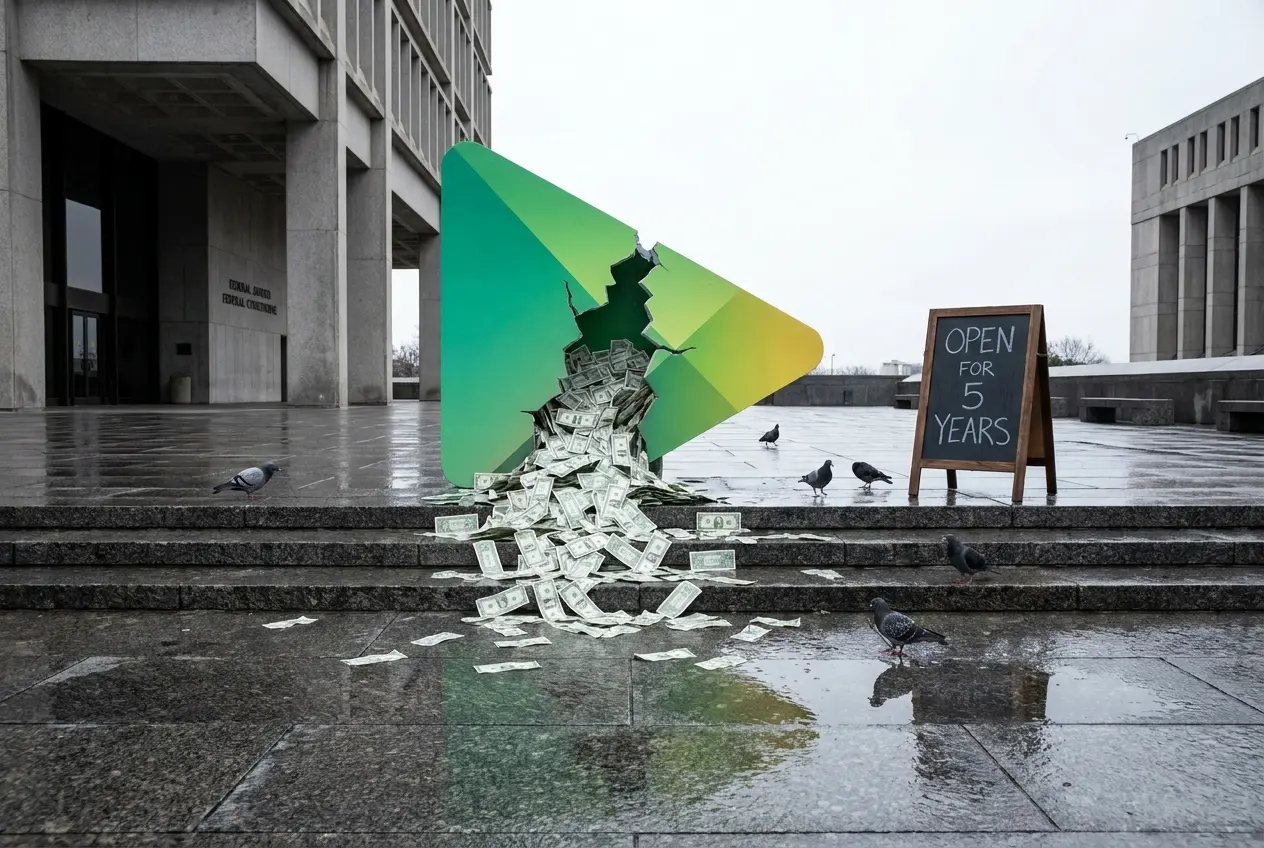
The Math Behind That $2 Minimum Check
Every eligible buyer is guaranteed at least $2. The exact payout scales with how much each person spent on Google Play during the seven-year window. Heavy spenders will collect well above the floor.
The arithmetic is rough but revealing. Divide the $630 million consumer pool across 102 million class members and the average pre-fee take comes out to roughly $6.18 a person. After the consumer counsel’s $85 million fee request and $8.6 million in expenses are deducted, the average drops closer to $5.25.
Most recipients won’t have to lift a finger. Payments arrive as a PayPal email or a Venmo text sent to the address or number tied to a buyer’s Google Play account. Anyone whose registered email or phone has gone stale must use the supplemental claims process on the official settlement claims site once it opens.
Phishing is the predictable risk. State AG offices have warned consumers not to click on payment links in unsolicited emails. The legitimate flow is initiated by PayPal or Venmo, not by a third party promising to release the funds.
The Rules That Outlive the Cash
Consumer checks clear once. The behavior rules run for years. That is where the structural value of this settlement sits, in the operational rewrite Google must follow on Android.
For at least five years from the effective date, Google has agreed to let app developers do what its contracts long forbade:
- Process in-app payments through third-party billing systems instead of Google Play Billing.
- Tell users inside the app about lower prices available outside Google’s payment flow, the same anti-steering practice the European Commission targeted under the Digital Markets Act.
- List the same app on competing Android storefronts without facing retaliation in search ranking, promotion, or developer support.
A separate seven-year commitment preserves Android sideloading. Users can install apps from a website, a competing store, or a sideloading client without Google blocking the install or pushing a friction screen designed to steer them back to Play. The Maryland Attorney General’s office said the structural piece is what makes the deal worth more than its dollar figure.
Donato’s $85 Million Fees Problem
The judge’s only real hesitation was not about the deal. It was about the lawyers’ check.
Counsel for the consumer class asked Donato for $85 million in fees, roughly 13.5% of the $700 million common fund, plus $8.6 million in unreimbursed costs and a $5,000 service award for each of the six individual consumer plaintiffs. They told the court they had logged close to 100,000 hours of attorney time over three years and carried the bulk of trial preparation in the final stretch before the deal closed.
That works out to roughly $850 an hour before expenses. It is a defensible number for a firm running parallel to a state-AG team. It is a high one in a class action where every fee dollar comes out of the consumer pool.
Donato did not rule on the fees from the bench. He told the firms he was considering appointing a special master to comb through the bills.
“Trim away the water and inefficiency.” U.S. District Judge James Donato, addressing consumer counsel at the April 30, 2026, fees hearing.
That assessment is the only piece of the deal still genuinely unsettled. Final approval can issue without the fee number being locked in, and the judge has signaled he intends to use that flexibility.
Why This Settlement Closed While Epic’s Deal Stalls
This is the Utah-led state-AG case. It is not the parallel Epic Games settlement with Google, which Donato is also overseeing in the same courthouse. The two cases have diverged sharply in the last six weeks.
Donato gave the AG deal a green light at the April 30 hearing. He has refused to do the same for Epic’s. He scheduled a summer 2026 evidentiary hearing he described as the final act of the Epic case while signaling skepticism that the Epic-Google compromise serves the public interest.
| Feature | Utah-Led State AG Settlement | Epic v. Google Settlement |
|---|---|---|
| Lead plaintiff | 53 attorneys general plus consumer class | Epic Games |
| Status as of May 2, 2026 | Final approval signaled April 30 | Stalled; evidentiary hearing this summer |
| Cash component | $700 million common fund | No direct consumer payout |
| Behavioral term | 5 yrs alt billing; 7 yrs sideloading | Broader injunction sought |
| Judge’s posture | “No reason to deny” | Public-interest skepticism |
How to Actually Get Your Money
For most class members, doing nothing is the right move. Payments will arrive without a claim form. The risk is missing the window when an old email or phone number breaks the automatic match.
Here is the order of operations the state AGs are circulating to consumers this week:
- Confirm eligibility. You must have made a Google Play purchase or in-app payment between August 16, 2016, and September 30, 2023, while living in the U.S. or a covered territory.
- Watch for a PayPal email or Venmo text. The notification will go to the address or number on file with your Google Play account.
- If nothing arrives within several weeks of distribution opening, register on the official settlement site. A supplemental claims process opens for consumers who have lost access to their original email or phone.
- Ignore third-party fast-track offers. Only PayPal, Venmo, and the official claims administrator are involved.
Most state AG offices, including the Utah Attorney General’s consumer guidance page, have published their own walkthroughs. The instructions line up across states because the distribution mechanics are identical nationwide.
Where the State Slice Lands and the Road Here
The $70 million state pool is divided as costs, fees, and civil penalties using a confidential allocation formula tied to population and Play activity in each jurisdiction. New York Attorney General Letitia James has indicated her state’s slice goes into a general antitrust enforcement fund.
Utah, as lead plaintiff, will collect a coordinator premium on top of its base share. Derek Brown’s office stands to recover more from this single matter than from any prior multistate settlement his predecessor closed. Brown inherited the case in January 2025 from former Attorney General Sean Reyes, who filed the original complaint in mid-2021.
- July 7, 2021. Utah-led coalition files the antitrust complaint in the Northern District of California.
- September 30, 2023. End of the conduct period covered by the settlement.
- December 18, 2023. Google reaches a $700 million agreement in principle with the states and consumer plaintiffs.
- November 20, 2025. Donato grants preliminary approval and orders class notice.
- February 19, 2026. Deadline for class members to opt out or object.
- April 30, 2026. Final approval hearing; Donato signals he will sign.
Frequently Asked Questions
Who qualifies for the Google Play $700 million settlement payment?
Any U.S. resident who paid for an app or made an in-app purchase through Google Play Billing between August 16, 2016, and September 30, 2023, while living in one of the 50 states, the District of Columbia, Puerto Rico, or the U.S. Virgin Islands. Roughly 102 million people fit the description, and no claim form is required for most of them.
How much will I actually receive from the Google Play settlement?
The minimum payout is $2. The amount scales upward based on how much you spent on Google Play during the seven-year period. Average pre-fee compensation works out to roughly $6 per person, but heavy buyers can collect substantially more. Final amounts depend on Donato’s ruling on the $85 million attorneys’ fee request.
When will Google Play settlement payments arrive?
Distribution begins shortly after Judge Donato signs the written final-approval order, expected within days of the April 30, 2026, hearing. Most consumers will receive a PayPal email or a Venmo text at the address tied to their Google Play account. Allow several weeks for funds to arrive once distribution opens.
Do I need to file a claim for the Google settlement?
No claim is required for the vast majority of eligible buyers. Payments are automatic via PayPal or Venmo. A supplemental claims process opens later for consumers whose registered email or phone is no longer accessible, or who never receive a notification despite qualifying.
Is the $700 million Google settlement the same as the Epic Games case?
No. This is the Utah-led case brought by 53 state attorneys general and a consumer class. Epic Games has a separate, parallel suit before the same judge, U.S. District Judge James Donato. The Epic deal is currently stalled, with a summer 2026 evidentiary hearing scheduled before Donato will decide whether to approve it.
What changes will Google have to make to the Play Store?
For at least five years, Google must let app developers use third-party billing, tell users about lower prices outside the Play Store, and list apps on competing Android storefronts without retaliation. For at least seven years, Android users will be able to sideload apps from outside the Play Store without Google interference.
The Utah-led coalition spent five years arguing that Google’s Play Store rules functioned as an illegal toll booth on Android. The court has now agreed in substance, and the cash will start flowing within weeks. The deeper test arrives later, when developers begin invoking the new billing and steering rights, and when Donato’s special master decides how much of the lawyers’ fee request to cut.

-
 TECH1 year ago
Where Garmin Watches are Made and How They are Assembled
-

 AUTO3 months ago
Tesla’s Roadster Is ‘a Few Weeks Away,’ Says Its Chief Designer
-
 NEWS10 years ago
Samsung Releases Galaxy Note7 TV Ad as Reddit AMA Leaks Specs
-
 NEWS10 years ago
Android 7.0 Nougat Rolls Out To Nexus Devices With New Emoji, Features
-
 FINANCE9 years ago
Cardano Price Surges as ADA Enters the Crypto Top Ten List
-
 NEWS10 years ago
Pre-Order the First Camera Made for Facebook Live Streaming Video
-
 FINANCE1 year ago
Binance Suspends Trading and Withdrawals for a System Upgrade
-
 FINANCE9 years ago
RChain Price Jumps Nearly 150% to a New All-Time High of $2.03