
NEWS
New York 3D Printer Gun Law Faces Its Firmware Test

The New York 3D printer gun law is now signed, but the hard part has only been handed to regulators. New York lists A10005C bill status and text as signed by the governor as Chapter 55 on May 27, 2026, making the state the first to put a future firearm-blocking requirement on printers sold there.
The rulebook may take years. The budget law asks a working group to test feasibility, tells the Division of Criminal Justice Services to write performance standards, and leaves manufacturers waiting for the first enforceable definition of a compliant printer.
The Law Now Runs on a Slow Clock
For printer makers, retailers, school labs and hobby buyers, the immediate answer is calendar. New York moved faster against digital gun files than against the machines themselves. The section that bars the sale or delivery of noncompliant printers waits for rules, and then waits another year after those rules are published.
- 90 days – The Division of Criminal Justice Services, Department of State and State University of New York must convene a working group within that window.
- One year – The working group gets up to a year after it convenes to recommend minimum safety standards.
- Nine months – The criminal justice agency then gets up to nine months to publish rules, unless the group says the mandate is not technologically feasible.
If officials use every window, the printer sales mandate could land near late May 2029, almost three years after signature. A faster rulemaking would move that date forward. A feasibility finding against the technology would stall it until the group changes course.
Blocking Technology Sits Between the File and the Print Bed
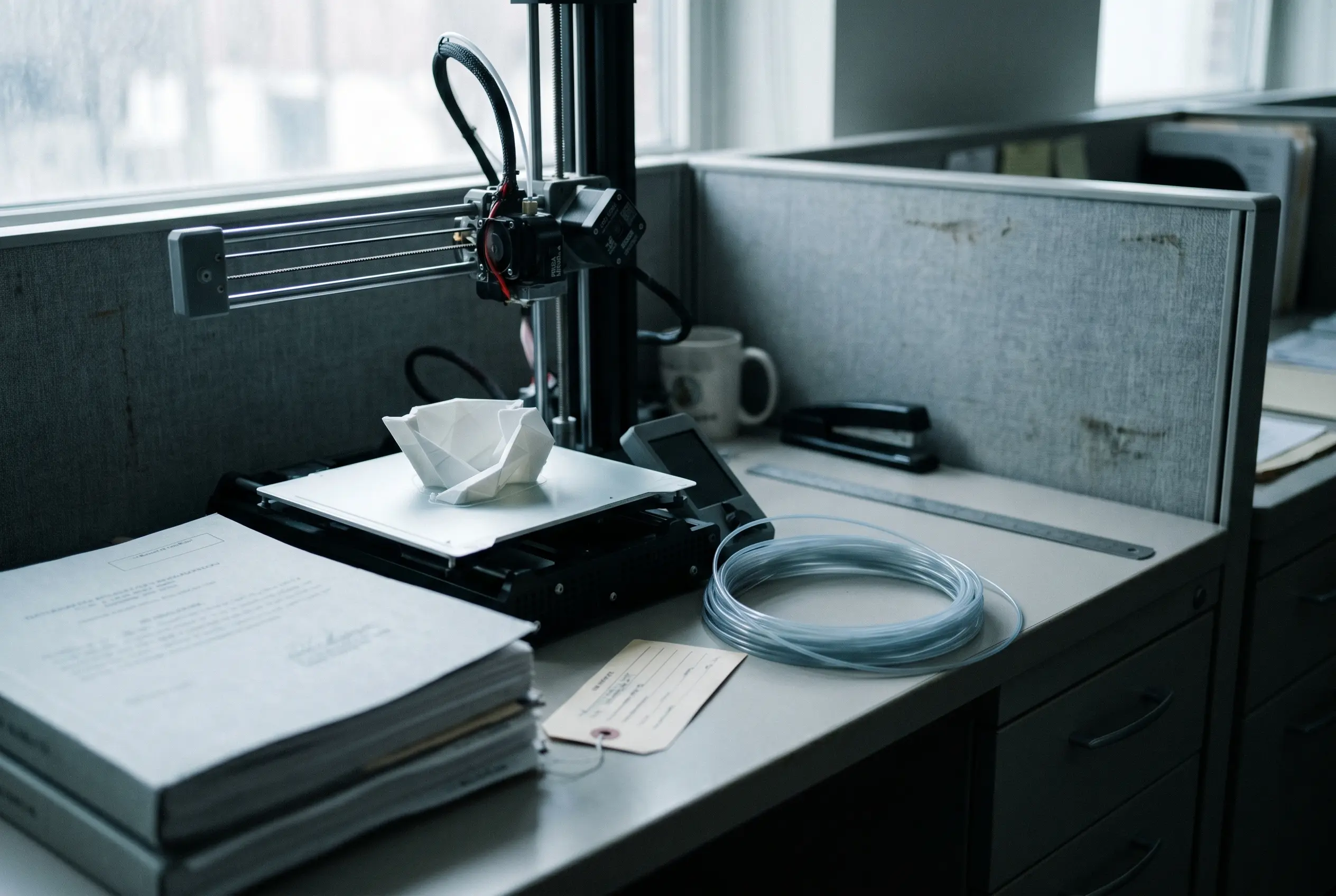
New York defines blocking technology as hardware, software, firmware or another integrated measure that stops a print job unless the underlying file has been checked by a firearms blueprint detection algorithm. The law reaches stereolithography (STL, a common 3D model format), computer-aided design (CAD, software drawings used by printers) and geometric code.
In plain terms, Albany is asking for a machine-level veto. Before plastic, resin or metal work begins, a system must decide whether the file would produce a firearm or an illegal firearm part. That creates two jobs: recognize disallowed files and stop the job before the printer acts.
The law also authorizes the state to create and maintain a library of firearm blueprint files and illegal firearm part files. It may include new files that enable 3D printing of firearms and scans of seized firearms. Access can be given to printer manufacturers, software vendors, computational design experts and public-safety specialists working on detection tools.
The weak point is geometry. A firearm component is a shape, but so are brackets, jigs, housings, repair parts and props. If the screen is too loose, a banned file slips through. If it is too strict, a legal print can be blocked because it resembles part of a controlled object.
The Code Crime Arrives Before the Printer Mandate
The signed law moves faster against digital firearm manufacturing code. It makes it a class A misdemeanor to knowingly sell, offer, transfer, distribute, sell access to, provide or otherwise dispose of covered code to someone who does not hold both a New York gunsmith license and a federal firearms license (FFL, federal authorization to make or sell firearms).
Possession also turns criminal when paired with intent to illegally manufacture a covered item, distribute to a prohibited person, or distribute in New York to someone who lacks both licenses. The definition reaches instructions for 3D printers and computer numerical control (CNC, automated milling from a digital file) machines.
- Digital file distribution to an unlicensed New York recipient can trigger a class A misdemeanor.
- Possession with intent to unlawfully manufacture or distribute covered code can trigger the same charge.
- After May 31, 2027, a dealer or gunsmith sale of a convertible pistol can become a class D felony, subject to listed exceptions.
The State Comparison Shows New York’s Caution
The first-in-the-nation label is less useful than the mechanics. California, Washington and Colorado have moved in the same policy direction, but each state has chosen a different pressure point. As of June 1, 2026, New York is the only one in this group with a signed statewide printer-blocking framework.
| State | Status | Device Rule | Main Enforcement Target |
|---|---|---|---|
| New York | Signed as part of Chapter 55 | Printer sale or delivery rule starts one year after state standards are published | Printer sellers, code distributors and gun industry members |
| California AB 2047 status record | Passed Assembly on May 26 and moved to the Senate | Would require manufacturer attestations and a public list before a later sales bar | Printer makers, sellers and users who disable blocking systems with unlawful intent |
| Washington HB 2321 bill summary | Still in House committee on the last posted status page | Would require manufacturer attestations to the attorney general | Manufacturers and vendors selling covered machines |
| Colorado HB26-1144 state summary | State page summarizes an act on 3D printing firearms and components | No broad printer-blocking mandate in the summary | People who manufacture covered items by 3D printing |
That spread matters for industry. A manufacturer can ship one printer into Colorado without building a detection layer, while a future New York sale may require proof that the machine refuses certain files. If California joins, the compliance market gets harder to ignore.
The Public-Safety Claim Meets Maker Pushback
Gov. Kathy Hochul, New York’s governor, sold the proposal as part of a public-safety shift from trafficked metal guns to printed parts and files. Her January announcement called for criminal penalties, reporting of recovered 3D-printed guns and minimum standards for printer manufacturers.
From the iron pipeline to the plastic pipeline, these proposals will keep illegal ghost guns off of New York streets.
Hochul made that statement in New York’s 3D-printed gun proposal, which also tied the printer rule to a separate ban on pistols that can be quickly converted into machine guns.
Electronic Frontier Foundation (EFF, a digital-rights nonprofit) sees a different risk. In EFF’s 3D printer campaign against California’s parallel bill, the group argues that mandatory scans could create surveillance, vendor lock-in, false positives and repair limits while still being bypassed by people already willing to break the law.
Both claims can be true at once. Police want fewer untraceable weapons. Makers do not want every model file sent through a government-approved filter. For law-abiding users, false positives carry costs even when no criminal case follows, because a blocked print can mean a delayed class project, failed repair, lost order or unusable tool.
Open-Source Printers Create the Enforcement Gap
Consumer 3D printing is not a single sealed appliance market. A typical workflow can involve a design file, slicing software, firmware, a controller board, motors, sensors and replaceable parts. Many machines are open-source or partly open-source, and many advanced users repair or modify them.
New York can pressure retailers and mainstream manufacturers. It can make large sellers decide whether the New York market is worth a special compliance path. It can also bring civil cases when a covered seller ignores the rule. That is a different task from stopping a homebuilt machine, a modified controller or an out-of-state file that never passes through a local vendor.
The working group provision shows Albany understands the gap. If the group says the printer requirement is not technologically feasible, the law says regulations do not have to be issued until feasibility exists. That clause is not a footnote. It is the escape hatch if the state cannot define a test that works in the lab and in the market.
The Rulebook Will Decide the Market
The market effect may arrive before enforcement. Retailers may restrict New York shipments, manufacturers may prepare compliant stock keeping units, and schools or libraries may review printer purchases long before the attorney general files a case. No company wants to discover compliance through litigation.
The statute also gives the attorney general tools beyond fines. It allows actions to stop unlawful sales and seek restitution. It adds civil penalties of five thousand dollars for each qualified product in certain gun industry violations, and it expands the state nuisance-style framework to include digital firearm manufacturing code.
Court fights are likely to test fit, speech and burden. Code can function as instructions, software and expression. A printer is a general-purpose tool. The state will argue it is regulating conduct tied to illegal weapons. Opponents will argue the filter sweeps in lawful making, lawful repair and lawful technical speech.
If the working group finds a reliable screen, New York becomes the test case for state-backed content controls on fabrication tools. If it reports infeasibility, the signed law becomes something rarer in gun policy: a statute that admits the machine may be harder to govern than the object it can make.
Disclaimer: This article is for informational purposes only and does not provide legal advice. Firearms, 3D printer sales, digital files and manufacturing rules carry criminal and civil risk. Consult a licensed attorney before acting on the law. Figures and dates are accurate as of publication.

-
 TECH1 year ago
Where Garmin Watches are Made and How They are Assembled
-

 AUTO3 months ago
Tesla’s Roadster Is ‘a Few Weeks Away,’ Says Its Chief Designer
-
 NEWS10 years ago
Samsung Releases Galaxy Note7 TV Ad as Reddit AMA Leaks Specs
-
 NEWS10 years ago
Android 7.0 Nougat Rolls Out To Nexus Devices With New Emoji, Features
-
 FINANCE9 years ago
Cardano Price Surges as ADA Enters the Crypto Top Ten List
-
 NEWS10 years ago
Pre-Order the First Camera Made for Facebook Live Streaming Video
-
 FINANCE1 year ago
Binance Suspends Trading and Withdrawals for a System Upgrade
-
 FINANCE9 years ago
RChain Price Jumps Nearly 150% to a New All-Time High of $2.03