
FINANCE
Clarity Act Vote Puts U.S. Crypto Rules on Global Stage

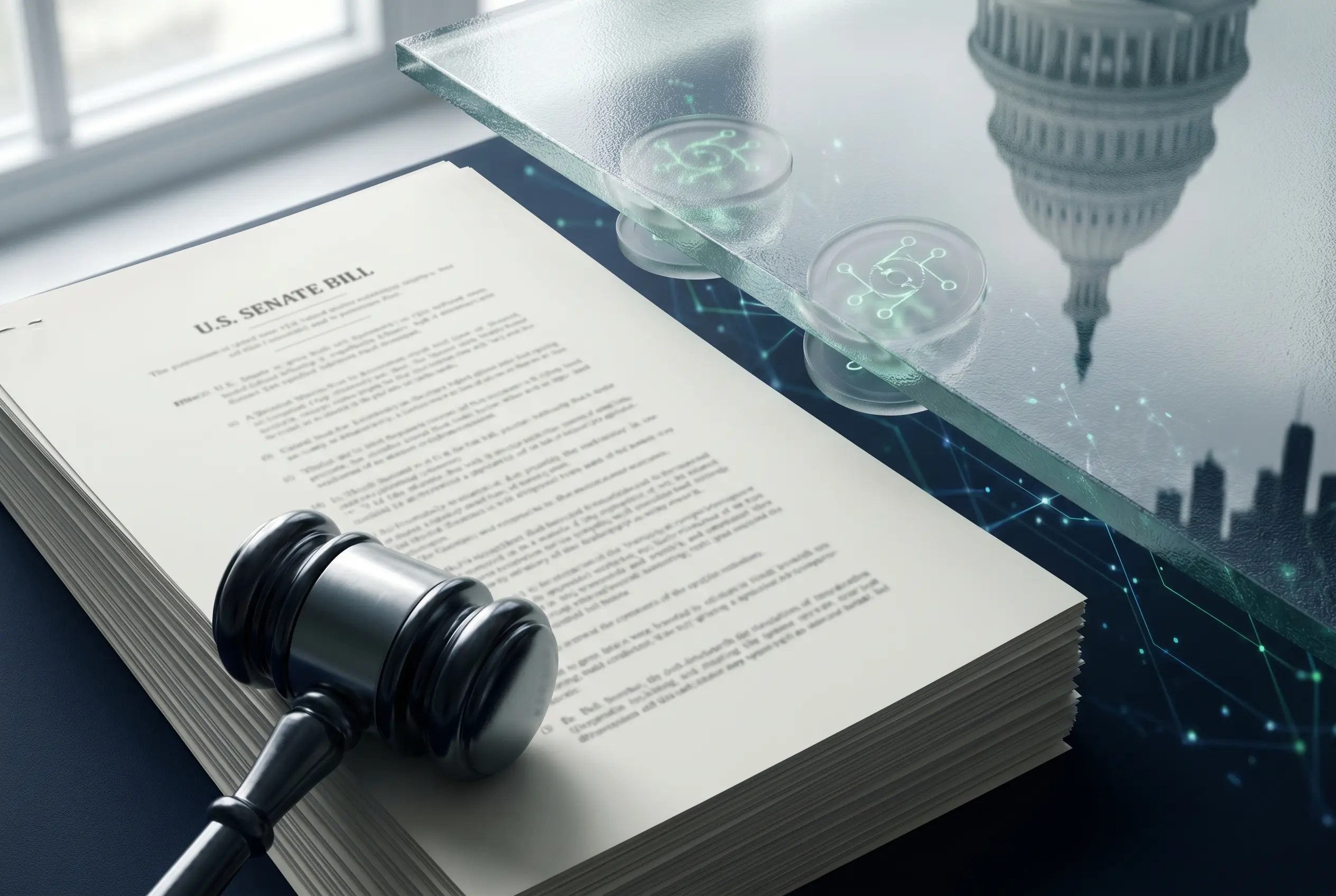
The Clarity Act global reach now turns on the Senate floor: the U.S. Senate Banking Committee advanced H.R. 3633 on May 14 by 15-9, sending a crypto market-structure bill toward a vote that could shift token trading toward the Commodity Futures Trading Commission (CFTC, the U.S. derivatives regulator) and become a reference point for foreign regulators. The measure now moves to the full Senate, according to the Senate Banking Committee’s May 14 vote notice.
The domestic argument is familiar: builders want legal certainty, banks want clean boundaries, and critics want tougher safeguards. For the rest of the world, the question is more practical. If Washington writes a clearer path for exchanges, stablecoin-linked activity and decentralized finance (DeFi, automated crypto services that run through software protocols), other capitals will decide whether to match it, resist it or build firewalls around it.
The Senate Floor Becomes a Global Signal
Tim Scott, Republican chair of Senate Banking, cast the committee vote as a way to pull digital assets into a clearer federal system. Cynthia Lummis, Wyoming Republican and chair of the committee’s digital assets subcommittee, treated the vote as a leadership marker. Elizabeth Warren, ranking Democrat on the panel, has pushed the opposite case: that weak crypto rules can raise risks for consumers, investors and national security.
Crypto rules travel through unusual plumbing. They move through exchange listing standards, dollar banking relationships, compliance vendors and the legal opinions that global firms reuse from one jurisdiction to the next. A U.S. statute would not bind London, Brussels, Singapore or Hong Kong, but it would give compliance departments a template that lawyers can price.
That is why the floor vote matters more than the committee tally. A narrow Senate win would signal a U.S. preference. A durable bipartisan margin would do something stronger: tell foreign ministries and market regulators that the rulebook might survive the next election cycle.
The Bill Draws New Agency Lanes
The heart of the bill is the agency split. The Securities and Exchange Commission (SEC, the U.S. markets regulator for securities) would keep important authority over primary fundraising and investment-contract activity, while digital commodity spot-market intermediaries would move toward commodity-market oversight. A Congressional Research Service overview of H.R. 3633 says the bill would give the commodity agency a central role while preserving parts of securities-law authority.
- Digital commodity exchanges, brokers and dealers would register under a new commodity-market regime rather than operate mainly through enforcement settlements.
- Issuers using limited exemptions would file offering statements and provide financial and development-plan disclosures.
- Trading platforms would face customer-asset segregation, conflict controls, record keeping and trade-monitoring duties.
- Certain DeFi activities, including validation and related software functions, would be excluded from registration while anti-fraud authority remains.
- The Bank Secrecy Act (BSA, the main U.S. statute for anti-money-laundering programs and suspicious activity reporting) would apply to newly registered intermediaries.
The split matters overseas because token sponsors chase classification. A project treated as a commodity-like asset in the United States will press regulators elsewhere for the same treatment. A project kept inside securities rules will face a harder path in markets that want access to U.S. liquidity.
The Existing Global Rulebook Is Already Crowded
Washington is late to the rule-writing race. The European Union already has Markets in Crypto-Assets Regulation (MiCA, the bloc’s harmonized crypto law). The Financial Stability Board (FSB, a global financial policy body linked to the Group of 20 economies) and International Organization of Securities Commissions (IOSCO, a securities regulator forum) have written international baselines. The Financial Action Task Force (FATF, the global anti-money-laundering standards setter) has pushed the Travel Rule into virtual assets.
| Framework | Core Choice | Global Relevance | Main Gap |
|---|---|---|---|
| U.S. Senate market-structure bill | Would send digital commodity spot-market intermediaries to commodity-market oversight while preserving securities oversight for primary investment-contract activity. | U.S. exchanges, dollar settlement and legal opinions give the approach force beyond U.S. borders. | DeFi status and the illicit-finance perimeter remain disputed. |
| European Commission MiCA page | Sets a bloc-wide framework for crypto-asset issuance and service providers, including trading venues and wallets. | Passporting inside the EU gives licensed firms a large regulated market. | Implementation is still being reviewed through consultations that run into late summer. |
| FSB crypto recommendations | Promotes technology-neutral regulation based on activities and risks. | Gives large economies a shared vocabulary for supervision and cross-border cooperation. | Recommendations are high-level and need national law to bite. |
| virtual asset standards update | Pushes licensing, registration and Travel Rule implementation for virtual asset service providers. | Illicit-finance controls become comparable across major markets when implemented well. | Offshore providers and uneven supervision still leave exploitable gaps. |
The pressure point sits in the gap between binding national statutes and international baselines. Global bodies can describe a floor. Legislatures decide how many doors get cut through it.
For firms, U.S. clarity would lower one cost and raise another: legal certainty at home, then pressure to map every overseas product to a new American taxonomy. For supervisors, the risk runs in reverse. A broad U.S. exemption can become a talking point for lobbyists in smaller markets within weeks.
DeFi Turns the Compromise Into a Border Problem
The DeFi fight is the global hinge. A protocol may have code in one country, developers in another, token holders everywhere and a foundation that insists it is not the operator. That structure makes anti-money-laundering and countering the financing of terrorism (AML/CFT, controls requiring firms to identify customers, monitor transactions and report suspicious activity) difficult to pin to one legal person.
A May 13 letter from Major County Sheriffs of America, the Association of State Criminal Investigative Agencies, the International Association of Chiefs of Police and the National Association of Police Organizations warned that Section 604 could create gaps in oversight and accountability. The groups said criminal organizations increasingly use digital assets to conceal crimes including narcotics trafficking, fraud, ransomware and terrorism-related financing in the law enforcement letter on Section 604 posted by Sen. Catherine Cortez Masto, Nevada Democrat.
That critique lands because DeFi is hard to localize. If a U.S. bill narrows who counts as a responsible intermediary, the country could set a defensible software boundary. It could also give offshore actors a script: remove the obvious operator, call the rest software and point back to Washington.
Senate minority staff have pressed the broader national-security concern, warning that carveouts can weaken the standard other countries are asked to adopt. Supporters answer that clear registration duties and anti-fraud powers are better than the current patchwork. Both sides are arguing about more than U.S. enforcement. They are arguing about the language other regulators will copy.
Stablecoins Give Washington Extra Weight
The stablecoin law signed last year matters because dollar tokens are where crypto policy meets payments, sanctions and Treasury-market demand. The GENIUS Act, now Public Law 119-27, moved payment stablecoins into federal law through the GENIUS Act public law text. The market-structure bill would decide how much adjacent trading and platform activity sits inside commodity-market rules.
The Financial Crimes Enforcement Network (FinCEN, Treasury’s anti-money-laundering bureau) showed why that matters on May 11. In an Iran digital asset alert for financial institutions, FinCEN said digital asset transactions serve as a leg of Iran’s shadow banking network and that Iranian facilitators are likely to use stablecoins because of liquidity, settlement speed and exchange-rate stability.
- 99 jurisdictions: the global standards body says that many have passed or are in the process of passing legislation implementing the Travel Rule.
- 98 percent: the same update says jurisdictions with materially important virtual asset service provider activity account for about this share of the global virtual asset market.
- $1.46 billion: the update cited the Democratic People’s Republic of Korea (DPRK, North Korea’s official name) theft from ByBit and said only 3.8 percent had been recovered.
Those figures explain why overseas regulators will read the U.S. bill through illicit-finance sections, not only through exchange registration. A system that boosts dollar-token use while leaving gaps in offshore supervision could improve legal certainty for U.S. firms and still worsen the cross-border burden for investigators.
A Passage Would Not End the Argument
Even if the Senate passes the bill, final law would still require matching text to clear both chambers and reach the White House. That process gives opponents another chance to harden law-enforcement language and gives supporters another chance to protect the agency division they have spent months negotiating.
Industry lobbyists want durability. Enforcement agencies want accountable intermediaries. Foreign regulators want neither U.S. ambiguity nor a Washington carveout they have to rebut in their own consultations. That triangle is why the bill’s export effect may be felt before it becomes law.
If Congress tightens the DeFi and illicit-finance language without breaking the agency split, Washington gets a rulebook other markets can copy. If the Senate protects the split but leaves the perimeter fuzzy, the first export may be the loopholes.

-
 TECH1 year ago
Where Garmin Watches are Made and How They are Assembled
-

 AUTO3 months ago
Tesla’s Roadster Is ‘a Few Weeks Away,’ Says Its Chief Designer
-
 NEWS10 years ago
Samsung Releases Galaxy Note7 TV Ad as Reddit AMA Leaks Specs
-
 NEWS10 years ago
Android 7.0 Nougat Rolls Out To Nexus Devices With New Emoji, Features
-
 FINANCE9 years ago
Cardano Price Surges as ADA Enters the Crypto Top Ten List
-
 NEWS10 years ago
Pre-Order the First Camera Made for Facebook Live Streaming Video
-
 FINANCE1 year ago
Binance Suspends Trading and Withdrawals for a System Upgrade
-
 FINANCE9 years ago
RChain Price Jumps Nearly 150% to a New All-Time High of $2.03