
BUSINESS
Iran Claims a Hormuz Supertanker Sank Without a Name
Iran says a two-million-barrel Hormuz tanker sank on a mine. No ship is named, and a separate logged attack left its crew safe.

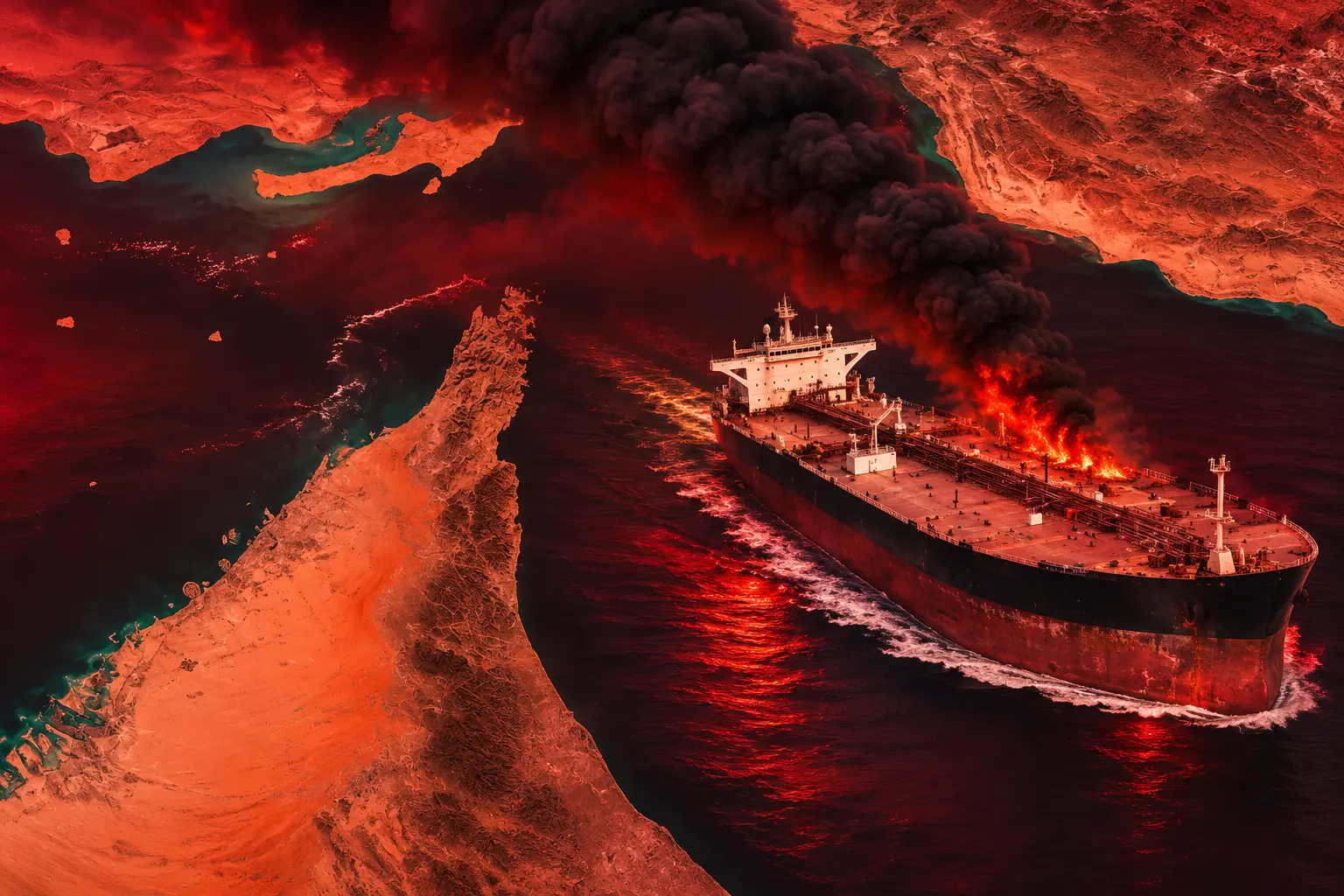
Iran’s Revolutionary Guard said on 15 November that a supertanker carrying more than two million barrels of crude sank after hitting a mine in the Strait of Hormuz. The Guard named no ship, flag, owner or crew, and no salvage or pollution bulletin has matched the wreck.
A British maritime centre logged a different tanker attack the same day, with the crew safe. The gap is the point: a claimed sinking can close a lane even when the hull never appears on a registry.
A Two-Million-Barrel Wreck That Has No Name
The Islamic Revolutionary Guard Corps Navy said two oil tankers on an unapproved southern route in the strait struck naval mines, blew up and caught fire. One, it said, was a supertanker that went down in the southern Persian Gulf after the blast and the fire.
The same statement said both ships had switched off identification and tracking systems and were trying to slip through with help from the US military. Fishermen were told to watch for wreckage. Owners and crews were told not to trust US routing, and any ship entering what the Guard called a contaminated zone was threatened with the same end.
Iran’s official news agency, IRNA, put the claim out in English with video of a blast at sea.
IRGC Navy: Over the past few hours, two oil tankers traveling an unauthorized route in the southern Strait of Hormuz hit sea mines, triggering an enormous explosion. pic.twitter.com/LLsKuAkHEf
— IRNA News Agency ☫ (@IrnaEnglish) November 15, 2026
IRNA’s own wording is the whole of the public file on the wreck. “One of the ships, a supertanker loaded with over two million barrels of crude oil, went down in the southern Persian Gulf after the explosion and fierce fire,” it said. There is still no name attached to that sentence.
WHAT WE KNOW
- The claim: The IRGC Navy said two tankers hit mines on an unapproved southern Hormuz route on 15 November and that one laden supertanker sank.
- The cargo: The Guard put the sunken load at more than two million barrels of crude, a very large crude carrier’s worth, without naming a charterer.
- The other log: UK Maritime Trade Operations recorded a separate tanker attack the same date, eastbound toward the strait, with the crew safe.
WHAT IS UNCONFIRMED
- The ship: No flag state, owner, insurer or port has identified either IRGC vessel.
- The sinking: No matching wreck, salvage job or pollution notice has been posted by a coastal state.
- The overlap: The British log does not describe a sinking, so it cannot be read as proof of the Guard’s wreck.
A cargo that large is about a tenth of the oil that used to move through the strait in a single day. Brokers, clubs and flag registries would have to deal with a burning very large crude carrier in public. Until someone names the hull, the statement is an IRGC account, not a confirmed loss.
UKMTO Logged a Different Attack Off Oman
United Kingdom Maritime Trade Operations issued warning 205-26 on the attack on 15 November, citing Indian shipping authorities. The tanker was eastbound through the Arabian Gulf, before it entered the strait, with the reference point at Khasab, Oman. The incident time was still to be confirmed.
UKMTO WARNING 205-26
Click here to view the full product.⤵️https://t.co/xTmMCPLvP8#MaritimeSecurity #MarSec pic.twitter.com/L8OJtLGSsc
— UKMTO Operations Centre (@UK_MTO) November 15, 2026
The centre marked the source as verified and classed the event as an attack. “The crew are accounted for and safe,” it said. Damage and any pollution were unknown at the time of the report. Vessels were told to transit with caution and to report anything suspicious.
That file and the Guard’s wreck sit on the same date and do not describe the same ship. One is a tanker still afloat, crew counted, damage unmeasured, approaching the strait from the Gulf. The other is a nameless supertanker the IRGC says is already on the bottom. Treating them as one incident would erase the only independent log of the day.
Mine Warnings Have Outrun Named Ships for Weeks
Sunday’s sinking line is new. The rest of the script is not. Through October the Guard kept announcing mine strikes on large, dark-running tankers that had used an unapproved southern track, and it never identified a vessel. The Joint Maritime Information Center, publishing through UKMTO, met the mid-October pair of supertanker claims with a flat note: there was no substantiation.
When Singapore looked at the container ship GFS Pride, which Iran had also tied to mines, the flag state said the ship was hit by unknown projectiles. A mine under a laden crude carrier is a different class of event, and it is a hard one to hide. The pattern still does work even when the hull is missing, because insurers and skippers hear “unapproved route” as “mined route.”
THE CLAIMS THAT NEVER NAMED A SHIP
- 28 February 2026: War begins, and Iran tightens control of Hormuz traffic, pushing ships onto routes it approves.
- 14 July 2026: The United States reinstates a naval blockade of Iranian ports after a short lift during a failed ceasefire.
- 16 October 2026: The IRGC Navy reports a first supertanker fire after a mine on an unapproved Hormuz route, with no ship named.
- 17 October 2026: A second such claim follows, again describing a dark-running laden tanker and again naming nobody.
- 18 October 2026: JMIC says there is no substantiation for the 17 October pair; the Guard announces a third strike the same weekend.
- 27 October 2026: The Iranian Navy reports another tanker fire after mines in the eastern strait, still without a name.
- 15 November 2026: The Guard says two tankers hit mines and a laden supertanker sinks in the southern Gulf.
Each of those October notices used the same pieces: systems off, southern or eastern track, US deceit, a big crude cargo, no registry. Raising the stakes from fire to wreck does not fill the missing name. It does tell every master still using the Omani-side lane that Tehran will call that water a minefield.
What Did Central Command Say About Mines?
Three weeks before Sunday’s claim, Adm. Brad Cooper, the US Central Command chief, flew the strait in an Army Chinook and said the main shipping lanes were clear of Iranian mines. CENTCOM said US forces had helped Gulf partners export more than 1.5 billion barrels of crude since summer, and that more than 3,000 commercial vessels had transited with its support over six months.
Today, primary transit routes in the Strait of Hormuz remain free and clear of Iranian sea mines thanks to incredible efforts by our people.
Adm. Brad Cooper, commander of US Central Command, 25 October statement
The same release said over 95% of ships navigating the strait in recent months had sailed through safely, which it offered as proof that the United States and regional partners control the waterway. Cooper said Washington was still working with Gulf states and the shipping industry to keep traffic moving.
That 95% figure is CENTCOM’s count of ships it treats as getting through in recent months. It is not a death toll, and it does not cancel the IMO’s separate count of seafarers killed since February. The two numbers describe different sets. They do collide as politics: one headquarters says the lanes are mine-free and under allied control, while the Guard says ships that follow the Americans hit mines and sink.
The US blockade of Iranian ports, back in force since 14 July, is the other half of that fight. Neutral ships heading to non-Iranian ports are still supposed to pass. Iran’s answer has been a permit regime, attacks on ships it calls unapproved, and this drumbeat of mine notices. Sunday’s wreck claim is the loudest of those notices because a sunk laden supertanker is meant to finish the argument about who owns the remaining lane.
Hormuz Oil Fell to a Fraction of Last Year
The strait is 21 nautical miles across at its narrowest, with two-mile inbound and outbound lanes and a two-mile buffer. Last year it carried an average of nearly 20 million barrels a day of crude and products, about a quarter of seaborne oil trade, according to the International Energy Agency. Nearly 15 million barrels a day of that was crude, about 34% of global crude trade.
OIL THROUGH THE STRAIT
| Period | Oil flow, million barrels a day | Compiler |
|---|---|---|
| 2025 average | 20 | IEA |
| Q4 2025 | 21.6 | EIA |
| Q2 2026 | 4.9 | EIA |
Second-quarter flows were under a quarter of the late-2025 peak, a drop of about three-quarters on the US Energy Information Administration’s tanker tracking. Pipelines can take only so much of the slack. The IEA puts spare bypass capacity on Saudi Arabia’s East-West line to Yanbu and the UAE line to Fujairah at 3.5 to 5.5 million barrels a day, and it notes those chains have not been tested at full stretch.
Most of That Oil Was Bound for Asia
About 80% of the oil that left via Hormuz in 2025 was headed for Asia. China and India together took 44% of the crude, and Japan and Korea are heavily exposed among IEA members. Only about 4% of the region’s crude went to Europe. A wreck claim aimed at the southern lane is therefore aimed at Asian refiners first, not at US gasoline docks.
Gas is tighter still. Almost all Qatari and Emirati LNG that is not piped to neighbours transits the same gap, almost 20% of world LNG trade, and Bangladesh, India and Pakistan took almost two-thirds of their LNG through it last year. There is no second loading dock for that Qatari gas if the strait is treated as mined.
Brent settled at $95.84 on 13 November after a weak week, and the IEA had just said global supply had moved above demand for the first time since the war, projecting a surplus of about 2 million barrels a day this quarter as some Gulf barrels returned. A confirmed two-million-barrel loss would still be a shock. An unnamed one, on a weekend of similar notices, is the kind of headline the paper market can fade, which is what public recaps of Monday’s open described.
Twenty-Five Crew Are Already Dead
Khaled Khiari, the UN assistant secretary-general who covers the Middle East, briefed the Security Council on 13 November using International Maritime Organization figures through 11 November. He said the IMO had recorded 134 confirmed incidents by mid-November in the strait and the wider Middle East sea area, and that 25 seafarers had been killed. October was the worst month since February.
THE IMO TALLY THROUGH 11 NOVEMBER
- Incidents: 134 confirmed cases in Hormuz and the wider Middle East maritime area.
- Dead: 25 seafarers, with others injured or missing.
- October: The highest monthly count of attacks on commercial shipping since the war began.
This situation cannot be allowed to become the new normal.
Khaled Khiari, UN assistant secretary-general, Security Council briefing, 13 November 2026
Khiari said civilian ships must not become targets and that every day brings new reports of incidents. He also said many commercial vessels and their crews have been stuck inside the Persian Gulf for months. Those 25 deaths are the documented human cost of the war at sea. They do not prove Sunday’s wreck. They do show why a Guard statement that a laden supertanker has gone down is aimed as much at the next crew as at the next cargo.
By 16 November no flag state had claimed the sunken ship, and UKMTO had not issued a wreck notice to match the Guard’s account. The named-ship test still sits in front of the story. Until a registry, an owner or a coastal state puts a hull under that two-million-barrel cargo, the sinking is a warning dressed as a casualty, and the remaining Hormuz lane is priced as if the mine were already there.

ADNOC Ship Hit in Hormuz Leaves One Crew Missing

SpiceJet’s Rs 5,500 Crore Plan Follows a Rescue That Failed

Hasina’s Return Fight Sets Fire to Yunus’s Bank

Bancroft Recants the 2018 Inquiry and Names the Team

Adhikari Ties the Saffron Saree Row to School Licences

Clancy Juror Says the Holdout Never Cited Evidence

The iPhone 18 Pro Max Splits Apple’s Fall in Two

OpenAI Calls GPT-6 Astra AGI Then Locks Its Exploits

Trump Claims Hormuz Control as Oil Holds Near $96

Russia Closes the Goethe-Institut Berlin Tried to Save

 NEWS2 months ago
Clancy Juror Says the Holdout Never Cited Evidence
- NEWS3 months ago
The iPhone 18 Pro Max Splits Apple’s Fall in Two
- NEWS3 months ago
OpenAI Calls GPT-6 Astra AGI Then Locks Its Exploits
- BUSINESS3 months ago
Trump Claims Hormuz Control as Oil Holds Near $96
- LIFESTYLE3 months ago
Russia Closes the Goethe-Institut Berlin Tried to Save
- AUTO3 months ago
Volkswagen’s Job Cuts Leave Four Plants Without Cars
- NEWS3 months ago
Dyson Puts Nurovi Robots on Sale Without the UV Flagship
- BUSINESS2 months ago
US Destroys Five Iranian Tankers as the Shock Hits Jordan










