
AUTO
Kia’s Andhra Plant Is a 2030 Mix Factory
Kia India’s $2 billion Andhra plant, due in early 2030, adds 200,000 units the company’s own 410,000 sales target does not need.

Kia India and its suppliers will put $2 billion into a second Anantapur car plant that is due to start building vehicles only in early 2030. The pact was signed on November 12, 2026, with the Andhra Pradesh government at the 31st CII Partnership Summit in Visakhapatnam. It adds 200,000 units a year and about 12,000 direct and indirect jobs.
Kia India’s own 2030 sales target is 410,000 vehicles, a figure that still fits inside the first plant.
A $2 Billion MoU, and No Cars Until 2030
Gwanggu Lee, managing director and chief executive of Kia India, told the summit the company was delighted to expand in Andhra Pradesh through an extra plant. Kia’s global newsroom later posted the same terms: a second plant in Anantapur, production planned for early 2030, 465 acres for the carmaker and its vendors, about 12,000 direct and indirect jobs, and 200,000 extra units a year.
That lift takes Kia India’s combined installed capacity from 430,000 vehicles to 630,000. The new money, counted with supplier outlays, takes spending across both Indian plants to nearly $5 billion. The first site, with vendors, is already booked at about $2.9 billion.
Lee did not give a date for breaking ground, a month for the first body-in-white, or a split of the $2 billion between Kia and the parts firms. The MoU is a state-level commitment, not a commissioning notice.
WHAT WE KNOW
- The pact: Kia and the Andhra Pradesh government signed the MoU on November 12, 2026, in Visakhapatnam.
- The bill: About $2 billion is a joint figure for Kia and its supplier partners, not Kia alone.
- The hall: 465 acres, 200,000 units a year, stamping, welding, paint and assembly, ICE and EV lines.
- The clock: Vehicle production is planned for early 2030.
WHAT IS UNCONFIRMED
- Build start: Kia has not said when construction begins or when capital will be spent.
- Model map: No nameplate has been assigned to the new hall.
- Money split: The $2 billion is not broken into Kia’s share and the vendors’ share.
Until those items land, Andhra has a signed plant and a three-year-plus wait for metal.
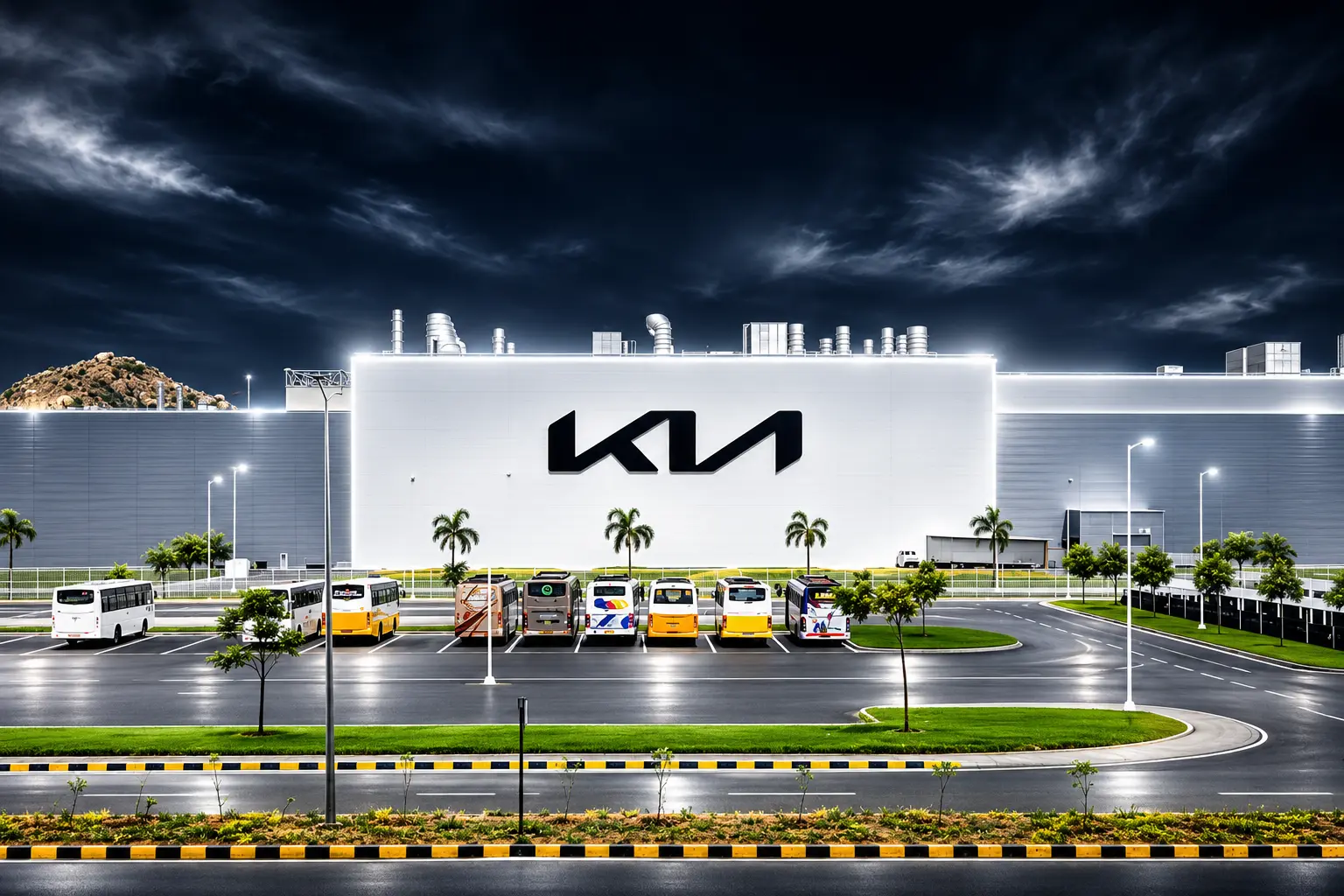
630,000 Units for a 410,000 Sales Target
In financial year 2026 the Anantapur plant built 317,000 vehicles. Of those, 289,000 went to Indian dealers and 27,953 were exported. Against 430,000 of installed capacity, that is about 74 percent full for the last completed fiscal year.
October 2026 was hotter on the sales side. Kia India posted its highest monthly tally since it entered the market, 33,462 units, up 13.22 percent from October a year earlier. That is demand, not a utilisation print, and it still sits under a full-capacity month of about 35,800 units. The first plant has room, even if the mix is getting crowded.
Atul Sood, senior vice-president of marketing and sales at Kia India, set the mid-term bar earlier this year. He said the company is targeting sales of 410,000 units, “which should give us a market share of 7.6%.” He also said Kia was looking at ways to expand capacity “to not only serve the domestic market but also scale up exports from the country.”
Put those two figures on one page. A 410,000 yearly sales target still fits in a 430,000 plant. A 630,000 network leaves about 220,000 units a year that 2030 domestic sales, on Kia’s own number, do not absorb. That leftover is the export and new-model pad.
THE TWO ANANTAPUR HALLS
| Item | First plant | Second plant |
|---|---|---|
| Location | Anantapur, Andhra Pradesh | Anantapur, Andhra Pradesh |
| Land (Kia and suppliers) | 945 acres | 465 acres |
| Annual capacity | 430,000 units | 200,000 units |
| Investment (Kia and suppliers) | $2.9 billion | $2 billion |
| Direct and indirect jobs | 24,237 | About 12,000 (planned) |
| Production | Running since August 2019 | Early 2030 (planned) |
The extra 200,000 units are a nearly 47 percent jump in installed capacity. They are not a patch for a plant that already ran out of shifts in FY2026.
Why the Second Line Still Has a Job
Seven nameplates already share the first floor, and several of them now come with more than one powertrain. Seltos, Sonet, Syros, Carens, Carens Clavis, Carnival and Sorento all run through Anantapur. Syros is sold as ICE and EV. Carens has ICE and CNG. Carens Clavis is listed as ICE, EV and CNG. Sorento has joined the mix as a larger SUV.
A single 430,000-unit hall can print 410,000 cars. It cannot print 410,000 cars across ten future models, eight of them electrified, without parking some of that mix somewhere else. That is the job of the second line, even if yearly volume still fits on paper.
Exports make the same case from the other side. Lee said the first plant has shipped more than 4.1 lakh vehicles and kits over its life to nearly 100 countries. In FY2026, though, exports were 27,953 units. The lifetime kits number is a stock of years. The FY2026 figure is a flow. Filling even a slice of that 220,000-unit leftover with export metal would mean several times the last fiscal year’s overseas dispatch, not a rounding error.
Anantapur is being talked about locally as a car town that still cannot pull software parks. The industrial answer in the MoU is more of the same: another hall, more vendors, no IT campus. The 2030 start is what keeps that from reading as an extra shift next summer.
Suppliers Share the 465 Acres and the Bill
The new site is not a Kia-only box. The 465 acres are drawn for the carmaker and its supplier partners, the same pattern as the 945-acre first complex. Stamping, welding, paint and assembly will sit on that land, matching the first plant’s four core processes.
That is why the $2 billion is written as a joint cheque. A paint shop and a press line do not run without seat, bumper, lamp and axle plants in the next plot. The first Anantapur site already supports 24,237 direct and indirect jobs on that model. The second is pitched at about 12,000 more, counted the same way, direct plus indirect.
WHAT THE NEW PLOT IS FOR
- Shared land: 465 acres for Kia and vendors, not a Kia fence with trucks from another state.
- Shared cash: $2 billion from the carmaker and supplier partners together.
- Full process: Stamping, welding, paint and assembly on site.
- Two fuels: ICE and EV production, with no model list attached yet.
Chief Minister N. Chandrababu Naidu used the first Kia plant at the same summit as an example of fast state approvals. The new MoU sits inside a larger Vizag pitch: 303 pacts the state said were worth Rs 9.89 lakh crore. Kia is one name on that board. The 465 acres are the part that will still be there if half those other pacts stay on paper.
The 14-Month Factory That Made Kia in India
Kia’s India story is still a single-district story. The company signed an April 2017 memorandum of understanding with Andhra Pradesh for the first Anantapur plant and began mass production in August 2019. That gap is 28 months from pact to metal. Lee’s “14 months” is the build-to-commission stretch he cites, not the MoU clock.
The first hall did what a late entrant needed. Kia says it was the fastest original-equipment maker in India to reach one million vehicles in four years, and two million in seven. On July 14, 2023, the company marked one million Make in India units by rolling out a Seltos at Anantapur.
THE ANANTAPUR CLOCK
- April 2017: Signs the first Andhra Pradesh MoU for a plant in Anantapur district.
- August 2019: Starts mass production at the first hall.
- July 14, 2023: Rolls out the one-millionth India-built vehicle, a Seltos.
- October 13, 2026: Hyundai Motor Group files a $15.5 billion India plan that names Kia capacity as part of the group map.
- November 12, 2026: Signs the MoU for the second Anantapur plant.
- Early 2030: Plans to start production at the second hall.
The second plant will not copy that 14-month sprint. Early 2030 is a product-cycle date. It sits after the 10-model, eight-electrified plan, not beside a 2019 launch rush.
Hybrids, CNG and EVs Need Their Own Floor
Lee’s longer brief at the summit was about mix, not a volume emergency.
India is central to Kia’s long-term growth ambitions, and the trust our customers have placed in us since we began operations in Anantapur, has been instrumental in our journey. Our second manufacturing plant marks a significant new chapter, strengthening our ability to respond to customer demand with greater speed and flexibility, while supporting the introduction of new models across ICE and EV powertrains.
Gwanggu Lee, Managing Director and CEO, Kia India, at the CII Partnership Summit
Sood had already sketched that mix. ICE stays. Work is on for EVs, strong hybrids and CNG. Kia has said eight of ten models in the 2030 book will carry some electrified hardware. The named pipeline includes Syros EV, Sorento hybrid and Carnival hybrid, with hybrid work also cited on Seltos. On September 18, 2026, the company put factory-fitted CNG on Carens at Rs 12.11 lakh and on Carens Clavis at Rs 12.38 lakh, ex-showroom.
WHAT ALREADY SHARES THE FIRST FLOOR
- Seltos: The volume SUV; a facelift is in market, with hybrid work cited for later.
- Syros: ICE and EV on the same nameplate, built in India.
- Carens and Clavis: ICE, CNG, and on Clavis an EV as well.
- Sonet, Carnival, Sorento: The rest of the Anantapur stack, from subcompact SUV to large MPV and three-row SUV.
EV6 and EV9 are on sale in India as the imported flagships. They are not the reason for a 200,000-unit hall. The reason is the made-in-India electrified stack that will not sit neatly on seven lines already splitting paint between petrol, diesel, CNG and battery packs.
The dealer plan that rides with this is 800 points by 2030. That is a retail map for a 410,000-unit sales year. It is not, by itself, a reason to install 630,000 units of welders.
Where the Group Already Builds in India
The Anantapur MoU is also a slice of a larger Korean cheque. On October 13, 2026, Hyundai Motor Group, Kia’s parent, told Indian exchanges it would run a 15.5 billion-dollar India investment plan from 2026 through 2032, covering Hyundai Motor India and Kia India, plus R&D, local suppliers and new mobility bets. Executive Chair Euisun Chung said the past 30 years were defined by the group’s commitment to India and that the new money was for the next 30.
The same filing counted more than 1.4 million units a year of group capacity in India: Hyundai Chennai at 824,000, Hyundai Pune at 170,000, and Kia Anantapur at the then-current hall. Using Kia’s 430,000 figure with those two Hyundai plants gives 1,424,000 units. Add the second Anantapur hall and the combined group map reaches 1,624,000, before any further Pune ramp, which the filing said would be scaled in phases.
HYUNDAI MOTOR GROUP IN INDIA, BEFORE AND AFTER
| Plant | Annual capacity |
|---|---|
| Hyundai, Chennai | 824,000 |
| Hyundai, Pune | 170,000 (further phases planned) |
| Kia, Anantapur, first hall | 430,000 |
| Kia, Anantapur, second hall (planned) | 200,000 |
| Combined after the second hall | 1,624,000 |
The group already employs more than 24,000 people in India and listed Mobis, Transys, Capital, Wia and Glovis as the parts, finance and logistics layer around the car plants. A $700 million-class R&D centre, including a test track, is in that plan. Kia’s 465 acres are the Andhra end of the same idea: welders and vendors in one fence, with Hyundai’s Tamil Nadu and Pune halls doing the rest of the volume.
Early 2030 is still the binding date. Until then the first Anantapur plant has to carry the 10-model book, the CNG and EV splits, and whatever export kits the last fiscal year’s 27,953 units can grow into. The second hall is bought and mapped. It is not, yet, a line that prints cars.

ADNOC Ship Hit in Hormuz Leaves One Crew Missing

SpiceJet’s Rs 5,500 Crore Plan Follows a Rescue That Failed

Hasina’s Return Fight Sets Fire to Yunus’s Bank

Bancroft Recants the 2018 Inquiry and Names the Team

Adhikari Ties the Saffron Saree Row to School Licences

Clancy Juror Says the Holdout Never Cited Evidence

The iPhone 18 Pro Max Splits Apple’s Fall in Two

OpenAI Calls GPT-6 Astra AGI Then Locks Its Exploits

Trump Claims Hormuz Control as Oil Holds Near $96

Russia Closes the Goethe-Institut Berlin Tried to Save

 NEWS2 months ago
Clancy Juror Says the Holdout Never Cited Evidence
- NEWS3 months ago
The iPhone 18 Pro Max Splits Apple’s Fall in Two
- NEWS3 months ago
OpenAI Calls GPT-6 Astra AGI Then Locks Its Exploits
- BUSINESS3 months ago
Trump Claims Hormuz Control as Oil Holds Near $96
- LIFESTYLE3 months ago
Russia Closes the Goethe-Institut Berlin Tried to Save
- AUTO3 months ago
Volkswagen’s Job Cuts Leave Four Plants Without Cars
- NEWS3 months ago
Dyson Puts Nurovi Robots on Sale Without the UV Flagship
- BUSINESS2 months ago
US Destroys Five Iranian Tankers as the Shock Hits Jordan










