
BUSINESS
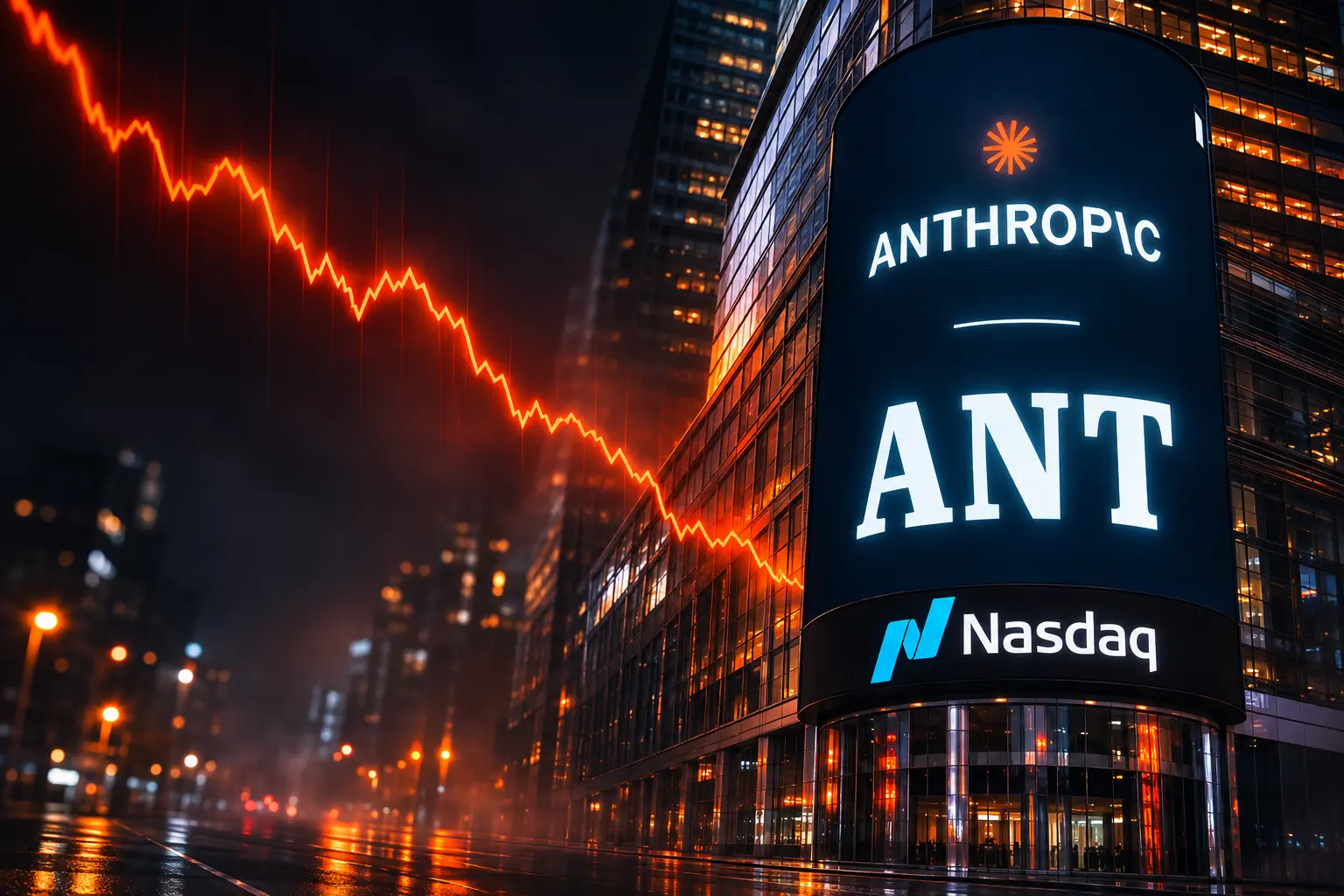
Anthropic’s IPO Becomes a Forced Raise After the Selloff
Anthropic’s IPO is stalling less on Claude demand than on an $895.4 billion compute bill that still comes due after the AI selloff.

Anthropic’s planned IPO is running into a buyers’ strike, with investors pushing back on a $1.5 trillion valuation days before a November roadshow. Four people familiar with those talks said some want a fatter discount before they commit, after the sharpest technology selloff in a year. The company declined to comment.
Investors are arguing about price. The harder problem is timing: Anthropic has to fund an $895.4 billion compute book that keeps accruing whether public buyers show up or not.
A Buyers’ Strike Days Before the Roadshow
The roadshow was first expected to start the week of November 9, with pricing the week after. Marketing that size into a week when more than 50 S&P 1500 technology stocks had just dropped 10% or more is a different job than the one bankers sketched when private-market talk still ran as high as $2 trillion.
Anthropic confidentially submitted a draft S-1 on June 1, 2026, then filed its public registration statement on October 26 for a Nasdaq listing under ANT. Goldman Sachs and Morgan Stanley are leading a 22-firm group. The price range, the share count, and the proceeds line are still empty. So is run-rate revenue as of October 31.
Keith Lerner, chief investment officer at Truist Advisory Services, called the tape a buyers’ strike in tech. His desk said technology had lagged the S&P 500 by 10.7% over the prior month, the widest one-month gap since May 2002. Vanda Research said retail selling was the strongest it had been since the COVID-19 pandemic, which is an awkward backdrop for a deal that added Schwab, Fidelity, Robinhood, SoFi, and E*TRADE to the selling group.
Some still expect the company to get there, even if the print moves. Rick Meckler, a partner at Cherry Lane Investments in New Vernon, New Jersey, said the firms will list and that private-market prices will probably give some of it back.
It’s not like these companies are not going to be a part of the future. They’re going to become public. Investors are still going to have a lot of interest in them. Valuations have risen for a long time in the private market, and we’ll probably see some pullback.
Rick Meckler, partner, Cherry Lane Investments
A May round raised $65 billion at a $965 billion post-money value. The gap from that print to $1.5 trillion is the bid investors are now refusing to rubber-stamp. Some people on the deal still talk about an offering around $100 billion, which would be larger than SpaceX’s 2026 debut. That figure is not in the prospectus.
Claude Kept Selling After the Only Profitable Quarter
The books do not show a demand collapse. They show a slower climb after a one-quarter profit, plus a cost line that jumped when cheap multi-year chips did not arrive fast enough.
Third-quarter revenue was $16.96 billion, up 1,127% from $1.382 billion a year earlier and up 47% from $11.56 billion in the second quarter. Second-quarter growth had been 144%. Nine-month revenue reached $33.24 billion. The June quarter produced $974 million of operating income, the first profit in the filing. The September quarter swung to a $567 million operating loss.
Management tied that swing to $5.0 billion of short-term compute, which costs more than capacity locked in years ahead, and $2.0 billion of non-cash donation-matching charges. Price cuts on new model versions and contract discounts trimmed about $600 million of revenue from the second quarter to the third. Adjusted operating income, which strips stock pay, those donations, and the Bartz settlement, still rose to $2.46 billion from $2.24 billion, while the adjusted margin slipped from 19% to 15%.
QUARTERLY P&L, 2026
| Line | Q1 | Q2 | Q3 |
|---|---|---|---|
| Revenue | $4.73B | $11.56B | $16.96B |
| Compute and infrastructure | $3.39B | $5.56B | $9.86B |
| Operating income (loss) | ($1.67B) | $974M | ($567M) |
| QoQ revenue growth | 132% | 144% | 47% |
The $104.0 billion nine-month net loss is mostly paper. Fair-value charges on convertible notes, derivatives, and SAFEs were $94.3 billion as the private value rose. Cash and short-term investments were $131.8 billion at September 30, with extra room on a $14.8 billion revolver. Net revenue retention was about 900%. More than 11,900 customers spent $100,000 or more over the trailing year. Headcount was about 5,300.
On November 6, Kate Clark, a reporter covering the offering, wrote on X that Anthropic’s run rate topped $80 billion at the end of October. That number is not in the S-1/A. It also is not the same as annualizing the third quarter, which comes to about $68 billion. If her figure holds, October did not confirm the slowdown; it sat above the third-quarter run. Buyers are still waiting to see it in a filing.
Amazon and Google Get Paid Even If the IPO Slips
Amendment No. 1, filed November 2, is the first time Anthropic put a total on the compute stack. The company disclosed aggregate committed spend of $895.4 billion as of and after September 30, almost all of it for compute and infrastructure. About $447.5 billion is expected before the end of 2030. About $69.8 billion falls in the 12 months after September 30. Roughly $213.8 billion still depends on termination rights or on counterparties raising money, getting sites, or clearing permits.
As of and subsequent to September 30, 2026, we have entered into purchase commitments and lease agreements, including short-term commitments, as well as leases not yet commenced, with an aggregate committed spend of approximately $895.4 billion, substantially all of which is related to compute and infrastructure.
Anthropic, PBC, Form S-1/A, November 2, 2026
Google, Amazon, and Microsoft are investors, distributors, rivals, and landlords at once. Their cloud floors are take-or-pay. If Anthropic uses less, it generally writes a true-up check. That is why a delayed listing does not delay their invoices.
NAMED COMPUTE CONTRACTS IN THE AMENDMENT
| Counterparty | Disclosed amount | Term / catch |
|---|---|---|
| Broadcom leases | $161.2B rent, excluding interest | Five-year equipment leases, non-cancelable except after default |
| Google Cloud | At least $121.3B | April 2026 to July 2033, paid even if unused |
| SpaceXAI | Up to $120.5B | About $3.1B a month at full load; either side can cancel on 90 days’ notice after early 2027 |
| Amazon | At least $110B | May 2026 to April 2036, paid even if unused |
| Microsoft Azure | At least $44.9B | November 2026 to June 2033, paid even if unused |
| Nscale | Up to $44.6B | Fees start only as capacity is delivered; Nscale must raise qualifying finance |
| Lambda | $41.3B | Fees on delivered capacity; either side can walk if a facility lease slips |
Those named floors and caps do not add to $895.4 billion on their own. The filed total also folds in leases that have not started, short-term overflow, and deals signed after September 30. Extra Google TPU capacity estimated at $125 billion to $150 billion, and more than $20 billion of AMD systems if the 2027 load is taken, sit outside the fixed total.
Jeff Park, a partner at Parafi Capital, wrote that the model is an asset-liability mismatch: long, hard compute bills funded by equity confidence, with credit behind those bills needing a high value as collateral. A cheap print, in that reading, does not just annoy founders. It makes the next dollar of chip finance harder to raise. Undrawn partner notes still on the page include $20 billion from Google, $15 billion from Amazon, and $42 billion from Broadcom.
Chip Stocks Fell 12% After the Data Center Votes
Tuesday’s midterms did not invent the fear. They dated it. Democrats took both chambers, and Gina Hinojosa won the Texas governor’s race after calling for a pause on new data centers until the legislature writes statewide rules. She does not take office until January 19, 2027, so this is a permit cloud, not a law that landed on Thursday.
The Philadelphia SE Semiconductor index fell 12% on November 5, its lowest close in more than six months. The Nasdaq had its deepest one-day drop since April 2025 and shed $2.5 trillion. CoreWeave’s five-year credit default swaps, per S&P Global Market Intelligence, widened to a record 1,267.9 basis points. UBS analysts put about 30% of expected 2028 U.S. data-center capacity additions at risk if construction pauses spread. Dan Ives at Wedbush estimated 10% of a planned 800 to 1,000 U.S. sites will not be built, or 80 to 100 campuses.
HOW THE WINDOW CLOSED
- June 1, 2026: Anthropic files a confidential draft registration and says a listing will depend on markets and other factors.
- October 26, 2026: The public S-1 lands with half-year sales of $16.3 billion, a blank compute total, and a blank third quarter.
- November 2, 2026: Amendment No. 1 fills in $16.96 billion of third-quarter sales and $895.4 billion of committed spend, and still leaves October’s run-rate blank.
- November 3, 2026: Midterm ballots land, including local data-center measures that broke heavily against new sites in early counts.
- November 4 to 5, 2026: Neocloud stocks, then the Nasdaq, sell off; Microsoft’s neocloud pullback hits the tape on November 5.
Local votes were already running against the build. Michael Eisenberg noted that of about 41 local data-center measures across 10 states, every counted result but one went against the projects, often by 70% to 80%, in both red and blue towns. Baird Strategas data shared during the week showed third-quarter project cancellations almost larger than 2024 and 2025 combined. Anthropic does not pour the concrete. It does sign the offtake that makes the concrete financeable.
Microsoft Walked Back Nscale, IREN and Nebius
The same Thursday, people familiar with the matter said Microsoft was tightening oversight of data-center projects at Nebius, IREN, and Nscale, stepping off work it saw as risky and debating whether to sign new neocloud deals. Shares of Nebius and IREN fell more than 16% in that session. CoreWeave dropped 12.29%.
Microsoft will not exercise an option that would have more than doubled its Nscale contract at a Ward County, Texas site, where Nscale had sold about 240 megawatts and held an option for another 700. The software company also dropped a plan to anchor Nscale’s flagship site in Loughton, Essex, after grid delays pushed supply into the 2030s. IREN’s Texas campus had cabling trouble, an April generator fire, and hardware slips; the two sides met the prior week on a timeline that may move completion by weeks or months. Microsoft spent about $5 billion less on third-quarter capital outlays than it had projected because rented capacity was late. Chief Financial Officer Amy Hood has now flagged third-party delivery slips on three earnings calls.
Our approach to infrastructure is built on flexibility and optionality, combining Microsoft-owned data centers, leased facilities and strategic partnerships with third-party providers to help us bring capacity online reliably and efficiently.
Microsoft spokesperson, November 5, 2026
Nscale is not a side character in Anthropic’s filing. The amendment lists up to $44.6 billion with Nscale into 2033, with fees accruing only as capacity is delivered and accepted, and with Nscale on the hook to use best efforts to obtain qualifying financing for the GPUs and the buildings. If Microsoft is no longer the anchor tenant and Texas permitting gets slower, that financing is the live risk, not a footnote. Anthropic’s other overflow names, including IREN-class neoclouds, are the same cohort whose five-year default insurance just made a high.
What a Slip Would Mean for the Rest of Tech
A postponed ANT listing would not be a private disappointment. Large technology names now carry so much of the equity market that a failed bid for one of the two frontier labs would be read as a funding stress test for the whole build. People on the investor calls said a delay would feed worry about data-center health at the same moment ballot fights have made that health a political fact.
Class A buyers would not run the firm in any case. A Founder LLC share is set to hold 50.1% of general voting power with no economic rights, and the Long-Term Benefit Trust elects a board majority through Class T stock. Anthropic is a Delaware public benefit corporation and a controlled company under Nasdaq rules. That structure was always going to be a diligence item. It becomes a harder one when the bid is already asking for a discount.
STILL BLANK IN THE S-1/A
- Price range: No per-share band, so no filed value to defend or cut.
- Share count: Company shares, selling-stockholder shares, and the overallotment option are empty.
- October 31 run-rate: Defined in the prospectus, then left as a hole, which is why Clark’s $80 billion note is doing so much work.
- Proceeds and date: Use of proceeds is sketched (working capital, compute, hiring); the dollars and the listing day are not.
WHAT WE KNOW
- The filing: Public S-1 on October 26, Amendment No. 1 on November 2, ticker ANT, lead banks named.
- The bill: $895.4 billion of committed compute spend, $69.8 billion inside 12 months of September 30.
- The quarter: $16.96 billion of sales, 47% sequential growth, a $567 million operating loss after a $974 million profit.
WHAT IS UNCONFIRMED
- The start gun: Whether marketing still opens the week of November 9.
- The print: Whether $1.5 trillion survives, gets cut, or is pulled.
- October sales: The $80 billion run-rate sits outside the registration statement until Anthropic files it.
Anthropic can wait. The invoices cannot wait as neatly. Google and Amazon true-ups, Broadcom rent, and Nscale deliveries keep moving on calendars that do not care whether ANT trades this month. That is the bind inside the $1.5 trillion argument: the company that most needs a clean raise is selling stock into the first week when the market has started to price the buildout as a credit story.
Disclaimer: This article is news reporting and analysis for information only. It is not a prospectus, and it is not investment, tax, or legal advice, nor a recommendation to buy, sell, or hold Anthropic securities, pre-IPO interests, or any related credit instrument. Readers who are considering an allocation should consult a licensed broker-dealer or registered investment adviser and read Anthropic’s SEC filings, including the risk factors in the S-1/A, before acting. Figures, contract terms, and deal status are taken from those filings and from named sources as dated in the piece and can change with the next amendment, pricing, or delay.

ADNOC Ship Hit in Hormuz Leaves One Crew Missing

SpiceJet’s Rs 5,500 Crore Plan Follows a Rescue That Failed

Hasina’s Return Fight Sets Fire to Yunus’s Bank

Bancroft Recants the 2018 Inquiry and Names the Team

Adhikari Ties the Saffron Saree Row to School Licences

Clancy Juror Says the Holdout Never Cited Evidence

The iPhone 18 Pro Max Splits Apple’s Fall in Two

OpenAI Calls GPT-6 Astra AGI Then Locks Its Exploits

Trump Claims Hormuz Control as Oil Holds Near $96

Russia Closes the Goethe-Institut Berlin Tried to Save

 NEWS2 months ago
Clancy Juror Says the Holdout Never Cited Evidence
- NEWS3 months ago
The iPhone 18 Pro Max Splits Apple’s Fall in Two
- NEWS3 months ago
OpenAI Calls GPT-6 Astra AGI Then Locks Its Exploits
- BUSINESS3 months ago
Trump Claims Hormuz Control as Oil Holds Near $96
- LIFESTYLE3 months ago
Russia Closes the Goethe-Institut Berlin Tried to Save
- AUTO3 months ago
Volkswagen’s Job Cuts Leave Four Plants Without Cars
- NEWS3 months ago
Dyson Puts Nurovi Robots on Sale Without the UV Flagship
- BUSINESS2 months ago
US Destroys Five Iranian Tankers as the Shock Hits Jordan










