
NEWS
Bengaluru Bets 18 Months on a Ballari Road Flyover
Bengaluru has banned buses and goods vehicles on Ballari Road for 18 months, starting a flyover whose matching Hebbal tunnel is already in court.

Bengaluru Traffic Police have banned goods vehicles, KSRTC buses and private buses on Ballari Road for 18 months from November 6, 2026. The Bangalore Development Authority starts a 1.6 km four-lane flyover from the UAS Staff Quarters to Mehkri Circle the same day.
The deck is the second half of a ₹2,215 crore Hebbal package. The matching short tunnel is already under a National Green Tribunal stay on tree cutting, and one end of that tunnel still needs Ballari Road dug up later.
Buses Leave Ballari Road for 18 Months
The curbs cover the stretch under the Sadashivanagar and Sanjaynagar traffic police stations. They apply to light, medium and heavy goods vehicles, Karnataka State Road Transport Corporation coaches, and private buses. School buses, cars, two-wheelers and auto rickshaws may still use the road.
That split is the wager inside the traffic order. The vehicles that move the most people per metre of tarmac are the first ones sent onto other streets, while private cars stay on the airport approach. Airport coaches that run as KSRTC or private buses have to leave Ballari Road too, so passengers heading to Kempegowda International Airport lose the most direct public service on the corridor.
WHO IS OFF THE ROAD
- Banned: Light, medium and heavy goods vehicles, KSRTC buses and private buses, for 18 months from November 6, 2026.
- Still allowed: Cars, two-wheelers, auto rickshaws and school buses on the same stretch.
- Emergency vehicles: Advised to follow the posted detours rather than force the works zone.
- Local slip: City-bound traffic from Hebbal may use the service road in front of Baptist Hospital down to CBI Junction.
The police framed the ban as a way to keep the remaining lanes moving while piers go up. The cost is that every KSRTC and private bus that used Ballari Road now loads Cantonment, Nagawara, the Outer Ring Road and Dr Rajkumar Road instead.
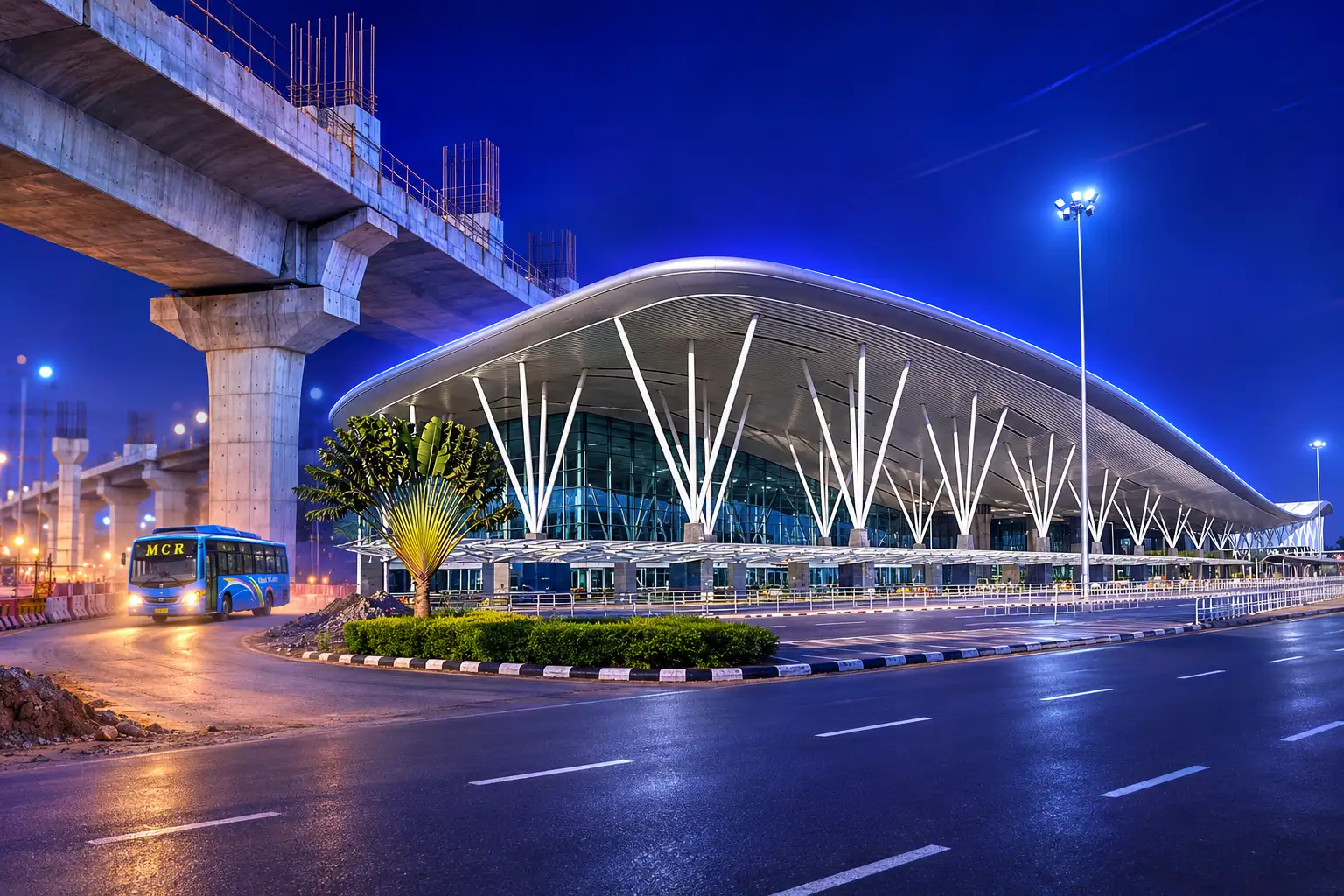
A ₹2,215 Crore Package Split in Two
The Karnataka Cabinet cleared the Hebbal to Mehkri Circle package on December 4, 2025, at ₹2,215 crore. An earlier Bengaluru Smart Infrastructure Ltd plan had priced a tunnel alone at ₹1,325 crore. The extra money bought a short cut-and-cover tunnel plus this elevated corridor and a rotary flyover at Mehkri Circle.
The tunnel is 2.2 km, six lanes, cut-and-cover, and toll-free. It runs from Hebbal Junction toward the Karnataka Veterinary, Animal and Fisheries University campus. Hyderabad-based Rithwik Projects, with AMR India, holds the civil contract at ₹1,139.67 crore. Chief Minister D.K. Shivakumar laid the foundation stone on June 28, 2026, and set a two-year finish on that piece.
The flyover now starting is four lanes, two each way, from the UAS Staff Quarters to a raised rotary at Mehkri Circle. BDA awarded the civil work at about ₹440 crore to Auro-KMC JV, the bid vehicle of Hyderabad-based Auro Infra. The rotary is meant to feed Jayamahal Road and the Yeshwanthpur side, and later a planned east-west elevated road between KR Puram and Yeshwanthpur.
THE TWO CIVIL CONTRACTS
| Piece | Length and lanes | Builder | Civil cost | Clock |
|---|---|---|---|---|
| Elevated corridor | 1.6 km, four lanes | Auro-KMC JV (Auro Infra) | About ₹440 crore | 18 months from November 6, 2026 |
| Short tunnel | 2.2 km, six lanes | Rithwik Projects with AMR India | ₹1,139.67 crore | Two years from June 28, 2026 |
BDA chairperson N.A. Haris has described the two jobs as one system, not two separate patches. At the veterinary college end, two lanes each way are supposed to climb onto the new deck, with the remaining tunnel lane held for local traffic. Coordinated execution, he said, is what would actually cut the queue.
The aim is to provide smoother traffic movement and strengthen connectivity to north Bengaluru and the airport.
N.A. Haris, BDA chairperson
The NGT Stay Runs Until at Least December 15
The flyover is starting while the rest of the same alignment is still in court. The National Green Tribunal’s southern bench in Chennai, on October 16, 2026, barred any tree cutting on the Hebbal short tunnel until the case is heard. The next listing is December 15, 2026. The order does not freeze other civil work. Digging has already begun on vacant land inside the veterinary college campus.
The Greater Bengaluru Authority had invited objections to the removal of 1,128 trees of more than 70 species along the tunnel line, through Hebbal tree park, Hebbal Lake, the college campus and the UAS staff quarters. It received around 1,600 objections. A Change.org campaign against the felling drew 20,000 signatures. Benedict Fernandes, secretary of Mangaluru-based Aranya Parisara Mathu Havamana Badalavane Sangha, the group that moved the tribunal, said the stay covers the whole project length.
Haris has said only 56 of those 1,128 trees would be felled and 1,072 would be transplanted, and that BDA is talking to groups about saving even the 56. A GBA official said 10 trees must be planted for every tree cleared, whether it is cut or moved. The tribunal’s line left no gap for that sequencing while the petition is live.
There should not be any cutting of trees, be it in any area of the Hebbal Short Tunnel Project till the matter is disposed of.
National Green Tribunal, southern zone order, October 16, 2026
THE CLOCK ON THE HEBBAL PACKAGE
- December 4, 2025: Cabinet clears the ₹2,215 crore tunnel-and-flyover package.
- January 1, 2026: Around this date BDA opens the delayed 1.25 km extra ramp at the Hebbal flyover, a job first proposed 10 years earlier.
- June 28, 2026: Shivakumar lays the tunnel foundation and sets a two-year finish.
- August 2026: Karnataka High Court asks whether any scientific study tested the tunnel’s effect on Hebbal Lake’s water flow, and warns of a stay if the state misses the affidavit deadline.
- October 16, 2026: NGT bars tree cutting until the case is heard; next date December 15, 2026.
- November 6, 2026: Flyover work and the 18-month bus and goods ban begin on Ballari Road.
By October, Haris was already saying the tunnel was moving slowly because of the High Court file. The 18-month flyover date and the two-year tunnel date only work if those cases do not stop the machines for long.
Who Can Still Drive the Airport Road?
Cars still get Ballari Road. That is the part of the order airport passengers will feel first, because cabs and private cars remain on a narrower works corridor while the buses that used to share it are gone. Early flights out of Kempegowda International Airport now depend on how fast a car can clear Hebbal, not on a coach lane that no longer exists on this stretch.
Goods operators lose the straight run into the city and out toward the airport for a year and a half. Light vans are in the same ban as heavy trucks, so shop deliveries that used Ballari Road have to thread Tannery Road, Nagawara and the Ring Road with everyone else. School buses were carved out, which keeps morning and afternoon school runs on the old line and puts them next to the cars the police chose to keep.
Baptist Hospital sits on the edge of the works. City-bound traffic that comes off the Hebbal flyover may still use the service road in front of the hospital as far as CBI Junction, then rejoin Ballari Main Road. That slip is also the posted path toward Anand Nagar, RT Nagar and Jayamahal Road. It is a thin mercy: the hospital approach stays open, but it becomes a relief valve for two neighbourhoods at once.
Hebbal’s Extra Ramps Pushed the Jam to Mehkri Circle
This flyover exists because the last “fix” at Hebbal moved the queue. BDA built a 1.25 km extra ramp at the Hebbal flyover, tied it into two older loops, and opened it around January 1, 2026. Officials said that job had been on the books for 10 years. Traffic at Hebbal eased. Mehkri Circle then took the spill.
BDA itself floated the tunnel and flyover tenders after that shift. A tunnel that dumped traffic onto the old surface road at the veterinary college, police and planners argued, would only relocate the bottleneck. The elevated deck is the attempt to catch that wave before it hits Mehkri Circle. It is also a second try at Ballari Road after an earlier steel flyover plan was dropped in the face of civic protests.
Shivakumar, at the tunnel stone-laying, called Hebbal a hebbagilu, a grand gateway, and said the short tunnel was an interim step, separate from the much longer Hebbal to Silk Board twin-tunnel plan. “We have provided some relief to the traffic congestion in the Hebbal area. Our aim is to solve Bengaluru’s traffic congestion in the coming days,” he said. The 18-month curb on the airport road is what those coming days look like on the ground.
Detours Run Through Cantonment, Nagawara and the Ring Road
The traffic police posted a long list of other ways to the airport and back into the centre. None of them is empty. Old High Grounds, Kalpana Junction, Cantonment railway station, Tannery Road and Nagawara Road are working city streets. So are Bamboo Bazaar, Queens Road, BEL Circle and the Outer Ring Road. The 18-month plan asks those streets to absorb the buses and trucks that Ballari Road just refused.
Bengaluru Traffic Police already issue congestion alerts every 15 minutes to officers on the beat. That system will now be asked to keep Hebbal, Nagawara and the Ring Road from locking at the same hour. The posted maps will not do that job if the detours lack boards, if Tannery Road is already broken, or if the Ring Road is in its usual evening crawl.
POSTED WAYS TO THE AIRPORT AND BACK
| Trip | Posted route |
|---|---|
| City to airport via Hebbal | Old High Grounds Junction, Kalpana Junction, Old Udaya TV Junction, Cantonment railway station, Tannery Road, Nagawara Road |
| Yeshwanthpur to airport | Mattikere Road, right at BEL Circle, Outer Ring Road |
| Airport to city | Left at Hebbal, Nagawara Junction, Bamboo Bazaar, Queens Road |
| Airport to city, second path | Right at Hebbal, Hebbal Ring Road, Kuvempu Circle, Goraguntepalya, Dr Rajkumar Road |
| Yeshwanthpur to the centre | BHEL Junction, Maramma Circle, Margosa Road |
| Hebbal to the centre | Service road in front of Baptist Hospital to CBI Junction, then Ballari Main Road |
| Hebbal to Anand Nagar and RT Nagar | Same hospital service road, left at CBI Junction onto Anand Nagar Main Road, then Jayamahal Road |
The 18-month date already reads like a paper figure to people who use this corridor every day. A flyover on this scale in Bengaluru has a habit of overrunning the first calendar. Alternate inner roads are being asked to carry airport traffic without a matching rebuild. Taking buses off Ballari Road during the works puts more cars on a thinner carriageway, which is the reverse of what a jammed airport approach needs.
IISc Says the Tunnel Moves the Queue
BDA is betting the finished pair will shrink the jam by 60 percent in a worst case and 80 percent in a best case, figures from an IIT Bombay microsimulation by Prof. Archak Mittal that Haris has cited. The IISc Sustainable Transportation Lab published the opposite finding in August.
An IISc study of the short tunnel, dated August 25, 2026, and led by Ashish Verma, professor of transportation systems engineering, found that spillover from the junction can cut the tunnel’s effectiveness to zero. On capital cost per passenger, the lab put the tunnel at ₹5.23 against ₹0.86 for an underground metro on the same demand. The NGT petitioners used that work, and said the tunnel would slide the queue toward the college and Mehkri Circle, which is the junction the new flyover is now supposed to protect.
WHERE THE STUDIES DISAGREE
- IIT Bombay: Prof. Archak Mittal’s integrated traffic microsimulation, cited by BDA, puts the congestion cut at 60 percent in a worst case and 80 percent in a best case.
- IISc IST Lab: Verma’s August 25, 2026 report says spillover can reduce the short tunnel’s effect to zero, and prices it at ₹5.23 a passenger against ₹0.86 for metro.
- The petition: Aranya Parisara Mathu Havamana Badalavane Sangha told the tribunal the tunnel relocates the jam toward the veterinary college and Mehkri Circle.
IISc also argued that flyover piers shrink the old surface road, a loss Mittal’s model, in the lab’s view, did not fully price. If that is right, Ballari Road will be tighter for the cars still allowed on it, not only while the deck is built but after it opens. The 18-month bus ban then looks less like a construction footnote and more like a preview of a corridor redesigned around private vehicles.
The traffic order runs to May 6, 2028, if the 18-month clock is real. One end of the tunnel still requires excavation of Ballari Road, a stage BDA has already said may come later. The flyover window is not the last time this stretch is due to be torn open.

ADNOC Ship Hit in Hormuz Leaves One Crew Missing

SpiceJet’s Rs 5,500 Crore Plan Follows a Rescue That Failed

Hasina’s Return Fight Sets Fire to Yunus’s Bank

Bancroft Recants the 2018 Inquiry and Names the Team

Adhikari Ties the Saffron Saree Row to School Licences

Clancy Juror Says the Holdout Never Cited Evidence

The iPhone 18 Pro Max Splits Apple’s Fall in Two

OpenAI Calls GPT-6 Astra AGI Then Locks Its Exploits

Trump Claims Hormuz Control as Oil Holds Near $96

Russia Closes the Goethe-Institut Berlin Tried to Save

 NEWS2 months ago
Clancy Juror Says the Holdout Never Cited Evidence
- NEWS3 months ago
The iPhone 18 Pro Max Splits Apple’s Fall in Two
- NEWS3 months ago
OpenAI Calls GPT-6 Astra AGI Then Locks Its Exploits
- BUSINESS3 months ago
Trump Claims Hormuz Control as Oil Holds Near $96
- LIFESTYLE3 months ago
Russia Closes the Goethe-Institut Berlin Tried to Save
- AUTO3 months ago
Volkswagen’s Job Cuts Leave Four Plants Without Cars
- NEWS3 months ago
Dyson Puts Nurovi Robots on Sale Without the UV Flagship
- BUSINESS2 months ago
US Destroys Five Iranian Tankers as the Shock Hits Jordan










