
NEWS
Pralay’s User Trial Hands the Army a Conventional Option
DRDO’s November 5 Pralay user trial keeps induction undated, but it moves a conventional quasi-ballistic missile toward Army use in a limited border war.

DRDO fired the Pralay quasi-ballistic missile from Dr APJ Abdul Kalam Island at about 1110 hrs on November 5, 2026. Range instruments at the Integrated Test Range, Chandipur, recorded a clean flight. The Ministry of Defence said every test objective was met.
The round flew as a user evaluation trial, with the Army, the Air Force, industry staff and DRDO scientists on the pad. The ministry then said the induction of the system has become imminent. It had used that same line after a two-missile salvo on December 31, 2025.
Odisha Hosted the Latest Shot in a 15-Month Trial
This was not the first time Pralay left the island. User evaluation began with back-to-back flights on July 28 and 29, 2025, which the ministry said checked minimum and maximum range. A salvo of two missiles from the same launcher followed at about 1030 hrs on December 31, 2025. Then-DRDO chairman Samir V. Kamat said that pair showed “imminent readiness of induction of the system with the users.”
The November 5 shot sat inside that campaign, 15 months after the July pair. Developmental flights had already run for years before any user team signed the sheets.
THE PRALAY FLIGHT RECORD
- December 22, 2021: Completes the first flight from Dr APJ Abdul Kalam Island and reaches a target at about 400 km.
- December 23, 2021: Flies a heavier payload out to 500 km.
- November 7, 2023: Completes a further developmental flight with mission objectives met.
- July 28-29, 2025: Flies two user evaluation rounds to check minimum and maximum range.
- December 31, 2025: Fires two missiles in salvo from one launcher at about 1030 hrs.
- November 5, 2026: Flies another user evaluation round at about 1110 hrs; the ministry again calls induction imminent.
Nearly five years separate the first flight from this latest one. The launcher itself rolled down Kartavya Path at the Republic Day parade on January 26, 2025, months before the salvo. Production hardware has been in public view while the user still signs off configurations.
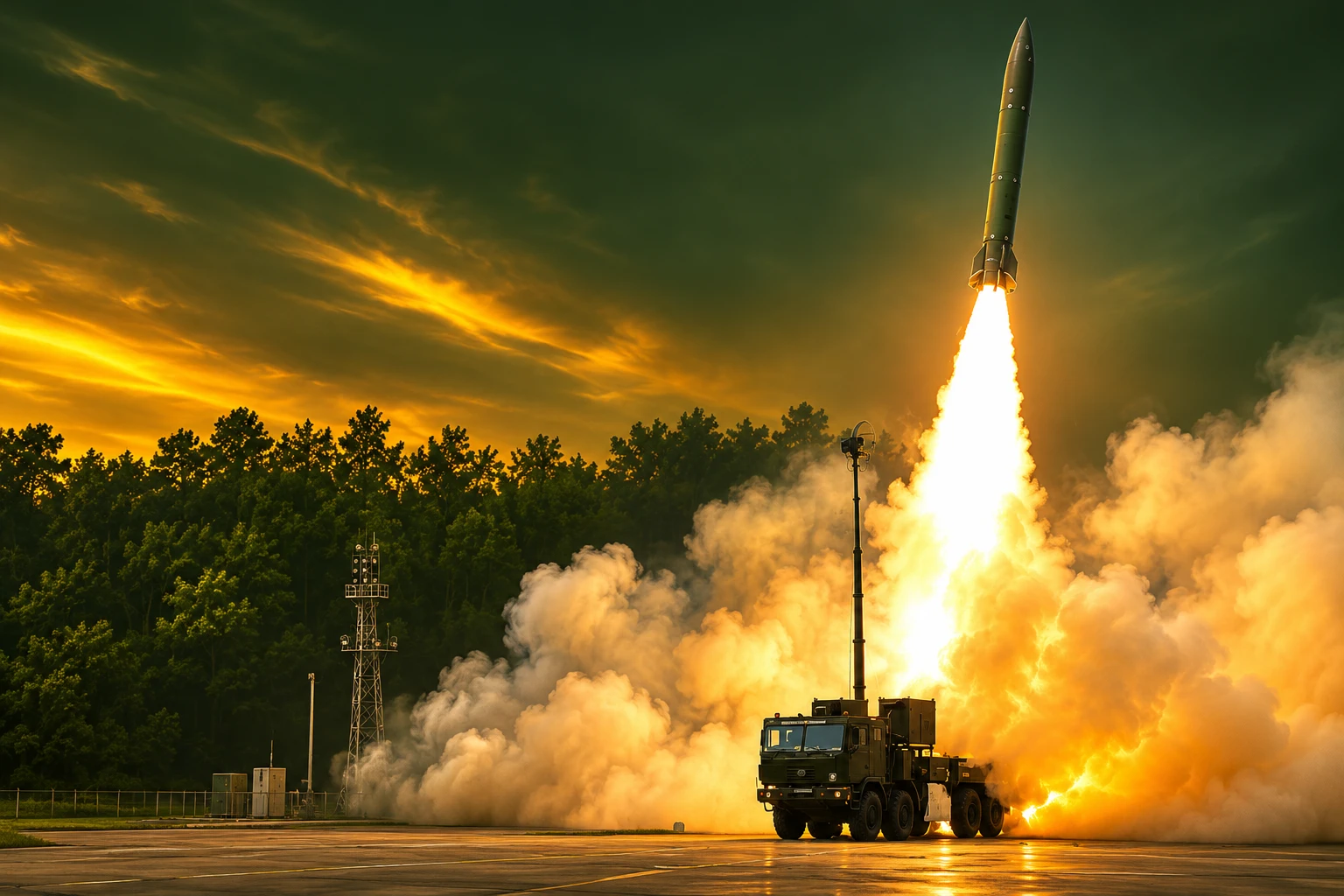
What a Quasi-Ballistic Missile Is Built to Do
A classic ballistic missile climbs high, then falls on a path gravity can predict. Pralay is built to stay lower, change course in flight, and still arrive with a conventional warhead. Defence Minister Rajnath Singh said the round uses “advanced technologies” and will raise the military’s preparedness “against emerging threats.”
That profile is the whole point of a tactical ballistic missile. A high, smooth arc is easier for a radar net to track and for an interceptor to meet. A depressed path with mid-course and terminal turns gives the defending battery less time and a worse intercept geometry. The ministry’s November 5 note did not publish a miss distance or a peak altitude. It said only that Chandipur’s instruments showed the objectives were met.
Research Centre Imarat in Hyderabad led the design, drawing on work already done for the Prithvi Defence Vehicle interceptor and the Prahaar tactical missile, with solid propellant from the Sagarika family. The missile is a canisterised, solid-fuel, surface-to-surface system. Solid fuel lets a crew keep a round loaded and move it on a road-mobile launcher, then fire without fuelling on the pad.
WARHEADS THE DESIGN CAN CARRY
- Fragmentation: A high-explosive pre-formed fragmentation warhead for open or lightly protected targets.
- Penetration-cum-blast: A PCB charge meant for bunkers, command posts and hardened sheds.
- Runway denial: RDPS submunitions meant to crater and seed an airstrip so it cannot be used in a hurry.
Akshat Upadhyay, writing for the Manohar Parrikar Institute for Defence Studies and Analyses, put the payload in the 350 to 700 kg band and the reach at 150 to 500 km. Those figures, not a nuclear role, are what make the missile a battlefield weapon rather than a strategic one. Strategic Forces Command keeps the Agni family. Pralay is meant to stay on the conventional side of that line so a launch does not have to be read as a nuclear shot.
China Has Flown This Class Since 1991
India is arriving late to a class China has had in service for more than three decades. The PLA’s DF-15 short-range ballistic missile, catalogued by the Center for Strategic and International Studies Missile Threat project, entered service around 1991. CSIS lists a reach of 600 to 900 km and a 500 to 750 kg payload, with conventional loads for precision strike, bunker work and runway attack, and a nuclear option on the family as well.
The original DF-15 is credited with a 200 to 300 metre circular error probable. The DF-15B adds a finned, manoeuvring warhead and a reported accuracy near 30 metres, with a reach above 725 km. CSIS notes the type can threaten northern India from the mainland. That is the inventory Pralay is being asked to answer at shorter range, with a conventional-only warhead and a lower flight path.
SHORT-RANGE STRIKE COMPARED
| System | User | Range | Warhead role |
|---|---|---|---|
| Pralay | India, pending induction | 150-500 km | Conventional only |
| DF-15 family | China, in service since 1991 | 600-900 km | Conventional and nuclear |
| Pinaka-class rockets | Indian Army | Up to 90 km | Conventional area fire |
Pakistan has been flying longer Fatah-series rockets in the same season. A conventional Indian ballistic missile is the matching piece on this side of the border, and the launch video is already being watched as a trophy clip. That is exactly how a nuclear-capable ballistic launch would be read in a crisis, which is why the warhead split matters more than the flame over the Bay of Bengal.
The Army Cleared a Regiment in 2023
The Defence Acquisition Council cleared a Pralay regiment for the Army on September 17, 2023, for use along the Line of Actual Control and the Line of Control. Officials said then it would be the first ballistic missile brought into service for conventional operations. A similar proposal had already been cleared for the Air Force. Accounts in 2023 described a first batch of 120 missiles. The November 5 statement did not give a regiment size, a rupee figure, or a fielding calendar.
Upadhyay’s January 2023 brief treated those 120 rounds as a likely starting block for an Integrated Rocket Force, a conventional missile command kept apart from Strategic Forces Command. Late Chief of Defence Staff General Bipin Rawat had pushed the idea in 2021. The point was to hold a non-contact strike arm that could hit military targets without climbing the nuclear ladder, and without waiting on fighter aircraft whose pilots, jammers and engines cost far more per shot.
Why 150 to 500 km Matters on the LAC
Upadhyay put Indian gun artillery at 20 to 50 km. Army rockets, in that brief, topped out near the Pinaka figure in the table above. Pralay’s band is what brings PLA garrisons, radars, SAM sites and airstrips in Eastern Ladakh and Arunachal Pradesh onto a conventional list that does not require an Agni. The LAC runs about 3,400 km. A road-mobile canister missile can be shifted along that front without the fuel trucks a liquid missile needs.
Both the Army and the Air Force sent officers to the November 5 firing, as they did for the December salvo. The ministry is still describing a dual-user system. An Integrated Rocket Force, if it is stood up, would have to settle who holds the launcher, who picks the target, and how fast a theatre commander can fire without a nuclear-release drill. That is not in the November 5 note.
Hyderabad Designed It and Bharat Dynamics Builds It
Research Centre Imarat in Hyderabad is the lead laboratory. Bharat Dynamics Limited, named as a development-cum-production partner, produced the round that flew on November 5. That sentence in the ministry note is easy to skip. It means a production partner already built a user-trial missile, so the remaining work is less about whether a prototype exists and more about whether the services will take serial lots, train crews, and write the missile into a war plan.
THE LABS ON THE MISSILE
- Lead centre: Research Centre Imarat, Hyderabad, integrates guidance, control and the overall design.
- Pune cluster: Armament Research and Development Establishment, High Energy Materials Research Laboratory, and Research and Development Establishment (Engineers) work the warhead, propellant and ground systems.
- Hyderabad and Chandigarh chain: Defence Research and Development Laboratory, Advanced Systems Laboratory, Defence Metallurgical Research Laboratory and Terminal Ballistics Research Laboratory supply airframe, materials and terminal-effects work.
- Range and industry: Integrated Test Range, Chandipur, instruments the shots; Bharat Dynamics Limited builds the missile, with Bharat Electronics Limited among the other production partners on earlier user rounds.
Defence Secretary Rajesh Kumar Singh, who also chairs DRDO, congratulated the teams after the November 5 flight. Kamat had held that chair at the December salvo. The programme has outlasted one DRDO chief and still has no public induction date.
Imminent Has Been the Line Since December
Ten months after Kamat’s “imminent readiness” line, the ministry used “imminent” again. User evaluation is a campaign of configurations, not a single pass/fail. The December salvo tested two rounds off one launcher. The July pair tested the range envelope. The November 5 statement does not say which remaining user box was ticked, and it does not say the campaign is over.
WHAT WE KNOW
- The flight: A user evaluation round from Dr APJ Abdul Kalam Island at about 1110 hrs on November 5, 2026, met its stated objectives on Chandipur’s instruments.
- The builder: RCI designed the missile; Bharat Dynamics Limited produced the system that flew.
- The buyers: The DAC cleared an Army regiment in September 2023, after a similar Air Force proposal, and both services sent officers to the recent trials.
WHAT IS UNCONFIRMED
- A fielding date: No induction day, unit location, or number of launchers was published with the November 5 note.
- A closed trial list: The ministry still describes the shot as part of user evaluation, not as the last required firing.
- Command: No public order has placed Pralay under a standing Integrated Rocket Force or left it inside Army and Air Force silos.
Singh posted the launch clip the same afternoon.
DRDO successfully conducted the flight test of the indigenously developed Pralay Missile off the coast of Odisha today at 1110 hrs.
The test was conducted as part of user evaluation trials and successfully met all the stipulated objectives, as validated by data captured through… pic.twitter.com/u4Du6gqWEL
— Rajnath Singh (@rajnathsingh) November 5, 2026
The missile equipped with advanced technologies will further enhance the technological capabilities and operational preparedness of the military against emerging threats.
Rajnath Singh, Defence Minister, Ministry of Defence statement, November 5, 2026
The clip will travel farther than the trial paperwork. The paperwork is what still has no date on it. BDL has already built the round that left the island. The Army has had a cleared regiment on paper since September 2023. Until a unit is named and a first lot is accepted, imminent remains a sentence in a press note.

ADNOC Ship Hit in Hormuz Leaves One Crew Missing

SpiceJet’s Rs 5,500 Crore Plan Follows a Rescue That Failed

Hasina’s Return Fight Sets Fire to Yunus’s Bank

Bancroft Recants the 2018 Inquiry and Names the Team

Adhikari Ties the Saffron Saree Row to School Licences

Clancy Juror Says the Holdout Never Cited Evidence

The iPhone 18 Pro Max Splits Apple’s Fall in Two

OpenAI Calls GPT-6 Astra AGI Then Locks Its Exploits

Trump Claims Hormuz Control as Oil Holds Near $96

Russia Closes the Goethe-Institut Berlin Tried to Save

 NEWS2 months ago
Clancy Juror Says the Holdout Never Cited Evidence
- NEWS3 months ago
The iPhone 18 Pro Max Splits Apple’s Fall in Two
- NEWS3 months ago
OpenAI Calls GPT-6 Astra AGI Then Locks Its Exploits
- BUSINESS3 months ago
Trump Claims Hormuz Control as Oil Holds Near $96
- LIFESTYLE3 months ago
Russia Closes the Goethe-Institut Berlin Tried to Save
- AUTO3 months ago
Volkswagen’s Job Cuts Leave Four Plants Without Cars
- NEWS3 months ago
Dyson Puts Nurovi Robots on Sale Without the UV Flagship
- BUSINESS2 months ago
US Destroys Five Iranian Tankers as the Shock Hits Jordan










