
NEWS
Delhi’s 391 AQI Meets a Severe Diwali Forecast
Delhi AQI hit 391 on 6 November with 30 stations already severe, while the official forecast books Diwali as severe and green crackers remain legal.

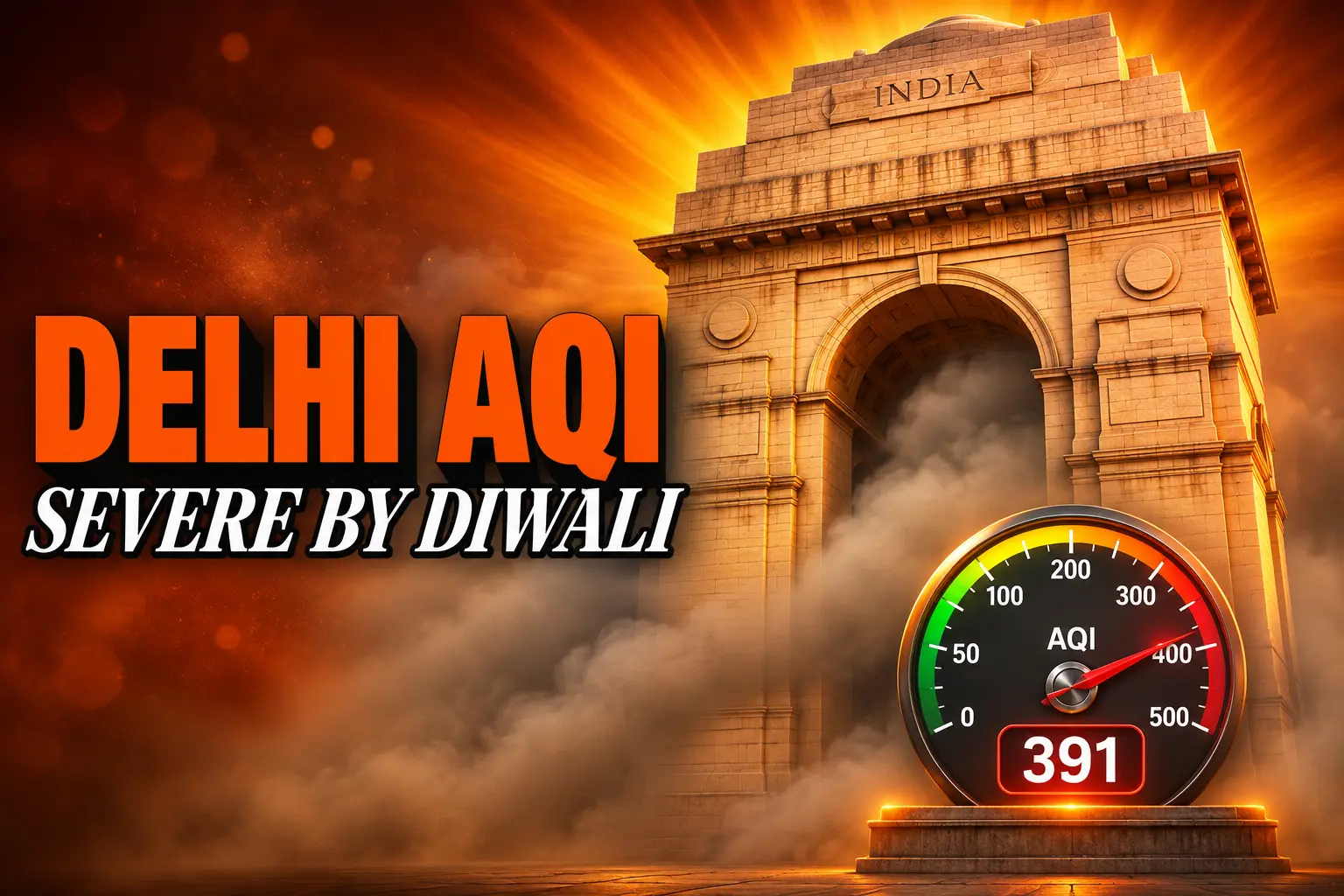
Delhi’s city Air Quality Index stood at 391 at 9 a.m. on Friday, 6 November, still in the very poor band. Thirty of 59 monitoring stations had already crossed 400 into severe, two days before Diwali, and the government’s early-warning bulletin has already booked Friday through Sunday as severe air.
Green crackers are legal on 7 and 8 November, the same stretch. Graded Response Action Plan Stage III, which starts at 401, has not been invoked.
Thirty Stations Crossed Into Severe Before Noon
The 391 reading is the Central Pollution Control Board’s rolling city figure, the number treated as Delhi’s official AQI. At 9 a.m. it was still 10 points short of 401, the floor of the severe band. Rohini led the network at 475. IIT Delhi was at 472. Both are severe on the national scale, which runs 401 to 500 for that band and 301 to 400 for very poor.
IIT Delhi, ITO, Dwarka, Rohini, Punjabi Bagh, Alipur, Bawana and Jahangirpuri were among the neighbourhoods already in severe air. Noida, Gurugram and Faridabad were in the very poor band on Friday morning. CPCB’s own health note for severe air is blunt: it affects healthy people and seriously impacts those with existing disease. Very poor air is listed as causing respiratory illness on prolonged exposure.
The city figure had been 369 in the 4 p.m. bulletin on Thursday, 5 November, a dip of 8 points from 377 on Wednesday. The morning jump back toward 400 is the opposite of relief. Truck-mounted sprinklers were working near India Gate under Stage II of the Graded Response Action Plan, which CAQM called on 2 November after Delhi’s daily average reached 324.
THE WEEK THE CITY AVERAGE CLIMBED
- 31 October 2026: Delhi’s 24-hour AQI is 117, still moderate, after late-October rain.
- 1 November 2026: The average rises to 261, poor.
- 2 November 2026: The CPCB 4 p.m. bulletin prints 324 with PM2.5 as the main pollutant, from 58 of 59 stations, and CAQM invokes GRAP Stage II across NCR.
- 3 November 2026: The city average is 350, very poor.
- 4 November 2026: The 4 p.m. bulletin is 377, still very poor.
- 5 November 2026: The official daily figure eases to 369 at 4 p.m.
- 6 November 2026: The city average is 391 at 9 a.m.; 30 of 59 stations are already severe.
That 2 November bulletin is the first very poor day of the season, the latest such start since at least 2018, matching 2021. October had no very poor day at all. The climb from 117 to 391 took six days.
The Early Warning Already Names Diwali
The Air Quality Early Warning System, issued by the India Meteorological Department at 1:30 p.m. on 5 November, did not hedge the next three days. Air quality was likely to be very poor on 5 November and severe from 6 to 8 November. The outlook for the following six days is severe to very poor. Diwali falls on 8 November.
WHAT THE BULLETIN SAYS THE AIR CAN DO
- Mixing depth: The predicted maximum mixing depth is 2,000 m on 6 November, 2,200 m on 7 November, and 1,600 m on 8 November.
- Ventilation index: IMD puts the index at 16,000 m2/s on 6 November, 12,000 m2/s on 7 November, and 2,500 m2/s on 8 November.
- The cutoff: A ventilation index below 6,000 m2/s, with average wind under 10 kmph, is listed as unfavourable for dispersing pollutants.
- Diwali day: 8 November is the only day in that four-day run below the cutoff, and the shallowest mixing depth of the set.
The same bulletin’s city table already prints Delhi as severe on 6 and 7 November. Gurugram is listed very poor across those days. Faridabad is very poor. Ghaziabad moves to very poor on 7 November. The Decision Support System at the Indian Institute of Tropical Meteorology put stubble burning’s share of Delhi’s PM2.5 at 15.6% on Thursday and 19.2% on Friday. Punjab officials have said unseasonal rain delayed the paddy harvest, so farm fires can still rise.
Green Crackers Land in a Severe Window
A Supreme Court bench of Justices M.M. Sundresh and Prasanna B. Varale, in an order dated 29 October and made public on 2 November in the Arjun Gopal matter, allowed certified green crackers in Delhi-NCR on 7 and 8 November. Bursting is limited to 6 a.m. to 7 a.m. and 8 p.m. to 10 p.m. The complete ban returns on 9 November. Sale licences that had been cancelled were restored only from 4 to 6 November, which is the window now closing.
Bursting of firecrackers, though it constitutes a religious practice meant to celebrate the occasion, shall result in severe environmental pollution, especially air and noise, apart from the creation of solid wastes. Amongst human beings, children, disabled and the elderly people constitute the most vulnerable groups.
Justices M.M. Sundresh and Prasanna B. Varale, Supreme Court of India, Arjun Gopal order
The bench said the right under Article 25 is subject to health, and that the right to life includes a pollution-free environment. It also said the year-round ban imposed from 1 January 2025 had not produced the hoped-for drop in AQI, and that conventional crackers were still being sold as green ones. Regulation, not a fresh total ban, is the trial for these two days.
THE TWO-DAY RULES
- Who may make them: Only CSIR-NEERI and PESO certified makers, and only products listed on the NEERI site from 2 to 6 November.
- What is barred: Series crackers, garlands, barium formulations, and any product not on that list. Online sale is prohibited.
- Where they may not be burst: Within 300 metres of hospitals, nursing homes, primary and district health centres, old-age homes, educational institutions and notified silence zones.
- What CPCB must file: Pre-Diwali AQI reports for 2 to 6 November, Diwali reports for 7 and 8 November, and post-Diwali reports for 9 to 30 November, plus sand and water samples, with affidavits due by 14 December.
The air that those pre-Diwali reports will describe is already at 391 as a city average, with 30 stations in severe. The Diwali reports will cover the two days IMD has already marked severe, including the day the ventilation index drops to 2,500 m2/s.
Stage III Waits on a 10-Point Gap
CAQM’s revised GRAP, approved on 28 September under Chairperson Rajesh Verma and issued the next day, tells the sub-committee to invoke the next stage in advance when IMD and IITM project that a higher band will hold. Stage III is severe air, AQI 401 to 450. Stage IV is above 450. The city average at 9 a.m. was 391. Stage III has not been called.
Stage II, in force since 2 November, is the very poor band, 301 to 400. It adds higher parking fees, staggered public-office hours and tighter dust checks on top of Stage I. Municipal crews have been sprinkling roads. That is the plan now running, not the severe-air plan.
The same commission already issued a separate order on 30 October restricting dust-generating outdoor construction across NCR from 5 to 20 November, with exemptions for railways, Metro, airports, hospitals, water, sanitation and national-security work, and capping physical office attendance at 50% in Delhi and in Gurugram, Faridabad, Sonipat, Ghaziabad and Gautam Buddha Nagar. Those curbs are on. They are not Stage III.
GRAP STAGES AGAINST FRIDAY’S READING
| Stage | Delhi AQI band | Status on 6 November | Extra bite when invoked |
|---|---|---|---|
| I Poor | 201-300 | In force | Dust rules, waste lifting, DG limits |
| II Very poor | 301-400 | In force since 2 November | Higher parking fees, staggered office hours |
| III Severe | 401-450 | Not invoked | C&D freeze, hybrid classes up to Class V, extra vehicle bans |
| IV Severe+ | Above 450 | Not invoked | Tighter truck entry curbs |
The September revision lists 48 actions in all: 25 in Stage I, 8 in Stage II, 10 actions under Stage III and 5 in Stage IV. BS-III petrol and BS-IV diesel cars face Stage III curbs in Gurugram, Faridabad, Ghaziabad, Gautam Buddha Nagar and now Sonipat. Diesel BS-IV light and medium goods vehicles registered outside Delhi lose their old essential-goods exemption at Stage III. None of that extra list is live while the city average remains 391.
Gurugram’s deputy commissioner posted the Stage II order on 2 November and told departments to intensify Stages I and II. Replies under that post pointed at dust on GCER, Southern Peripheral Road and old Delhi-Gurugram Road, and asked where the extra buses were if older cars were going to be squeezed. Stage II has not answered those complaints in the days since.
#ORDER | GRAP Stage-II Measures Implemented Across Delhi-NCR to Curb Air Pollution
In view of the deteriorating air quality, the Commission for Air Quality Management (CAQM) has invoked Stage-II of the Graded Response Action Plan (GRAP) across the entire Delhi-NCR, with… pic.twitter.com/HAkx8GBTmk
— DC Gurugram (@DC_Gurugram) November 2, 2026
Punjab’s Fire Count Jumped by 440 in a Day
The Punjab Pollution Control Board’s season tally reached 2,787 farm fires by 5 November after 440 fresh cases that day. Through 4 November the count had been 2,347, against 2,839 in the same span of 2025, a drop of 492. One heavy day ate a large share of that gap. Tarn Taran led the district list. Inspectors had confirmed burning at hundreds of visited fields and levied environmental compensation; a little over half the latest penalty total had been collected by 5 November.
CAQM has flying squads in 18 Punjab districts and 16 in Haryana through the harvest. Chairperson Rajesh Verma held a video conference with 12 Punjab districts after the recent spike. The DSS share of 19.2% for Friday is still a minority of Delhi’s PM2.5, which means vehicles, dust and local combustion are carrying most of the load even as the farm-fire count jumps. North-westerly winds are the usual carrier from those fields toward the capital. IMD’s 8 November forecast turns the surface wind toward the east by evening, on the day mixing is shallowest.
Dr Saurabh Mittal, assistant professor of pulmonary, critical care and sleep medicine at AIIMS Delhi, said patients who already have lung disease are coming in with worse symptoms, needing higher inhaler doses and in some cases oral steroids, and that some people who had no symptoms are now ill. CPCB’s severe-band note matches that clinic picture. Union environment minister Bhupender Yadav said CAQM is watching wind direction, wind speed and the movement of air and taking steps on that basis. The step that matches a three-day severe forecast is Stage III. It has not been taken.
Every November Since 2018 Had Severe Days
A compilation of CPCB’s 4 p.m. daily bulletins for 2018 through 2025 shows every November had between 3 and 11 severe days, with the first severe day of each season in by 13 November. 2021 is the closest calendar twin: a late first very poor day on 2 November, Diwali on 4 November, then 462 on 5 November, the first severe day, and 11 severe days that month, the most in that set. 2025 had only 3 severe days, the fewest, with the first on 11 November at 428. The worst November bulletin readings in the set were 494, on 3 November 2019 and again on 18 November 2024.
NOVEMBER, YEAR BY YEAR
| Year | Diwali | First very poor day | First severe day | Severe days in November |
|---|---|---|---|---|
| 2018 | 7 Nov | 17 Oct (313) | 30 Oct (401) | 5 |
| 2019 | 27 Oct | 16 Oct (304) | 30 Oct (419) | 7 |
| 2020 | 14 Nov | 15 Oct (312) | 5 Nov (450) | 9 |
| 2021 | 4 Nov | 2 Nov (303) | 5 Nov (462) | 11 |
| 2022 | 24 Oct | 24 Oct (312) | 1 Nov (424) | 3 |
| 2023 | 12 Nov | 22 Oct (313) | 3 Nov (468) | 9 |
| 2024 | 31 Oct | 21 Oct (310) | 13 Nov (418) | 8 |
| 2025 | 20 Oct | 20 Oct (345) | 11 Nov (428) | 3 |
| 2026 | 8 Nov | 2 Nov (324) | Not yet in the 4 p.m. bulletin | 0 in the bulletin through 5 Nov |
The 2026 row will change if Friday’s 4 p.m. bulletin crosses 400. At 9 a.m. the city average had not. Station-level air already has. In 2021 the first severe bulletin arrived the day after Diwali. This year’s forecast puts severe air on Diwali itself, and on the two days before it, which is a harder calendar than 2021’s.
What Stage III Would Stop This Weekend
If the sub-committee moves to Stage III, dust-raising construction and demolition that survived the 5 to 20 November order face a tighter freeze: excavation, piling, demolition, masonry, RMC plants, open-trench utilities, and loading of cement and sand, with a narrow carve-out for pothole repair. Stone crushers and specified mining stop. State governments in Delhi, Gurugram, Faridabad, Ghaziabad and Gautam Buddha Nagar must run classes up to Class V in hybrid mode where online school is feasible, with the online choice left to families.
WHO FEELS THE NEXT STAGE
- Primary pupils: Hybrid classes up to Class V in Delhi and the four named NCR districts, only after Stage III is actually invoked.
- Older diesel and petrol cars: BS-III petrol and BS-IV diesel four-wheelers face curbs in the high-density districts, including Sonipat, under Stage III.
- Outstation goods vans: Diesel BS-IV light and medium goods vehicles registered outside Delhi lose the essential-commodities exemption at Stage III.
- Outdoor workers: Construction labour already under the 5 to 20 November dust limits would see the remaining dusty tasks shut; delivery riders and guards stay in the open air either way.
CAQM’s September meeting also restated an advisory to reschedule physical sports meets in NCR in November and December. Schools were already told, under the winter action plan, to run anti-cracker campaigns and watch classroom dust. None of that substitutes for the hybrid-class rule, which is written into Stage III and is idle while the city average sits 10 points under 401.
The court has asked states to file, by 14 December, the exact rise in hospital admissions through 30 November. CPCB’s pre-Diwali file covers 2 to 6 November, which now includes a morning at 391 and 30 stations in severe. The Diwali file will cover 7 and 8 November, the two days green crackers are legal and the two days the early-warning system has already marked severe, with Diwali afternoon the weakest ventilation of the set.
Disclaimer: This article is news reporting on official air-quality readings, forecasts and court directions, and is for information only. It is not medical advice, a diagnosis, or a guide to whether any person should go outdoors, take medicine, or change treatment. Readers with asthma, heart disease, pregnancy, or other conditions, and anyone deciding care for children or older relatives, should consult a qualified physician before acting on air-quality numbers. Figures and GRAP stages reflect the CPCB, IMD, CAQM and court records cited here as of 6 November 2026 and can change with the next bulletin or order.

ADNOC Ship Hit in Hormuz Leaves One Crew Missing

SpiceJet’s Rs 5,500 Crore Plan Follows a Rescue That Failed

Hasina’s Return Fight Sets Fire to Yunus’s Bank

Bancroft Recants the 2018 Inquiry and Names the Team

Adhikari Ties the Saffron Saree Row to School Licences

Clancy Juror Says the Holdout Never Cited Evidence

The iPhone 18 Pro Max Splits Apple’s Fall in Two

OpenAI Calls GPT-6 Astra AGI Then Locks Its Exploits

Trump Claims Hormuz Control as Oil Holds Near $96

Russia Closes the Goethe-Institut Berlin Tried to Save

 NEWS2 months ago
Clancy Juror Says the Holdout Never Cited Evidence
- NEWS3 months ago
The iPhone 18 Pro Max Splits Apple’s Fall in Two
- NEWS3 months ago
OpenAI Calls GPT-6 Astra AGI Then Locks Its Exploits
- BUSINESS3 months ago
Trump Claims Hormuz Control as Oil Holds Near $96
- LIFESTYLE3 months ago
Russia Closes the Goethe-Institut Berlin Tried to Save
- AUTO3 months ago
Volkswagen’s Job Cuts Leave Four Plants Without Cars
- NEWS3 months ago
Dyson Puts Nurovi Robots on Sale Without the UV Flagship
- BUSINESS2 months ago
US Destroys Five Iranian Tankers as the Shock Hits Jordan










