
AUTO
Tata’s Cash Bet on Iveco Hinges on a Six-Tonne Rank
Tata Motors now holds 89.42% of Iveco after a cash tender, claiming fourth place in trucks above six tonnes while FPT engines and India SKD carry the wager.

Tata Motors holds 89.42% of Iveco Group after settling a cash tender at €14.40 a share. On November 3 in Turin, the two firms billed the pairing as the world’s fourth-largest commercial vehicle maker, a rank they apply to trucks above six tonnes.
The bid bought trucks, buses, engines and a finance arm. It did not buy the tanks. Remaining Iveco holders can still tender through November 6.
An All-Cash Bid With Defence Carved Out
TML CV Holdings B.V., an indirect wholly owned arm of Tata Motors, took 238,157,212 Iveco common shares on October 30. That block is 87.81% of Iveco’s issued common capital and 89.42% once 4,868,597 treasury shares (1.80%) are stripped out. Cash paid for the settled tranche is €3,429,463,852.80, about €3.43 billion.
The offer began at €14.10 a share when the companies struck a deal on July 30, 2025, a package then put at about €3.8 billion (₹41,363 crore) for Iveco excluding defence. Tata raised the price to €14.40 on October 9 and called it its best and final bid, lifting the maximum offer value to about €3.91 billion (₹42,561 crore). Iveco shareholders had already cut the minimum acceptance threshold from 95% to 80% at an extraordinary meeting on October 16. Exor, the Agnelli family’s holding company and Iveco’s largest owner, had locked in its 27.06% stake from the start.
Fifteen months passed between the July 2025 announcement and the October 30 settlement. Girish Wagh, MD and CEO of Tata Motors, told investors on October 23 that Iveco would be consolidated from the October-December quarter, with the first job a clean handover.
N Chandrasekaran, chairman of Tata Sons, Tata Motors and now Iveco Group, used the Turin briefing to welcome Iveco staff “into the Tata family.” Olof Persson stays as Iveco’s chief executive. P.B. Balaji and Wagh joined the Iveco board as non-executive directors, with Guenter Butschek and Charles Nichols as independents. Special voting shares were bought back for nothing after the October 16 meeting, flattening the old dual-vote structure.
Iveco stays in Turin, with its brands, plants and teams kept distinct, the companies said. Existing customer contracts, dealer ties, warranties, aftermarket pledges and captive finance run on as before.
A new chapter in global commercial mobility begins today. Tata Motors Commercial Vehicles and Iveco Group have come together, creating a new global force in commercial mobility. Two organisations, proud legacies, complementary strengths & shared ambition to build for the future. pic.twitter.com/vOJjoIHgxf
— Tata Motors Commercial Vehicles (@TataMotorsCV) November 3, 2026
The listed buyer is itself a new wrapper. Under a composite scheme, TML Commercial Vehicles Limited took the Tata Motors name from October 29, 2025, and trades as a commercial-vehicle company (BSE 544569, NSE TMCV). Jaguar Land Rover sits in a different group company. Treating this bid as a sequel to the 2008 car purchase mixes two balance sheets.
WHAT SAT INSIDE THE BID
- IVECO trucks: Light, medium and heavy commercial vehicles for Europe and Latin America.
- Buses: IVECO BUS and HEULIEZ city, intercity and coach lines.
- FPT: Engines and drivelines for road, off-road, marine and power-generation work.
- IVECO CAPITAL: The captive finance arm, left in place for dealers and fleets.
- Left out: IDV and ASTRA, the defence brands sold to Leonardo before the tender could close.
Iveco itself employs 33,000 people at 16 industrial sites and 22 research centres. The combined headcount the companies published is more than 73,000, across 27 plants, 25 research centres and about 9,300 sales and service points in more than 130 countries.
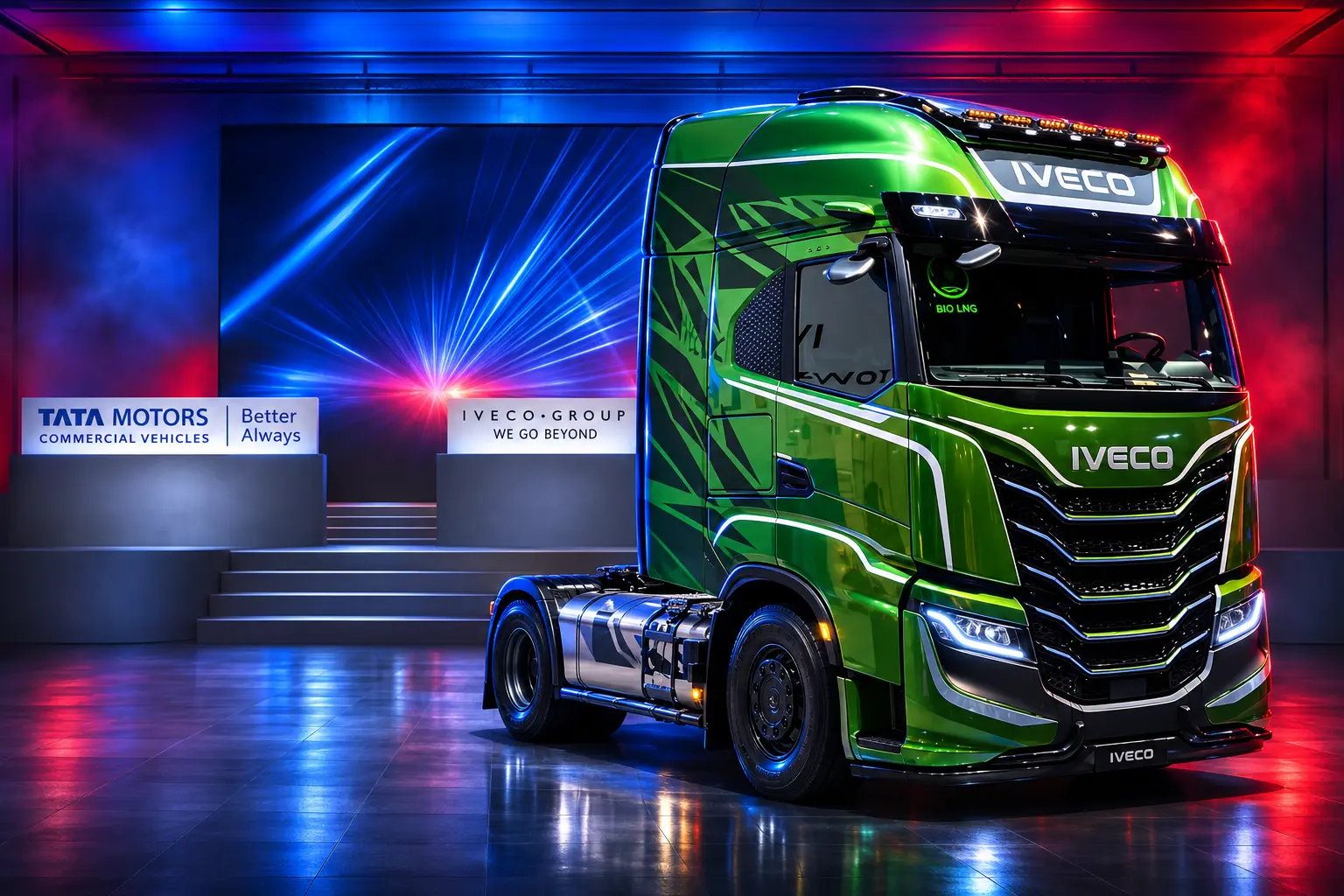
Fourth Place Counts Trucks Above Six Tonnes
The Turin release ranks the pairing fourth among commercial vehicle makers. Wagh has been more precise in shareholder meetings: fourth globally in the above-six-tonne segment. That is a narrower cut than the 590,000 vehicles and combined revenues of about €21 billion (INR 2,28,000 Cr.+) the same release puts on the combined book.
Tata’s Indian range still runs from sub-1-tonne cargo vans to 55-tonne trucks and from 10-seaters to 51-seat buses. Those light units swell the 590,000 figure. They do not all sit in the six-tonne ranking the companies use when they say fourth.
HOW THE UNIT COUNTS COMPARE
| Group | Units cited | What the figure covers |
|---|---|---|
| Tata Motors plus Iveco | ~590,000 a year | All commercial vehicles, including sub-1-tonne, per the Turin release |
| The same pairing’s rank claim | Fourth | Trucks above six tonnes, per Wagh’s own cut |
| Daimler Truck | 422,510 in 2025 | Group trucks and buses, down 8% from 460,409 in 2024 |
Daimler Truck, the German group behind Mercedes-Benz trucks, Freightliner and FUSO, sold 422,510 trucks and buses in 2025. Battery-electric models in that pile rose to 6,726. A combined Tata-Iveco book of ~590,000 therefore looks larger until the mix is unpacked: India’s small commercial vehicles against a global heavy-truck oligopoly that still earns more from fewer, dearer machines.
Wagh said in January that the gap to the third-ranked name in his six-tonne cut was about 10,000 units, with Traton just behind. The Turin show did not republish that gap. Chandrasekaran told the room he expects volumes and revenue to rise over five years, with a better margin profile. At the first annual meeting of the demerged truck company he had already sketched a path from the opening ~590,000 toward one million vehicles “in the years to come.”
The rank is a starting claim, not a profit statement. European heavy-truck cycles are ugly when freight stalls, and Iveco has long sat behind Daimler, Volvo and Traton on that turf. Fourth in a defined slice is the wager Tata is now on the hook to fund.
Tata Still Runs the Korean Plant It Bought in 2004
Wagh has been pointing at Gunsan, South Korea, since the Iveco talks became public. Tata Motors bought Daewoo Commercial Vehicle in 2004, its first overseas purchase, and still runs it as Tata Daewoo Mobility, the country’s second-largest heavy commercial vehicle maker.
“The Daewoo acquisition helped us understand how to compete with global CV giants, as Daewoo operates in a market alongside players like Daimler, Volvo, and Traton,” Wagh said when the Iveco offer was unveiled. Medium and heavy Daewoo trucks use a cabin developed in India and adapted for Korea. Light-duty entry there was built on Indian aggregates. He wants that joint-engineering habit scaled onto Iveco.
The other European chapter is the warning. Tata took 21% of Spain’s Hispano Carrocera in 2005 and the remaining 79% in 2009. Four years after full control, it shut the plant, saying the European bus market had suffered its worst drop after the 2008 crash. Iveco is a much larger industrial system than Hispano was, with a bus business Tata now says it will keep. The Spanish episode is still the last time Tata tried to run a European bus factory and walked away.
Brand handling is meant to follow the JLR pattern even though the car company is no longer inside this listed vehicle. Iveco’s name, dealer face and channels stay independent, Wagh said, so local strengths are not sanded off. That is also how Tata described Daewoo in 2004: a Korean company in Korea, managed by Koreans, inside a global alliance.
The Engine Shop Tata Has Used for 20 Years
If one asset in the Iveco perimeter already has a Tata fingerprint, it is FPT. Wagh called it “a jewel in the entire Iveco Group” in Turin, citing the technology set and the customer book. Tata Daewoo has been fitting FPT engines for two decades. FPT said on September 30, 2024, that the partnership was approaching 20 years and that it had supplied about 90,000 engines to Tata Daewoo, covering the full light, medium and heavy line-up with Euro VI units from 4 to 13 litres since 2015.
Together, there is perhaps no commercial mobility requirement we cannot serve. From sub-one tonne pickups to 55 tonne long haulers, from 10 seater vans to 51 seater coaches. A pickup in Pune, a bus in Bogota, a long hauler on the Autobahn, a yacht in the Mediterranean. One enterprise with the capabilities to power them all.
Girish Wagh, MD and CEO, Tata Motors, in Turin
The yacht line is FPT’s marine book talking. Chandrasekaran said Tata wants those industrial engines and power-generation sets pushed into more uses, not only trucks. Wagh was careful on the Indian heavy-duty engine slot: Tata will keep its more than 30-year joint venture with Cummins for heavy commercial vehicles at home, and look at FPT in other industrial jobs and in markets where Tata already has a network, including Africa and Southeast Asia.
That split matters. Cummins is not being swapped out of Indian heavy trucks on day one. FPT’s upside, as Tata is drawing it, sits in extra applications and in the Korean and export lines that already know the engines. Powertrain choice across the combined group still spans diesel, natural gas, battery-electric and hydrogen, the Turin release said, which is a way of admitting no single fuel wins every market Tata and Iveco now share.
Exor Took the Cash, Leonardo Took the Defence Brands
The Agnelli vehicle got an all-cash exit from a truck maker it no longer wanted to own. Italy kept the part of Iveco that shoots back. On March 18, 2026, Iveco Group transferred its defence business to Leonardo (IDV and ASTRA) at an enterprise value of €1.7 billion, a sale price of €1.6 billion after adjustments. Leonardo said the unit had 2025 revenues of €1,368 million, about 2,000 people and six plants in Italy, Germany, Romania and Brazil.
That carve-out was a condition of Tata’s tender. Italian golden-power clearance in October 2025 came with a promise to keep the Turin headquarters, the brands and the factories. Chandrasekaran thanked Prime Minister Giorgia Meloni and industry minister Adolfo Urso from the Turin stage. In parts of Europe the sale still reads as a large commercial-vehicle name leaving the continent’s control, a bruise that no amount of HQ stationery will fully cover.
Persson called the close “a defining moment for Iveco Group,” and said the company approached it “with confidence and great energy.” The industrial question sitting under that line is simple: can a cash buyer from India fund Iveco’s next truck generation in Foggia, Brescia and Turin while it also funds Indian localisation, without turning the European plants into a kit operation?
What SKD Assembly in India Would Change
Wagh said Iveco products are being picked for India, first as semi-knocked-down assembly, then with deeper localisation. Tata platforms are being studied for markets where Iveco already has dealers. Chandrasekaran called the two catalogues complementary and said ideas should “flow in both directions.”
That is the part of the wager Indian fleets will actually see. A Daily 4×4 or an S-Way badged through a Tata plant is a different object from a press-release rank. India as a parts and SKD hub for Iveco’s other markets is the reverse flow. Neither product list was named in Turin. Until those codes are public, the “bring those products to India” hope that followed the official posts is still a hope.
Tata does not arrive empty-handed. In the quarter to September 30, 2026, the standalone truck company reported revenue of ₹23,900 crore, up 42%, EBITDA of ₹2,800 crore and an EBITDA margin of 11.7%. Wholesale volumes were 135,100 units, also up 42%. Domestic VAHAN share for the first half of FY27 was 36.2%, with heavy commercial vehicles at 55.7%. Export volumes were up 177% year on year, off a smaller base. GV Ramanan, the company’s CFO, said free cash flow of ₹4,600 crore in the quarter took standalone net cash to ₹11,300 crore.
On a consolidated basis Tata reported consolidated net cash of ₹15,900 crore at September 30. The maximum Iveco offer of ₹42,561 crore is larger than that cash pile, so this was not a spare-cash purchase. Steel and rubber costs were already eating the margin in the first half, Wagh said, and diesel prices and rates remain the domestic watch-outs. Folding a European truck cycle onto that cost base is the integration job Ramanan flagged on the same call.
The Offer Reopens Through November 6
Holders who sat out the first round still have a five-session window at the same €14.40. Settlement of those shares is set for November 13. After that, Tata has said it can use a voluntary purchase, a Dutch squeeze-out if it reaches the right threshold, or a post-offer demerger and liquidation to finish the job and take Iveco off Euronext Milan. About 10.58% of common capital, net of treasury stock, was still outside the October 30 settlement.
THE BID TIMETABLE
- July 30, 2025: Tata and Iveco announce an all-cash offer at €14.10 a share, after and conditional on the defence sale to Leonardo.
- March 18, 2026: IDV and ASTRA transfer to Leonardo at a €1.6 billion sale price.
- October 9, 2026: Offer price rises to €14.40 a share.
- October 16, 2026: Iveco shareholders cut the minimum acceptance condition to 80% and clear the voting-share buyback.
- October 26, 2026: Acceptances reach 87.81% of issued common shares, 89.42% net of treasury stock.
- October 30, 2026: Initial settlement; Iveco becomes an indirect Tata Motors subsidiary.
- November 3, 2026: Turin press meet presents the combined commercial-vehicle group.
- November 2 to 6, 2026: Reopening of the tender; payment for those shares on November 13.
Chandrasekaran said the pair would “invest for the long term” and use scale to go faster to market. The immediate work is duller than that line: keep dealers paid, keep FPT shipping, pick the first SKD models, and fund a bid that is larger than the cash on the September 30 sheet. Fourth place in trucks above six tonnes is the claim Tata bought. The engines it already knows, and the Indian bays it has not yet tooled for Iveco metal, are how that claim either compounds or stalls.
Disclaimer: This article is news reporting and analysis of Tata Motors’ tender for Iveco Group and is for information only. It is not investment advice, a solicitation to tender or hold Iveco or Tata Motors shares, or a recommendation on any security, derivative or financing tied to the offer. Readers who may buy, sell or tender shares should consult a qualified financial adviser or broker licensed for their jurisdiction before acting. Stake figures, offer prices, cash balances and product plans reflect company filings and statements available on November 3, 2026, and can change as the reopening, squeeze-out steps and integration proceed.

ADNOC Ship Hit in Hormuz Leaves One Crew Missing

SpiceJet’s Rs 5,500 Crore Plan Follows a Rescue That Failed

Hasina’s Return Fight Sets Fire to Yunus’s Bank

Bancroft Recants the 2018 Inquiry and Names the Team

Adhikari Ties the Saffron Saree Row to School Licences

Clancy Juror Says the Holdout Never Cited Evidence

The iPhone 18 Pro Max Splits Apple’s Fall in Two

OpenAI Calls GPT-6 Astra AGI Then Locks Its Exploits

Trump Claims Hormuz Control as Oil Holds Near $96

Russia Closes the Goethe-Institut Berlin Tried to Save

 NEWS2 months ago
Clancy Juror Says the Holdout Never Cited Evidence
- NEWS3 months ago
The iPhone 18 Pro Max Splits Apple’s Fall in Two
- NEWS3 months ago
OpenAI Calls GPT-6 Astra AGI Then Locks Its Exploits
- BUSINESS3 months ago
Trump Claims Hormuz Control as Oil Holds Near $96
- LIFESTYLE3 months ago
Russia Closes the Goethe-Institut Berlin Tried to Save
- AUTO3 months ago
Volkswagen’s Job Cuts Leave Four Plants Without Cars
- NEWS3 months ago
Dyson Puts Nurovi Robots on Sale Without the UV Flagship
- BUSINESS2 months ago
US Destroys Five Iranian Tankers as the Shock Hits Jordan










