
BUSINESS
India’s Cell Scheme Now Faces Its Materials Bill
A new Indian study finds battery materials cost 18% to 61% more than Chinese cargo, after the 2021 cell scheme built almost no plants.

Indian battery-component plants make cathode, anode and electrolyte at an 18% to 61% cost penalty against Chinese cargo, a government-released study finds. Those powders, films and foils are about 76% of what it costs to build a cell, yet India’s 2021 cell subsidy has so far switched on 1.4 GWh of plants.
The Net-Zero Energy Transition Association wrote the October 2026 report with ARCI, CSIR-National Chemical Laboratory, IIT Madras and Deloitte, and Union Heavy Industries Minister H.D. Kumaraswamy released it after meeting component makers, while a ₹12,000-crore support plan for the same materials remains in inter-ministerial talks.
India’s Cell Plants Still Import 76% of the Bill
A lithium-ion cell is a stack of specialised parts: cathode active material, anode active material, electrolyte, a polymer separator, and copper and aluminium foils. The NETRA study, drawing on more than 20 Indian companies, puts those parts at about 76% of total cell manufacturing cost, with cathode at 34% and anode at 25%.
That is the hole in the 2021 design. New Delhi paid for cell factories first. The powders that dominate the bill were left to imports, and the cell plants now say they cannot run at full tilt without them.
India’s battery demand is put at about 33 GWh in 2025, 236 GWh by 2032 and nearly 600 GWh by 2037. Against the 2032 load, domestic cathode capacity is 7.98 ktpa, anode 0.80 ktpa and electrolyte 8 ktpa. Each of those covers less than 3% of projected need (7.98 of 283 ktpa of cathode, 0.80 of 236 ktpa of anode, 8 of 283 ktpa of electrolyte). Separator output is listed as NA. Battery-grade copper foil is listed as nil.
Kumaraswamy released the findings after a session with Secretary Kamran Rizvi and component firms. The ministry posted the same meeting.
Shri H. D. Kumaraswamy, Hon’ble Union Minister for Heavy Industries & Steel, chaired a meeting with Shri Kamran Rizvi, Secretary, Ministry of Heavy Industries (MHI), senior MHI officials, and key stakeholders from India’s Advanced Chemistry Cell (ACC) component industry to… pic.twitter.com/2av02xCXeI
— Ministry of Heavy Industries (@MHI_GoI) October 28, 2026
Industry players have announced about 220 GWh of cell capacity, with about 67 GWh expected by FY2028-29. Component makers told the study they would put up more than 50 GWh equivalent of materials if the state pays. The report therefore asks for at least 50 GWh of component capacity as the target for new fiscal support in FY2026-27.
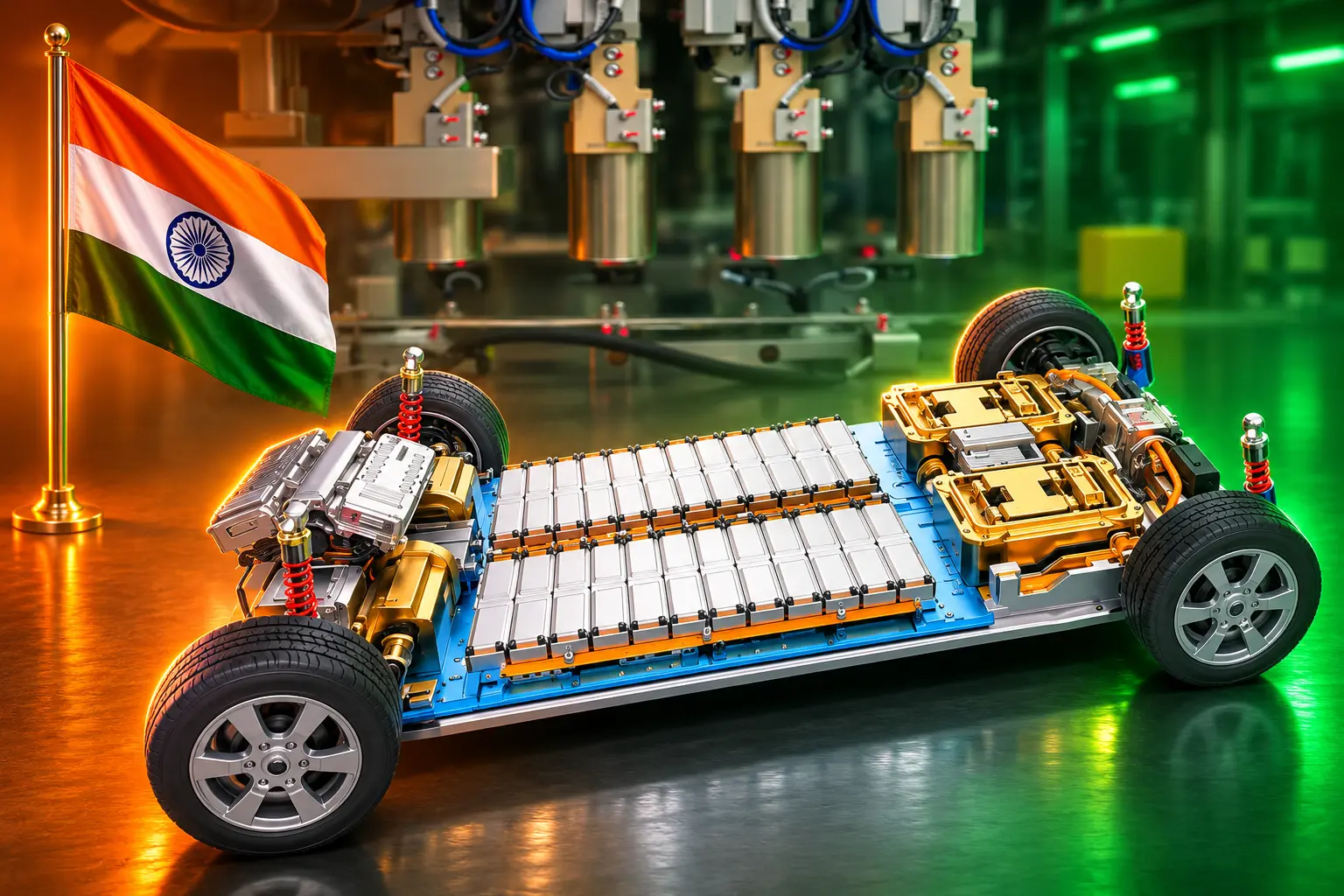
What the 18% to 61% Gap Looks Like
The study compared Indian factory cost with the landed price of Chinese material, using company data and JP Morgan price series through July 2026. NMC cathode is the narrowest gap. Synthetic graphite anode is the widest, because graphitisation burns power, needs heavy kit, and carries high depreciation and loan charges.
COST GAP BY COMPONENT
| Component | India cost | China landed | Gap |
|---|---|---|---|
| NMC cathode | $25,860 / tonne | $21,917 / tonne | 18% |
| Copper foil | $18,705 / tonne | $14,787 / tonne | 27% |
| Electrolyte | $5,750 / tonne | $4,182 / tonne | 37% |
| LFP cathode | $10,004 / tonne | $6,818 / tonne | 47% |
| Separator | $0.25 / sq m | $0.17 / sq m | 49% |
| Natural graphite anode | $5,560 / tonne | $3,671 / tonne | 51% |
| Synthetic graphite anode | $7,622 / tonne | $4,738 / tonne | 61% |
Raw material is the main extra cost for cathode, electrolyte and copper foil. For graphite anodes the extra sits in conversion, energy, depreciation and finance. Separators add a different load: high first-year capex, imported machines, and low use while a new plant fills.
Capital cost is a second penalty. Setting up cathode active-material capacity in India is put at ₹46 crore per ktpa, 235% above China. Anode capacity is put at ₹129 crore per ktpa, 425% above China. Indian loan rates in the study run from 8.5% to 16%, against about 3.1% in China and 4% to 5% in Korea. The 25% capital grant already on offer for digital-device cell parts under the Electronics Component Manufacturing Scheme does not close a 425% anode gap.
Four Awards and One Working Line
The National Programme on Advanced Chemistry Cell Battery Storage was approved in May 2021 with an outlay of ₹18,100 crore and a 50 GWh domestic-cell goal. Forty GWh went to four firms in two rounds. Land is acquired. Output is not.
In a 31 July 2026 Rajya Sabha reply, Minister of State Bhupathiraju Srinivasa Varma gave company figures 1.4 GWh commissioned as of 30 June 2026, with ₹5,270 crore invested and 1,292 direct jobs, all as reported by the firms.
PLI ACC AWARDS VERSUS OUTPUT
| Firm | Awarded | Commissioned | Investment | Jobs |
|---|---|---|---|---|
| Ola Cell Technologies | 20 GWh | 1.4 GWh | ₹1,846 crore | 731 |
| ACC Energy Storage | 5 GWh | 0 | ₹262 crore | 189 |
| Reliance New Energy Battery Storage | 5 GWh | 0 | ₹1,144 crore | 277 |
| Reliance New Energy Battery | 10 GWh | 0 | ₹2,018 crore | 95 |
| Total | 40 GWh | 1.4 GWh | ₹5,270 crore | 1,292 |
On 24 March 2026 the ministry told the Lok Sabha that “No incentive disbursement has been made till date under the PLI ACC Scheme.” The later June snapshot does not change the picture that only Ola’s Krishnagiri line is making cells under the programme.
However, at present, the domestic demand continues to be met largely through imports.
Bhupathiraju Srinivasa Varma, Minister of State for Heavy Industries, written reply in the Rajya Sabha, 31 July 2026
An earlier parliamentary list of delays named limited technology, a skilled-labour gap, imported machines, and the absence of upstream cathode, anode and electrolyte. The cell scheme, in other words, has already recorded the materials hole as a reason it cannot pay out. Besides the four PLI firms, at least 10 other makers have announced about 178 GWh. In July 2026 the ministry also tendered the leftover 10 GWh, earmarked for grid-scale storage.
China Holds 99% of LFP Cathode Material
Cheap Chinese cargo is not a labour quirk. It is scale, a dense supplier net, processing kit, and years of state support. JP Morgan and Nomura figures cited in the NETRA study give China the following shares of 2025 global supply.
CHINA’S 2025 SHARE OF KEY MATERIALS
- LFP cathode: 99% of global output.
- Anode material: 90%.
- Electrolyte: 93%.
- Separators: 85%.
- Copper foil: 74%.
The International Energy Agency’s Global EV Outlook 2026 puts China at over 80% of battery cell production in 2025, and at even higher shares of the active materials inside those cells. Chinese firms are set, on stated policies, to remain the largest makers of batteries and battery materials through 2035.
Keeping the import door open is the cheap option only while the door stays open. A subsidy that pays for the last assembly step, while the powders, foils and films stay imported, recreates a pattern India has already lived through in other clean-tech chains: pack and module lines rise first, and the chemistry stays abroad.
New Delhi Is Weighing Three Subsidy Designs
The proposed component programme would sit beside the cell PLI and cover cathode and anode powders, electrolyte, separators and current-collector foils. The study refuses a single rate, because each part has a different cost structure. It sets out three ways to pay, and in each case the maker still carries part of the gap.
THREE SUPPORT MODELS IN THE STUDY
- Hybrid grant: A 25% capital subsidy plus a sales-linked operating payment meant to cover about 30% of the assessed cost gap, with part-by-part rates in the 5% to 18% band.
- Operating pay only: A production-linked payment covering about 60% of the gap, at 11% to 37% by part, for five to seven years.
- Heavy capital grant: A 50% capital subsidy released as the investor spends, on the same pari-passu idea used in the Semicon India programme.
A flat cheque would overpay some lines and starve others. Synthetic graphite needs help with energy and depreciation. Separators need help buying machines and surviving the empty first years. Cathode, electrolyte and foil need cheaper raw material more than they need another building grant.
Paying for tonnes actually sold, rather than for announced capacity, is the obvious lesson of a cell scheme that has awarded 40 GWh and commissioned 1.4 GWh. Crediting recycled cathode and anode from spent packs would also cut the materials deficit faster than virgin lines alone, because those metals and graphites are already inside Indian vehicles and storage racks.
WHAT WE KNOW
- The study: Cost gaps of 18% to 61%, capex penalties of 235% and 425%, and a 50 GWh component-capacity ask are in the October 2026 NETRA report released by the ministry.
- The cell PLI: ₹18,100 crore, 50 GWh goal, 40 GWh awarded, 1.4 GWh running as of 30 June 2026.
WHAT IS UNCONFIRMED
- The new outlay: A ₹12,000-crore component scheme is in inter-ministerial consultation and has not been notified.
- The pause date: China’s commerce ministry has not published a new notice changing Announcement 70’s end date of 10 November 2026.
The Electronics Component Manufacturing Scheme, notified on 8 April 2025, already offers a 25% capital incentive for lithium-ion cell parts used in digital devices. Electric mobility and grid storage are expected to account for more than 90% of India’s battery-component demand by 2032, and those uses sit outside that scheme. That is the case for a separate mobility and storage programme.
No Indian Line for Separators or Copper Foil
Aluminium foil is the exception. The study drops it from the cost-gap work because Indian supply is not the binding constraint. Separators and battery-grade copper foil are the opposite: no known commercial line, imported UHMWPE and titanium drums, and almost no dedicated test lab for foil.
India has cell-level labs at ARCI, CSIR institutes and IIT Madras. Component qualification is still split across sites, which lengthens sample movement and raises cost. New suppliers need 18 to 24 months to pass a cell maker’s checks. During that wait a new plant runs below capacity, so the loan bill lands before the revenue does.
Money does not replace that clock. The report also wants a national testing and certification net using existing labs, a programme for battery-grade raw-material processing, local making of specialised machines, and clustered sites where powder plants, cell plants, equipment vendors and recyclers sit together. Without those, a subsidy buys a factory that still imports its coke, its salts, its drums and its know-how.
Cell makers cannot switch to a new Indian powder because it is Indian. They switch when it hits purity, particle size, tap density and cycle-life specs, batch after batch. A grant that ignores that queue will fund idle kilns.
10 November Is the Next Supply Test
On 9 October 2025, China’s Ministry of Commerce and General Administration of Customs issued export controls on lithium batteries and graphite anodes, including cells at 300 Wh/kg and above, cathode materials, artificial graphite anode, and the granulation, graphitisation and coating kit used to make them. Those rules were due to start on 8 November 2025.
CHINA’S BATTERY EXPORT-CONTROL CLOCK
- 9 October 2025: Beijing publishes Announcements 55 to 58, 61 and 62, covering superhard materials, rare-earth kit, selected rare earths, lithium batteries, artificial graphite anode, and related foreign-made items and technologies.
- 7 November 2025: Announcement 70 suspends those six notices from that day until 10 November 2026.
- 8 November 2025: Announcement 58’s original start date passes under the pause.
- 10 November 2026: The published term of the pause ends unless a new notice extends or replaces it.
The operative sentence of Announcement 70 is short. With approval, the six notices are suspended until 10 November 2026. A later US-China trade truce was extended, but that notice does not rewrite this date. Older graphite licensing under separate dual-use rules was never part of the pause.
FY2026-27 is the window the study gives for a component grant. Buyer approval still takes 18 to 24 months after a plant exists. About 67 GWh of Indian cells are expected by FY2028-29. A scheme that is still being argued across ministries has a short run-up to that date, and 1.4 GWh of working cell capacity is a thin home market for a new powder line to qualify against.

ADNOC Ship Hit in Hormuz Leaves One Crew Missing

SpiceJet’s Rs 5,500 Crore Plan Follows a Rescue That Failed

Hasina’s Return Fight Sets Fire to Yunus’s Bank

Bancroft Recants the 2018 Inquiry and Names the Team

Adhikari Ties the Saffron Saree Row to School Licences

Clancy Juror Says the Holdout Never Cited Evidence

The iPhone 18 Pro Max Splits Apple’s Fall in Two

OpenAI Calls GPT-6 Astra AGI Then Locks Its Exploits

Trump Claims Hormuz Control as Oil Holds Near $96

Russia Closes the Goethe-Institut Berlin Tried to Save

 NEWS2 months ago
Clancy Juror Says the Holdout Never Cited Evidence
- NEWS3 months ago
The iPhone 18 Pro Max Splits Apple’s Fall in Two
- NEWS3 months ago
OpenAI Calls GPT-6 Astra AGI Then Locks Its Exploits
- BUSINESS3 months ago
Trump Claims Hormuz Control as Oil Holds Near $96
- LIFESTYLE3 months ago
Russia Closes the Goethe-Institut Berlin Tried to Save
- AUTO3 months ago
Volkswagen’s Job Cuts Leave Four Plants Without Cars
- NEWS3 months ago
Dyson Puts Nurovi Robots on Sale Without the UV Flagship
- BUSINESS2 months ago
US Destroys Five Iranian Tankers as the Shock Hits Jordan










