
NEWS
Delhi’s Green Cracker Window Repeats a Test That Failed
Delhi-NCR gets a two-day green cracker window on November 7 and 8, repeating last year’s test as GRAP-II already covers the capital.

The Supreme Court has allowed certified green firecrackers in Delhi-NCR on November 7 and 8, for three hours a day. The order, dated October 29 and issued on November 2, restores a full ban from November 9.
On November 2 the Commission for Air Quality Management put the region on GRAP-II after Delhi’s index hit 324, the first very poor reading of this winter. Last Deepavali, the same green-hour formula left the capital in the same band the following afternoon.
The Supreme Court Replays Its 2025 Experiment
Justices M.M. Sundresh and Prasanna B. Varale granted bursting “on the same lines” as the Court’s October 15, 2025 order. Fireworks may go off only between 6:00 a.m. and 7:00 a.m. and between 8:00 p.m. and 10:00 p.m. on both days, a total of six legal hours. Diwali falls on November 8.
Makers who hold CSIR-NEERI and PESO papers may produce, from November 2 to November 6, only those green products listed on the NEERI site. Traders whose licences had been cancelled get them back from November 4 to November 6, solely to sell that stock. After that, the year-round ban returns.
THE TWO-DAY CLOCK
| Dates | What the order allows |
|---|---|
| November 2 to 6 | Certified makers may produce only listed green crackers |
| November 4 to 6 | Licensed traders may sell at designated points, not online |
| November 7 and 8 | Bursting, 6:00-7:00 a.m. and 8:00-10:00 p.m. |
| From November 9 | Complete ban restored across Delhi-NCR |
The 2025 window was billed as a test so states could measure what green crackers do to air and health. The new Bench found that the states “utterly failed” to gather that material. It then copied the same hours anyway, because it said it still lacked the numbers to decide if a total ban works.
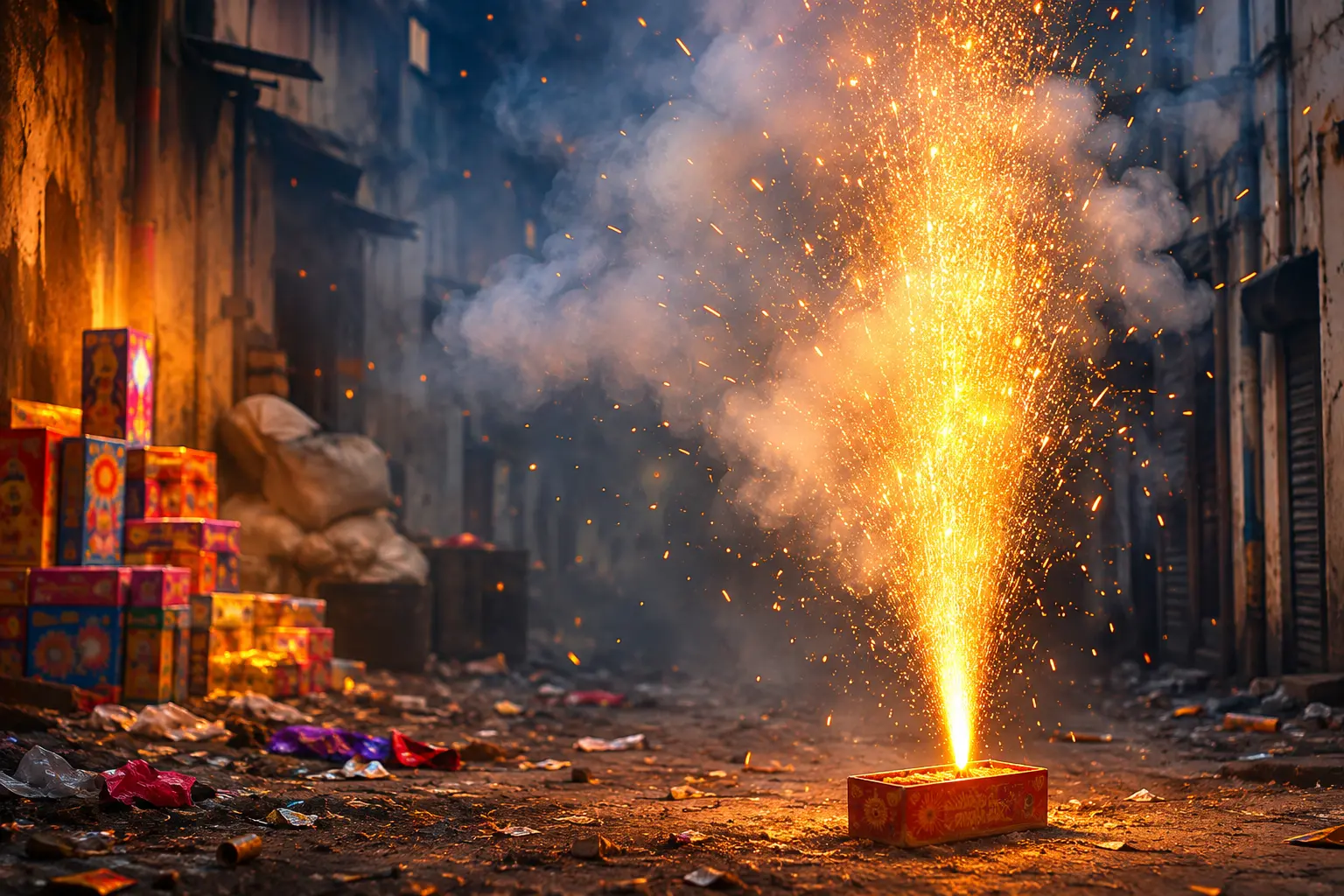
Last Deepavali, Green Hours Still Produced Very Poor Air
Diwali in 2025 fell on October 20, with the same morning and night slots. The Central Pollution Control Board’s next-day bulletin, covering 35 Delhi stations, put the city’s 24-hour AQI of 351 in the very poor category, with PM2.5 as the main pollutant.
AFTER LAST YEAR’S GREEN WINDOW
- Delhi index: 351, very poor, on October 21, 2025.
- Fine particles: 24-hour PM2.5 averaged 260 micrograms per cubic metre on October 20, with PM10 at 359.
- Stubble’s share: IITM-Pune put farm-fire impact on Delhi PM2.5 at about 0.8 percent that day, so the jump was not harvest smoke.
- Hot spots: Bawana logged 424 (severe); Gurugram’s Sector-51 station hit 426.
Around the capital the same afternoon, Gurugram stood at 370, Ghaziabad at 324 and Noida at 320. Faridabad was 268 and Greater Noida 282. Crackers went off well outside the two-hour night slot, as they have in other years when the Court tried to keep the bang inside a clock.
That record is the hole in this year’s order. The Bench wrote that the 2024 year-round ban, which Delhi applied from January 1, 2025, had not come with “adequate data” to show it cleaned the air, and that AQI readings had shown “no significant improvement.” Last year’s green test was meant to supply the missing file. The file is still thin, and the experiment is being run again on a tighter calendar.
A Green Cracker Cuts About 30 Percent of the Dust
CSIR-NEERI, the Nagpur lab that designed the products, says green firecrackers cut particulate matter by 30 percent and above against a conventional cracker of the same type, and keep sound under 125 dBA. Approved mixes are not supposed to carry barium, lead, arsenic or mercury. They still burn metal fuels and oxidisers. They still throw fine dust. Most of that dust still goes into the air.
THE THREE NEERI MIXES
- SWAS: Safe Water Releaser, built to vent water vapour so particles settle faster, used in flower pots, spinners and fountains.
- STAR: Safe Thermite Cracker, a changed thermite mix meant to lower dust while keeping the flash.
- SAFAL: Safe Minimal Aluminium, which trims the aluminium that feeds fine particles, used in sparklers and chakkars.
A 2023 paper in Environmental Pollution by NEERI scientists found barium 30 to 60 percent lower in the dust from tested green packs than from conventional ones, depending on shell size and chemistry. That is a cut in one toxic metal inside the plume, not a clean burst. The Union environment ministry this season asked the Court to allow a further-reduced dose of barium nitrate, claiming a 45 to 50 percent emission cut. The Bench refused. Crackers with barium stay banned, as do series packs known as ladis and garlands.
R.J. Krupadam, who coordinates NEERI’s National Centre of Excellence on Green Firecrackers, put the registered maker count at about 1,700 in late October 2026. Registration is supposed to mean the unit can follow NEERI’s formula. It does not mean a constable can tell that formula from a fake by looking at a stall in Chandni Chowk.
The QR Check Manufacturers Have Already Learned to Copy
Every box, the Court said, must stay sealed and carry a product- and batch-specific QR code with the maker’s name, NEERI registration, PESO or district licence, formulation and test certificate. Sale or transfer of those codes cancels the licence. Patrolling teams are to learn the NEERI list, scan packs at random, seize conventional stock and prosecute. Vehicles entering Delhi-NCR are to be checked.
NEERI does not print those codes. A lab note on green fireworks says registered units must print their own QR codes, which regulators such as PESO and the CPCB are then meant to verify. In late October, Krupadam told traders in Kolkata that the institute was dropping the scan check in that market because codes issued to one maker were being used by others. “QR codes meant for one manufacturer were being used by others without our knowledge. Therefore, we decided to discontinue the QR code mechanism,” he said.
Delhi-NCR’s order still leans on that stamp. Buyers are told to look for the green NEERI mark and to scan packs with the NEERI Green QR Code app. A copied code, a barcode in place of a QR, or a pack that opens nothing on a scan, is how last year’s “green” stalls moved ordinary powder. In the lanes around Jama Masjid and Sadar Bazaar, a green print on the wrapper is already being treated as cover; banned stock still comes out of sacks when a buyer asks.
Though imposition of a blanket ban seems to be the ideal solution, we are of the opinion that this Court, at this point in time, is short of adequate data to decide whether or not a complete ban would be the best solution to solve the problem of environmental pollution, caused by bursting firecrackers.
Justices M.M. Sundresh and Prasanna B. Varale, Supreme Court, order dated October 29, 2026
The same order says a complete ban had “facilitated the illegal sale of firecrackers” and stopped people buying tested green stock. That is the trap. The ban fed a black market. The permission, with three sale days and a scan that makers have already gamed, gives that market a legal street on which to stand.
GRAP-II Curbs Land Before the Legal Window Opens
CAQM invoked Stage II of the Graded Response Action Plan on November 2, after Delhi’s index climbed from 117 on October 31 to 261 on November 1 and then to 324. The last very poor day before that was February 11, 2026. Stage II is the band for readings from 301 to 400.
Diesel generator sets for ordinary commercial use are off. Coal and firewood, including tandoors in restaurants, are banned. Parking fees are to rise. The Metro added 20 weekday trips on top of the 20 it added when Stage I began on October 28. Dust-heavy demolition and outdoor building work face a separate 15-day stop from November 5. Non-BS-VI vehicles registered outside Delhi face entry curbs through January 31, 2027.
Into that regime the Court has placed six hours of legal fireworks. Article 25, it noted, is subject to health. Article 21 includes clean air. Bursting, it said, is a religious practice that still “shall result in severe environmental pollution, especially air and noise.” Children, disabled people and the elderly are named as the groups that take the hit. The weather does the rest: winter inversions trap whatever is lit, green or not.
Delhi DCP Niharika Bhatt restated the shop clock in public remarks after the order. “Green crackers can be sold only on November 4, 5 and 6. Bursting permitted on November 7 and 8 within designated hours,” she said. Manufacture is already allowed. The first legal counter opens on November 4. Sivakasi units that actually run NEERI mixes cannot restock a whole capital in three days. Stock that is already in the city can be relabelled in an afternoon. That is the complaint from traders and local politicians watching the calendar: Diwali’s date is known a year out, and a late order rewards whoever can print “green” on a box that is already here.
Three Sale Days and a 300-Metre Silence Line
District collectors and commissioners, with district police chiefs, must name the only places where green packs may be sold. Everywhere else, including apps and websites, is closed. Banners at those points have to show how to read a pack, the sealed-box rule, the dates and how to complain. Shopkeepers must display the order.
WHAT THE ORDER BARS ON THE GROUND
- Silence belt: no bursting within 300 metres of hospitals, nursing homes, primary and district health centres, old-age homes, notified silence zones or schools, all of them to be marked as no-cracker zones.
- Banned powder: barium mixes, unlisted products, imported packs, ladis and garlands.
- Online trade: no e-commerce sale of any firecracker in the region during the window.
- Security money: makers and traders must lodge a “handsome” deposit, forfeited on a breach, with licences pulled at once.
Police in Delhi, Uttar Pradesh and Haryana share the vehicle checks. The CPCB, with state boards, must file daily air reports for November 2 to 6, November 7 and 8, and November 9 to 30, plus sand and water samples. Dead monitoring stations are to be repaired. After the festival, the dirtiest stretches are to be washed. Education departments must talk to schoolchildren. The Delhi Metro is to run the warning on its public-address system.
Amicus curiae Uttara Babbar had asked for a full ban, arguing that earlier controls had not moved AQI or hospital load. Licensed traders, through the Delhi Fireworks Shopkeepers Association and the Federation of Fireworks Traders, said keeping their shutters down would only feed cross-border illegal powder. Additional Solicitor General Aishwarya Singh Bhati, for the Union, Delhi and CAQM, told the Bench the machinery was “geared up.” The Court warned that a weak ground operation would make its orders a “mockery,” and that contempt would follow.
Affidavits Are Due in December, After the Smoke
The case began in 2015 as Arjun Gopal’s petition for three infants. In 2018 the Court banned barium salts and joined crackers. NEERI’s green mixes arrived in 2019. Delhi’s government imposed a year-round ban from January 1, 2025. The October 15, 2025 relaxation was the first test. This order is the second.
THE LOOP THE COURT IS STUCK IN
- January 1, 2025: Delhi’s year-round ban on making, storing, selling and bursting all firecrackers takes effect.
- October 15, 2025: the Court opens a green-cracker test for Diwali and asks for air, water, sand and health data.
- October 20, 2025: Diwali night under those hours; the next afternoon CPCB logs Delhi at 351.
- October 29, 2026: the same hours are granted again; affidavits on deposits, sale points, prosecutions, AQI and hospital admissions are due December 14, with the matter listed on December 16.
NEERI opened a National Centre of Excellence on Green Firecrackers in Nagpur on December 2, 2025, under CSIR Director General N. Kalaiselvi, to handle a heavier testing load after last year’s permission. Testing still costs a maker Rs 7,000 per sample for air emissions, Rs 2,500 for noise and Rs 3,000 for banned chemicals, before tax. That pipeline cannot inspect a three-day street market in real time.
The Bench asked lawyers, film stars and sportspersons to talk people into a quieter festival. It also invoked the precautionary principle: act before the harm, rather than count the admissions after. The affidavits it has now demanded, including any rise in hospital cases through November 30, will arrive in mid-December. By then the six legal hours will be over, the ban will be back, and Delhi will know, as it knew last October, what the index did on the morning after.

ADNOC Ship Hit in Hormuz Leaves One Crew Missing

SpiceJet’s Rs 5,500 Crore Plan Follows a Rescue That Failed

Hasina’s Return Fight Sets Fire to Yunus’s Bank

Bancroft Recants the 2018 Inquiry and Names the Team

Adhikari Ties the Saffron Saree Row to School Licences

Clancy Juror Says the Holdout Never Cited Evidence

The iPhone 18 Pro Max Splits Apple’s Fall in Two

OpenAI Calls GPT-6 Astra AGI Then Locks Its Exploits

Trump Claims Hormuz Control as Oil Holds Near $96

Russia Closes the Goethe-Institut Berlin Tried to Save

 NEWS2 months ago
Clancy Juror Says the Holdout Never Cited Evidence
- NEWS3 months ago
The iPhone 18 Pro Max Splits Apple’s Fall in Two
- NEWS3 months ago
OpenAI Calls GPT-6 Astra AGI Then Locks Its Exploits
- BUSINESS3 months ago
Trump Claims Hormuz Control as Oil Holds Near $96
- LIFESTYLE3 months ago
Russia Closes the Goethe-Institut Berlin Tried to Save
- AUTO3 months ago
Volkswagen’s Job Cuts Leave Four Plants Without Cars
- NEWS3 months ago
Dyson Puts Nurovi Robots on Sale Without the UV Flagship
- BUSINESS2 months ago
US Destroys Five Iranian Tankers as the Shock Hits Jordan










