
BUSINESS
The Pitch Fire at HPCL’s New Visakh Residue Unit
HPCL’s Visakh pitch-tank fire on November 2 killed nobody, hitting a residue unit started in January at a plant with a long fire record.

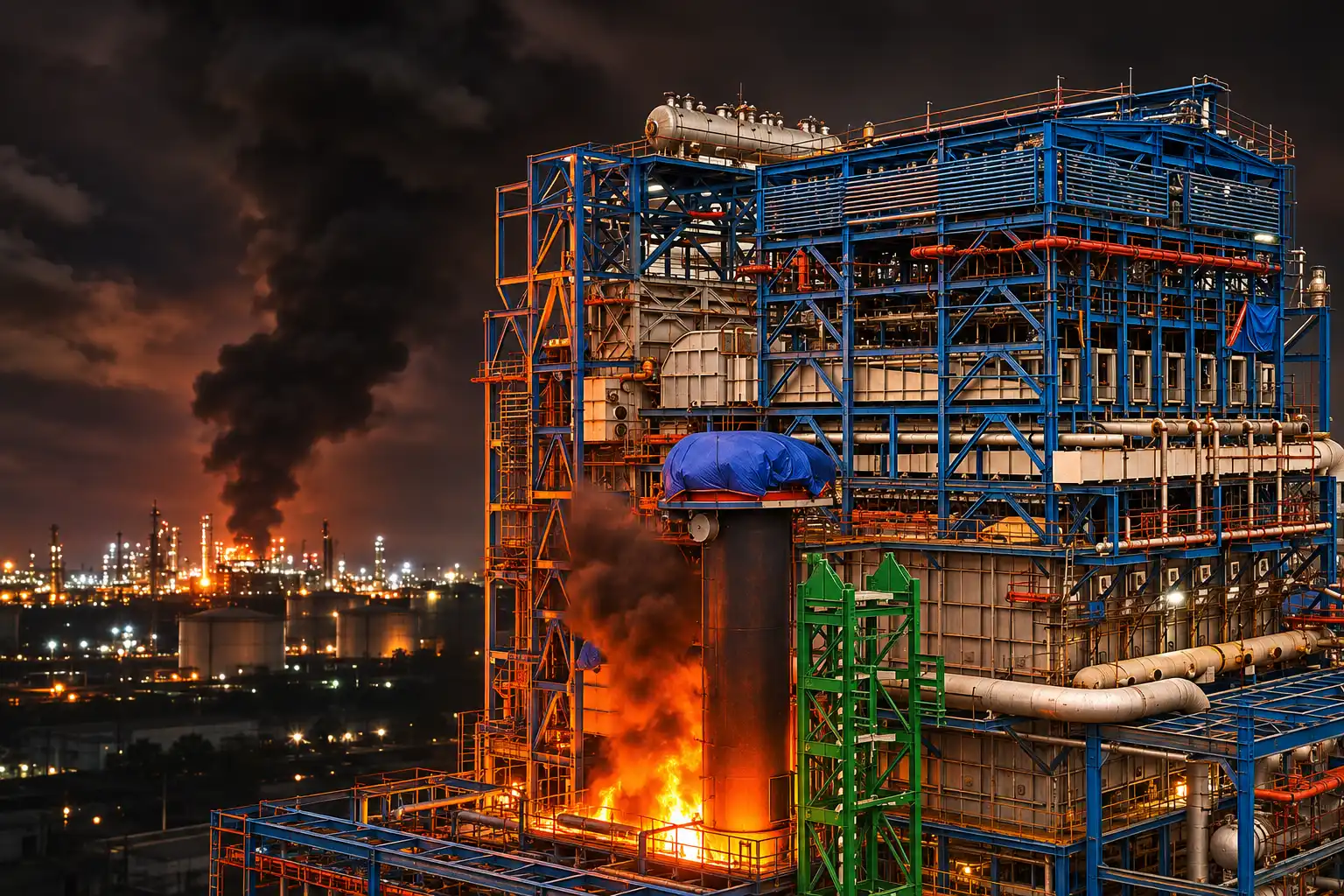
A fire broke out at about 10 pm on November 2 in a pitch storage tank at HPCL’s Visakh Refinery, and the company said nobody was hurt. Thick black smoke rose over Malkapuram. Nearby residents heard a blast and saw flames on the new residue unit.
The tank sits on the Residue Upgradation Facility that Hindustan Petroleum Corporation Limited started in January 2026, billed then as the world’s first LC-Max unit of this size. Primary crude units kept running. The leftover-handling end of that new kit did not have a quiet night.
Black Smoke Over Malkapuram
HPCL said the fire was reported at the pitch intermediate storage tank around 10 pm. Its own Fire and Safety team turned out with plant tenders. The company said the blaze stayed in the pitch tank area and was brought under control in a short time.
Malkapuram Inspector of Police E. Narasimha Rao put out a voice message telling people the situation was under control. He said there were no deaths and no injuries, and that HPCL’s own tenders were enough. Revenue Divisional Officer Dileep Chakravarthy, who went to the plant, described a small blast before the fire and said Andhra Pradesh Fire Department kit was also used.
MONDAY NIGHT AT THE REFINERY
- November 2, 2026, about 10 pm: Fire is reported at the pitch intermediate storage tank at the Visakh Refinery.
- November 2, 2026, night: Plant fire crews isolate the tank area. Neighbours see thick black smoke and hear a blast.
- November 2, 2026, late night: Inspector Rao tells the public the fire is under control and that no one is hurt.
- November 3, 2026, early hours: HPCL says all refinery units are working safely. Chakravarthy says an industrial-safety enquiry will follow.
Local accounts also pointed to a Pitch Tower on the newly tied-in residue unit. The company’s own wording was narrower: a pitch intermediate storage tank, fire localised, units still running. Those two descriptions can both be true if the tank is part of the residue unit’s pitch train. They are not the same claim.
The Residue Unit Started Up in January
HPCL announced in the first week of January 2026 that the Residue Upgradation Facility at the 15 million-tonne Visakh Refinery was on stream. The unit is rated at 3.55 million tonnes a year. It uses LC-Max residue hydrocracking, licensed by Chevron Lummus Global, to turn vacuum residue, the heavy leftover after crude distillation, into diesel-range fuels.
The company said the unit can convert about 93% of those bottom oils into higher-value products and lift distillate yield by up to 10% from pre-modernisation levels. The Nelson Complexity Index of the refinery was put at 11.6 after the start-up. Three LC-Max reactors, each about 2,200 tonnes, sit at the core of the train.
Larsen & Toubro built the unit on an EPC turnkey contract, with Engineers India as project consultant. L&T said the job put more than 750 pieces of equipment in a tight brownfield plot in the city, including 230 oversize loads, and that more than half the structural and piping work went in as 135 modules. It also said the project logged 58 million safe workhours.
WHAT THE NEW UNIT WAS SOLD AS
- World first: HPCL called it the world’s first LC-Max residue upgradation unit at this scale, and India’s first residue hydrocracking unit.
- Pitch train: L&T listed Pitch Solidification and Handling Units among first-of-kind kit in Indian refineries, alongside ebullating pumps and pressure let-down stations.
- Product mix: The stated aim was more middle distillate, a wider crude diet, and less need to buy diesel from outside.
- Parent project: The residue unit is the last heavy piece of the Visakh Refinery Modernisation Project, which raised crude capacity from 8.33 million tonnes a year to 15 million tonnes.
That modernisation did not arrive cheap or on time. HPCL approved it in July 2016 at an original estimate of Rs 20,928 crore, with completion due in July 2020. In an exchange filing dated September 11, 2024, the board posted a revised VRMP cost of Rs 30,609 crore and said mechanical completion was due that October, with the residue unit still to start. Petroleum minister Suresh Gopi told the Rajya Sabha on December 2, 2024 that Covid curbs, construction snags, and slow local approvals had pushed the job, and that Rs 27,360 crore had been spent by October 2024.
What Petroleum Pitch Is Doing There?
LC-Max is not a clean-fuels slogan. It is a two-stage hydrocracking scheme with a solvent step in the middle that knocks asphaltenes out of the unconverted residue. Chevron Lummus Global, the licensor, says the flowsheet is built for more than 90 percent conversion of vacuum residue. HPCL’s figure for this train is about 93%. The stream that does not become diesel is a dark, sticky pitch, loaded with metals, and it has to go somewhere.
PITCH, IN THIS UNIT
- The term: Petroleum pitch here is the asphaltene-rich leftover from residue hydrocracking, not a sulphur-recovery byproduct, even though Inspector Rao described the burning stuff as sulphur pitch, a waste or bottom product from a sulphur unit.
- The kit: The RUF was built with pitch solidification and handling as part of the train, so an intermediate pitch tank is where that leftover sits before it is cooled and moved.
- The heat: Residue units run hot. Dense pitch throws a heavy black plume when it burns, which is what neighbours saw on November 2.
That is why a fire in this corner of the plant can look worse than a fire in a crude unit even when the company says the rest of the refinery is still on line. The smoke is the leftover. The leftover is the point of having a pitch tank.
HPCL’s All-Clear After a Small Blast
HPCL’s public line came in a company post on the night of the fire. It named the pitch intermediate storage tank, said its own team had the fire in a short time, and said every unit was working.
The fire was localized to pitch tank area and was brought under control within a short time. There has been no casualties. All the Units of the Refinery are working safely.
Hindustan Petroleum Corporation Limited, statement on X, November 2, 2026
Fire Incident at HPCL Visakhapatnam Refinery
A fire incident was reported at the pitch intermediate storage tank at Visakh Refinery of Hindustan Petroleum Corporation Limited (HPCL), at around 10 PM on November 2, 2026.
Fire & Safety Team of Visakh Refinery promptly activated…
— Hindustan Petroleum Corporation Limited (@HPCL) November 2, 2026
Inspector Rao told people there was no need for panic. “There are no casualties, no injuries and no major issues. Everyone is safe, and there is no need for panic,” he said. Chakravarthy, after visiting, said the fire was fully out and that people should not worry, and he added that a small blast had been reported before the flames. He also said an enquiry would look at industrial safety under the applicable norms. HPCL, when asked locally, said a technical committee would study the cause and that fuel supply chains would not be hit because primary processing units were still up.
Those statements do not line up on every point. Rao said plant tenders were enough and no outside engines were needed. Chakravarthy said state fire equipment was deployed as well. HPCL said all units are working. It has not published a damage figure for the tank itself. Early talk of an overhead electrical-line fault has not been confirmed by a named investigator.
WHAT WE KNOW
- Place and time: Pitch intermediate storage tank, Visakh Refinery, about 10 pm on November 2, 2026.
- People: No deaths and no injuries, according to HPCL, Rao, and Chakravarthy.
- Plant: HPCL says the fire stayed in the pitch tank area and that all units are working.
WHAT IS UNCONFIRMED
- The spark: Cause is with a technical committee. No official finding yet.
- The tank: How much of the pitch system is damaged, and for how long it stays down, has not been stated.
- The blast: Chakravarthy reported a small blast first. HPCL’s note does not describe an explosion.
On the company’s own post, the first public instinct was relief that no one was hurt. The next instinct, from people who watch these plants, was to ask whether hazard studies and fire-zone rules on a unit started in January had been kept current. That is a fair question on a site with this history. It is not a finding.
Malkapuram Already Knows This Kind of Night
The all-clear landed in a neighbourhood that has watched this refinery burn before. On September 14, 1997, an LPG leak during ship unloading turned into a vapour-cloud explosion and tank-farm fire. An engineering investigation by BakerRisk later recorded that 56 people were declared dead, with property loss put in that paper at $15 million. A Lok Sabha reply in May 2000 put the Indian loss at Rs 72 crore and said the refinery stayed shut from September 14, 1997, to February 15, 1998.
On August 23, 2013, a cooling tower that was being commissioned blew and burned. The Oil Industry Safety Directorate later counted 28 dead, including one HPCL employee, and listed 13 lapses. The joint chief inspector of factories found that hydrocarbons in a cooling-water return line reached hot work, and that workers who were not part of the commissioning were still in the area. HPCL went ahead without an OISD clearance, the directorate said.
FIRES ON THIS SITE
| Date | What burned | Deaths |
|---|---|---|
| September 14, 1997 | LPG leak, tank farm and adjoining plant | 56 declared dead |
| August 23, 2013 | Cooling tower being commissioned | 28, including 1 HPCL staff |
| March 12, 2018 | Cooling tower under construction | 1, with at least 40 injured |
| April 6, 2019 | Continuous catalytic reformer in the MS block | 0 (3 minor injuries) |
| May 25, 2021 | Crude unit CDU-111 | 0 |
| November 2, 2026 | Pitch intermediate storage tank on the RUF | 0 |
The 2013 fire is the closer rhyme. It happened on new kit, during commissioning, and the later probes said the plant had pushed ahead with unfinished safety steps. Monday’s fire is not that fire. No one died. The residue unit has been running since January, not since that afternoon. The rhyme is the place and the newness of the hardware, not the death toll.
A lightning strike on a crude tank on July 30, 2017, caused a scare and no injuries. Each of those nights sent people in Malkapuram to the gates or onto rooftops. That is why a black column on November 2 produced a police voice note before most of the city had a company statement.
The District Officer Called an Enquiry
Chakravarthy said the enquiry would follow industrial-safety norms. HPCL said its technical committee would look for a cause. Those are two tracks, and neither has reported. The company also said fuel supplies would hold because primary units are running. That claim is about crude distillation and the product slate already in the system. It does not, by itself, say when the pitch tank or the rest of the residue train will be back in normal service.
For a plant that was built to wring diesel from the bottom of the barrel, a fire in the pitch handling end is a problem even when the rest of the yard is still pumping. The unit that was meant to lift margins by eating vacuum residue still has to put its leftover somewhere. Until the committee says what failed in that tank, Malkapuram has the same picture it has had since 1997: smoke over the wall, then a promise that this one was contained.
Rao’s message was that everyone was safe. On the numbers that can be checked tonight, he was right. The residue unit that started in January now has a pitch tank in the incident log, and the district has opened a safety file on a plant this city already knows too well.

ADNOC Ship Hit in Hormuz Leaves One Crew Missing

SpiceJet’s Rs 5,500 Crore Plan Follows a Rescue That Failed

Hasina’s Return Fight Sets Fire to Yunus’s Bank

Bancroft Recants the 2018 Inquiry and Names the Team

Adhikari Ties the Saffron Saree Row to School Licences

Clancy Juror Says the Holdout Never Cited Evidence

The iPhone 18 Pro Max Splits Apple’s Fall in Two

OpenAI Calls GPT-6 Astra AGI Then Locks Its Exploits

Trump Claims Hormuz Control as Oil Holds Near $96

Russia Closes the Goethe-Institut Berlin Tried to Save

 NEWS2 months ago
Clancy Juror Says the Holdout Never Cited Evidence
- NEWS3 months ago
The iPhone 18 Pro Max Splits Apple’s Fall in Two
- NEWS3 months ago
OpenAI Calls GPT-6 Astra AGI Then Locks Its Exploits
- BUSINESS3 months ago
Trump Claims Hormuz Control as Oil Holds Near $96
- LIFESTYLE3 months ago
Russia Closes the Goethe-Institut Berlin Tried to Save
- AUTO3 months ago
Volkswagen’s Job Cuts Leave Four Plants Without Cars
- NEWS3 months ago
Dyson Puts Nurovi Robots on Sale Without the UV Flagship
- BUSINESS2 months ago
US Destroys Five Iranian Tankers as the Shock Hits Jordan










