
NEWS
Delhi’s Average AQI Hides Severe Air in the North
Delhi’s AQI is 330 under GRAP Stage II, while Rohini already reads 429, and schools stay open until the city average hits 401.

Delhi’s 24-hour Air Quality Index stood at 330 at 8 a.m. on Tuesday, November 3, in the very poor band. Rohini, Punjabi Bagh and Bawana were already in the severe range on the Central Pollution Control Board scale, and Stage II of the Graded Response Action Plan stayed in force across the NCR.
Stage II starts when the city average is 301. Stage III waits until that average reaches 401. On Tuesday morning the capital was still 71 points short of that line, even as several north Delhi monitors had already crossed 400.
The City Average That Keeps Stage III Off
The Commission for Air Quality Management (CAQM) invoked Stage II across the NCR on November 2, after the CPCB’s daily bulletin put Delhi at 324, the first very poor reading of the season. Stage I had been running since October 21. The sub-committee said IMD and IITM forecasts pointed to more very poor days, and it layered Stage II on top of Stage I rather than jumping to Stage III.
The Air Quality Index (AQI) of Delhi which was observed 117 (‘Moderate’ Category) on 31.10.2026, has exhibited a sharp rise with AQI of 261 (‘Poor’ Category) on 01.11.2026 & has further increased to 324 (‘Very Poor’ Category) on 02.11.2026 owing to unfavorable meteorological conditions.
CAQM Sub-Committee on GRAP, press release, November 2, 2026
That is a 207-point rise in two days, from 117 on October 31 to 324 on November 2, including a 144-point jump in a single day to 261 on November 1. Tuesday’s 330 at 8 a.m. was only a small further move. The legal trigger for the next stage is still the city-wide average, not the worst station.
Noida, Kaithal and Hapur were also in the very poor band on Tuesday morning. The Air Quality Early Warning System for Delhi put the capital in very poor air through November 5, with the following six days ranging from very poor to poor.
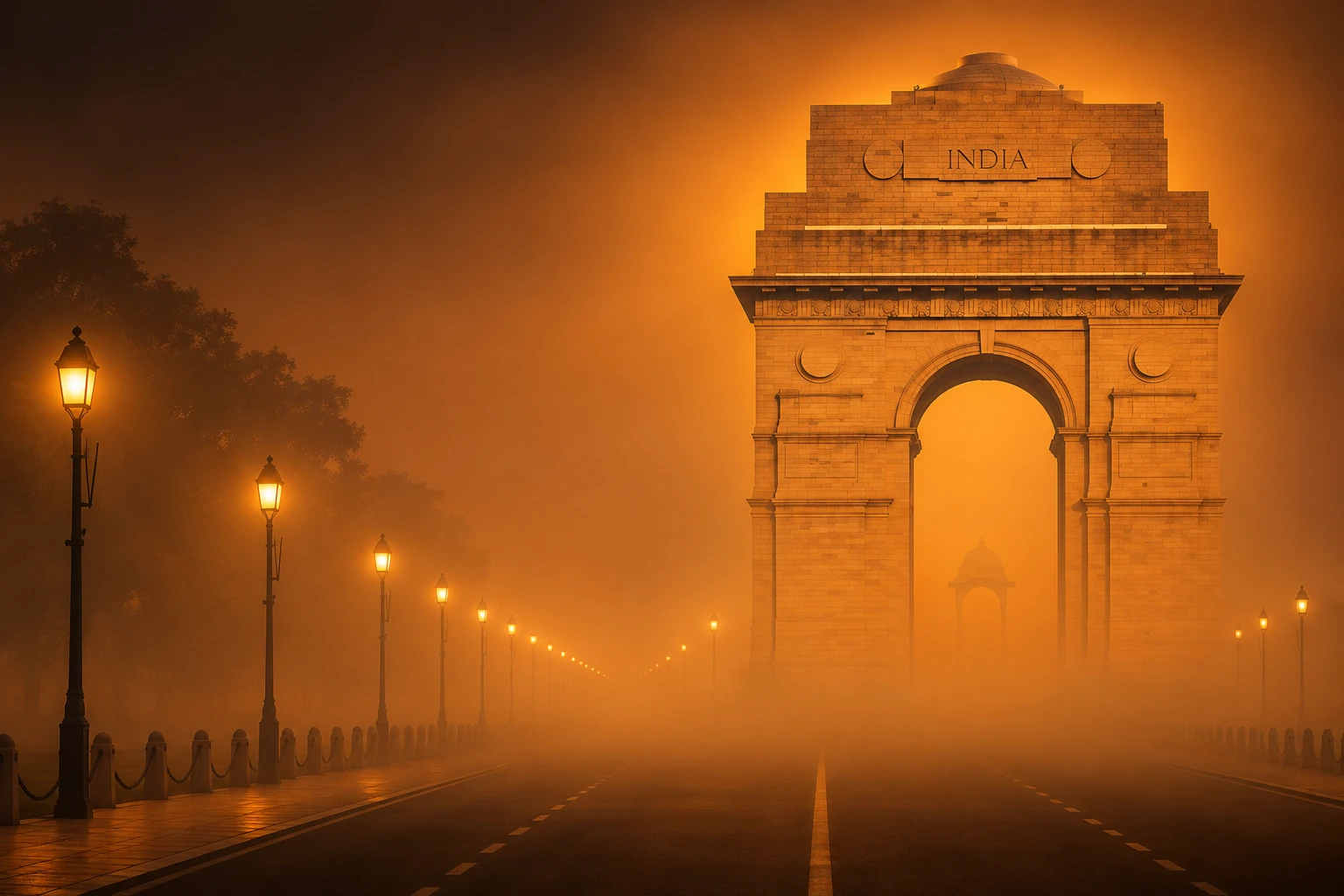
Rohini, Bawana and Jahangirpuri Cross 400
CPCB station data on Tuesday morning put Rohini at 429, Punjabi Bagh at 424 and Bawana at 408, all in the 401-500 severe bracket. The same feed left IMD Lodhi Road at 226, in the poor band, 203 points below Rohini. The gap between a severe pocket and a poor one is larger than the entire width of the very poor category.
On November 2 at 4 p.m., the bulletin that triggered GRAP II had already shown the split. Jahangirpuri led at 436, with Rohini at 415 and Punjabi Bagh at 413. Of 58 stations, 3 were severe, 37 very poor, 17 poor and 1 moderate. Monday morning, 53 of those 58 stations had been above 200, and Tikri Kalan was the cleanest at 159.
The Hindu’s Tuesday round-up named seven severe locations: Rohini, Punjabi Bagh, Alipur, Bawana, Jahangirpuri, Vivek Vihar and Narela. That belt runs through north and north-west Delhi, industrial edges, and dense housing, not the Lodhi Road and airport corridor that still held the average down. Anyone comparing Delhi’s station-wise AQI readings on the government board could see a Stage III city in those neighbourhoods and a Stage II city on the official average.
TUESDAY MORNING STATIONS AGAINST THE CITY 330
| Location | AQI | Category |
|---|---|---|
| Rohini | 429 | Severe |
| Punjabi Bagh | 424 | Severe |
| Bawana | 408 | Severe |
| Patparganj | 379 | Very poor |
| R.K. Puram | 374 | Very poor |
| ITO | 373 | Very poor |
| Jawaharlal Nehru Stadium | 355 | Very poor |
| Okhla Phase-2 | 352 | Very poor |
| Chandni Chowk | 352 | Very poor |
| JNU | 328 | Very poor |
| Delhi 24-hour average (8 a.m.) | 330 | Very poor |
| IGI Airport T3 | 287 | Poor |
| Anand Vihar | 279 | Poor |
| Uttam Nagar | 274 | Poor |
| IMD Lodhi Road | 226 | Poor |
Rohini sat 99 points above the city number that still governs GRAP. Local boards in the north already look like a later stage of the plan. The rule that turns those boards into school closures and a wider vehicle curb is the average, and the average had not moved.
What GRAP Stage II Leaves Untouched
Stage II covers Delhi AQI from 301 to 400. The November 2 press release listed eight agency steps, plus a citizen charter. Schools, shops and most private cars are not in that list. Public transport keeps running. The charter asks people who can work from home to do so. It does not order it.
STAGE II AGENCY STEPS NOW IN FORCE
- Road sweeping: Daily mechanical or vacuum sweeping with water, preferably at night or early morning, and more machine-hours so collected dust goes to designated sites.
- Dust suppressants: Water mixed with suppressants on heavy corridors and congestion points before peak traffic.
- Hotspots: Targeted action at identified pollution hotspots, aimed at the main source in each one.
- C&D inspections: Stricter checks that construction and demolition sites are controlling dust.
- Parking fees: Higher charges to push people off private cars.
- RWA heaters: Resident welfare associations must give security, sanitation and garden staff electric heaters and a power point, so they do not burn biomass or municipal waste.
- Staggered offices: Delhi and the districts of Gurugram, Faridabad, Ghaziabad and Gautam Buddha Nagar stagger timings for public offices and municipal bodies.
- Central offices: The Centre may stagger timings for its own offices in Delhi-NCR.
The citizen list adds public transport, lane driving, fresh vehicle air filters, no open burning, and no outdoor smoke for cooking or heating. It also asks residents to skip dust-heavy building work from October through January. None of that takes a Class 1 child out of a Jahangirpuri classroom, and none of it parks a BS-IV diesel car. Those moves sit in Stage III and Stage IV, which open at 401 and above 450.
The CPCB scale is blunt about what severe air does. It affects healthy people and hits those with existing disease harder. PM2.5 was the main pollutant at most stations. Very poor air is already a health problem. Severe air is the band the plan treats as a different emergency, and the plan had not yet called it for the city as a whole.
Construction Crews Lose 16 Days From November 5
A separate CAQM order, dated October 30 and signed by Member Secretary Tarun Kumar Pithode, does not wait for 401. It uses the November pattern from 2018 through 2025, when AQI often reached severe and severe-plus in early to mid-November, and it sets calendar curbs for November 5 to November 20. That window is 16 days, and it starts two days after Tuesday’s 330 reading.
The direction restricts dust-generating demolition and outdoor construction across the NCR, including highways, roads, flyovers, power lines, pipelines and telecom. Exemptions are narrow: railways, metro, airports, interstate bus terminals, hospitals, water supply and sanitation, national security and defence, and projects of national importance. State government and private offices in the NCT of Delhi and in Gurugram, Faridabad, Sonipat, Ghaziabad and Gautam Buddha Nagar must run on up to 50 percent of staff in the office, with the rest at home, except where industry or essential services cannot do that.
For daily-wage crews on private sites, the halt is the story. The work stops on a fixed date, not when a local monitor hits 401, and it runs through Diwali week. Essential public jobs continue. Private building work does not. Stage II had only intensified inspections at those sites. The October 30 order is the actual stop, and it arrives before the city average has earned Stage III.
The same order is the first large work-from-home mandate of this spike. Stage II only invited people who could stay home to do so. From November 5, half the desk workforce in those six territories is directed out of the office whether the city is at 330 or 430.
Stubble’s Climbing Share of Delhi’s PM2.5
The Indian Institute of Tropical Meteorology’s Decision Support System put stubble burning at 5.3 percent of Delhi’s PM2.5 on October 31, when the city average was still 117. The share rose to 18.57 percent on November 1 as the index jumped to 261, then eased to 8.5 percent on November 2. The same system forecast 22 percent by Thursday, November 5, the morning the construction halt begins.
Farm fire counts remain well below the worst recent years, but they are no longer a rounding error. A CAQM reply covering September 15 to October 29 recorded 1,383 stubble-burning cases: 1,007 in Punjab, 29 in Haryana, 345 in Uttar Pradesh and 2 in Delhi. Agencies imposed environmental compensation of ₹18.17 lakh and recovered ₹13.57 lakh. Punjab then logged 194 fires on October 31, the state’s highest single day of this season at that point.
A senior CPCB official said late October rain had stopped many farmers from harvesting on time, and that they would now rush the work, stacking fires into a short window. The official also said no weather system was lined up to clear the air, and that heavy firecracker use on Diwali would make the load worse. IITM’s Thursday forecast of a 22 percent farm-fire share sits on that rush, in still air, five days before Lakshmi Puja.
STUBBLE’S SHARE AND THE FIRE COUNT
- October 31: Farm fires were 5.3 percent of Delhi PM2.5; city AQI 117; Punjab recorded 194 fires that day.
- November 1: The share rose to 18.57 percent as the city AQI reached 261.
- November 2: The share was 8.5 percent on the first very poor day; IITM forecast 22 percent by November 5.
- Season through October 29: 1,383 recorded fires, most of them in Punjab, with ₹13.57 lakh of fines recovered.
Local dust, traffic and waste burning are still the base load. The DSS numbers only measure the extra slice from fields. That slice is growing into the same week as the construction stop and Diwali, which is why a city that had a relatively clean October fell 207 points in two days once the wind dropped.
Schools Stay Open While Pockets Sit in Severe Air
Delhi’s Directorate of Education told government, aided and recognised private schools on October 29 to sprinkle water, improve classroom ventilation, add greenery, skip dust-heavy building work on campus, and file monthly notes through February 2027. Those are housekeeping rules. They are not a closure. Under Stage II, physical classes continue.
Hybrid or online shifts are a later-stage decision, tied to a city average in the severe band, not to a cluster of north Delhi stations. Children in Rohini, Jahangirpuri, Bawana and Narela go to school in air the CPCB already calls severe. Office staff in the same districts will be halved from November 5 by the calendar order. The group with the least choice, school-age children in the worst-reading wards, is the group Stage II does not pull indoors.
THE WEEK ON THE CALENDAR
- October 21, 2026: Stage I of GRAP takes effect across Delhi-NCR.
- October 30, 2026: CAQM issues the November 5 to 20 construction and 50 percent office order, and logs 1,383 farm fires through the previous day.
- October 31, 2026: Delhi’s AQI is 117, moderate; Punjab records 194 stubble fires.
- November 1, 2026: AQI rises to 261, poor; stubble’s share of PM2.5 reaches 18.57 percent.
- November 2, 2026: CPCB bulletin 324, very poor; CAQM invokes Stage II; three stations are already severe at 4 p.m.
- November 3, 2026: City AQI 330 at 8 a.m.; Rohini 429, Punjabi Bagh 424, Bawana 408.
- November 5, 2026: Outdoor C&D halt and 50 percent office staffing begin; IITM’s 22 percent stubble share is dated here.
- November 8, 2026: Diwali Lakshmi Puja, five days after Tuesday’s 330, with Dhanteras on November 6.
The construction stop starts on November 5. Diwali night is November 8. Stage III still needs a city average of 401, 71 points above Tuesday’s 330, while Rohini has already printed 429.

ADNOC Ship Hit in Hormuz Leaves One Crew Missing

SpiceJet’s Rs 5,500 Crore Plan Follows a Rescue That Failed

Hasina’s Return Fight Sets Fire to Yunus’s Bank

Bancroft Recants the 2018 Inquiry and Names the Team

Adhikari Ties the Saffron Saree Row to School Licences

Clancy Juror Says the Holdout Never Cited Evidence

The iPhone 18 Pro Max Splits Apple’s Fall in Two

OpenAI Calls GPT-6 Astra AGI Then Locks Its Exploits

Trump Claims Hormuz Control as Oil Holds Near $96

Russia Closes the Goethe-Institut Berlin Tried to Save

 NEWS2 months ago
Clancy Juror Says the Holdout Never Cited Evidence
- NEWS3 months ago
The iPhone 18 Pro Max Splits Apple’s Fall in Two
- NEWS3 months ago
OpenAI Calls GPT-6 Astra AGI Then Locks Its Exploits
- BUSINESS3 months ago
Trump Claims Hormuz Control as Oil Holds Near $96
- LIFESTYLE3 months ago
Russia Closes the Goethe-Institut Berlin Tried to Save
- AUTO3 months ago
Volkswagen’s Job Cuts Leave Four Plants Without Cars
- NEWS3 months ago
Dyson Puts Nurovi Robots on Sale Without the UV Flagship
- BUSINESS2 months ago
US Destroys Five Iranian Tankers as the Shock Hits Jordan










