
NEWS
The Supreme Court Shuts KN Nehru’s Cash-for-Jobs FIR Challenge
The Supreme Court dismissed K.N. Nehru’s cash-for-jobs FIR challenge after Tamil Nadu’s new government registered the case and dropped the state’s earlier fight.

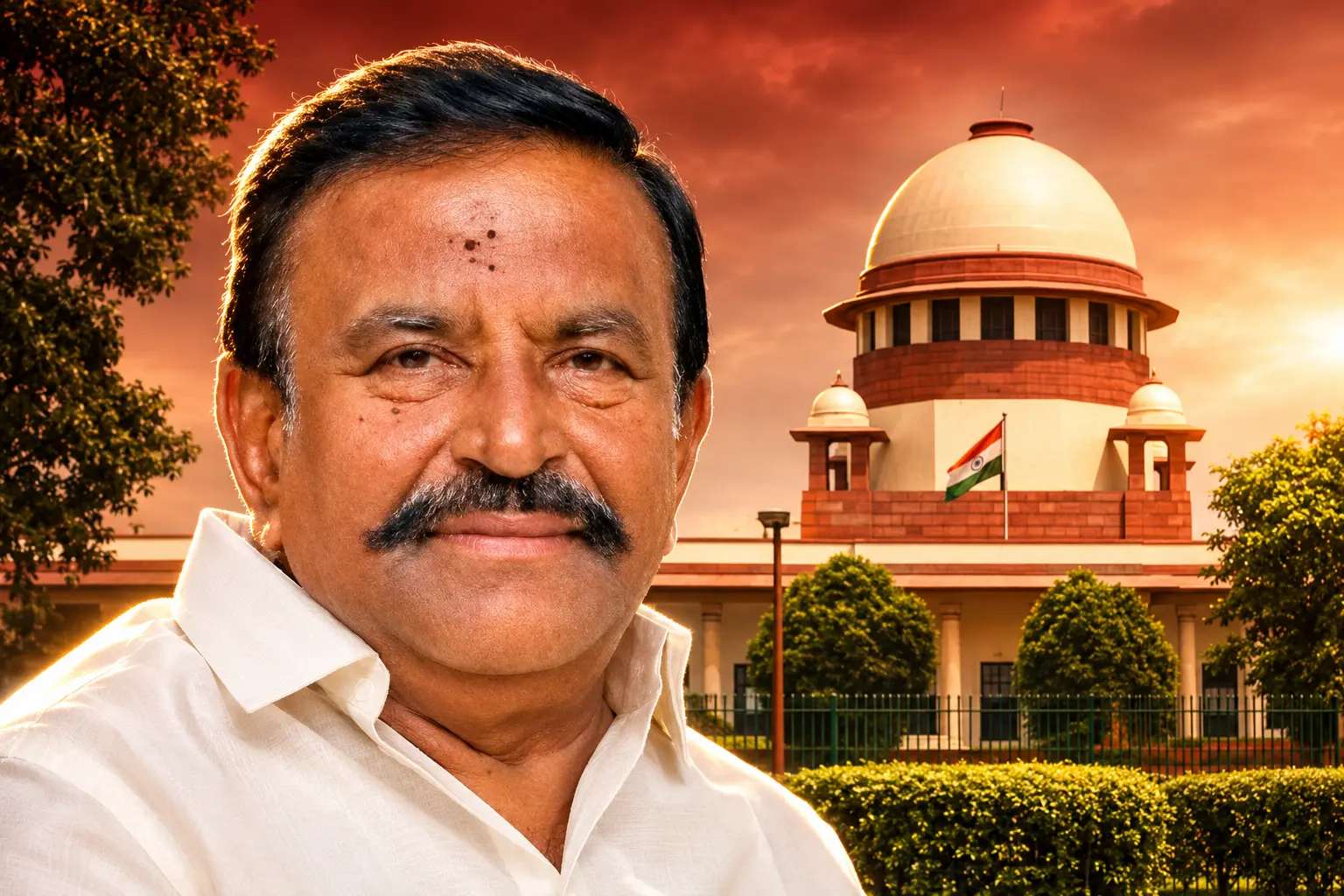
The Supreme Court on November 2 dismissed former Tamil Nadu minister K.N. Nehru’s plea against a cash-for-jobs FIR. Justices Dipankar Datta and Sheel Nagu said there was no ground to interfere with two Madras High Court orders that had already put the Directorate of Vigilance and Anti-Corruption on the case.
The FIR was not born in that courtroom. DVAC registered it on June 5, 2026, after a new state government took office and stopped fighting the High Court’s direction. Nehru kept fighting alone. That last challenge is now gone, and the probe continues without a finding of guilt.
Supreme Court Finds No Ground to Interfere
Nehru, a DMK leader who headed the Municipal Administration and Water Supply Department in the 2021 to 2026 government, asked the court to undo the High Court’s February 20 judgment and its October 26 refusal to review that judgment. The petition was titled Thiru KN Nehru v. IS Inbadurai & Ors. Senior Advocate Shyam Divan appeared for him. The State had entered a caveat, asking to be heard before any stay.
Divan told the bench the High Court had gone beyond a bare direction to investigate and had recorded adverse remarks without a real chance to reply. Notice, he said, arrived on the day the High Court reserved its order, so there was no effective chance to file a response. Justice Datta did not accept that the High Court had recorded findings against Nehru, treating those passages as a record of the Enforcement Directorate’s material rather than a verdict.
When a political rival has approached the Court, the Court ought to be more circumspect. The greater the potential prejudice, greater the obligation on the Court to be fair and just, and to appear just and fair.
Shyam Divan, Senior Advocate, Supreme Court
On the papers, Divan also argued that an Enforcement Case Information Report had been set aside in July 2025 after the predicate offence was quashed, so the ED could not rely on Section 66 on disclosure of information to pass the file to state police. The bench was not persuaded. Justice Datta said a thorough probe was needed because Nehru had headed the department under scanner, and that Nehru could raise every defence later, in accordance with law.
The Enforcement Directorate’s 232-Page File
The case did not begin as a state police complaint. In April 2025, ED officers searching premises linked to Nehru’s brother N. Ravichandran in a bank fraud case seized communications, bank trails, selection lists, call letters and digital records that, the agency later told Tamil Nadu, pointed to a hiring racket in the department Nehru then ran.
In October 2025 the ED sent the Director General of Police a 232-page bundle under the Prevention of Money-Laundering Act. The High Court recorded that this source information reached the State on October 27, 2025. The file alleged that money moved through hawala channels to fill 2,538 posts, including assistant engineers, junior engineers and town planning officers, with bribes of ₹25 lakh to ₹35 lakh a head and an alleged haul of ₹634 crore.
WHAT THE ED FILE ALLEGED
| Item | Figure |
|---|---|
| Government posts named in the file | 2,538 |
| Alleged bribe per post | ₹25 lakh to ₹35 lakh |
| Alleged total collected | ₹634 crore |
| Records sent to the DGP | 232 pages |
Those figures are the ED’s case, not a court’s finding. The High Court on February 20 said the material disclosed a cognizable offence and that a long “preliminary enquiry” was being used to avoid an FIR. From October 27, 2025, to that order, no case had been registered. The State had pointed to Section 173(3) of the Bharatiya Nagarik Suraksha Sanhita, which allows a short pre-FIR check. The bench of then Chief Justice Manindra Mohan Shrivastava and Justice G. Arul Murugan said a preliminary inquiry is not mandatory in corruption cases and could not be stretched into a mini-trial.
The fact that though the source information was shared on 27.10.2025, even after 3½ months the same has not even resulted in registration of a case, prima facie shows that the State, under the guise of conducting a preliminary enquiry, is not inclined to register a case.
Madras High Court, February 20, 2026 order
The same order warned that delay in a case of this kind can destroy evidence, and that the court could not ignore the charge that high-ranking people were being shielded. It directed DVAC to register a case and investigate. That was a direction to open a file, not a decision that Nehru or anyone else was guilty.
After the Government Changed, an FIR Followed
AIADMK Rajya Sabha MP I.S. Inbadurai, who had moved the High Court after a December 13, 2025 representation, came back within a week of the February 20 order with a contempt plea. He named A.T. Durai Kumar, then holding charge as DVAC director, and said the FIR still had not been filed. The DMK-led government filed a review. So did Nehru, who said he had not been heard even though the allegations concerned his tenure.
The 2026 Assembly election then changed who spoke for the State. The Tamilaga Vettri Kazhagam government told the High Court it would withdraw the review filed by its predecessor. Advocate General Vijay Narayan said the new government intended to go on with the investigation and that there was no hidden motive. Nehru’s lawyers objected, arguing that a change of party could not justify abandoning a legal stand the State had already taken. The FIR, the court was told, had already been registered on June 5, 2026.
HOW THE FIR CAME TO BE
- April 2025: ED officers search premises linked to N. Ravichandran in a bank fraud case and seize recruitment records.
- October 27, 2025: The High Court records that ED source information reaches the Tamil Nadu government.
- February 4, 2026: The High Court reserves judgment after notice to Nehru.
- February 20, 2026: The court directs DVAC to register a case and investigate.
- June 5, 2026: DVAC registers the FIR after the change of government.
- October 26, 2026: The High Court dismisses Nehru’s review, lets the State withdraw its review, and closes the contempt plea.
- November 2, 2026: The Supreme Court refuses to interfere.
On October 26, Chief Justice S.A. Dharmadhikari and Justice Arul Murugan held that dropping the State’s review after the FIR had already been filed did not subvert the rule of law. Keeping up a fight against registration after the government itself had chosen to comply, they said, would damage it more. They also closed Inbadurai’s contempt plea, because the FIR the court had asked for was by then on the books.
Why Nehru Fought the Hearing Question to the End
Nehru’s remaining point was narrower than the merits of the ED file. He said a court should not have ordered an FIR that touched his tenure without hearing him. The review bench answered that the February 20 order had been reserved on February 4 and pronounced 16 days later. Once notice reached him, nothing stopped him from moving an application in that window. He did not. The judges said that fact supported the Advocate General’s submission that he sat by and watched, then complained.
The same bench stressed what the February 20 order actually did. It told DVAC to register a case and investigate. It did not decide guilt. The remarks in that order, the judges said, recited the ED’s case rather than the court’s own conclusions. Whether the papers stood up, and whether Nehru or his relatives had any role, would be tested in the investigation and, if charges followed, in a criminal court. A person who might later be examined, they said, does not have to be heard before that first step.
That is why the Supreme Court fight was always a fight about the threshold. Divan accepted that a bare order to investigate might have been tolerable. What he could not accept were remarks he called findings, entered on a political rival’s writ, without a reply. The apex court still declined to stay or set aside the High Court record. It left Nehru with the ordinary defences that any accused person has once a probe reaches him.
Twenty-Five Searches Came Before the Final Hearing
Nehru moved the Supreme Court on October 26, the day the review fell. DVAC did not wait for Delhi. On October 29 it ran searches tied to the cash-for-jobs FIR, which names Nehru and seven others and concerns recruitment in 2024 to 2025.
WHAT DVAC SAYS IT TOOK ON OCTOBER 29
- The map: Teams searched 25 premises in Chennai, Tiruchirappalli, Coimbatore, Namakkal and Tirunelveli.
- Paper: Officers seized 170 documents they described as incriminating.
- Devices: They also took 13 electronic gadgets.
- Other stops: The residence of former DMK MLA Ramalingam in Namakkal was among the sites, along with premises linked to K.N. Ravichandran.
The agency said in its statement that money collected for the 2,538 appointments had been routed through hawala, and that further investigation was under way. Those searches were the first hard sign that the June 5 FIR was no longer a paper entry. They also showed that the Supreme Court petition, still unheard, did not freeze the probe.
Call Letters Went Out Before Official Selection
The ED material, as later described in court, is specific in a way a vague “irregularities” charge is not. It alleges that call letters went to candidates before those people were officially selected and appointed. If that holds, the hiring process was not merely leaky. The result was known, and sold, before the public list existed.
The posts named across the court record are not all the same grade. Assistant engineers, junior engineers and town planning officers sit in the High Court’s February account. DVAC’s later statement also lists sanitary inspectors and draughtsmen. The alleged price band of ₹25 lakh to ₹35 lakh is the same across those descriptions. At the low end of that band, 2,538 posts come close to the ₹634 crore total the ED put on the racket. That arithmetic explains the headline figure. It does not prove the payments happened.
Inbadurai’s contempt affidavit had already put hawala at the centre of the charge, saying the money was obtained that way and then moved into the banking system. The ED’s original search, in a bank fraud case rather than a recruitment case, is how those papers entered the State’s file. That path is why Divan spent so much of the Supreme Court hearing on whether the ED still had a lawful basis to share what it had seized once its own money-laundering proceeding, on his telling, had ended.
Municipal Tenders Face a Second Probe
The jobs FIR is not DVAC’s only file on the same former minister. A separate investigation deals with alleged commission-based tender work in the same department between 2021 and 2025, a suspected ₹1,020 crore trail. September searches in that case covered about 30 locations. Mixing the two numbers into one “Nehru scam” figure is how the public argument gets sloppy. The courts have treated the recruitment case as its own proceeding, built on the ED’s October 2025 sharing and the February 20 direction.
None of this makes Nehru a convict. The High Court said so in October, and the Supreme Court said he may raise every point in his defence at the proper stage. An FIR starts a probe. It does not end one. What November 2 did is smaller and harder: it removed the last court order that could have paused this particular cash-for-jobs file at the gate. DVAC already has the June 5 FIR, the October 29 seizures, and now a Supreme Court refusal to unwind the High Court’s direction. The argument moves from whether a case should exist to what the papers actually prove.
Frequently Asked Questions
What Does Section 66 of the PMLA Allow the ED to Share?
Section 66 of the 2002 money-laundering statute is the disclosure clause. It lets the ED pass information in its possession to other officers and agencies so those bodies can do their own lawful work, including a state corruption probe. Sharing a dossier is not the same as the ED filing a charge-sheet, and it is not a finding that the people named in the papers committed an offence. Nehru’s counsel argued that once an ECIR is gone, that sharing power should go with it. The Supreme Court still left the High Court’s reliance on the shared file undisturbed.
Is a Preliminary Enquiry Required Before a Corruption FIR in India?
No. The Constitution Bench in Lalita Kumari said registration is mandatory when information discloses a cognizable offence, and listed corruption among the categories where a preliminary enquiry may be made. Later Supreme Court cases have held that such an enquiry is not a right of the accused and not a condition for every Prevention of Corruption Act case. If police use the short pre-FIR check in Section 173(3) of the BNSS, that check is capped at 14 days and is only to see whether a cognizable offence is made out, not to try the case in secret.
Who Else Besides I.S. Inbadurai Went to the High Court?
K. Athinarayanan filed a parallel writ, listed with Inbadurai’s case as WP(MD) No. 34197 of 2025 and W.P. Crl No. 74 of 2026. Inbadurai is an AIADMK Rajya Sabha member and a practising advocate. After February 20, he also filed the contempt plea that named the DVAC officer then in charge. The High Court closed that contempt file in October once it recorded that the June 5 FIR had already been registered.
Does the Supreme Court Order Mean K.N. Nehru Has Been Found Guilty?
It does not. Both courts described registration of an FIR as a first step that starts investigation and leaves the presumption of innocence in place. Nehru can still seek the usual criminal-process remedies as the probe proceeds, including challenges to arrest, requests to be heard during investigation, and, if a charge-sheet is filed, a full defence at trial. November 2 only refused to quash or stay the High Court’s direction that the case exist.
Disclaimer: This article is news reporting and analysis of court orders and public case papers. It is informational only and is not legal advice, a finding of guilt, or a recommendation to take or drop any legal step. Readers who face investigation, arrest risk, or related proceedings should consult a qualified criminal lawyer before acting on anything described here. Figures, case statuses and party names reflect the court records and official statements cited above and may change as the investigation or later hearings proceed.

ADNOC Ship Hit in Hormuz Leaves One Crew Missing

SpiceJet’s Rs 5,500 Crore Plan Follows a Rescue That Failed

Hasina’s Return Fight Sets Fire to Yunus’s Bank

Bancroft Recants the 2018 Inquiry and Names the Team

Adhikari Ties the Saffron Saree Row to School Licences

Clancy Juror Says the Holdout Never Cited Evidence

The iPhone 18 Pro Max Splits Apple’s Fall in Two

OpenAI Calls GPT-6 Astra AGI Then Locks Its Exploits

Trump Claims Hormuz Control as Oil Holds Near $96

Russia Closes the Goethe-Institut Berlin Tried to Save

 NEWS2 months ago
Clancy Juror Says the Holdout Never Cited Evidence
- NEWS3 months ago
The iPhone 18 Pro Max Splits Apple’s Fall in Two
- NEWS3 months ago
OpenAI Calls GPT-6 Astra AGI Then Locks Its Exploits
- BUSINESS3 months ago
Trump Claims Hormuz Control as Oil Holds Near $96
- LIFESTYLE3 months ago
Russia Closes the Goethe-Institut Berlin Tried to Save
- AUTO3 months ago
Volkswagen’s Job Cuts Leave Four Plants Without Cars
- NEWS3 months ago
Dyson Puts Nurovi Robots on Sale Without the UV Flagship
- BUSINESS2 months ago
US Destroys Five Iranian Tankers as the Shock Hits Jordan










