
NEWS
Delhi’s GRAP-II Curbs Land Beside a Diwali Cracker Window
Delhi’s GRAP-II curbs add eight extra actions after AQI hit 324, while a construction halt and a two-day green-cracker window share the same Diwali stretch.

The Commission for Air Quality Management invoked GRAP Stage II across Delhi-NCR on November 2 after the city’s daily average AQI of 324 landed in the Very Poor band. Two days earlier the same index had been 117.
Stage I was already in force. What Stage II adds is a short list of extra steps, and those steps now sit beside a 16-day building halt and a two-day green-cracker permit that share the run-up to Diwali on November 8.
The Index Went From Moderate to Very Poor in Two Days
CAQM’s sub-committee met on November 2 with the Central Pollution Control Board’s daily bulletin and the air-quality forecast from the India Meteorological Department and the Indian Institute of Tropical Meteorology. The three-day sequence is the entire trigger.
THE THREE-DAY JUMP
- October 31, 2026: Delhi’s daily average AQI sits at 117, in the Moderate band.
- November 1, 2026: The index rises to 261 and enters the Poor band, as Delhi’s separate winter vehicle rules also take effect.
- November 2, 2026: The daily average hits 324, in the Very Poor band, and Stage II is invoked across the NCR with immediate effect.
That is a 207-point rise in two daily bulletins, which CAQM blamed on unfavourable weather. IMD and IITM told the panel the index is likely to stay Very Poor in the coming days.
The Air Quality Index (AQI) of Delhi which was observed 117 (‘Moderate’ Category) on 31.10.2026, has exhibited a sharp rise with AQI of 261 (‘Poor’ Category) on 01.11.2026 & has further increased to 324 (‘Very Poor’ Category) on 02.11.2026 owing to unfavorable meteorological conditions. The forecast by IMD/IITM has also predicted AQI to remain in ‘Very Poor’ category in coming days.
CAQM Sub-Committee on GRAP, November 2, 2026 press release
Stage II is the plan for the Very Poor band of 301-400. Stage III begins only at 401. The city crossed the Stage II line and stopped there, on paper, even as the forecast refused to turn around.
#CAQM invokes Stage-II of #GRAP in the entire #NCR with immediate effect, as #DelhiAQI reaches 324. Citizens are requested to follow the Citizen Charter.
For more details, kindly visit: https://t.co/QVsGbP0Q9x pic.twitter.com/use29Y6rDN— Commission for Air Quality Management (@CAQM_Official) November 2, 2026
Late monsoon rain and stronger winds had kept October cleaner than the usual early smog season. The clean spell did not hold once the weather turned. Delhi Traffic Police’s Northern Range said it checked 7,657 vehicles at the border and turned back 609 that failed the winter entry rules already in force from November 1. Those checks are a different order from Stage II, and they were already running when the index jumped.
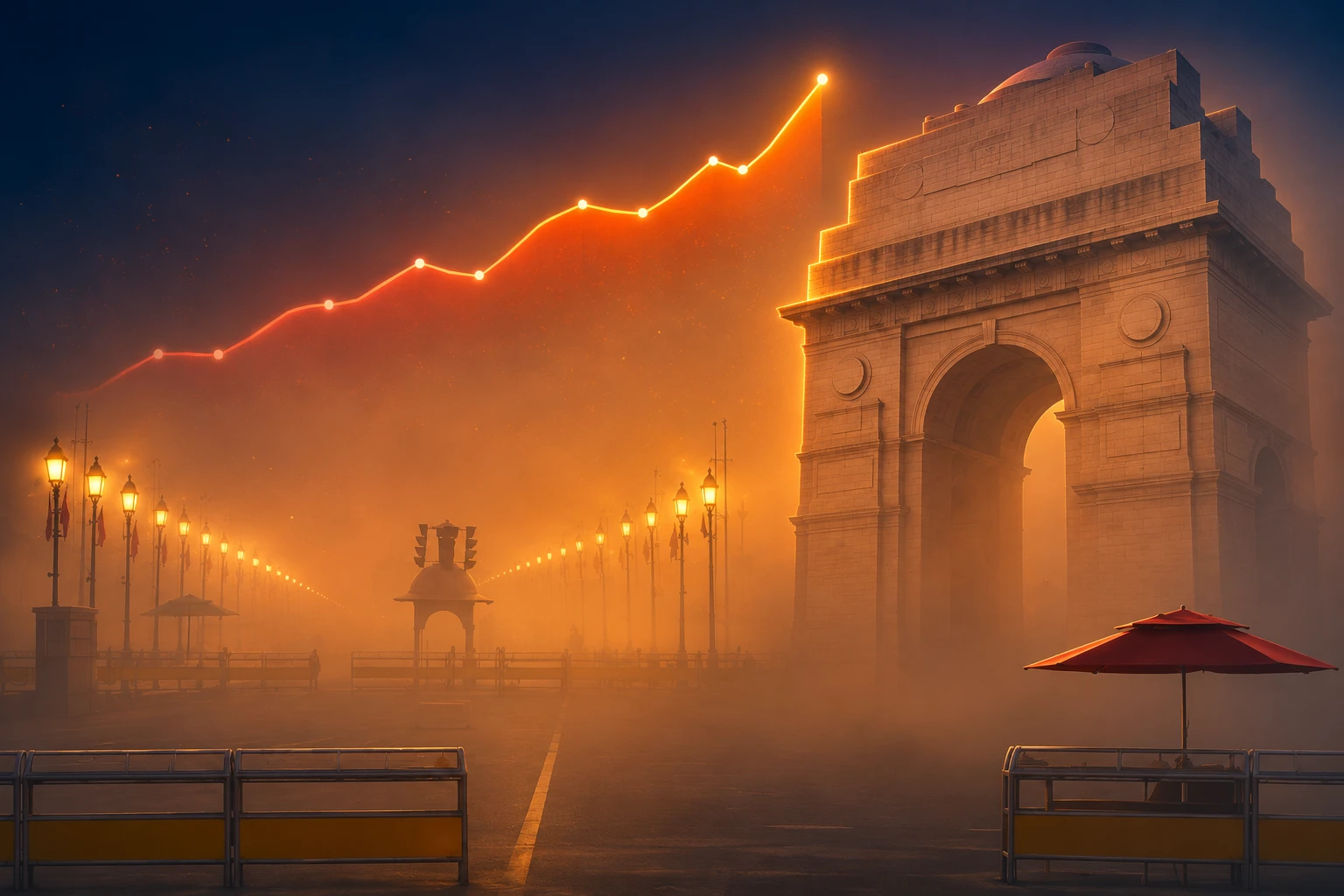
Stage II’s Eight Extra Actions
A September rewrite is the reason Stage II looks thinner than the version most winters trained people to expect. On September 28, CAQM’s full commission, chaired by Rajesh Verma, approved a new schedule. The Press Information Bureau’s note the next day recorded the new counts: 25 actions in Stage I, eight actions in Stage-II, 10 in Stage III and 5 in Stage IV, 48 in all.
Diesel generator rules and a ban on BS-IV and older buses entering from NCR and adjoining states moved from Stage II into Stage I. So did several dust and waste items that used to be repeated. When Stage II fires now, it does not newly switch off tandoors or generator sets. Those duties are supposed to be live already.
THE EIGHT STAGE II ACTIONS
- Night sweeping: Daily mechanical or vacuum sweeping of identified roads, with water, extra shifts, and dust sent to designated landfills.
- Dust suppressants: Water plus suppressants on heavy corridors before peak traffic.
- Hotspots: Targeted work on the main polluting sector at each listed hotspot.
- Site inspections: Tighter checks on dust control at construction and demolition sites, not a halt on the work itself.
- Parking fees: Higher charges to push people off private cars.
- Staff heaters: Resident welfare associations must give electric heaters to security, sanitation and garden staff so they do not burn biomass or mixed waste.
- Staggered offices: Delhi and the governments of Gurugram, Faridabad, Ghaziabad and Gautam Buddha Nagar stagger timings for public offices and municipal bodies.
- Central offices: The Centre may stagger timings for its own offices in Delhi-NCR.
CAQM also asked residents to use public transport, keep filters fresh, skip open waste burning, and work from home if the job allows. Raising parking fees is the one Stage II lever that hits private cars directly, and Delhi’s winter plan had already doubled authorised parking rates from November 1 to February 28, with Delhi Metro lots exempt. Stage II repeats a price signal that is, in the capital, already on the board.
Sweepers and sprinklers still matter on dusty corridors. They do not touch farm fire, fireworks, or a stagnant wind field. The louder problem is that the extra toolkit is municipal housekeeping, while the emissions that usually break November sit outside it.
A Separate 16-Day Squeeze Starts November 5
The harder curbs are not in Monday’s Stage II list. They are on a calendar. Union environment minister Bhupender Yadav said CAQM would halt construction and demolition across the NCR from November 5 to 20, calling the stretch the region’s peak pollution period. Member Secretary Tarun Kumar Pithode signed the order on October 30.
Dust-generating demolition and outdoor building work is restricted across the NCR for those 16 days. The curb also covers highways, roads, flyovers, power lines, pipelines and telecom work. Railways, Metro, airports, interstate bus terminals, hospitals, water and sanitation, national security, defence, and other projects of national importance stay exempt.
Offices face a parallel cap. Government and private offices in Delhi, Gurugram, Faridabad, Sonipat, Ghaziabad and Gautam Buddha Nagar may put only 50% of staff in the building. The rest work from home, with a carve-out for industry and essential services where that split is not feasible.
#ORDER | CAQM DIRECTIVES FOR AIR POLLUTION CONTROL | 05–20 NOVEMBER 2026
In view of the anticipated seasonal rise in air pollution across Delhi-NCR, the Commission for Air Quality Management (CAQM) has directed the implementation of precautionary measures from 05 November to 20… pic.twitter.com/7OWbKSM8op
— DC Gurugram (@DC_Gurugram) October 31, 2026
STAGE II VERSUS THE NOVEMBER 5 WINDOW
| Measure | Stage II from November 2 | CAQM window, November 5 to 20 |
|---|---|---|
| Construction | Intensify dust inspections at sites | Restrict dust-generating outdoor work across NCR |
| Offices | Stagger public office timings in Delhi and four NCR districts | Cap physical attendance at 50% in Delhi and five NCR districts |
| Private cars | Raise parking fees | No new parking rule in this order |
| Road dust | Daily sweeping and sprinkling | Not the focus of the Oct 30 order |
Stage III, which starts at AQI 401, is the GRAP stage that normally stops dusty building work. CAQM has pulled a Stage III-style halt forward by date, not by index, and parked it on the Diwali fortnight. Outdoor crews on ordinary sites lose those 16 days. Metro and hospital jobs keep running. Idle traffic on broken roads still throws dust that the night sweepers are then asked to pick up, which is the complaint already coming off Gurugram’s own order thread: the machines follow the potholes instead of the potholes getting fixed.
Green Crackers on November 7 and 8
Diwali falls on November 8. On the same day Stage II began, the Supreme Court made public an October 29 order that opens a two-day window for certified green crackers. A bench of Justices M.M. Sundresh and Prasanna B. Varale allowed bursting between 6 am and 7 am and between 8 pm and 10 pm on November 7 and 8. The complete ban returns on November 9.
Only CSIR-NEERI green crackers with PESO licences may be made and sold. Barium formulations are out. So are series ‘ladis’ and garlands. Manufacture is allowed from November 2 to November 6. Sale is confined to sites named by district officials; online sale is barred. Each box needs a product-specific QR code. Bursting is banned within 300 metres of hospitals, nursing homes, primary and district health centres, old-age homes and notified silence zones.
THE DIWALI CRACKER RULES
- The days: November 7 and 8 only, with the full ban restored on November 9.
- The clock: 6 am to 7 am, then 8 pm to 10 pm, on both days.
- The product: CSIR-NEERI green crackers with PESO licences; no barium, no ladis.
The court said religious practice cannot override public health, then wrote a narrow exception into the same week as Stage II and the building halt. Night sweepers will still be on the roads. Parking will still be dearer. Certified crackers will still be legal for three hours across two evenings, including Diwali night, unless local officers block a street under the 300-metre rule.
Enforcement is already the weak joint. Residents have been flagging open burning and ignored dust rules under Stage I. A two-day cracker window is harder to police than a parking board. Green crackers cut some metals; they still add a pulse of particles into a Very Poor night with weak winds.
Winter Means Have Oscillated Between 280 and 304
Stage II is not a new machine. It is the same seasonal switch, firing later this year because October stayed cleaner, then firing anyway once the weather flipped. Manoj Kumar, an analyst at the Centre for Research on Energy and Clean Air, tracked daily AQI and GRAP stages from October 2022 through February 2026 and found no steady winter improvement after the 2022 GRAP rewrite.
FOUR WINTERS OF DELHI AQI
| Winter | Mean AQI | Median AQI | Stage III-IV days |
|---|---|---|---|
| 2022-23 | 280 | 294 | 32 |
| 2023-24 | 304 | 324 | 39 |
| 2024-25 | 285 | 289 | 57 |
| 2025-26 | 295 | 305 | 42 |
Both the mean and the median in 2025-26 were higher than in 2022-23. Delhi spent 78% to 83% of the sampled winter days at Stage II or higher, roughly four days in five. Stage III and IV days peaked at 57 in 2024-25 and eased to 42 last winter, without pulling the mean back to 280.
CREA also lined up 12 times the city jumped from Stage II or below into Stage III or IV, three episodes in each of the four winters. In 10 of those 12, the index was worse in the week after the tighter curbs. The sharpest jump in that set came after November 2, 2023, when the mean moved from 317 to 431, a 114-point rise. Kumar’s conclusion was that emergency stages do not, by themselves, reverse a winter once the weather and the regional sources have locked in.
The invocation dates match the ritual. Stage II came on October 21, 2023, with the index at 248, and on October 21, 2024, at 310. In 2025 it came on October 19, with the index at 296 at 4 pm and 302 at 7 pm, a day before Diwali. In 2026 it arrived on November 2, later than those three winters, at 324, six days before Diwali. The date moved. The band did not.
Why This November’s Weather Is Stacked Against the City
CAQM’s own order pins the two-day crash on the weather. The monthly outlook behind that forecast is not gentle. IMD’s November 2026 note, issued on October 31, said very strong El Nino conditions are in place over the equatorial Pacific and are likely to last through November and December.
IMD’S NOVEMBER OUTLOOK
- Pacific state: Very strong El Nino now, likely to hold through December.
- Rain: Below-normal for most of India, with the country as a whole most likely under 77% of the long-period average of 29.7 mm.
- Heat: Above-normal maximum temperatures over most of the country, except some Himalayan foothills.
- Nights: Above-normal minimum temperatures over most of India, except many parts of the centre and east.
Northwest India is one of the pockets where November rain could still be normal to above normal. That is a local maybe, not a seasonal rescue. Neutral Indian Ocean Dipole conditions are likely through December, so the Pacific signal is the one IMD is carrying into early winter.
El Nino does not invent Delhi’s fumes. It can slow the winds that usually carry them out and cut the rain that would wash them down. A late-monsoon October bought the city a Moderate reading of 117 on October 31. Two Poor-to-Very-Poor days later, Stage II was on, the building halt was three days out, and the court had already reserved two Diwali evenings for green crackers. IMD and IITM have told the sub-committee the index is likely to stay in the Very Poor band in the coming days, which is the same forecast that triggered Stage II.

ADNOC Ship Hit in Hormuz Leaves One Crew Missing

SpiceJet’s Rs 5,500 Crore Plan Follows a Rescue That Failed

Hasina’s Return Fight Sets Fire to Yunus’s Bank

Bancroft Recants the 2018 Inquiry and Names the Team

Adhikari Ties the Saffron Saree Row to School Licences

Clancy Juror Says the Holdout Never Cited Evidence

The iPhone 18 Pro Max Splits Apple’s Fall in Two

OpenAI Calls GPT-6 Astra AGI Then Locks Its Exploits

Trump Claims Hormuz Control as Oil Holds Near $96

Russia Closes the Goethe-Institut Berlin Tried to Save

 NEWS2 months ago
Clancy Juror Says the Holdout Never Cited Evidence
- NEWS3 months ago
The iPhone 18 Pro Max Splits Apple’s Fall in Two
- NEWS3 months ago
OpenAI Calls GPT-6 Astra AGI Then Locks Its Exploits
- BUSINESS3 months ago
Trump Claims Hormuz Control as Oil Holds Near $96
- LIFESTYLE3 months ago
Russia Closes the Goethe-Institut Berlin Tried to Save
- AUTO3 months ago
Volkswagen’s Job Cuts Leave Four Plants Without Cars
- NEWS3 months ago
Dyson Puts Nurovi Robots on Sale Without the UV Flagship
- BUSINESS2 months ago
US Destroys Five Iranian Tankers as the Shock Hits Jordan










