
AUTO
Delhi High Court Leaves the Number-Plate Vehicle Ban Standing
The Delhi High Court refused to stay a winter ban that blocks non-Delhi pre-BS-VI vehicles while the city’s own older fleet keeps running through January.

The Delhi High Court refused on November 2 to stay a winter ban on non-Delhi pre-BS-VI vehicles entering the capital. A bench of Acting Chief Justice Nitin Wasudeo Sambre and Justice Sanjay Sharma issued notice on a Faridabad lawyer’s plea and listed it, with a related case, for November 27. The curb has already run from November 1 and lasts until January 31, 2027, while Delhi-registered older petrol and diesel cars keep plying.
Gurmukh Dass Kohli, the petitioner, told the court the rule sorts identical exhaust by the number plate. His BS-IV petrol car is registered in Haryana.
High Court Leaves the Number-Plate Filter Standing
Kohli, appearing through advocate Anurag Saxena, challenged paragraph 4 of a June 23, 2026, notice from the Department of Environment and Forests, issued under Section 5 of the Environment (Protection) Act, 1986. Saxena argued that Delhi needed a full plan, not a piecemeal or knee-jerk step that treats one car differently from an identical car because of where it was registered.
The plea says pre-BS-VI vehicles registered in Delhi may still run in the city through the ban, while similar vehicles from neighbouring states cannot enter. That, it argues, fails Article 14 because the split turns on the registering office, not on what comes out of the pipe. The bench declined a stay and kept the notice alive until the November 27 hearing.
The classification turns on the place of registration and not on emission. Exhaust does not change with the registering authority; the differentia has no nexus with the object of controlling pollution and fails the test of Article 14.
Petition of Gurmukh Dass Kohli, Delhi High Court
Kohli also lives the commute the order describes. Advocates and litigants who travel into Delhi from the wider National Capital Region, the plea says, are hit harder than residents who already hold a Delhi registration on an older car.
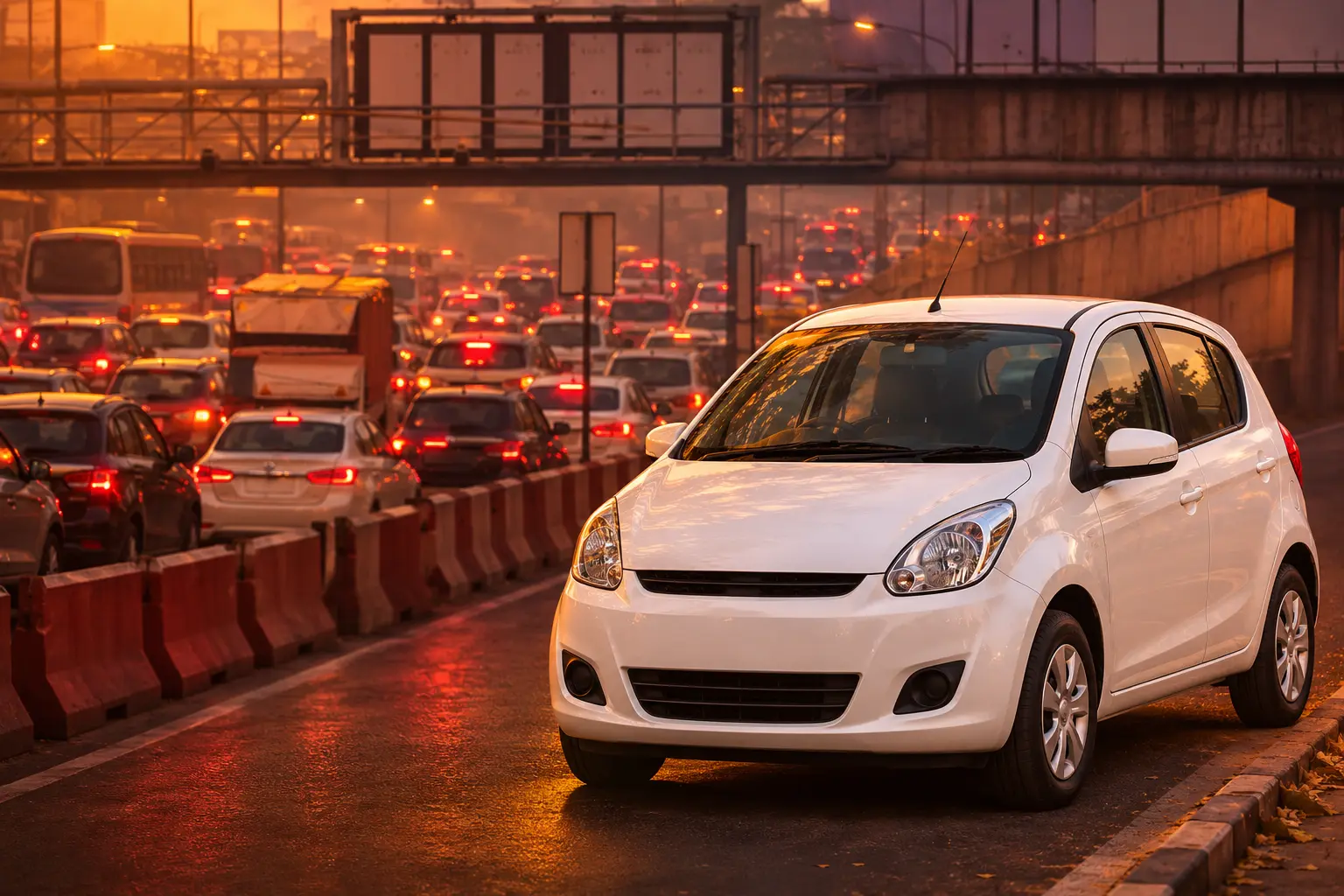
Exhaust Does Not Follow the Number Plate
The operative line is blunt. From November 1 to January 31, all motor vehicles registered outside Delhi and below BS-VI emission standards “shall not be permitted to ply in Delhi.” Transport, the Municipal Corporation and Delhi Traffic Police are told to enforce it. Compressed natural gas and electric vehicles are out of the net, as are ambulances, fire tenders, police vehicles and any other class the Environment Department specially exempts.
A Delhi-registered BS-IV hatchback of the same year can still use those roads. A Haryana-registered twin cannot. In December 2025 the Supreme Court allowed action against over-age BS-III and lower vehicles, while keeping BS-IV and newer cars outside seizure based on age alone. The winter gate then adds a second shield for the city’s own BS-IV stock: it is not the vehicle this entry bar is built to stop.
Delhi Traffic Police told motorists the curb sat “under the revised GRAP rules,” then listed below-BS-VI vehicles, missing Pollution Under Control certificates, non-compliant interstate buses, non-destined trucks, tractors and “certain vehicles registered outside Delhi.”
From 1 November 2026, vehicle entry into Delhi will be restricted under the revised GRAP rules.
✅ Allowed: BS-VI, CNG, electric and exempted vehicles, subject to applicable rules.
⛔ Restrictions apply to:
* Vehicles below BS-VI standards
* Vehicles without a valid PUCC
*… pic.twitter.com/rTtsr35sXi— Delhi Traffic Police (@dtptraffic) October 29, 2026
A valid PUC does not lift the plate test. Officers at the border are not being asked whether the engine is dirty today. They are being asked where the car was registered, and the answer decides whether it turns around.
48 Lakh Older Vehicles Sit Next Door
Ministry of Road Transport and Highways registration data, compiled for the adjoining NCR districts, put 48 lakh pre-BS-VI vehicles next door to Delhi. About 3.02 crore Bharat Stage I to IV vehicles sit on the books in Uttar Pradesh, Haryana and Rajasthan as a whole. The 48 lakh are the ones that cross in and out, often daily.
THE OLDER STOCK AROUND DELHI
| Slice | Count | Share of the 48 lakh |
|---|---|---|
| Haryana NCR districts | 30.65 lakh | More than 60% |
| Uttar Pradesh NCR districts | 11.8 lakh | Smaller than Haryana’s block |
| Rajasthan NCR districts | 5.6 lakh | The smallest of the three |
| Two-wheelers across those districts | 36.5 lakh | About three-quarters |
| Cars and cabs | 7.26 lakh | 15% |
| Goods vehicles, buses and tractors | About 2.9 lakh | 6% |
Gurugram, Faridabad, Rohtak, Sonipat, Jhajjar, Nuh, Rewari and Palwal make up the Haryana pile. Two-wheelers dominate the headcount, which is why a car-only picture of the ban understates the queue. In the heavier classes diesel is the rule: 81% of goods vehicles, 70% of buses and 93% of tractors and farm vehicles.
Those figures are registrations, not daily crossings. Delhi has 23 entry points, and officials estimate that more than 12 lakh vehicles enter the capital every day. Traffic officers told interviewers it is almost impossible to turn every non-compliant vehicle without choking the gates, and that once a car is on a flyover into the city it is hard to send back. Fines they described range from Rs 20,000 to Rs 40,000, with camera challans waiting inside the city for anyone who slips through.
CAQM Never Wrote a Calendar Ban
The Commission for Air Quality Management, chaired by Rajesh Verma, approved a revised Graded Response Action Plan on September 28 and published it the next day. The plan has 48 actions across four GRAP stages: 25 in Stage I (Poor, AQI 201-300), eight in Stage II (Very Poor, 301-400), 10 in Stage III (Severe, 401-450) and five in Stage IV (Severe+, above 450).
Private older cars are not banned on a winter calendar in that schedule. Under the Stage III Severe air quality band, the four-wheeler curb is limited to BS-III petrol and BS-IV diesel cars in Delhi plus Gurugram, Faridabad, Ghaziabad, Gautam Budh Nagar and Sonipat. Stage III also names diesel BS-IV and below light and medium goods vehicles registered outside Delhi. BS-IV and below buses from NCR and adjoining states were moved from Stage II to Stage I. None of those lines is a three-month lock on every non-Delhi petrol BS-IV car, on every hour of every day, whatever the AQI.
WHAT EACH RULE ACTUALLY STOPS
| Instrument | Trigger | Who is stopped |
|---|---|---|
| GRAP Stage III | Delhi AQI 401-450 | BS-III petrol and BS-IV diesel four-wheelers in Delhi and five NCR districts |
| GRAP Stage III | Same Severe band | Diesel BS-IV and below light and medium goods vehicles registered outside Delhi |
| GRAP Stage I (revised) | AQI 201-300 | BS-IV and below buses from NCR and adjoining states, except EV, CNG and BS-VI diesel |
| Delhi June 23 notice | November 1 to January 31, any AQI | Every non-Delhi motor vehicle below BS-VI, unless exempted |
The gazette’s own recitals undercut the blanket. Across the winters of 2023-24, 2024-25 and 2025-26, average AQI from November 1 to February 15 sat between 312 and 342, which is Stage II, with peaks of 461 to 494. Stage II does not, in CAQM’s table, take a BS-IV petrol private car off the road. Kohli’s plea puts the same point in court language: from November 1, 2026, to January 31, 2027, “on every day and at every hour, irrespective of the Air Quality Index on that day,” he is barred from driving his Haryana car into Delhi, while a comparable Delhi-registered BS-IV car is not.
The Indian Institute of Tropical Meteorology’s Decision Support System puts transport at 15-20% of Delhi’s winter pollution. A joint IIT-Delhi and TERI study found about 16,900 heavy-duty trucks enter daily and produce 61% of transport-related PM2.5 between 10 pm and 7 am. The winter passenger-plate filter does not touch that night truck share, and it does not touch a Delhi number on an older engine.
Ghazipur Backed Up on Day One
The gate closed on Sunday, November 1, a day before the High Court sat. Environment Department figures compiled till 5 pm that day are the working tally.
DAY ONE AT THE BORDERS
- Checked: 14,930 vehicles by Delhi Traffic Police and the Transport Department.
- Turned back: 1,539, or 10.31% of those checked.
- Entry penalties: 127 challans, 62 vehicles impounded, Rs 2 lakh in fines.
- PUCC: 566 challans and Rs 56.6 lakh.
- Among those sent back: 140 light motor vehicles, 54 light commercial vehicles, 95 heavy and medium goods vehicles and 34 buses.
- Two-wheelers and others: of 1,423 checked, 789 turned back and 38 impounded.
- Non-destined traffic: 7,279 checked, 314 turned back, no challans on that slice.
- Exempt verified: 740 CNG, electric and essential-service vehicles allowed in.
Construction and demolition sites added Rs 9.8 lakh in environmental compensation, taking the day’s penalties and compensation to Rs 68.4 lakh. Delhi environment minister Manjinder Singh Sirsa posted the check and PUC counts the same evening, with 300 sites inspected.
Our teams are enforcing vehicle entry restrictions, checking PUC compliance and tackling construction dust. Today : 14,930 vehicles checked, 566 PUCC challans and 300 sites inspected. Keep PUCC valid, follow entry rules and dust norms. The quest for clean air needs our collective… pic.twitter.com/LyAn5pVYw8
— Manjinder Singh Sirsa (@mssirsa) November 1, 2026
On November 2, the first working morning of the ban, Ghazipur backed up as officers stopped non-BS-VI traffic on the Uttar Pradesh side. The pattern is the one the stay plea asked the court to freeze: non-Delhi BS-IV cars blocked at Delhi border checks, while a Delhi plate on the same engine rolls through. People who drive from Faridabad to Noida, and have to cut through Delhi because there is no other road, sit in that queue even when their trip is NCR to NCR.
Haryana and Uttar Pradesh could answer with a mirror rule on Delhi plates. That counter has already been floated as the clean reply to a one-way gate. It would not measure exhaust either. It would only copy the differentia.
Parking Fees Were Already in the Gazette
Kohli’s papers note that the same June 23 notice already set milder tools, including year-round PUC checks and higher parking charges, and asked why a complete entry bar was needed on top. Those milder tools are in force anyway.
WHAT THE JUNE 23 NOTICE ALSO DOES
- No PUC, no fuel: All petrol, diesel and CNG/LPG outlets in Delhi must refuse fuel without a valid Pollution Under Control certificate, all year, with ANPR and VAHAN used to catch pumps that skip the check.
- Parking: Authorised lot fees are doubled from November 1 to February 28, with Delhi Metro lots kept out of the hike because they feed public transport and park-and-ride.
- Exemptions from the entry bar: CNG, electric, ambulance, fire, police, and any other class the Environment Department names.
Chief Minister Rekha Gupta folded those vehicle rules into a Winter Action Plan that also caps physical attendance at 50% in government and private offices from November 1 to January 31, with emergency services out, and bars dust-generating demolition and outdoor civil work except listed public infrastructure. Union environment minister Bhupender Yadav sat with her on September 28 when that package was reviewed. The Traffic Police helpline for the vehicle rules is 011-25844444 or 1095.
The Delhi High Court Bar Association wrote to the Lieutenant Governor seeking an exemption for judges, lawyers and court staff, calling the legal fraternity an essential service. That ask sits uneasily beside Kohli’s Article 14 case. A special pass for one profession would deepen the split the petition attacks, which is already a split between plates, not between engines.
Kohli Comes Back on November 27
THE ROAD TO THE NEXT HEARING
- June 23, 2026: Environment Department issues the winter directions, including the outside-Delhi below-BS-VI ply ban from November 1 to January 31.
- September 28, 2026: CAQM’s full commission revises GRAP into 48 staged actions and does not write a matching calendar lock on private non-Delhi cars.
- October 20, 2026: Chief Minister Rekha Gupta announces the Winter Action Plan package around the same entry rule.
- November 1, 2026: The entry bar takes effect; 1,539 vehicles are turned back by 5 pm.
- November 2, 2026: The division bench refuses a stay and issues notice.
- November 27, 2026: Kohli’s petition is listed with a related case.
By the time the bench hears him, the ban will have been live since November 1. Standing counsel Sameer Vashisht appears for the Delhi government. The question on the file is still the one in the petition: whether a Haryana BS-IV car and a Delhi BS-IV car are different for Article 14 because their plates are different. The stay was refused. The filter stays up until that date, and the city’s own older fleet stays on the road with it.

ADNOC Ship Hit in Hormuz Leaves One Crew Missing

SpiceJet’s Rs 5,500 Crore Plan Follows a Rescue That Failed

Hasina’s Return Fight Sets Fire to Yunus’s Bank

Bancroft Recants the 2018 Inquiry and Names the Team

Adhikari Ties the Saffron Saree Row to School Licences

Clancy Juror Says the Holdout Never Cited Evidence

The iPhone 18 Pro Max Splits Apple’s Fall in Two

OpenAI Calls GPT-6 Astra AGI Then Locks Its Exploits

Trump Claims Hormuz Control as Oil Holds Near $96

Russia Closes the Goethe-Institut Berlin Tried to Save

 NEWS2 months ago
Clancy Juror Says the Holdout Never Cited Evidence
- NEWS3 months ago
The iPhone 18 Pro Max Splits Apple’s Fall in Two
- NEWS3 months ago
OpenAI Calls GPT-6 Astra AGI Then Locks Its Exploits
- BUSINESS3 months ago
Trump Claims Hormuz Control as Oil Holds Near $96
- LIFESTYLE3 months ago
Russia Closes the Goethe-Institut Berlin Tried to Save
- AUTO3 months ago
Volkswagen’s Job Cuts Leave Four Plants Without Cars
- NEWS3 months ago
Dyson Puts Nurovi Robots on Sale Without the UV Flagship
- BUSINESS2 months ago
US Destroys Five Iranian Tankers as the Shock Hits Jordan










