
BUSINESS
Qatar Mediates U.S.-Iran Talks With Its Gas Plants Exposed
Qatari mediators spent 12 hours in Tehran to restart U.S.-Iran talks, racing a midterm strike threat that would hit Gulf energy plants first.

Qatari mediators sat in Tehran for more than 12 hours on Friday to restart U.S.-Iran talks before a possible strike after the November 3 midterms. The same channel continues in Doha on Saturday.
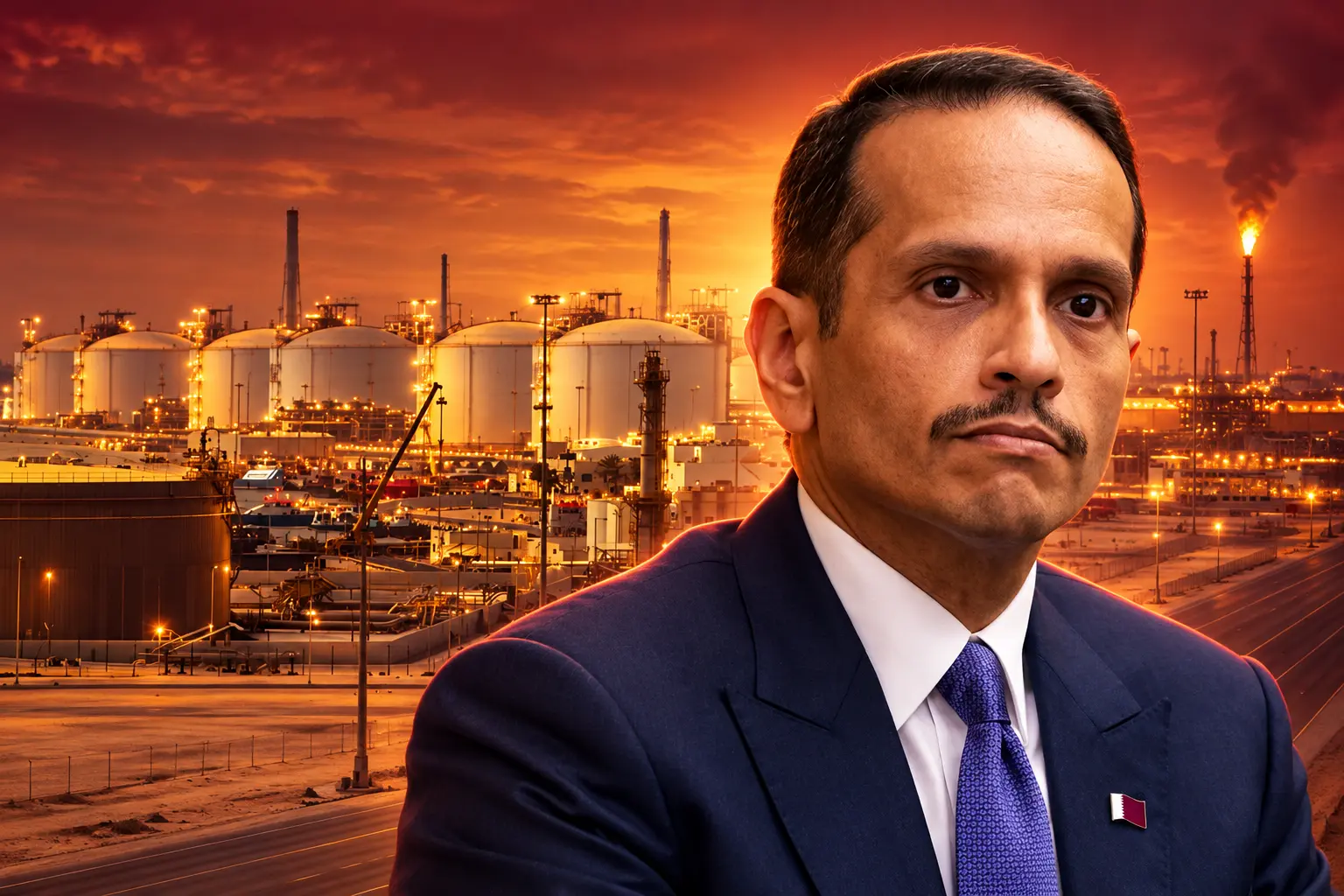
Iranian missiles already wrecked two liquefied natural gas trains at Ras Laffan in March, and Tehran has vowed to hit Qatari oil and gas plants again if the United States bombs Iranian energy sites.
Qatar Sat in Tehran With Its Plants Exposed
Iran’s state news agency IRNA said the team that arrived Friday morning was led by a senior adviser to Prime Minister and Foreign Minister Sheikh Mohammed bin Abdulrahman Al Thani, and that the visit was coordinated with U.S. officials. A diplomatic source in contact with the White House during the daylong session described progress and said the work was still aimed at unlocking a deal.
Vice President JD Vance had already sent a letter to National Security Council Secretary Mohsen Rezaei, carried by Qatar, that sketched a framework for talks rather than a finished peace text. Sources in Tehran called the tone more respectful than earlier U.S. messages. That is a low bar, and it is not a ceasefire.
Doha is doing this work with scars of its own. On March 18, Israeli forces struck Iran’s South Pars gas field. Hours later, and again on March 19, Iranian forces attacked oil and gas infrastructure at Ras Laffan, the liquefied natural gas hub that Human Rights Watch says supplies about one-fifth of the world’s LNG.
WHAT THE MARCH STRIKES TOOK FROM QATAR
- The trains: Two of Qatar’s 14 LNG trains were damaged, QatarEnergy chief executive Saad al-Kaabi said.
- The volume: Those two trains can produce 12.8 million tons a year, about 17% of Qatar’s LNG export capacity.
- The outage: Al-Kaabi said repairs would sideline that output for three to five years and cost about $20 billion in lost annual revenue.
- The partners: ExxonMobil is in the damaged LNG trains and Shell is in the damaged gas-to-liquids unit, he said, and QatarEnergy had already declared force majeure on its LNG output.
Al-Kaabi said he had never imagined Qatar would be hit that way, in Ramadan, by a country he called a brotherly Muslim state. Qatar has since told Iran that threats against Arab Gulf states have to stop, and that the Strait of Hormuz has to reopen, if mediation is going to work. That is not the language of a referee with nothing on the board.
The Sequence Fight Has Not Moved
The Qataris want both capitals to accept a short set of reciprocal steps, carried out over a few days, that would put them back in direct talks on the nuclear program and on the war around it. Iran has floated a seven-day plan of those steps. The order of the steps is the fight.
Washington wants nuclear concessions as the price of sitting down. Tehran wants the naval blockade lifted, frozen funds released, and oil sales restored before it talks about nuclear sites. The Qatari bridge is to send U.N. inspectors into bombed plants first, with some sanctions relief as the U.S. answer.
THREE POSITIONS IN THE ROOM
| Party | First demand | What it would trade |
|---|---|---|
| Washington | Nuclear concessions before talks resume | Some sanctions relief if inspectors go in |
| Tehran | Lift the blockade, release frozen funds, allow oil sales first | A seven-day plan of steps, then talks |
| Doha | Reciprocal steps over a few days | Inspectors at bombed sites as a first confidence step |
Tehran had already dismissed a Qatari draft earlier in the week as falling short of its terms. Foreign Minister Abbas Araghchi has kept a public line open with the mediating countries, but the nuclear file is still where the last ceasefire came apart. Each side wants the other to move first, and a few days is a thin window for that kind of distrust.
Bessent Wants the Blockade to Keep Working
Treasury Secretary Scott Bessent is the aide arguing hardest to stay on the economic track instead of rolling back into a new bombing campaign. On August 24 he launched Operation Economic Outcast and called it, in his own words, an economic onslaught against Iran’s financial connections around the globe.
“Our objective is to sever every economic lifeline that sustains this tyrannical regime until Tehran stands alone,” Bessent said that day. He named five sectors as new targets for secondary sanctions: digital assets, technology, gold, aviation, and shipping. OFAC, he said, was designating over 60 entities, people, and vessels in the same breath.
Treasury launched Operation Economic Outcast to tighten the noose and block every potential source of revenue that funds the IRGC and murderous Iranian regime.
Less than two months later, we have decimated every layer of Iran’s oil lifeline. Its shadow tanker fleet stands… pic.twitter.com/eQD9Wqc8bH
— Treasury Secretary Scott Bessent (@SecScottBessent) October 23, 2026
A Treasury report circulated this week said Iran has not loaded oil onto tankers since August 25. U.S. Central Command has said the naval blockade stopped Iran from exporting $25 billion in crude. The same Treasury report said the rial has lost roughly a quarter of its value since August. Bessent has said output could fall 20% to 25%.
OPERATION ECONOMIC OUTCAST, IN FIGURES
- Launch: August 24, 2026, with new sectoral determinations and over 60 designations.
- Oil: No tanker loadings since August 25, per the Treasury report; CENTCOM puts blocked crude at $25 billion.
- Currency: The rial down roughly a quarter since August, according to that report.
- Bessent’s forecast: Iranian output down 20% to 25% if the campaign is allowed to run.
He has also said some military pay is late and some police are not reporting for duty. That is his case to the president: the squeeze is working, and a new round of bombs would waste it. Defense Secretary Pete Hegseth and Secretary of State Marco Rubio do not buy the other half of that case. They doubt a nuclear deal with this Iranian government, a U.S. official said, and they want Trump’s record to include further weakening of it, including with more strikes.
Who Gets Hit If the Talks Fail
A new U.S. operation after the vote would be run with Israel and would likely hit energy sites, nuclear plants, and missile stores. Iran has said it would answer any U.S. strike on its energy plants by hitting oil and gas facilities in Saudi Arabia, the UAE, Qatar, Kuwait, and Bahrain. Those are the same capitals that have been telling Tehran to come back to the table before November 3.
Egypt, Turkey, Iraq, Pakistan, and Saudi Arabia have been urging Iran to resume talks before the midterms, a regional source said. Saudi and Turkish leaders have also asked Trump for more time. They are not asking as spectators. Gulf plants came under fire earlier in this war, and the next round would start from that map, not from a blank one.
Ras Laffan Lost Two LNG Trains in March
The Revolutionary Guard, in March, named a list that already included Saudi Arabia’s Samref refinery and Jubail complex, the UAE’s al-Hosn gas field, and Qatar’s Ras Laffan and Mesaieed plants, and said those sites had become direct targets. Fires followed. European gas jumped hard in the days after Ras Laffan was hit, and QatarEnergy said production restart depended on the shooting stopping.
Iranian security officials have also described plans to go after undersea cables in the Gulf if the United States and Israel start bombing again. Hezbollah, the source trail says, could open a second front on Israel. The energy hit is the one Gulf ministers can price. It is also the one they cannot dodge if they fail in Doha and the strike party wins in Washington.
After the Vote, Netanyahu Wants a Joint Strike
Israeli Prime Minister Benjamin Netanyahu is lobbying Trump to launch a joint operation against Iran as soon as the election is over. Vance, and Trump envoys Steve Witkoff and Jared Kushner, want talks restarted. Trump himself is skeptical that Iran will accept a deal he likes, even as he tells the country there is time.
There are talks. They want to talk. They keep talking…. We have time, frankly. It’s a war, but it is not a typical war.
Donald Trump, President, to reporters on Friday
He also said the war will get wrapped up soon and that he needs a guarantee there will never be a nuclear weapon. He did not say whether that guarantee arrives as a deal or as another air campaign. One U.S. official said Trump might be more inclined to order a major operation if Republicans lose badly, and that Iran’s best shot at a deal is now, because a president who feels embarrassed or cut off may choose something bold. A White House official said the election results will not be a factor in the Iran decision.
Those two statements cannot both be a guide for Tehran, and they do not have to be. Gulf governments are being told, in private, to prepare for a short, high-intensity campaign after the vote if diplomacy does not produce a workable frame. The incentive that leaks into the mediating room is ugly in a simple way: a bad night for Republicans is being treated as a reason to bomb, not a reason to wait. Iran can also run the clock through the vote and ask for more on the blockade once the pressure of November 3 is gone.
Inspectors Have Waited Since the 2025 Strikes
The inspector offer is not a new invention. IAEA Director General Rafael Grossi told the U.N. Security Council on October 27 that inspectors were pulled out at the end of June 2025, when the first U.S.-Israeli strikes on safeguarded plants began, and that they have been ready to go back for many months. The agency still cannot say that nuclear material under Iran’s safeguards agreement has not been diverted.
One area of particular concern is Iran’s previously declared nuclear material, which includes 440kg of High Enriched Uranium.
Rafael Grossi, IAEA Director General, U.N. Security Council, October 27, 2026
That 440kg of High Enriched Uranium is the stockpile the United States wants on the table from the first hour of any new talks. Grossi said the agency has seen no repair or rebuild at the plants damaged in 2025 and 2026, but that satellite watch is not a substitute for access. Inspectors are still working at the Bushehr power plant. They have not been allowed into Fordow, the Natanz enrichment plants, several sites at Isfahan, or the Khondab heavy water reactor.
On September 9, 2025, Grossi and Araghchi signed the Cairo Agreement on practical safeguards steps after the strikes, under Egyptian President Abdel Fattah El-Sisi. Grossi told the Council that revisiting that text could open a path back in. A year later, on September 9, 2026, the IAEA Board reported Iran to the U.N. Security Council. The United Kingdom said it was the first referral to the Security Council in two decades.
HOW THE WAR REACHED THIS WEEKEND
- Late June 2025: U.S. and Israeli strikes hit Iranian nuclear sites, and IAEA inspectors leave the country.
- September 9, 2025: Grossi and Araghchi sign the Cairo Agreement on safeguards after the attacks.
- February 28, 2026: The United States and Israel launched military operations against Iran; Supreme Leader Ayatollah Ali Khamenei is killed in the opening wave.
- March 18-19, 2026: Israel hits South Pars; Iran hits Ras Laffan and other Gulf energy sites.
- April 8, 2026: A temporary ceasefire takes hold. The White House says the operation struck more than 450 ballistic missile targets and about 800 attack-drone targets. A U.S. naval blockade of Iranian ports follows in April.
- August 24, 2026: Bessent launches Operation Economic Outcast. Iran’s last oil loading, the Treasury report says, is the next day.
- October 30-31, 2026: Qatari mediators sit 12 hours in Tehran, then carry the file to Doha.
The Defense Intelligence Agency, in an April assessment cited by Congress, still credited Iran with thousands of missiles and one-way attack drones that can reach U.S. and partner forces in the region. That is the arsenal Hegseth is looking at when he argues for more strikes. It is also the arsenal Gulf air defenses would meet if the inspector deal dies this weekend.
Saturday in Doha Is the Last Window
The Doha session is the same channel as Friday’s, not a new one. A meeting between Vance and Rezaei, if it happens at all, has been sketched for Doha or Istanbul on a one-week horizon. Nothing in the public record says Iran has accepted inspectors in exchange for sanctions relief, and nothing says Trump has accepted a blockade freeze without a nuclear step he can sell.
WHAT WE KNOW
- The clock: The November 3 midterms sit three days after the Friday Tehran session, and strike planning has been described to Gulf governments as live after that vote.
- The bargain: Inspectors into bombed sites, in return for some sanctions relief, is the Qatari attempt to break the sequence fight.
- The prior hit: Qatar already lost two LNG trains in March, and Iran has named Gulf energy plants as the answer to any new U.S. strike on Iranian energy sites.
WHAT IS UNCONFIRMED
- Iran’s answer: No public acceptance of the inspector-for-relief offer has been issued.
- Trump’s choice: Whether a deal he will accept exists, and whether a bad midterm night would push him toward a joint strike, is still an argument inside his own circle.
- The Doha product: Saturday’s session has not produced a signed set of reciprocal steps.
Iran has not yet answered the inspector-for-relief offer, and the strike plans remain on the table after the vote.

ADNOC Ship Hit in Hormuz Leaves One Crew Missing

SpiceJet’s Rs 5,500 Crore Plan Follows a Rescue That Failed

Hasina’s Return Fight Sets Fire to Yunus’s Bank

Bancroft Recants the 2018 Inquiry and Names the Team

Adhikari Ties the Saffron Saree Row to School Licences

Clancy Juror Says the Holdout Never Cited Evidence

The iPhone 18 Pro Max Splits Apple’s Fall in Two

OpenAI Calls GPT-6 Astra AGI Then Locks Its Exploits

Trump Claims Hormuz Control as Oil Holds Near $96

Russia Closes the Goethe-Institut Berlin Tried to Save

 NEWS2 months ago
Clancy Juror Says the Holdout Never Cited Evidence
- NEWS3 months ago
The iPhone 18 Pro Max Splits Apple’s Fall in Two
- NEWS3 months ago
OpenAI Calls GPT-6 Astra AGI Then Locks Its Exploits
- BUSINESS3 months ago
Trump Claims Hormuz Control as Oil Holds Near $96
- LIFESTYLE3 months ago
Russia Closes the Goethe-Institut Berlin Tried to Save
- AUTO3 months ago
Volkswagen’s Job Cuts Leave Four Plants Without Cars
- NEWS3 months ago
Dyson Puts Nurovi Robots on Sale Without the UV Flagship
- BUSINESS2 months ago
US Destroys Five Iranian Tankers as the Shock Hits Jordan










