NEWS
Census 2027 Brings Caste Questions Into Four Poll States
Population enumeration for Census 2027 begins December 1 in four poll-bound states, with caste, Aadhaar and parent questions landing during voter-roll revision.

Field trainers are preparing about 34 lakh enumerators for Census 2027, whose second phase opens December 1 in four poll-bound states. Uttar Pradesh, Uttarakhand, Goa and Punjab will face 40 questions, including caste and Aadhaar, before the rest of India is counted.
Each interview is meant to last 20-25 minutes and be typed on a phone, unlike the brief houselisting round earlier this year. Those four states have also just come through a Special Intensive Revision of electoral rolls, and a further summary revision still sits on the same winter calendar.
Four Poll-Bound States Start Counting on December 1
The Centre advanced population enumeration in the four states so the count is not running through assembly polling in early 2027. A Directorate of Census Operations briefing for Uttar Pradesh district magistrates sets a 35-day count from December 1 to January 4, 2027, with 40 questions asked of every person.
Residents in those states can use an optional self-enumeration portal from November 16 to 30. Enumerators then go door to door. A revisional round follows the January 4 close. Snow-bound belts of Uttarakhand were already counted with Ladakh, Himachal Pradesh and Jammu and Kashmir, against a reference moment of 00:00 hours on October 1, 2026.
Mritunjay Kumar Narayan, Registrar General and Census Commissioner of India, issued a separate notification on October 30 for every other state and union territory except Manipur. Self-enumeration there runs January 10 to 24, 2027. House-to-house work runs January 25 to February 28, with a revisional round from March 1 to 5. The reference moment for that larger map is 00:00 hours on March 1, 2027.
THE POPULATION ENUMERATION CALENDAR
- June 16, 2025: Gazette order S.O. 2681(E) declares that a census of the population of India shall be taken during 2027.
- April 1 to September 30, 2026: Houselisting and Housing Census runs on state-chosen 30-day windows, except in Manipur.
- September 30, 2026: Population enumeration finishes in Ladakh and notified snow-bound areas.
- November 16 to 30, 2026: Self-enumeration window in Goa, Uttar Pradesh, Punjab and non-snow-bound Uttarakhand.
- December 1, 2026 to January 4, 2027: Door-to-door population enumeration in those four states.
- January 10 to 24, 2027: Self-enumeration for the rest of the country, except Manipur.
- January 25 to February 28, 2027: Door-to-door count for the rest of the country, then a March 1-5 revisional round.
That winter split is why trainers in Uttar Pradesh were already in classrooms in late October, including a session in Ghazipur, while most of India still has a January start. Manipur remains off the calendar until a further declaration, after local demands that a National Register of Citizens exercise come first.
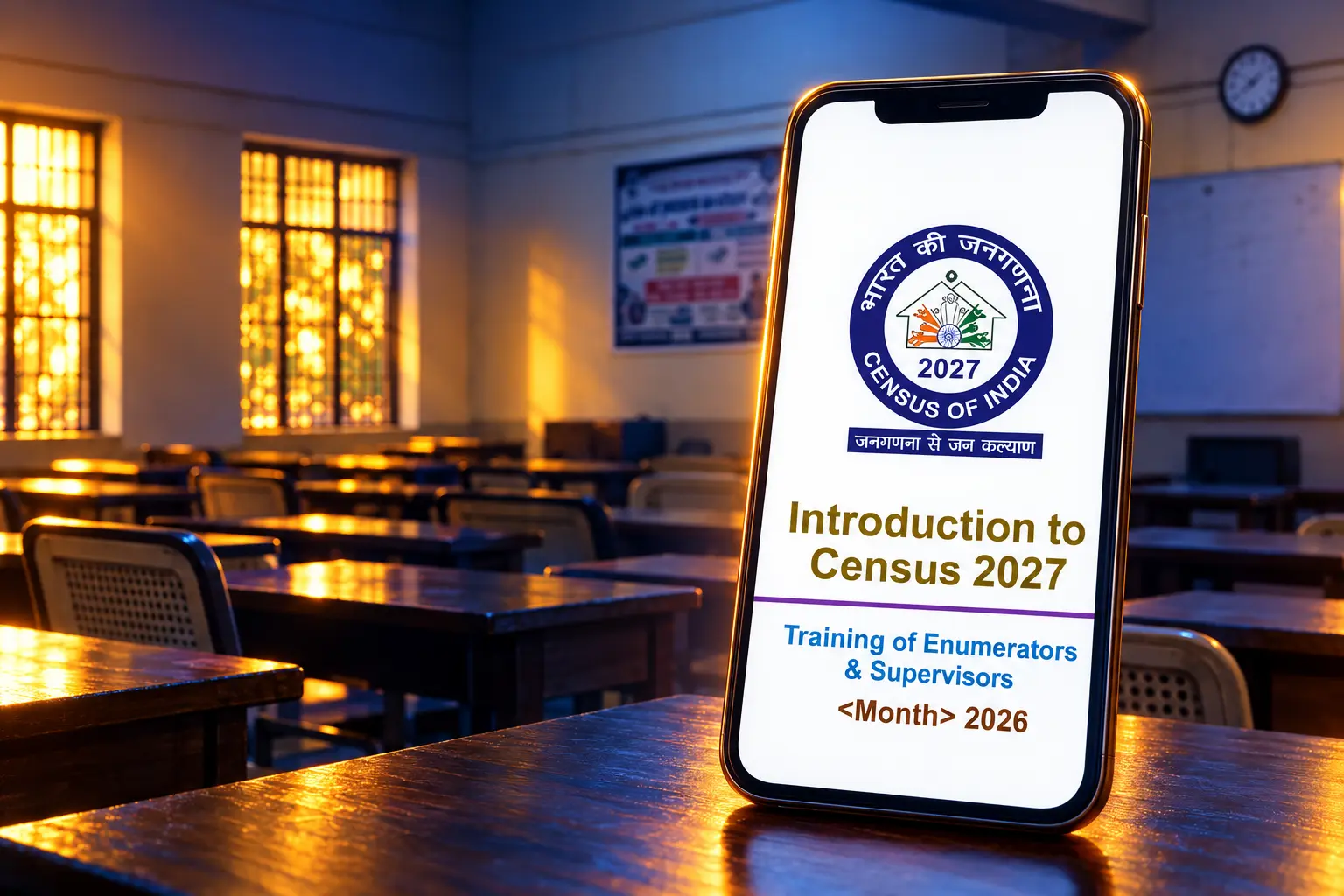
Forty Questions, Thirteen of Them New
Narayan notified the household schedule on August 14, 2026. Census 2011 asked 29 questions. Census 2027 asks 40, and the office describes 13 of those as new data fields. Religion, mother tongue, literacy, work, migration and fertility stay on the form. What is new is a stack of identity and family fields that never appeared on the 2011 schedule.
The additions include spouse’s name, nationality as declared, father’s particulars, mother’s particulars, digital literacy, permanent residential address, place of Covid-19 vaccination, total number of bank accounts, passport number, whether the person holds a driving licence, and, if available, mobile number, Aadhaar number and voter ID number. Caste beyond Scheduled Caste and Scheduled Tribe status is collected in the same round, the first such count since 1931.
NEW FIELDS ON THE 2027 SCHEDULE
| Field | Question | How it is asked |
|---|---|---|
| Caste | 10 | SC/ST names from a drop-down; others type the caste |
| Father’s particulars | 11 | New; includes name, and parental place and date of birth |
| Mother’s particulars | 12 | New; same family of details, including religion of parents |
| Place of Covid-19 vaccination | 34 | New |
| Bank accounts | 35 | Total number held |
| Mobile number | 36 | If available |
| Aadhaar number | 37 | If available |
| Voter ID number | 38 | If available |
| Passport number | 39 | For Indian passport holders |
| Driving licence | 40 | Whether the person has one |
Several of those lines match fields on the 2019 rehearsal form for the National Population Register, which the government later took off the Census 2027 track. Narayan has said the NPR update was delinked and that he sees no tie to the Special Intensive Revision of rolls. The questions still sit on the census form, and enumerators still have to ask them in homes that may also be sorting a voter-list notice.
Caste Goes in an Open Box, With No OBC Column
The Cabinet Committee on Political Affairs, chaired by Prime Minister Narendra Modi, decided on April 30, 2025, that caste would be counted in this census. Question 10 is labelled “Scheduled Caste (SC)/ Scheduled Tribe (ST)/ Caste.” For SC and ST respondents, enumerators pick from a prepared list. For everyone else, question 10(C) reads: “If not SC/ST in this State/UT-Enter Caste name.”
Trainers in Uttar Pradesh told staff there is no Other Backward Classes column. The caste fields are marked mandatory, with two exits: “Does not want to declare Caste” and “No Caste.” The Socio-Economic Caste Census of 2011, which was not released as a public caste table, produced about 46 lakh different caste strings. The 1931 Census, the last full caste count, recorded 4,147 castes. Open typing will decide which of those histories Census 2027 resembles.
HOW CASTE WILL BE WRITTEN DOWN
- SC and ST names: Chosen from a drop-down tied to the lists in force for that state or union territory.
- All other respondents: The enumerator types the caste exactly as it is spoken, with no prepared menu.
- Two refusals: “Does not want to declare Caste” and “No Caste” are built into the app.
- No OBC box: Backward-class status is not a separate code on the schedule.
Congress leader Jairam Ramesh called the caste method “deliberately flawed” and said the wider questionnaire had “a deeper nefarious purpose.” A field trainer in Uttar Pradesh put the same sensitivity in plainer terms, and told staff not to argue with the answer they are given.
You have to manually write the caste, as what is being told to you, there will be no drop box with options. It is a sensitive question and your job is not to argue or do any kind of commentary on the issue.
Field trainer, Population Enumeration session, Uttar Pradesh
Narayan had already written to state nodal officers in September to put extra time on religion, mother tongue, SC and ST status, caste, disability, migration, fertility and work, and on how to probe those answers without turning the visit into a debate.
Who Will Knock, and What They Are Paid
Each enumeration block is built around 750-800 people. In Uttar Pradesh, houselisting blocks that go above 850 people are split so the second-round workload stays manageable. The same state briefing puts the Phase 2 training pyramid at 8 national trainers, 305 master trainers at the State Institute of Rural Development in Lucknow, 7,500 field trainers across 75 district headquarters, and about 5,63,800 enumerators and supervisors at tehsil level.
Narayan fixed batch size at 40 to 45 people, and barred any batch above 50. Training for the four early states is supposed to finish by the third week of November; training for the January round is supposed to finish by January 15, 2027. On October 16 the Centre widened Census Rules, 1990, so private school teachers and members of institutions, societies and trusts can be appointed. Officials said the 34 lakh headcount for this phase cannot be met from government school staff alone, after private teachers in Uttar Pradesh, Maharashtra and Haryana went to court during houselisting.
PAY AND TRAINING IN THE FIELD
- Houselisting fee: Rs 9,000 after the first phase, under Circular No. 7 of December 24, 2025.
- Population enumeration fee: Rs 16,000 for the second phase, for a total honorarium of Rs 25,000.
- Training day: Rs 600 for enumerators and supervisors, of which Rs 200 is for refreshments.
- The device: Staff record answers on a mobile app on their own phones, not on paper schedules.
Duty exemption after training is limited to maternity, illness or retirement. Appointment orders, area maps and abridged house lists are supposed to be handed over in the classroom so staff can start walking their blocks before December 1. The Union Cabinet has approved Rs 11,718 crore for the whole census. District magistrates in Uttar Pradesh get Rs 1,50,000 for local outreach, and charge officers get Rs 25,000, with a written bar on big newspaper ads and large hoardings.
The Same Weeks Rewrite the Voter Lists
The four early census states are also the states whose rolls just went through Special Intensive Revision, with a Special Summary Revision now scheduled on top. Draft SSR rolls are due on November 12, claims and objections run to December 11, and final rolls are due on January 4, 2027, the same date Uttar Pradesh’s door-to-door census window closes. Assembly elections in Uttar Pradesh, Uttarakhand, Punjab and Goa are due in early 2027.
VOTER-ROLL CHANGES IN THE FOUR STATES
| State | Roll before SIR | Final roll | Names off the roll |
|---|---|---|---|
| Uttar Pradesh | 15.44 crore | 13.39 crore | 2.05 crore |
| Punjab | 2.14 crore | 2.01 crore | 13.6 lakh (6.3%) |
| Uttarakhand | 84.29 lakh | 71.59 lakh | 12.70 lakh |
| Goa | 11.85 lakh | 10.57 lakh | 1.28 lakh (10.8%) |
From December 1 an enumerator in these states will ask for Aadhaar and voter ID “if available,” plus parents’ names, religion and place of birth down to village, in households that may still be filing SSR claims through December 11. That is a statistical visit on paper. It is also a second official knocking on a door that has already been through a roll purge.
Independent tallies of Uttar Pradesh’s adult population have put the gap between estimated adults and the post-SIR roll in the crores. The Election Commission’s own figures already show 2.05 crore names off the Uttar Pradesh list. Census staff are not electoral registration officers. They will still leave those homes with a voter ID number, an Aadhaar number and a caste string stored on a personal phone that uploads to the Census Management and Monitoring System.
What Section 15 Still Protects
The legal shield is old. Section 15 of the Census Act, 1948, says census records are not open to inspection and are not admissible in evidence. Section 8 binds a respondent to answer to the best of their knowledge or belief. Nityanand Rai, Minister of State for Home Affairs, has told Parliament that individual census data is kept confidential and that only aggregated figures are published. The same Census Act confidentiality provisions make it an offence for a census officer to disclose what a household has said.
Former census officials have pointed out that 1951 census material was still used to build the National Register of Citizens in Assam, which is why the new parent and document fields alarm them. A group of 108 former civil servants in the Constitutional Conduct Group warned that if information “collected ostensibly for the Census” is later “transferred or mined for another governmental purpose,” the confidentiality principle would be compromised. “It must not be done by quietly expanding the Census questionnaire,” the letter said.
Statistician P.C. Mohanan argued the form should ask whether a person has Aadhaar, not the number itself, because personal identifiers are the wrong grain for a statistical count. Advocate Prashant Mali has said Section 15 is a hard statutory bar and that census records cannot be turned into an evidentiary citizenship file merely because another authority wants them. None of those objections changes the app. Question 37 still asks for the Aadhaar number if it is available, and question 11 and 12 still ask for the parents.
Snow-Bound Villages Are Already Counted
The June 16, 2025 Gazette notification that a census shall be taken during 2027 set two reference moments: March 1, 2027 for most of India, and October 1, 2026 for Ladakh and snow-bound non-synchronous areas of Jammu and Kashmir, Himachal Pradesh and Uttarakhand. Those high villages have already been through the 40 questions. The rest of the map, minus Manipur and the four early states, was timed on October 30.
Notification for the conduct of Phase II of Census 2027 i.e. Population Enumeration (PE) has been issued for all States and Union Territories, except Manipur.
Notifications for four States including Uttar Pradesh, Goa, Punjab and Uttarakhand along with the Union Territory of… pic.twitter.com/smQ6VOAJOm
— Census India 2027 (@CensusIndia2027) October 30, 2026
Houselisting, the first phase, used 33 questions on houses, assets and amenities and finished by September 30 except in Manipur. Population enumeration is the headcount that feeds delimitation, finance transfers and, this time, a caste table. India’s last census was in 2011. The 2021 round was held over because of Covid-19, leaving a 16-year gap. This is the eighth census since Independence and the first run fully on phones, with datasets promised the same year because there is no paper schedule to digitise later.
In the four states that vote next, that faster machine will be tested first, by staff who have been told not to argue about caste, on phones they own, in the same weeks a voter-list rewrite is still open. The form is 40 questions long. The calendar is shorter than it looks.

ADNOC Ship Hit in Hormuz Leaves One Crew Missing

SpiceJet’s Rs 5,500 Crore Plan Follows a Rescue That Failed

Hasina’s Return Fight Sets Fire to Yunus’s Bank

Bancroft Recants the 2018 Inquiry and Names the Team

Adhikari Ties the Saffron Saree Row to School Licences

Clancy Juror Says the Holdout Never Cited Evidence

The iPhone 18 Pro Max Splits Apple’s Fall in Two

OpenAI Calls GPT-6 Astra AGI Then Locks Its Exploits

Trump Claims Hormuz Control as Oil Holds Near $96

Russia Closes the Goethe-Institut Berlin Tried to Save

 NEWS2 months ago
Clancy Juror Says the Holdout Never Cited Evidence
- NEWS3 months ago
The iPhone 18 Pro Max Splits Apple’s Fall in Two
- NEWS3 months ago
OpenAI Calls GPT-6 Astra AGI Then Locks Its Exploits
- BUSINESS3 months ago
Trump Claims Hormuz Control as Oil Holds Near $96
- LIFESTYLE3 months ago
Russia Closes the Goethe-Institut Berlin Tried to Save
- AUTO3 months ago
Volkswagen’s Job Cuts Leave Four Plants Without Cars
- NEWS3 months ago
Dyson Puts Nurovi Robots on Sale Without the UV Flagship
- BUSINESS2 months ago
US Destroys Five Iranian Tankers as the Shock Hits Jordan