
BUSINESS
NPPA’s Cancer Drug Cuts Repeat the 2019 Margin Cap
NPPA’s 543-brand cancer list repeats the 2019 30 percent margin cap, slashing Palbopro 93.3 percent while Keytruda stays at ₹2,16,500.

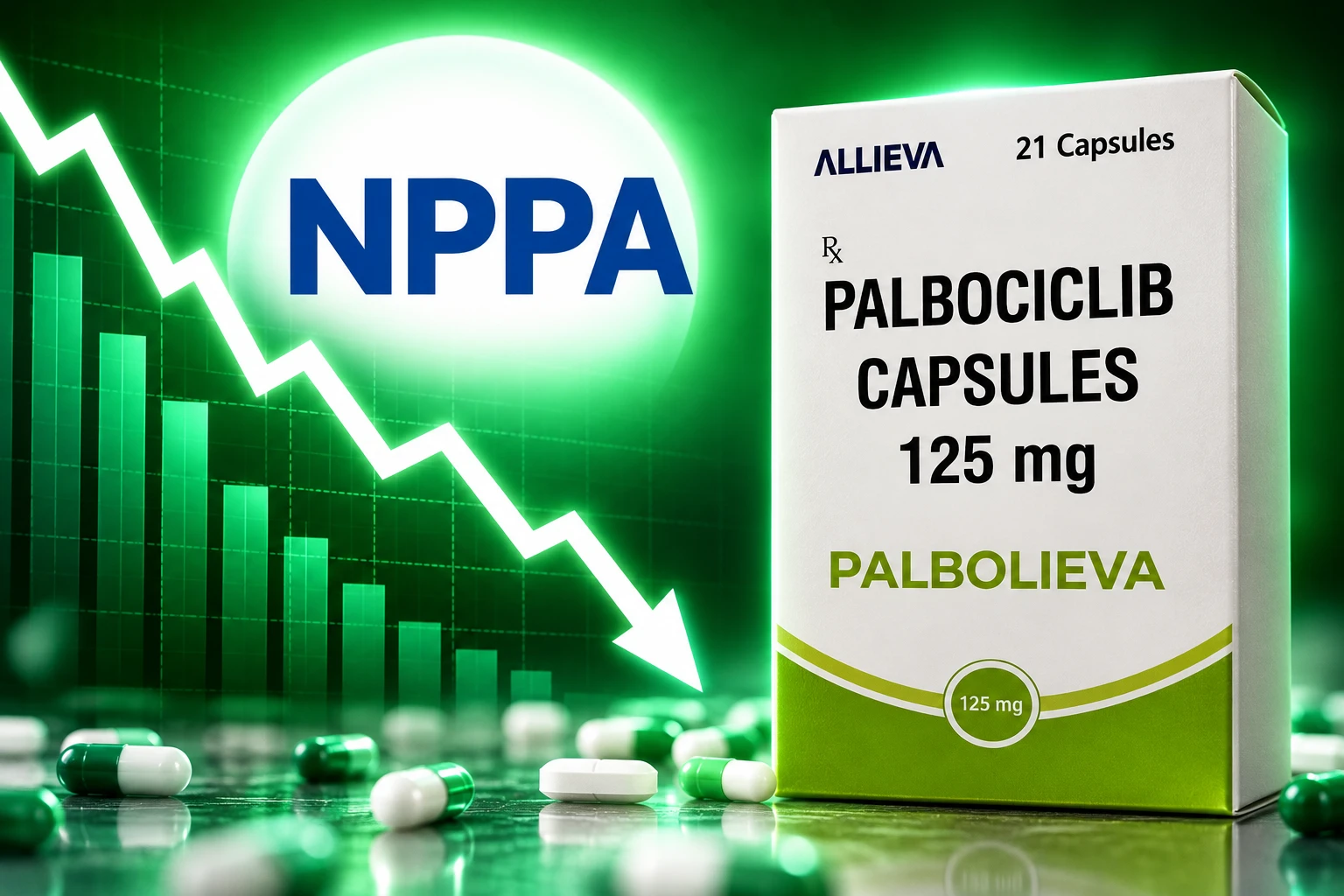
The National Pharmaceutical Pricing Authority posted revised MRPs for 543 brands of anti-cancer medicine on October 28, using company filings received up to October 27. One palbociclib pack, Palbopro 125 mg from RPG Life Sciences, falls from ₹40,421.33 to ₹2,720 for 21 capsules.
Those stickers take effect on November 9. They follow a October 17 gazette order that capped the trade margin on 137 non-scheduled anti-cancer drugs at 30 percent of MRP, excluding GST, the same last-mile lid NPPA first tried in 2019.
Palbopro Falls From ₹40,421 to ₹2,720
Palbopro’s new price is a 93.3 percent cut. The old printed MRP was 14.9 times the figure that will apply from November 9. Samarth Life Sciences’ SAMTEPA, a 100 mg thiotepa vial, drops from ₹80,071.86 to ₹7,150.33, a 91.1 percent cut of ₹72,921.53 a vial.
NPPA had said on October 17 that MRPs could fall by up to 70 percent, depending on each brand’s existing structure. Several generic and biosimilar lines on the October 28 list went further than that forecast. Glenmark’s Hertumab (pertuzumab) falls from ₹94,951 to ₹30,593 for a 30 mg vial, a 68 percent cut. RPG’s ANARZOLE (anastrozole 1 mg, 10 tablets) goes from ₹695.76 to ₹73.
Of the 543 entries, 397 get cheaper and 146 show no cut. The unchanged group includes MSD Pharmaceuticals’ Keytruda, pembrolizumab 100 mg, still listed at ₹2,16,500 a vial, and Novartis India’s Kryxana, ribociclib, still ₹24,435 for 21 tablets.
SELECTED BRANDS ON THE OCTOBER 28 LIST
| Brand | Drug | Old MRP (₹) | Revised MRP (₹) |
|---|---|---|---|
| Palbopro, 21 capsules (RPG Life Sciences) | Palbociclib 125 mg | 40,421.33 | 2,720 |
| SAMTEPA, 100 mg vial (Samarth Life Sciences) | Thiotepa | 80,071.86 | 7,150.33 |
| ANARZOLE, 10 tablets (RPG Life Sciences) | Anastrozole 1 mg | 695.76 | 73.00 |
| Fulbreca, 5 ml vial (RPG Life Sciences) | Fulvestrant | 26,072.16 | 5,491.00 |
| Azacytin (Dr. Reddy’s Laboratories) | Azacitidine 100 mg | 6,337.00 | 1,495.04 |
| Keytruda, 100 mg vial (MSD) | Pembrolizumab | 2,16,500 | 2,16,500 |
Jan Swasthya Abhiyan India, a public-health network, said drops of this size on Indian generic brands raise questions about how those packs were priced while patients paid the old stickers. Tanvi Singh, a medical oncologist at MOC Cancer Care, said high drug bills lead patients to delay starts, skip doses, or stop early, and that cheaper packs help people finish the course they were prescribed.
The Same 30% Cap Ran in 2019
The October 17 note presents the 137-drug order as an extension of NPPA’s 2019 pilot on 42 drugs, when trade margins were also capped at 30 percent of MRP. After that pilot, MRPs on 526 brands of non-scheduled anti-cancer medicine fell by up to 90 percent.
Seven years later the method is unchanged. The 2026 gazette, S.O. 5690(E), again invokes Paragraph 19 of the Drugs (Prices Control) Order, 2013, and again sets a trade margin at 30 percent of MRP, excluding GST. That share equals a 42.86 percent mark-up on the price to stockist or distributor, the first sale in the chain.
Ribociclib and osimertinib, two originator products that sat under the 2019 cap, illustrate what the formula does not touch. Kryxana remains ₹24,435 a pack. Three packs a month, a common ribociclib course, still cost ₹73,305 at the listed price. Tagrisso, AstraZeneca’s osimertinib, is among the originator brands whose listed MRP did not move on the October 28 table, alongside Roche’s Tecentriq, Johnson & Johnson’s Darzalex, and AstraZeneca’s Imfinzi.
HOW THE MARGIN CAP RETURNED
- February 2019: NPPA caps trade margins on 42 non-scheduled anti-cancer drugs at 30 percent of MRP, a pilot covering 526 brands with cuts of up to 90 percent.
- March 8, 2019: Those revised prices come into force.
- October 17, 2026: Gazette S.O. 5690(E) applies the same 30 percent cap to 137 drugs, with a March 2026 price-to-stockist reference and a November 9 start.
- October 28, 2026: NPPA publishes 543 brand and pack MRPs from filings received up to October 27, and says the portal will keep taking updates.
- November 9, 2026: Retailers and hospitals must charge the revised prices and display them.
The official account posted the October 17 cap the day the gazette went out.
NPPA caps trade margin on 137 non-scheduled anti-cancer drugs at 30% of MRP in public interest to ensure affordability.
🔗 https://t.co/PcWW9RHvNJ
#NPPA #CancerCare #HealthForAll pic.twitter.com/Jd9ZlI0TXZ— NPPA~India🇮🇳 (@nppa_india) October 17, 2026
Why Keytruda Stays at ₹2,16,500
TMR does not cap what a company charges the stockist. It caps the gap after that first sale. If the starting price is already high, a 42.86 percent mark-up still prints a high MRP. NPPA’s October 17 release said pembrolizumab, durvalumab, and osimertinib would become more accessible. On the October 28 list, Keytruda, Imfinzi, and Tagrisso did not get cheaper.
K.M. Gopakumar, co-convenor of the Working Group on Access to Medicines and Treatments, said single-source medicines, mainly patented ones, are sold to stockists and hospitals at high prices, so their prices are unlikely to fall to affordable levels even after trade margins are capped. The group’s analysis put about 56 of the 137 drugs in a single-source class.
A reply to NPPA’s own announcement put the loophole in plainer terms: if a hospital was billed ₹100 and charged ₹7,000, the next move is to inflate the landing cost. The formula uses March 2026 net sales realisation divided by quantity sold, excluding government sales. A firm that raises the first-sale price, or that keeps it high, carries that base into the new MRP.
Dr Aashish Chaudhry, managing director of Aakash Healthcare Super Speciality Hospital in New Delhi, said cancer doctors are hardly using generics, because if the generic does not work the disease flares fast. About half the cancer drugs used at his hospital, he said, are newer patented molecules. Those are the packs the 2019 cap already failed to cheapen, and they are the packs that sit still again.
Hospitals Keep a 42.86% Ceiling
A large share of oncology medicine goes straight to hospitals. The gazette treats a hospital that buys direct as the stockist, and the manufacturer’s invoice to that hospital becomes the base for MRP. On a ₹1 lakh invoice, the allowed mark-up is 42.86 percent, or ₹42,860, before GST. Scheduled essential medicines under DPCO carry a 16 percent retail margin. The cancer cap is more than twice that figure.
Gopakumar said that spread can push a hospital toward the dearer brand of the same molecule, because 42.86 percent of ₹1 lakh is twice 42.86 percent of ₹50,000. Dr Chandrasekar Chikkamuniyappa, chairman of DHEE Hospitals in Bengaluru, said 42.86 percent is a ceiling, not a compulsory take, and that hospitals can charge less. The cap narrows the old incentive, he said, and does not erase it.
Private hospital pharmacies have long billed patients the printed MRP on injectables they bought at a steep discount from the manufacturer or a distributor, and pocketed the gap. SAMTEPA’s ₹72,921.53 collapse is what that gap looks like on a single chemo vial. Chaudhry, pushing back on the idea that every hospital ran 30 percent, said margins on newer cancer medicines at his centre were generally 10 to 12 percent, and that hospitals keep about two weeks of stock and lean on distributors rather than hold 500 cycles in a fridge.
NPPA’s analysis ahead of the order put average trade mark-ups on non-scheduled anti-cancer drugs near 170 percent, and as high as 700 percent on some packs. The 30 percent lid is aimed at that last-mile gap. It does not fix the first price, and it does not itemise the day-care bill that sits beside the vial.
The Average That Ignores Free Vials
Patient assistance programmes that give medicine free can be left out of the PTS average if the firm files an undertaking. Gopakumar walked through the arithmetic. If a company sells 50 vials for ₹50 lakh and gives 50 vials free, dropping the free stock from the sum turns ₹1 lakh a paid vial into the base. Counting all 100 vials would have set the average at ₹50,000. He said more than half the pembrolizumab used in India moved through assistance programmes.
Malini Aisola, co-convener of the All India Drug Action Network, said even thin cuts on patented medicines have been undercut by leaving PAP volumes out of the TMR maths. NPPA asked every manufacturer for a PAP undertaking by October 29, and again whenever MRP changes. Free stock that fails the conditions is supposed to come back into the calculation. The authority is still taking those papers as the November 9 start approaches.
Jan Swasthya Abhiyan made the same point in its October 28 note: excluding PAP supplies from the formula limited the order’s effect on the packs patients actually buy. The group also said companies should not be left to compute and self-report revised MRPs without independent checks across the chain.
Packs Already on Shelves Need No New Sticker
Manufacturers had seven days from the gazette to file Form V and Annexure-I on NPPA’s IPDMS portal, even when MRP does not change. Non-filing is to be treated as no cut, with recovery of the overcharged amount under DPCO, 2013. Firms may still take the yearly rise allowed under Paragraph 20(1), as long as the 30 percent margin still holds.
NPPA’s TMR FAQs told companies they need not recall, relabel, or resticker packs already in the market if they can make retailers charge the new MRP. That shifts the burden onto price lists, pharmacy boards, hospital websites, and the Pharma Sahi Daam app. Companies must also place newspaper notices for every product whose price falls, showing the old and new MRP.
WHAT NOVEMBER 9 REQUIRES
- The shelf price: Retailers and hospitals must charge the revised MRP from November 9 and display it in the pharmacy.
- Hospital boards: Hospitals that take direct supply must also post the new rates on their websites and are responsible for compliance on those packs.
- Old stock: Recall and restickering are not mandatory if the manufacturer can show the retailer is charging the new price.
- Supply: Firms must keep production and supply of the notified packs at current levels.
- The public check: Patients can look up revised prices on the Pharma Sahi Daam app and the NPPA site, which the authority says it will keep updating.
State drug controllers are to enforce the order against manufacturers, dealers, retailers, and medical institutions. The dossier NPPA circulated for the trade walks through the arithmetic with a worked line: a PTS of ₹70 becomes an MRP of ₹100 before GST, because 30 percent of ₹100 is the ₹30 gap. Packs already cheaper than that computed ceiling keep their current MRP.
Activists Want Ceiling Prices, Not a Margin Cap
JSA said a 42.8 percent mark-up over PTS still blesses a fat margin in a chain that often has one intermediary, or none, when the sale is straight to a hospital. The group wants a mark-up closer to the 16 percent that applies to scheduled formulations, plus cost-based ceilings, standing margin caps, and NPPA checks that do not rely on self-reported MRPs.
For example, the reported MRP of one brand of palbociclib fell from approximately ₹40,421 to ₹2,720 per pack, while thiotepa fell from approximately ₹80,072 to ₹7,150 per vial. Such drastic reductions raise serious questions about the pricing practices of pharmaceutical companies, including major Indian manufacturers of generic cancer medicines that have reportedly offered substantial trade margins while patients continued to face unaffordable prices.
Jan Swasthya Abhiyan India, statement, October 28, 2026
Dr Abhay Shukla, national co-convenor of JSA, called the margin cap a step forward of limited value and said approved medicines should be brought under government-fixed ceiling prices on the scheduled list. Sandeep Nayak, chairman of oncology at MACS-Renova Oncology Institute, KIMS Hospital, Bengaluru, called the price control a positive move and added that low-cost life-saving drugs should remain viable to make and sell.
WHERE EXPERTS DISAGREE
- Cost-based ceilings: JSA and allied groups want DPCO-style ceiling prices on cancer medicines, with a 16 percent-class margin, standing caps, and independent verification.
- Last-mile only: NPPA is using Paragraph 19 to cap the trade gap and leave the manufacturer’s first-sale price, and yearly non-scheduled rises of up to 10 percent, in place.
- Supply and mix: Nayak warns that rock-bottom selling prices have to stay worth making; Chaudhry says originator molecules still dominate many cancer wards, which is why a margin cap on generics will not rewrite a Keytruda bill.
Singh said cheaper drugs help continuity only if they sit beside wider insurance, government reimbursement, quality biosimilars, working assistance programmes, and cancer centres that patients can actually reach. Dr Pragya Shukla, head of clinical oncology at the Delhi State Cancer Institute, said listed cuts have to show up on the full bill, not only on the vial line.
On November 9 the printed numbers change on 397 of the 543 packs filed by October 27. Kryxana is still ₹24,435 a pack, Keytruda is still ₹2,16,500 a vial, and the formula that produced those stickers is the one NPPA first ran in 2019.
Disclaimer: This article is news reporting and analysis of NPPA’s trade-margin order and the October 28 MRP list. It is informational only and is not medical advice, a treatment recommendation, or guidance on whether to start, stop, or switch any cancer medicine. Readers should consult a qualified oncologist or other licensed doctor, and where cost is the issue a hospital pharmacist or benefits officer, before acting on any price or product named here. Brand prices, filing status, and PAP rules are those published by NPPA and the firms as of the dates cited and will change as the authority updates the list and as November 9 billing begins.

ADNOC Ship Hit in Hormuz Leaves One Crew Missing

SpiceJet’s Rs 5,500 Crore Plan Follows a Rescue That Failed

Hasina’s Return Fight Sets Fire to Yunus’s Bank

Bancroft Recants the 2018 Inquiry and Names the Team

Adhikari Ties the Saffron Saree Row to School Licences

Clancy Juror Says the Holdout Never Cited Evidence

The iPhone 18 Pro Max Splits Apple’s Fall in Two

OpenAI Calls GPT-6 Astra AGI Then Locks Its Exploits

Trump Claims Hormuz Control as Oil Holds Near $96

Russia Closes the Goethe-Institut Berlin Tried to Save

 NEWS2 months ago
Clancy Juror Says the Holdout Never Cited Evidence
- NEWS3 months ago
The iPhone 18 Pro Max Splits Apple’s Fall in Two
- NEWS3 months ago
OpenAI Calls GPT-6 Astra AGI Then Locks Its Exploits
- BUSINESS3 months ago
Trump Claims Hormuz Control as Oil Holds Near $96
- LIFESTYLE3 months ago
Russia Closes the Goethe-Institut Berlin Tried to Save
- AUTO3 months ago
Volkswagen’s Job Cuts Leave Four Plants Without Cars
- NEWS3 months ago
Dyson Puts Nurovi Robots on Sale Without the UV Flagship
- BUSINESS2 months ago
US Destroys Five Iranian Tankers as the Shock Hits Jordan










