
NEWS
ISRO’s NVS-03 Launch Tries to Restore NavIC’s Floor
GSLV-F18 is due to fly NVS-03 on October 30, 2026, a repair shot to lift NavIC from three position satellites back to the four-satellite floor.

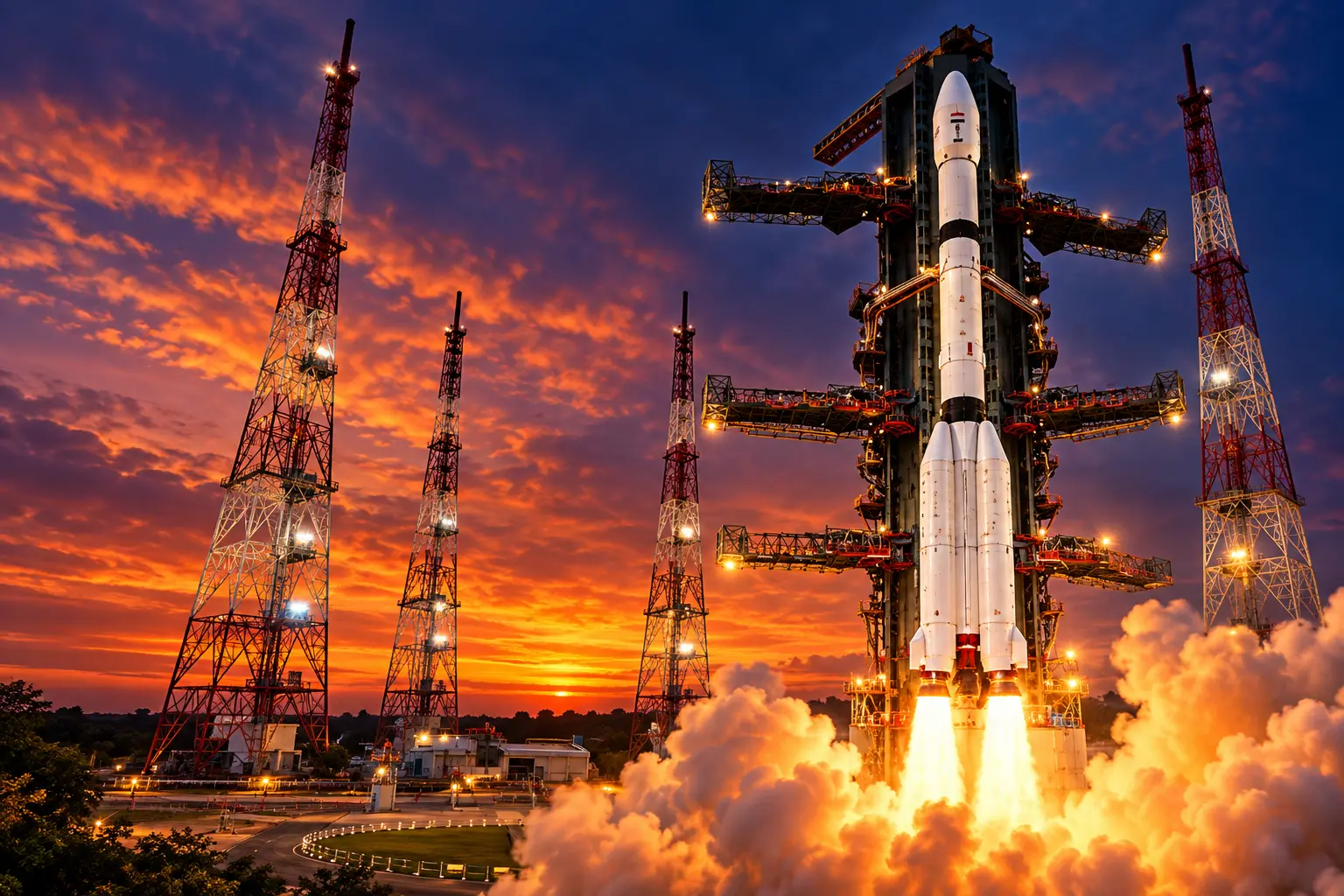
At 11:51 p.m. IST on October 30, 2026, ISRO is due to send the NVS-03 navigation satellite off the Second Launch Pad at Sriharikota on GSLV-F18. The flight is a repair shot: NavIC has been below the four-satellite mark needed for a standalone position fix since March.
A clean injection would only start that repair. NVS-03 still has to raise itself from transfer orbit, the same sequence that left its predecessor stranded in January 2025.
NavIC Has Run on Three Birds Since March
Dr. Jitendra Singh, minister of state in the Prime Minister’s Office, told the Rajya Sabha on August 13, 2026, that three satellites are broadcasting PNT signals and five others can still send one-way messages. The three still doing positioning, navigation and timing are IRNSS-1B, IRNSS-1I and NVS-01.
He also restated the floor the Department of Space has used for years. A basic position service needs four working satellites in orbit. With three, NavIC can still keep time. It cannot, on its own, tell a receiver where it is.
THE THREE SATELLITES STILL PROVIDING PNT
| Satellite | Launch | Status |
|---|---|---|
| IRNSS-1B | April 2014 | First-generation, past 10-year design life |
| IRNSS-1I | April 12, 2018 | First-generation replacement, still inside design life |
| NVS-01 | May 29, 2023 | First second-generation bird, Indian-made clock on board |
ISRO has launched 11 navigation satellites since July 2013 for the nearly Rs 2,250-crore NavIC programme. NVS-03 would be the 12th attempt. The network was built as a seven-satellite regional system covering India and about 1,500 km beyond the landmass.
Why Four Satellites Are the Floor
A phone listening to NavIC has four unknowns to solve at once: latitude, longitude, height, and how wrong its own cheap clock is. Each satellite supplies one timing measurement. Three measurements leave that sum open, so a three-bird NavIC can run a clock service and still fail a 3D fix.
That is the gap Singh described to Parliament. Timing still works. Standalone positioning does not. Users fall back to GPS, GLONASS, Galileo or BeiDou, the global networks NavIC was meant to give India a way around.
ISRO began the programme after the 1999 Kargil war, when Indian forces could not count on GPS in the conflict zone. The public service was designed, with a full seven-satellite layer, to locate a user to about 10 metres. A restricted channel was meant for military and other select users. None of that runs as a standalone Indian fix while the count sits at three.
A rebuilt network is also supposed to support real-time tracking of around 12,000 trains, with around 8,700 already fitted. Those receivers still need four healthy NavIC signals if the government wants that tracking to run without a foreign constellation in the loop.
The Clock Failures That Emptied the Sky
The drop below four was not a surprise failure of a young satellite. It was the last imported clock on an old one, dying three days after that spacecraft crossed its rated life, while the replacement pipeline was already jammed.
THE PATH TO A FOUR-SATELLITE FLOOR
- January 29, 2025: NVS-02 reaches transfer orbit on GSLV-F15, then never completes orbit raising.
- March 10, 2026: IRNSS-1F completes its 10-year design life.
- March 13, 2026: the last procured atomic clock on IRNSS-1F stops, taking the PNT count from four to three.
- August 13, 2026: the government tells the Rajya Sabha that NVS-03 is ready, with NVS-04 and NVS-05 to follow.
- September 4, 2026: GSLV-F17 succeeds with EOS-05 and reopens a launch path.
- October 30, 2026: GSLV-F18 is due to fly NVS-03 at 11:51 p.m. IST.
First-generation IRNSS satellites each flew three imported rubidium clocks, one running and two in reserve. Several lost the full set well before ten years were up. IRNSS-1F, launched on March 10, 2016, had already burned through two of those clocks and was hanging on the third when that unit stopped on March 13, 2026.
On 13th March 2026, the procured on-board atomic clock stopped functioning. However, the satellite will continue to function in-orbit for various societal applications to provide one way broadcast messaging services. IRNSS-1F satellite launched in March 2016 has completed its design mission life of 10 years on 10th March 2026.
Indian Space Research Organisation, official statement, March 13, 2026
Singh told the House the impact of those imported-clock failures had been assessed, and that corrected clocks flown from 2018 onwards were working. India put its first space-grade rubidium clocks, built at the Space Applications Centre in Ahmedabad, on NVS-01 in May 2023 and again on NVS-02 in January 2025. He said the Indian clocks on both of those satellites are working. They are now standard kit on every NavIC satellite still to fly, including NVS-03, which also carries procured clocks as backup.
NVS-02 Never Left Its Transfer Orbit
The Indian clocks on NVS-02 still tick. The satellite is just in the wrong orbit. GSLV-F15 placed it in a transfer orbit on January 29, 2025, solar panels deployed, and then the orbit-raising engine never fired. ISRO’s own list still marks NVS-02 as not operational, 21 months later.
An ISRO apex committee traced the miss to the pyro system that should have opened the oxidiser line. The drive signal did not reach the pyro valve, so the engine never lit. The most likely cause, the panel said, was that at least one contact had come off in each of the main and redundant connector paths. ISRO said the recommended checks and extra redundancy have already been built into later spacecraft.
That is the scar on this flight. Liftoff is not the test people who follow the hardware are watching. The first burn after NVS-03 separates is, because a healthy navigation satellite stuck in transfer orbit does nothing for a four-satellite floor. NVS-03 has to finish the job NVS-02 never started.
After PSLV Failures, GSLV Carries the Repair Job
GSLV-F18 is the 20th flight of India’s Geosynchronous Satellite Launch Vehicle. ISRO’s about 2,250 kg navigation satellite is due to go into geosynchronous transfer orbit, perigee 170 km, apogee 37,023 km, inclination 20.75°. The rocket stands about 50 metres tall and about 420 tonnes at liftoff, a three-stage stack with a cryogenic upper stage, flying from the Second Launch Pad at the Satish Dhawan Space Centre.
The date itself is late. NVS-03 had been moved to Sriharikota about three months before this attempt, waiting on a launch clearance that kept slipping. After PSLV-C61 failed on May 18, 2025, and PSLV-C62 failed on January 12, 2026, ISRO slowed the manifest to study those anomalies. Chairman V. Narayanan had first pointed to a window between October 15 and 20, then locked October 30 after GSLV flew again.
The pad opened after the GSLV-F17 flight that lofted EOS-05 on September 4, 2026, the vehicle’s only successful 2026 mission before this one. GSLV, not the grounded workhorse, is the rocket carrying the NavIC repair. Full GSLV-F18 mission specifications and a live webcast from 11:20 p.m. IST are posted on ISRO’s channels.
GSLV-F18, India’s Geosynchronous Satellite Launch Vehicle mission, will carry the NVS-03 navigation satellite.
Launch: 30th October 2026, 23:51 hours IST
Watch live: 30th October 2026, 23:20 hours IST onwardshttps://t.co/6X42ANRnTC
Mission details: https://t.co/wtZ6TmjUhc… pic.twitter.com/SC9159mDrN
— ISRO (@isro) October 28, 2026
What the L1 Band Changes for Ordinary Phones
NVS-03 is the third satellite in the second-generation NVS series, planned as five birds to replace and thicken the old IRNSS layer. Like NVS-01, it adds an L1 civilian signal on top of the L5 and S signals the first generation already used. L1 is the band cheap phone and watch chipsets already listen to for GPS, which is the practical on-ramp NavIC never had when it spoke only on L5 and S.
The older pair of frequencies still matter for a two-frequency fix and for the restricted service. L1 is how a handset, a wearable, or a low-power tracker hears NavIC without a special chip. That only helps if the satellite is in the right slot and switched on. A new frequency from a bird stuck in transfer orbit is as silent as NVS-02.
Second-generation spacecraft are also rated for 12 years, two years longer than the first IRNSS set. That extra life is the point of flying Indian clocks next to the procured ones. The imported units that died early on 1A, 1C, 1D, 1E, 1F and 1G are the reason this replenishment is running behind the hardware it was meant to replace.
A Four-Satellite Floor Still Leaves Ageing Hardware in Charge
Even if NVS-03 reaches its slot and is declared healthy, the four-satellite floor would still rest on IRNSS-1B, a satellite about two and a half years past its 10-year design life, and on IRNSS-1I, which reaches that mark in April 2028. NVS-01, launched on May 29, 2023, would be the only other second-generation bird in the PNT set. Four is the minimum, not a spare.
Singh’s August reply already mapped the rest of the rebuild. NVS-04 and NVS-05 come next, then one more satellite after that to finish the seven-satellite base layer. Until those fly, a single clock death on 1B would put NavIC back under four. GPS still flies around 32 satellites, GLONASS 24, Galileo 27 and BeiDou 30. A regional four-bird floor does not match those numbers and was never meant to; it was meant to work without them over India.
WHAT STILL HAS TO GO RIGHT
- The first burns: NVS-03 must fire the orbit-raising sequence that NVS-02 never completed, then settle in its assigned slot.
- Commissioning: Launch success is not service; in-orbit tests still have to clear the satellite for PNT use.
- NVS-04 and NVS-05: Both are in an advanced stage of build, and both still have to fly before the network has spare second-generation hardware.
- The seventh bird: One more satellite is planned after NVS-05 to finish the seven-satellite base layer.
If the 11:51 p.m. IST window holds, GSLV-F18 will have done the part the public sees. NavIC gets a fourth ranging source only after that satellite climbs, checks out, and starts broadcasting, and only for as long as IRNSS-1B keeps ticking on borrowed time.

ADNOC Ship Hit in Hormuz Leaves One Crew Missing

SpiceJet’s Rs 5,500 Crore Plan Follows a Rescue That Failed

Hasina’s Return Fight Sets Fire to Yunus’s Bank

Bancroft Recants the 2018 Inquiry and Names the Team

Adhikari Ties the Saffron Saree Row to School Licences

Clancy Juror Says the Holdout Never Cited Evidence

The iPhone 18 Pro Max Splits Apple’s Fall in Two

OpenAI Calls GPT-6 Astra AGI Then Locks Its Exploits

Trump Claims Hormuz Control as Oil Holds Near $96

Russia Closes the Goethe-Institut Berlin Tried to Save

 NEWS2 months ago
Clancy Juror Says the Holdout Never Cited Evidence
- NEWS3 months ago
The iPhone 18 Pro Max Splits Apple’s Fall in Two
- NEWS3 months ago
OpenAI Calls GPT-6 Astra AGI Then Locks Its Exploits
- BUSINESS3 months ago
Trump Claims Hormuz Control as Oil Holds Near $96
- LIFESTYLE3 months ago
Russia Closes the Goethe-Institut Berlin Tried to Save
- AUTO3 months ago
Volkswagen’s Job Cuts Leave Four Plants Without Cars
- NEWS3 months ago
Dyson Puts Nurovi Robots on Sale Without the UV Flagship
- BUSINESS2 months ago
US Destroys Five Iranian Tankers as the Shock Hits Jordan










