
BUSINESS
A Mecca Drone Falls After Talks That Changed Nothing
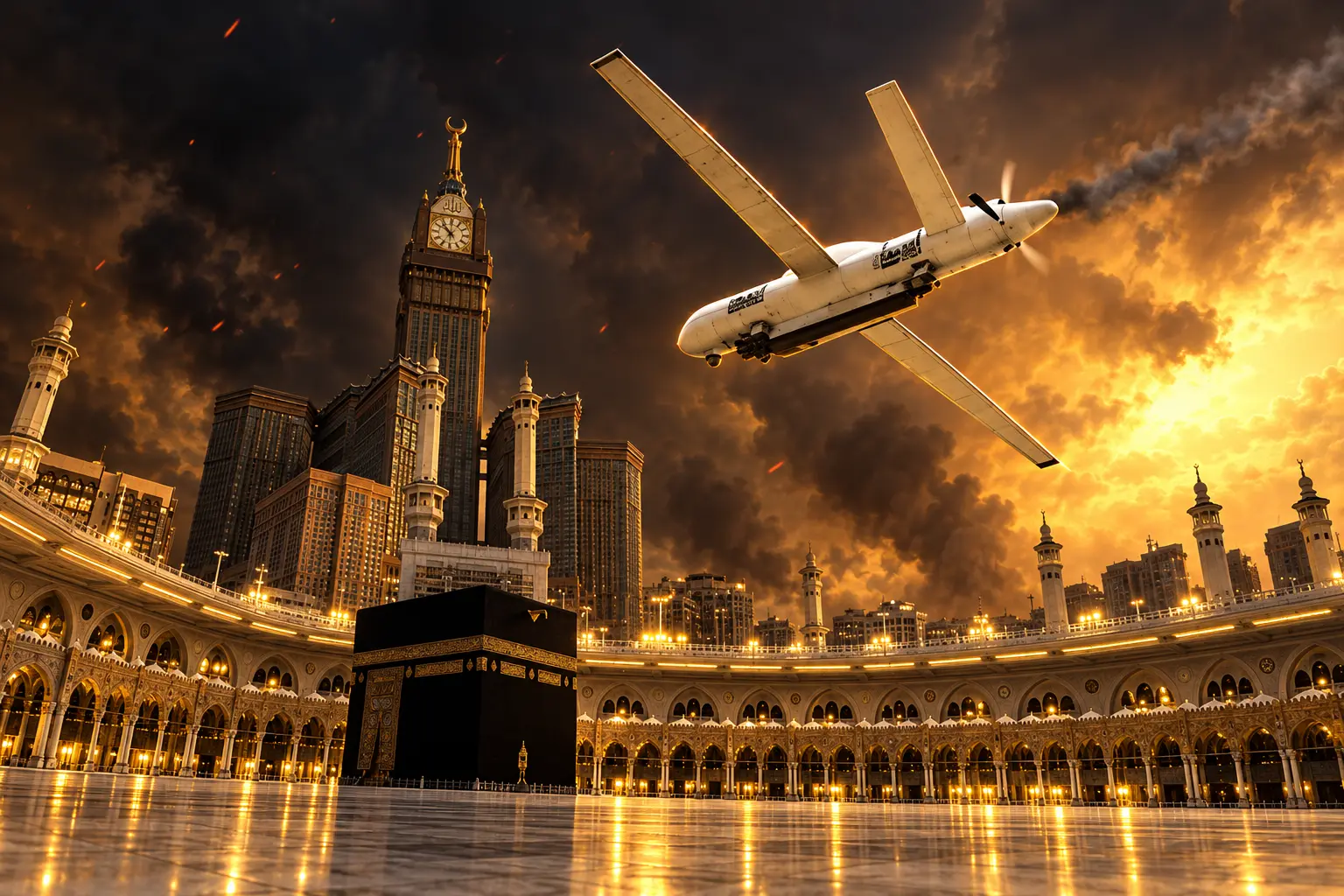
A Houthi drone was downed over the Mecca region four days after Riyadh talked peace in Tehran, as Sanaa denied the flight and claimed six other Saudi strikes.

The Saudi-led coalition said on October 30 that air defences destroyed a Houthi drone over the Mecca region. Hours later, Houthi spokesman Yahya Saree said his forces had flown no mission into Saudi Arabia that day.
The intercept came four days after Defence Minister Prince Khalid bin Salman sat with Iranian officials in Tehran and agreed to keep talking about regional peace.
A Drone Over the Mecca Region, Then a Denial
Coalition spokesman Major General Turki al-Maliki’s command put out a short statement on Friday: a drone launched by Yemen’s Houthis had been intercepted and destroyed in the Mecca region, home to Islam’s holiest mosque. The statement did not say how close the aircraft came to the city, whether anyone was hurt, or what the intended target was.
Saree answered before midday. In a post on X he said the Yemeni armed forces did not carry out any operation toward the Saudi interior on October 30, and that the claim of a drone in the skies of Mecca was a great and huge slander. He repeated a line his group has used all month: its fire is aimed at oil plants and military bases, not the holy cities.
The Yemeni Armed Forces confirm they did not carry out any operation toward the Saudi interior today, and that the claim of intercepting a drone in the skies of Mecca is a great and huge slander. Our operations target its oil facilities and military bases.
Yahya Saree, Houthi military spokesman, on X
That denial is now the standard reply. Riyadh treats a projectile over Mecca province as an attack on the holy sites. Sanaa treats the same report as a political smear. The public is left with an intercept, a rejection, and no wreckage displayed by either side.
The group that controls much of western Yemen has spent October firing ballistic missiles and drones at Saudi airports and energy plants, in what it calls payback for Saudi air raids inside Yemen. Saree said Saudi aircraft and missiles had flown 116 sorties in the previous 24 hours and 3,596 since the latest round of fighting began, figures that come from his command and have not been matched by an independent count.
Saree’s Six Claims Stretch From Ras Tanura to Najran
On Thursday evening, before the Mecca-region drone report, Saree read a six-part battle list that ran from the Gulf coast to the Red Sea and down to the Yemen border. He posted the full statement on X.
بيانٌ صادرٌ عن القواتِ المسلحةِ اليمنيةِ
بسمِ اللهِ الرحمنِ الرحيمِ
قال تعالى: {{ وَلَمَنِ ٱنتَصَرَ بَعۡدَ ظُلۡمِهِۦ فَأُو۟لَـٰۤىِٕكَ مَا عَلَیۡهِم مِّن سَبِیلٍ } صدق اللهُ العظيمفي إطارِ الردِّ على العدوانِ السعوديِّ الغاشمِ الذي يستهدفُ بلدَنا وشعبَنا وردًّا على المجازرِ… pic.twitter.com/yBDY2ljrsP
— العميد/ يحيى سريع (@Yah_Saree) October 29, 2026
He said a ballistic missile hit the Ras Tanura refinery, another hit an Aramco site in Abqaiq, a salvo struck King Khalid International Airport in Riyadh, a drone hit King Fahd International Airport in Dammam and stopped flights there, a ballistic missile hit the Rabigh refinery, and a strike on a Saudi headquarters in Najran killed and wounded soldiers. He said the campaign would go on “deep inside” the kingdom until Saudi operations and the blockade of Yemen ended.
THURSDAY’S SIX CLAIMS
| Claimed target | Weapon named by Saree | What Saudi officials put on the record |
|---|---|---|
| Ras Tanura refinery | Ballistic missile | No public confirmation of a hit |
| Aramco site, Abqaiq | Ballistic missile | No public confirmation of a hit |
| King Khalid Airport, Riyadh | Missile salvo | Two ballistic missiles toward Riyadh intercepted |
| King Fahd Airport, Dammam | Drone | No public confirmation of a hit |
| Rabigh oil refinery | Ballistic missile | No public confirmation of a hit |
| Military headquarters, Najran | Strike on a command site | Alerts in Najran; no confirmed death toll |
The only damage Saudi Civil Defence described from Thursday’s fire over the capital was shrapnel that wounded one Saudi citizen in Riyadh and scarred a house and a vehicle. Warning alerts had gone out in Riyadh, al-Kharj, and Najran before al-Maliki said the two missiles were destroyed. That is a much smaller picture than six successful deep strikes.
WHAT WE KNOW
- Confirmed Friday: The coalition says a Houthi drone was destroyed over the Mecca region.
- Confirmed Thursday: Two ballistic missiles toward Riyadh were intercepted, and one civilian was wounded by falling fragments.
- Sanaa’s position: Saree denies a Mecca flight and says Thursday’s six operations hit oil and military sites.
WHAT IS UNCONFIRMED
- Energy hits: Ras Tanura, Abqaiq, and Rabigh have not been confirmed as damaged by Saudi authorities or Aramco.
- Dammam flights: A drone shutdown of King Fahd Airport has not been independently shown.
- Najran deaths: Claimed Saudi military casualties have not been matched by a coalition list.
Unverified refinery claims still move markets, because Ras Tanura and Abqaiq sit at the core of Saudi crude handling and because traders have already watched airports burn this month. The gap between a spokesman’s list and a civil-defence note is now part of the daily rhythm.
The Tehran Meeting Left the Fire Unchanged
On October 26, Prince Khalid led a Makkah pact group to Tehran. Pakistan’s army chief, Field Marshal Asim Munir, and Turkey’s intelligence chief, Ibrahim Kalin, sat with President Masoud Pezeshkian, Foreign Minister Abbas Araghchi, and Supreme National Security Council secretary Mohsen Rezaei. It was the first high-level contact between Iran and the three pact states since the wider war, which began with U.S. and Israeli strikes on Iran, spread into Saudi Arabia and Yemen.
The Saudi foreign ministry said the trip was meant to open channels “to prevent a return to military escalation.” Iranian state media said the four countries had agreed to keep talking about peace and security. Rezaei called the discussions “very good” and said regional states, not outside powers, should handle security.
Regional sources briefed on the closed sessions said there was no deal to quiet the Houthis. Saudi, Pakistani, and Turkish officials asked Iran to press its Yemeni allies to stop firing on the kingdom. Iran, those sources said, claimed it lacked leverage to do so, even though it remains the Houthis’ main outside supplier of training, targeting help, and kit. Tehran instead asked its guests to push Washington toward a two-week pause across the region, in return for a gradual reopening of the Strait of Hormuz.
A source in Tehran said Iran was “willing to help,” with a condition that has not moved: the Houthis still want Saudi Arabia to lift its air blockade of Yemen before they stop. A Yemeni source said Iran also wanted any final talks held in Sanaa. Hours after the photos in Tehran, the Saudi-led coalition said it had intercepted three ballistic missiles and four drones headed for the kingdom.
The sequence is the story. A defence minister flew in, the communique promised more meetings, and the missiles kept coming. Iran’s public line is that it cannot switch the Houthis off. Riyadh’s bet in going to Tehran was that it could. Friday’s drone report over Mecca, whether it was a stray, a probe, or something else, landed on top of that failed bet.
How Empty Did Riyadh’s Airport Get in October?
King Khalid International Airport, the kingdom’s second-busiest after Jeddah, is the one target nobody has to take on faith. Aviation analytics firm Cirium counted the holes in the schedule after repeated Houthi strikes, including an October 10 attack that later tallies put at 13 people killed and more than 300 wounded, the deadliest strike in the kingdom in more than a decade.
Between October 8 and 25, Cirium logged 4,071 of 4,736 planned Riyadh departures as canceled or never flown, about 86%. Across all Saudi airports the count was 7,802 of 17,299, or 45.1%. On October 11, the day after the worst terminal strike, 353 of 354 Riyadh departures were wiped; one flight got out. The worst day nationwide was October 12, when more than 60% of scheduled departures did not operate.
SAUDI DEPARTURES LOST, OCTOBER 8 TO 25
| Airport | Departures canceled or not flown | Share of schedule |
|---|---|---|
| Riyadh (King Khalid) | 4,071 of 4,736 | 86% |
| Najran | All scheduled flights | 100% |
| Abha | Not published as a raw count | 46.7% |
| Dammam (King Fahd) | 823 of 1,956 | 42.1% |
| Jeddah | 1,402 of 6,380 | 22% |
| All Saudi airports | 7,802 of 17,299 | 45.1% |
Jeddah, the busiest airport and the main Hajj and Umrah gateway, kept about four in five of its flights. Najran, on the Yemen border, lost every one. King Khalid handled 37 million passengers in 2024, so an 86% hole is not a rounding error in a tourist brochure. It is a capital airport that, for more than two weeks, almost stopped.
Authorities partly reopened it on October 25, with Terminal 1 for domestic flights and Terminal 2 for international services by Saudi airlines. Foreign carriers stayed away. Lufthansa listed Riyadh as shut through November 18. Delta Air Lines pushed a planned Atlanta-Riyadh launch to March 2027. Riyadh Air’s travel page still shows passengers being sent through Al Qassim instead of the capital. Saree, on the day flying resumed, again called King Khalid a military target and told airlines and travellers it was not safe.
After September’s Red Line, Debris Fell in Mecca Province
Friday’s drone is not the first time Mecca has been pulled into the exchange. Each time, Riyadh uses the language of a religious red line. Each time, Sanaa says it never aimed at the holy cities. The argument has become a script.
MECCA AND THE HOLY SITES, THIS YEAR
- September 16, 2026: The coalition says air defences destroy a Houthi drone south of Mecca before it enters restricted airspace, calling it the second such attempt after a ballistic missile in July 2017. Al-Maliki says the security of Mecca and its pilgrims is a “red line.” Saree says there is “no threat whatsoever from Yemen to the holy sites.”
- October 24, 2026: Saudi Civil Defence says shrapnel from two intercepted ballistic missiles falls in Wadi Al-Mughammas in Mecca province and in Jeddah, Taif, and Rabigh. GCC Secretary-General Jasem Mohamed AlBudaiwi calls the fire “a grave violation of the sanctity of the Holy Sites and a provocation to the sentiments of Muslims worldwide.” Saree calls the Mecca and Medina charge a great and huge lie and says the group hit oil plants and bases.
- October 24 to 25, 2026: The coalition says it intercepts a wider barrage, including 10 ballistic missiles aimed at the south, plus a drone and a ballistic missile over Riyadh and a cruise missile toward Khamis Mushait.
- October 26, 2026: Prince Khalid meets Iranian leaders in Tehran. The statement promises more talks.
- October 27, 2026: The coalition reports three ballistic missiles and four drones intercepted, hours after those talks.
- October 29, 2026: Saree claims the six-site list. Civil Defence reports one civilian wounded in Riyadh.
- October 30, 2026: The coalition reports a drone destroyed over the Mecca region. Saree denies any interior mission that day.
AlBudaiwi’s line about the sanctity of the holy sites is the one Riyadh wants the wider Muslim world to hear. Saree’s line about oil and bases is the one he wants that same audience to believe. Both can be true in a narrow sense, if a missile aimed at Rabigh sheds fragments over Mecca province, and both can be used as weapons of their own. The Kaaba does not have to be the aim point for the charge to land.
Oil Climbs as Explosive Charges Hit a Hormuz Tanker
Brent crude traded at $115.74 a barrel at 01:22 GMT on October 30, up 86 cents, or 0.75%. U.S. West Texas Intermediate rose 72 cents, or 0.71%, to $102.72. Both were heading for a fourth straight monthly gain, with Brent on course for a rise of nearly 14% in October and WTI about 15%. Those prints followed the Houthi energy claims and a fresh scare in the Strait of Hormuz, the waterway Iran has tried to squeeze since the war with the United States widened.
FRIDAY’S PRESSURE POINTS
- Brent: $115.74 a barrel at 01:22 GMT on October 30, up 86 cents.
- WTI: $102.72, up 72 cents, on the same stamp.
- Riyadh flying: 86% of King Khalid departures lost from October 8 to 25, per Cirium.
- Houthi raid count: Saree puts Saudi air and missile sorties since the escalation at 3,596.
The United Kingdom Maritime Trade Operations centre first logged a tanker on fire 25 nautical miles northeast of Khasab, Oman, at 2212 UTC on October 29. In a verified update it said a small boat had come alongside on the port beam and fixed two explosive devices to the hull above the waterline. The blasts started an engine-room fire that stopped the ship for a time. The crew put the fire out, no oil went into the water, and the tanker sailed on. UKMTO told other ships to move with caution.
UKMTO WARNING 187-26 UPDATE 001
Click here to view the full product⤵️https://t.co/ashHdPmfaI#MaritimeSecurity #MarSec pic.twitter.com/PO5X3LlNCO
— UKMTO Operations Centre (@UK_MTO) October 30, 2026
Iran’s Islamic Revolutionary Guard Corps, in a separate account, said three tankers had hit mines and caught fire on an “unauthorised” southern track through the strait, and Iran’s army later added a fourth vessel east of the waterway. U.S. Central Command has said the main lanes are clear of mines. The British notice describes a boat and charges, not a floating mine. Those are different weapons, and they should not be flattened into one incident.
Saudi crude that cannot easily use Hormuz has been pushed toward the Red Sea and the East-West pipeline, which the Houthis have also claimed to hit. A war that empties Riyadh’s airport and keeps Brent above $115 is already charging people who will never see Mecca province. Prince Khalid, on October 30, called Spain’s defence minister, Margarita Robles, and wrote that they had reviewed defence ties after the Houthi terrorist attacks on the Kingdom and talked about security and stability. Stability is the word in the communiques. The intercept over the Mecca region, the six unproven energy claims, and a tanker burning off Oman are what the week actually produced.

ADNOC Ship Hit in Hormuz Leaves One Crew Missing

SpiceJet’s Rs 5,500 Crore Plan Follows a Rescue That Failed

Hasina’s Return Fight Sets Fire to Yunus’s Bank

Bancroft Recants the 2018 Inquiry and Names the Team

Adhikari Ties the Saffron Saree Row to School Licences

Clancy Juror Says the Holdout Never Cited Evidence

The iPhone 18 Pro Max Splits Apple’s Fall in Two

OpenAI Calls GPT-6 Astra AGI Then Locks Its Exploits

Trump Claims Hormuz Control as Oil Holds Near $96

Russia Closes the Goethe-Institut Berlin Tried to Save

 NEWS2 months ago
Clancy Juror Says the Holdout Never Cited Evidence
- NEWS3 months ago
The iPhone 18 Pro Max Splits Apple’s Fall in Two
- NEWS3 months ago
OpenAI Calls GPT-6 Astra AGI Then Locks Its Exploits
- BUSINESS3 months ago
Trump Claims Hormuz Control as Oil Holds Near $96
- LIFESTYLE3 months ago
Russia Closes the Goethe-Institut Berlin Tried to Save
- AUTO3 months ago
Volkswagen’s Job Cuts Leave Four Plants Without Cars
- NEWS3 months ago
Dyson Puts Nurovi Robots on Sale Without the UV Flagship
- BUSINESS2 months ago
US Destroys Five Iranian Tankers as the Shock Hits Jordan










