
NEWS
UAE Honours Captain Smit Machchhar After the Axe Attack
Captain Smit Machchhar received the Order of Zayed II after a co-pilot turned the cockpit crash axe into a weapon on flydubai FZ1073.

UAE President Sheikh Mohamed bin Zayed Al Nahyan gave Captain Smit Machchhar and the flydubai crew the First Class Order of Zayed II on October 27.
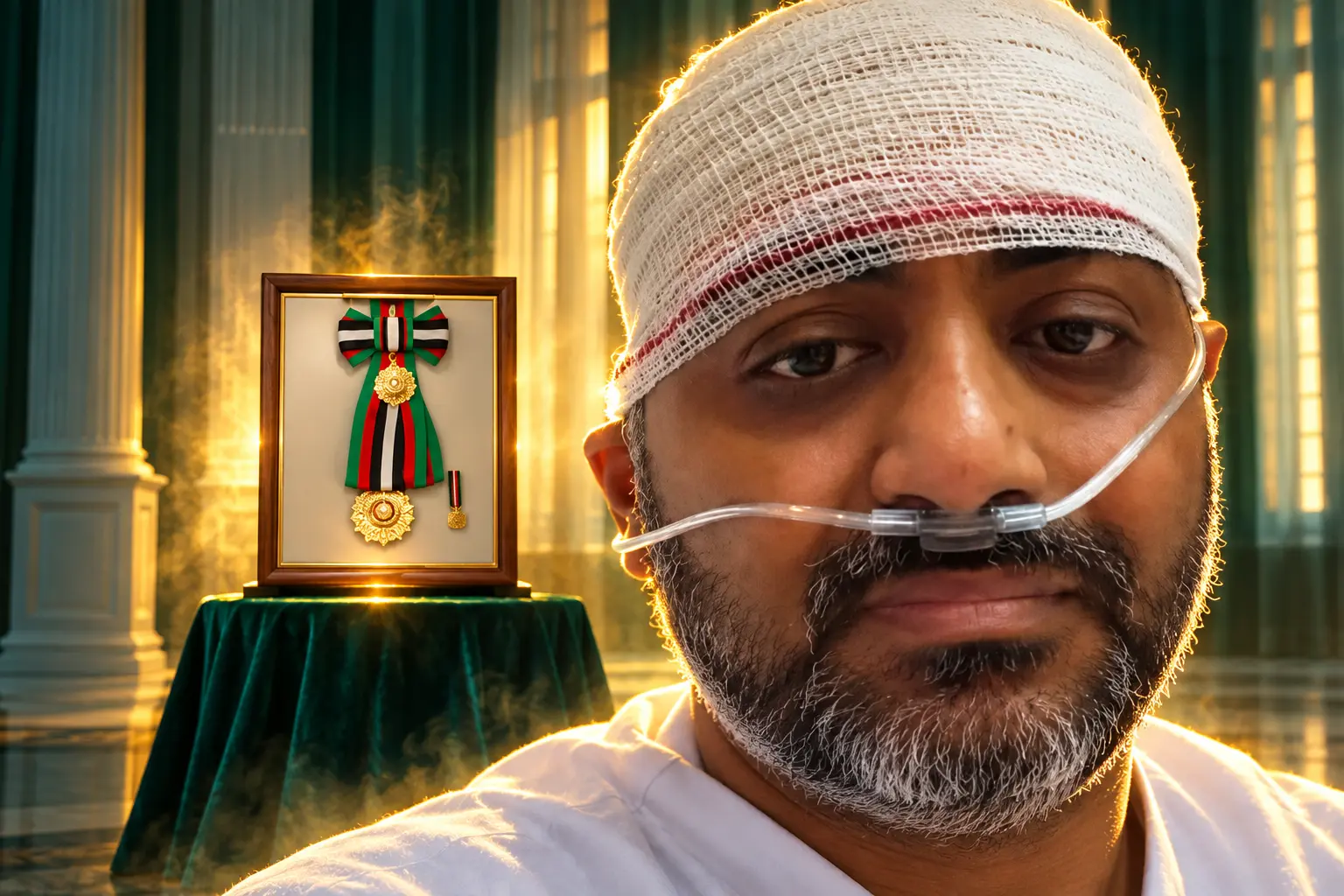
The Indian captain walked in with staples across his scalp and his left arm in a sling, 27 days after his co-pilot attacked him with the aircraft’s emergency axe on Dubai-Tel Aviv flight FZ1073. Sheikh Mohamed looked at the sling, asked when it would heal, and offered a fight-training session once it did. The laugh travelled. The axe that made the wound was not smuggled on. It belonged in the cockpit.
Sheikh Mohamed Asks When the Captain Will Heal
The President received the flydubai crew in Abu Dhabi with Vice President Sheikh Mohammed bin Rashid Al Maktoum, the ruler of Dubai, beside him. Sheikh Hamdan bin Mohammed bin Rashid Al Maktoum, Crown Prince of Dubai, deputy prime minister and defence minister, put the decorations on the crew and praised the duty they had shown.
Machchhar, who joined flydubai in 2022, hugged the President and said it was his honour. Sheikh Mohamed inspected the stapled wound, then the sling.
When will you heal? So I have an idea. When you heal, I want to have a session with you to train you how to fight.
Sheikh Mohamed bin Zayed Al Nahyan, UAE President, Abu Dhabi reception
Machchhar put a hand on his heart and called it his biggest honour. Sheikh Mohamed told the crew and passengers they were family, that the UAE was their country, and that there was a home for them there.
The First Class Order of Zayed II usually goes to diplomats and senior officials, not line pilots. The foreign ministry said the President had six UAE ambassadors received days earlier for work on overseas posts. The same decoration now sits on a captain who opened a cockpit door with a fractured skull. Sheikh Ahmed bin Saeed Al Maktoum, who chairs the Dubai Civil Aviation Authority, Dubai Airports and the Emirates group, was in the room. Israel’s President Isaac Herzog has said Machchhar will also receive Israel’s Presidential Award for Civilian Heroism once he is strong enough to take it. New Delhi has not announced a civilian award of its own.
How flydubai Flight FZ1073 Ended in Tabuk
flydubai FZ1073 left Dubai for Tel Aviv on September 30, 2026, as a Boeing 737 MAX 8 carrying 174 passengers, including 24 children, and six crew. About two hours in, the 29-year-old Omani first officer, named in multiple accounts as Hamam al-Hammami, attacked Captain Machchhar with the cockpit’s emergency axe. The jet dropped about 16,000 feet in 30 seconds, then diverted to Tabuk in Saudi Arabia after a return-sector captain, cabin crew and passengers pulled the attacker off the controls. Everyone on board survived. Machchhar did not walk away unhurt.
THE DROP ON SEPTEMBER 30
- September 30, 2026, 7.05 a.m. GST: FZ1073 leaves Dubai for Tel Aviv with 174 passengers and six crew, 180 people in all.
- About 9.21 a.m. GST: Near the Jordan-Saudi border, the co-pilot surprises the captain in the cockpit and strikes him with the emergency axe.
- Seconds later: The 737 MAX 8 plunges about 16,000 feet in 30 seconds as the wounded captain fights toward the door knob.
- The same morning: A captain assigned to the return flight uses the cockpit access code, crew and passengers restrain the attacker, and the jet lands at Tabuk.
Machchhar has said the sector felt normal until his colleague asked to pray. He kept his eyes on the screens out of respect, then felt the first blow and thought the airframe had failed. The next blows told him it was the man beside him.
The blows were coming on the head. Immediately my hand went to the knob which opens the door and screaming for my colleagues, screaming his name.
Captain Smit Machchhar, flydubai, recounting the attack
He has said he believes that was the first time he lost consciousness. A forensic report later found the wounds concentrated on the head, a vital area, and matched them to an implement with the traits of an emergency axe. He has described a compound depressed skull fracture. The sling on October 27 was the public remainder of that morning.
The Crash Axe Was Already in the Cockpit
The tool was not a kitchen knife slipped through screening. UAE Attorney-General Counsellor Dr Hamad Saif Al Shamsi said the co-pilot attacked the captain with the aircraft’s emergency axe as he tried to seize the jet for a premeditated suicide attack on Ben Gurion Airport’s passenger terminal. Crash axes exist so a crew can cut, pry or break through material after a crash, a fire or a jammed exit, when the usual way out is gone.
US airline rules still name the tool. requires a crash ax on covered airplanes under 14 CFR 121.309(e), with only a narrow exception. Europe and the UAE write the job more broadly. EASA rule CAT.IDE.A.255 requires a crash axe or crowbar in the flight crew compartment on aeroplanes above 5,700 kilograms or with more than nine passenger seats. Aircraft laid out for more than 200 passengers need a second tool in or near the rear galley, stored where passengers cannot see it. UAE commercial rules follow that axe-or-crowbar model. flydubai did not have to carry an axe. It had to carry a breaching tool on the flight deck. The 737 MAX 8 on FZ1073 carried an axe.
CRASH AXE RULES ON LARGE JETS
| Jurisdiction | Rule for larger commercial aircraft |
|---|---|
| United States, Part 121 | Crash ax required, with a limited exception |
| EASA | Crash axe or crowbar in the flight crew compartment |
| United Arab Emirates | Crash axe or crowbar, same size thresholds as EASA |
After the attacks of 11 September 2001, reinforced cockpit doors turned the flight deck into the hardest room on the aeroplane, and emergency tools followed the crew inside so no one in the cabin could grab them. In 1995 the FAA had already flagged the other risk: on aircraft without a lockable flight-deck door, an axe would be a security problem because passengers could reach it. The hardened door was meant to close that gap. FZ1073 showed the remaining one. The man who picked up the axe was licensed to sit beside it.
The accident file still argues for some kind of breaching tool. On March 31, 2002, a crewmember on Delta Air Lines Flight 12 used a crash axe to deflate an evacuation slide that had inflated inside the cabin and pinned a flight attendant. A crowbar would not end the insider problem. It is still a heavy object in a locked room.
A Locked Door Did Not Stop an Insider
The last time a first officer turned a cockpit into a weapon, the design failure ran the other way. In March 2015, Germanwings co-pilot Andreas Lubitz locked the captain out of the flight deck and flew an Airbus A320 into the French Alps, killing 150 people. The post-9/11 door, built to keep hijackers out, let one pilot keep the other out. Europe briefly pushed a two-person cockpit rule, then stepped back to a risk-based approach. Some German airlines later dropped the extra body in the seat because the door would have to open more often.
On FZ1073 both pilots were already inside. A second person in the jump seat would not have moved the axe. What moved the flight was the opposite of Germanwings: Machchhar got the door open, and a return-sector captain standing near the flight deck treated the strange cycling of that door as a warning, then used the access code. The fortress still assumed the threat would come from the cabin. The confession prosecutors describe assumed the opposite. Al Shamsi said the co-pilot drew the idea of using an aircraft from the 11 September 2001 attacks, and that the idea became tied to his choice of career. The same era that sealed the door also left him a blade in easy reach.
Oman Grounded the Co-Pilot in 2024
Al Shamsi, in an October 9 update, traced a 29-year-old career that cleared every box flydubai says it checks and still put a planned attacker in the right-hand seat. Signs of a drift toward extremism, the attorney general said, first showed in 2017 while the suspect studied in Australia, through takfiri writing and online material that glorified terrorist groups and suicide attacks. He later confessed that he trained in boxing under a private coach as he prepared himself for the plot. The President’s joke about teaching Machchhar to fight landed on a man whose attacker had already paid for punching lessons.
THE CO-PILOT’S PATH TO THE SEAT
- 2017: While studying in Australia, he is influenced by extremist literature and content that glorifies suicide attacks, the attorney general says.
- 2020 to 2024: He works for Oman Air.
- Early 2025: He joins Royal Air Maroc and stays several months.
- January 2026: He moves to flydubai after presenting a licence, a certificate of good conduct and the required checks.
- September 30, 2026: On his third Tel Aviv duty, after two earlier sectors used to learn the route and the airport, he begins the attack.
People familiar with his Oman service have said the carrier took him off flying in 2024, moved him to a desk, and put him through a deradicalisation programme after he was found on extremist sites, and that flydubai did not call Oman when it hired him, running a criminal check instead. Al Shamsi’s public finding is narrower. The suspect met professional and security requirements, the attorney general said, and none of those steps showed extremist views or an intent to carry out a plot. He confessed, with a lawyer present, that he acted alone. Prosecutors are still testing that claim.
Two Return-Sector Pilots Took the Controls
The medal citation names flydubai crew. The morning itself was wider than a two-pilot roster. Al Shamsi said a pilot assigned to the return flight was already near the cockpit, saw the door open and close in a way that looked wrong, and went in on the access code. He found the captain under attack. Cabin crew and several passengers helped pull the injured man free and hold the suspect. The return-flight captain and his co-pilot then took the jet to Tabuk. flydubai has not released those two pilots’ names. Hometown posts after the October 27 reception have started to attach names the airline still has not confirmed.
Passenger Daniel Schlichter, in the second row, said the extra pilots were on board because they were due to fly the aircraft back from Tel Aviv to Dubai, a routine known as deadheading, and called their presence one of the miracles of the sector. An Israeli dentist on the flight, Dr Shota Musayev, moved forward to treat the captain. Other passengers, among them a plumber, have described tying the attacker with whatever was in reach, including headphone cords and zip ties, until the relief crew could close the door and fly.
WHO MOVED WHEN THE DOOR OPENED
- The captain: Machchhar reaches the door knob under axe blows and lets the cabin into a locked flight deck.
- The return captain: A flydubai pilot deadheading for the Tel Aviv-Dubai sector uses the access code after seeing the door cycle.
- Cabin and cabin-adjacent hands: Crew and passengers, including Dr Musayev, pull the captain out and pin the attacker.
- The second relief pilot: The return captain’s co-pilot helps take the damaged 737 MAX 8 to Tabuk.
Without those extra crew, the manuals assume one fit pilot can still fly. After the axe, that assumption was gone. The landing in Tabuk held because two more licensed pilots happened to be in the cabin for a later duty, not because the cockpit was designed for a fight inside it.
The Medals Arrive Before the Case Closes
The honour is finished. The file is not. India’s National Investigation Agency registered a case on October 10 under section 3 of the Anti-Hijacking Act, 2016, and sections 16 and 15(1)(a) of the Unlawful Activities (Prevention) Act, 1967, to look at conspiracy links around the attack on an Indian captain. Australian police and intelligence are examining the co-pilot’s years in Melbourne, including time around RMIT. The Public Prosecution in Abu Dhabi is still reviewing recordings, technical reports, and whether anyone else was involved.
WHAT WE KNOW
- The plot: Prosecutors say the co-pilot meant to fly FZ1073 into the Ben Gurion terminal and that he used two earlier Tel Aviv sectors to study the route.
- The weapon: The forensic report matches the captain’s head wounds to an emergency axe already carried on the flight deck.
- The landing: A return-sector pair, cabin crew and passengers stopped the attacker, and the jet reached Tabuk with all 180 people alive.
WHAT IS UNCONFIRMED
- The hire: Whether flydubai asked Oman Air about a 2024 grounding remains a claim from people familiar with the process, not a finding in the attorney general’s public update.
- Accomplices: The suspect says he acted alone; prosecutors say they are still checking that.
- The tool itself: No regulator has said it will drop the cockpit breaching requirement, or swap every axe for a crowbar, after FZ1073.
Sheikh Mohamed’s offer of a training bout waits on a skull that still has staples in it. Herzog’s award waits on the same recovery. The First Class Order of Zayed II is already on the crew. The emergency axe remains, under UAE rules, a legal object in the room where two pilots sit.

ADNOC Ship Hit in Hormuz Leaves One Crew Missing

SpiceJet’s Rs 5,500 Crore Plan Follows a Rescue That Failed

Hasina’s Return Fight Sets Fire to Yunus’s Bank

Bancroft Recants the 2018 Inquiry and Names the Team

Adhikari Ties the Saffron Saree Row to School Licences

Clancy Juror Says the Holdout Never Cited Evidence

The iPhone 18 Pro Max Splits Apple’s Fall in Two

OpenAI Calls GPT-6 Astra AGI Then Locks Its Exploits

Trump Claims Hormuz Control as Oil Holds Near $96

Russia Closes the Goethe-Institut Berlin Tried to Save

 NEWS2 months ago
Clancy Juror Says the Holdout Never Cited Evidence
- NEWS3 months ago
The iPhone 18 Pro Max Splits Apple’s Fall in Two
- NEWS3 months ago
OpenAI Calls GPT-6 Astra AGI Then Locks Its Exploits
- BUSINESS3 months ago
Trump Claims Hormuz Control as Oil Holds Near $96
- LIFESTYLE3 months ago
Russia Closes the Goethe-Institut Berlin Tried to Save
- AUTO3 months ago
Volkswagen’s Job Cuts Leave Four Plants Without Cars
- NEWS3 months ago
Dyson Puts Nurovi Robots on Sale Without the UV Flagship
- BUSINESS2 months ago
US Destroys Five Iranian Tankers as the Shock Hits Jordan










