
NEWS
Putin Calls Musk a Genius as Russia Trails Starlink
Putin called Elon Musk a genius while Russia’s Rassvet network has 31 satellites against Starlink’s 11,190, days after Ukraine’s Starshield slowdown.

Vladimir Putin called Elon Musk a genius on October 28, while Russia’s own satellite internet fleet still numbers 31 birds. He said SpaceX’s Starlink already had more than 5,000 satellites up, and that Moscow was only taking its first steps.
Four days after Ukraine said Starshield was running at full speed again, Putin told African leaders he stays in close contact with Musk so the two networks do not bump in orbit. SpaceX did not comment.
A Genius Remark in Front of African Leaders
The line came on the sidelines of the Russia-Africa summit in Moscow, during a walk through a space exhibit. Digital Development Minister Maksut Shadayev was briefing Putin on Rassvet, the low-orbit internet project Russia is building as an answer to Starlink, and said the country had launched more than 30 satellites.
Putin cut in. Shadayev, answering a question from the president, put Musk’s fleet at more than 5,000 low-orbit satellites. Independent trackers put the true Starlink count much higher. Putin treated the smaller figure as quite high enough.
Elon Musk is a genius, truly a genius. We are just taking our first steps, but we are proud that we started doing this and began doing it on our own. We are in close contact with our American partners, including Mr. Musk, because it is very important not to interfere with each other in orbit and to maintain certain discipline and order. Both we and our American partners value this.
Vladimir Putin, President of Russia, Russia-Africa summit, Moscow
He added that the job now was to move from quality to quantity, and that Roscosmos and other Russian firms were in the work. The Russian Embassy in South Africa called Rassvet “Russia’s Starlink alternative” and said it “marks only the country’s first steps in this field.”
African delegates were in the room for a compliment that also told them the host is late. Russia put Sputnik up in 1957 and still talks like a space power. The man doing the talking just ranked a California rocket company above his own first production batches.
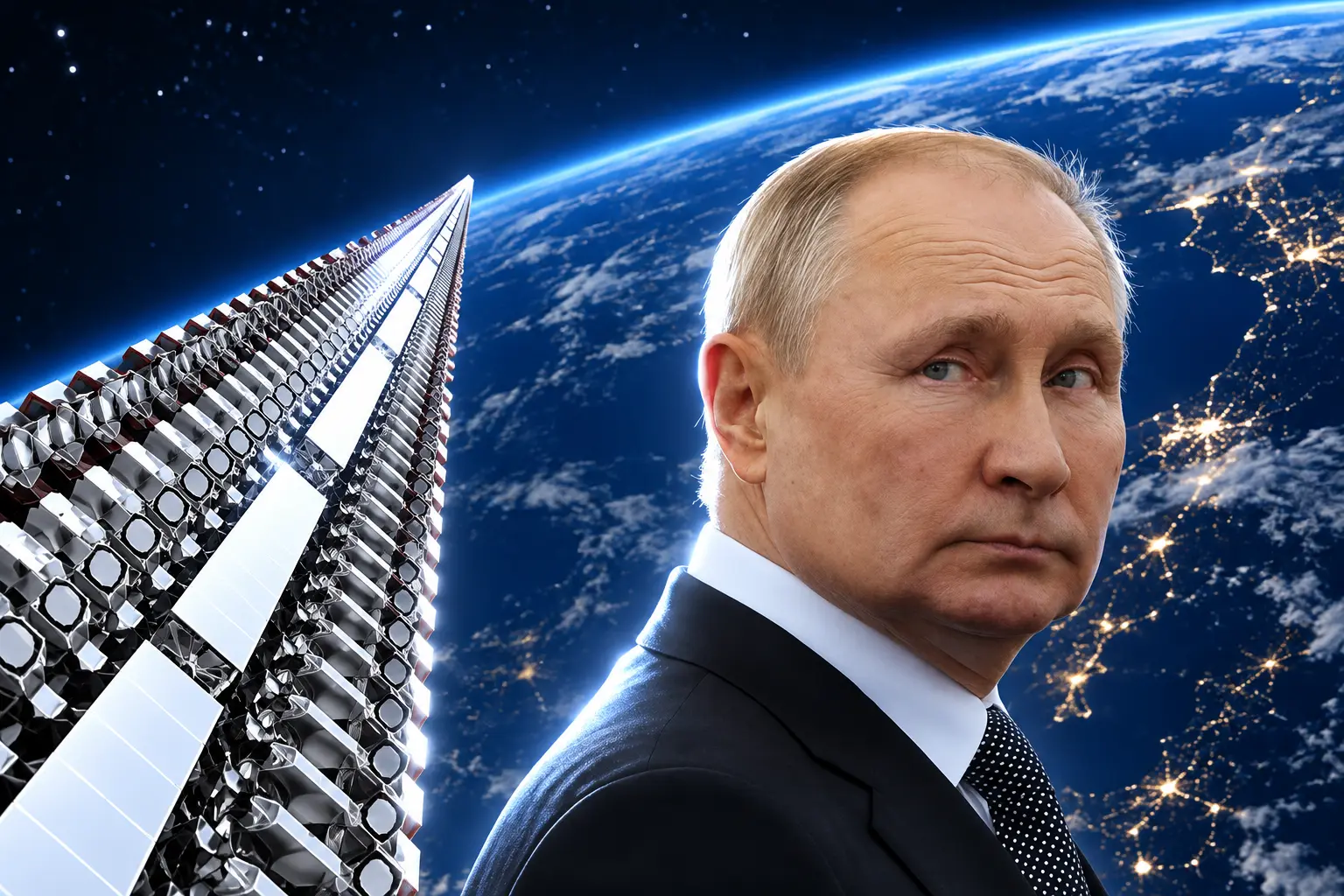
Rassvet Has 31 Satellites Against Starlink’s 11,190
KeepTrack’s October 28 census, built from public tracking data, lists 11,190 Starlink satellites in orbit, of which 11,176 are classed as working. SpaceX has launched 13,069 Starlink satellites since the first batch in May 2019, and 1,879 have already come down.
Orbital Radar’s live Rassvet board, updated the same day, counts 31 of 32 production satellites in orbit. Twenty-six have reached a working altitude of about 509 km. Two are still climbing, one is holding lower, two are falling, and one re-entered on June 6.
That is more than 360 Starlink satellites for every Rassvet bird now on orbit. Putin’s spoken figure of more than 5,000 was already stale when he said it.
STARLINK AND RASSVET ON OCTOBER 28
| Network | Operator | In orbit | Status note |
|---|---|---|---|
| Starlink | SpaceX | 11,190 | 11,176 classed as working |
| Rassvet | Bureau 1440 | 31 | 26 at about 509 km |
| OneWeb | Eutelsat | 654 | about 1,200 km |
| Amazon Leo | Amazon | 392 | about 590 to 630 km |
| Qianfan | Spacesail | 248 | about 1,160 km |
| Guowang | China SatNet | 231 | about 500 to 1,145 km |
Bureau 1440, a firm inside Russia’s IKS Holding group that began as a MegaFon study office, flew the first 16 production satellites on March 23 from Plesetsk on a Soyuz-2.1b. The second 16 went up on July 19, same rocket, same site. Each craft is released around 300 km and climbs on electric thrusters, a rise that takes weeks to months. The first one reached working altitude on June 10, 79 days after launch.
In July the company published a plan for 156 satellites in orbit by the end of 2026, 292 in 2027 when partial service is supposed to start, 610 in 2028, and 900 by 2035, with Russia-wide cover by 2030. Against that year-end target, 31 in orbit leaves a hole of 125 satellites, and Orbital Radar lists no Rassvet launch on the public schedule.
The production birds fly at about 82 degrees, close to polar, so they sweep most of the inhabited Earth. Laser links are meant to pass data across the fleet before it comes down. Six test satellites flew earlier, three on June 27, 2023 and three on May 16, 2024. The 2024 trio still sits near 785 km under generic catalogue names.
The Week Starshield Slowed to 160 kph
The praise landed on a battlefield that still runs on Musk’s radios. Ukraine has used Starlink since 2022, and later the Pentagon-funded Starshield version, to fly drones, move supplies, and catch incoming Shahed-type jets. Commercial Starlink terminals in Russian hands have been blocked since February, so only verified dishes can join.
On October 14, Ukrainian units found that dishes going faster than 160 kph dropped the link. Interceptor drones hunting Russian jets lost their video. A commander who gave only his first name, Oleh, said armed drones lost their feeds at once and many fell, wiping out more than $1 million in kit and forcing a three-day halt on strikes against command posts and fuel hubs.
THE STARSHIELD SLOWDOWN
- October 14, 2026: Ukrainian units begin reporting Starshield dropouts above 160 kph, a cap that lasts 10 days.
- October 21, 2026: President Donald Trump is described by people familiar with the matter as asking Musk to restore full access, after a row over a U.S. plan to buy Russian diesel and over Ukrainian strikes on Russian refineries.
- October 23, 2026: Trump says Musk “put it back.” Ukrainian officials, including chargé d’affaires Denys Sienik, say the speed cap is still in place.
- October 24, 2026: Defense Minister Yevheniy Khmara says monitoring shows Starlink and Starshield stable above 400 kph. President Volodymyr Zelensky says the speeds are back where they need to be. Musk posts that Ukraine broke Starlink’s terms.
- October 27, 2026: Zelensky says Ukraine used Starshield against Russian forces on Ukrainian soil, calling it defensive, and that civilians died while the systems were slowed.
- October 28, 2026: Putin, touring the Africa summit exhibit, calls Musk a genius and says the two sides talk so their satellites do not interfere.
Musk split the two products. Starshield, he wrote, is a different system controlled by the U.S. government. Commercial Starlink, he said, was never meant for killing.
Using Starlink, a civilian commercial service, for offensive drone strikes to kill people has never been allowed, nor should it be. Starshield, a different system, is controlled by the U.S. government. What they decide to do is up to them. Ukraine military violated Starlink terms of service and used it for offensive drone strikes to kill people. That loophole was closed last week.
Elon Musk, SpaceX chief executive, on X, October 24, 2026
He also wrote that Starlink cannot be jammed or blown up, “at least for now,” and that if it were turned off “the Ukrainian front line would collapse immediately.” He called that a fact, not a threat. Serhii Beskrestnov, an adviser to Zelensky, said Ukraine is physically unable to use commercial Starlink for long- and medium-range attack drones, because those dishes already sit inside a 70 to 90 kph cap and do not work in Russia.
Zelensky said he did not know who told SpaceX to slow the military service, only that “technically, SpaceX turns these systems on and off.” Starshield speeds came back on October 24, after days in which Washington, Musk, and Kyiv pointed at one another. Putin’s compliment arrived while that argument was still warm.
Why Russia Wants Musk to Keep Order in Orbit
Low Earth orbit is crowded. Starlink occupies shells from about 480 to 550 km. Rassvet is trying to settle near 509 km, in the same band, on a polar path that crosses those planes. Two networks that close need some way not to hit each other, even when their governments are at odds.
Putin cast that need as mutual discipline. He said American partners value the contact “despite all the political issues.” SpaceX has not said it talks to Moscow. The claim sits on Putin’s word.
Last week, U.S. diplomats accused a Russian military satellite of a close pass on a U.S.-registered, Finnish-operated radar satellite that feeds intelligence to Ukraine. Moscow called the charge absurd. The same president who wants “order” in orbit is answering a reckless-flying allegation by praising the American whose civilian network his army cannot switch off.
WHAT WE KNOW
- The ask: Putin says Russia talks to Musk and other U.S. partners so Rassvet and Starlink do not interfere.
- The altitude: Rassvet’s working orbit, about 509 km, sits inside Starlink’s low-orbit shells.
- The silence: SpaceX did not respond to questions about the contact claim.
WHAT IS UNCONFIRMED
- The channel: No public SpaceX, State Department, or Pentagon statement confirms talks with Musk or Roscosmos on Rassvet traffic.
- The switch: Trump, Musk, and Ukrainian officials still do not agree on who ordered the October speed cap on Starshield.
The sharper point is not whether Musk takes Kremlin calls. It is that a former space superpower now treats a private launch company as the party that keeps the sky tidy. The old race was state against state. The new one has countries asking one firm not to run them over.
Ukraine Lists 49 Companies Behind the Rival Network
On the same day Putin spoke, Ukraine’s military intelligence directorate, HUR, posted a roster of 49 Russian and Belarusian companies it says are building Rassvet. Twenty-three of them, including Roscosmos, are under no sanctions from the coalition that has blacklisted other Russian defense names. HUR asked that the whole list go on “blacklists” of countries, banks, and businesses, with a ban on dealing with them.
WHAT UKRAINE’S MILITARY INTELLIGENCE PUBLISHED
- Lead firm: Bureau 1440 is named as chief developer and operator, tying its flight-control center to Russian Defense Ministry space-surveillance and spacecraft-control systems.
- The holding: X Holding (IKS Holding) is listed as the technology group around Bureau 1440, spanning satellite links, telecom gear, and information security.
- The launcher: Roscosmos supplies pads and the Soyuz flights that put Rassvet into orbit; HUR says its head, Dmitry Bakanov, oversees the project.
- The money: VTB is named as an investor. MegaFon is listed as a strategic partner and a likely customer.
- The guns: HUR says Russia plans to put Rassvet terminals on command vehicles, including those used with the Iskander-M ballistic missile, once 292 satellites are up, and that the first coverage priority is Ukraine and EU countries.
HUR frames Rassvet as a military network first, a civilian internet second. The same-day dump is the Ukrainian reply to Putin’s exhibit: Moscow is not only catching up for Arctic villages and trains. It is trying to own a radio no foreign company can mute.
That is the other half of the genius remark. Starlink can be throttled from California, as Ukraine just learned. A finished Rassvet would not. Until the 292-satellite mark, though, Russian units still live with the gap, and with whatever limits SpaceX and Washington choose to set on the other side of the front.
Falling Birds and a 125-Satellite Hole
Two satellites from the July batch are not going to make the working shell. Orbital Radar has RASSVET-3 17 at about 181 km and dropping, and RASSVET-3 23 at about 233 km and dropping. RASSVET-3 4 from the March batch already burned up on June 6. Bureau 1440 has not put those losses on its public channel.
RASSVET’S LIVE BOARD
- Working altitude: 26 production satellites near 509 km.
- Still climbing: 2, including one from each batch.
- In trouble: 1 holding lower, 2 descending, 1 already re-entered.
- Year-end gap: 125 satellites short of the 156 the company listed for the end of 2026, with no next launch posted.
Public demos have begun anyway. Residents of the Arctic village of Nelmin-Nos cast electronic votes through a Bureau 1440 terminal on September 19. Coal firm Elga signed a remote deal over the link on October 8. A live test with MegaFon and a YADRO base station ran on October 9. Kremlin spokesman Dmitry Peskov said in late September he hoped the system would start working as soon as possible. Roscosmos deputy director general Boris Glazkov has given corporate customers a 2027 to 2028 window.
That is not a network that can replace Starlink over a war. Serhii Beskrestnov said in May that stable communications would need 200 to 250 satellites in orbit. HUR told Janes that seven more launches were planned by the end of 2026. Two batches of 16, four months apart, do not get Russia to 156 before January unless the cadence breaks hard.
Putin told the African guests he was proud Russia had started on its own. The tracker on October 28 still showed 31 production satellites, two of them dying, and a California fleet of 11,190. The genius, on his telling, already owns the sky Russia has to share.

ADNOC Ship Hit in Hormuz Leaves One Crew Missing

SpiceJet’s Rs 5,500 Crore Plan Follows a Rescue That Failed

Hasina’s Return Fight Sets Fire to Yunus’s Bank

Bancroft Recants the 2018 Inquiry and Names the Team

Adhikari Ties the Saffron Saree Row to School Licences

Clancy Juror Says the Holdout Never Cited Evidence

The iPhone 18 Pro Max Splits Apple’s Fall in Two

OpenAI Calls GPT-6 Astra AGI Then Locks Its Exploits

Trump Claims Hormuz Control as Oil Holds Near $96

Russia Closes the Goethe-Institut Berlin Tried to Save

 NEWS2 months ago
Clancy Juror Says the Holdout Never Cited Evidence
- NEWS3 months ago
The iPhone 18 Pro Max Splits Apple’s Fall in Two
- NEWS3 months ago
OpenAI Calls GPT-6 Astra AGI Then Locks Its Exploits
- BUSINESS3 months ago
Trump Claims Hormuz Control as Oil Holds Near $96
- LIFESTYLE3 months ago
Russia Closes the Goethe-Institut Berlin Tried to Save
- AUTO3 months ago
Volkswagen’s Job Cuts Leave Four Plants Without Cars
- NEWS3 months ago
Dyson Puts Nurovi Robots on Sale Without the UV Flagship
- BUSINESS2 months ago
US Destroys Five Iranian Tankers as the Shock Hits Jordan










