
FINANCE
Bessent’s Iran Economic D-Day Tests China More Than Tehran
US Treasury’s financial offensive targets Iran lifelines but forces China and Gulf buyers into a binary that risks rare-earths pushback and prolonged Hormuz.

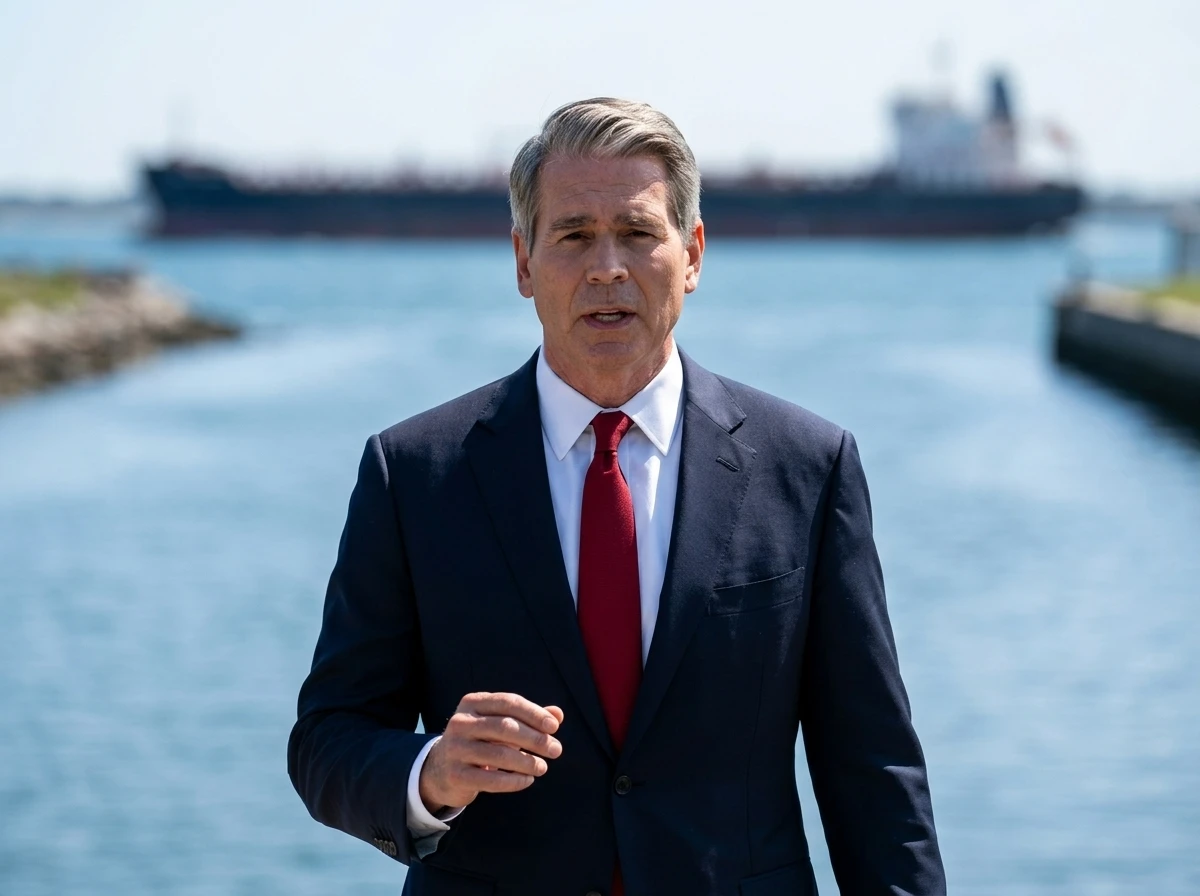
US Treasury Secretary Scott Bessent declared Monday the start of an economic D-Day against Iran, promising the single greatest financial offensive ever marshalled against an adversary and secondary penalties for any country that keeps buying its oil or moving its money. The announcement, set for a 2 p.m. EDT press conference, lands six months into a war that has already left the Strait of Hormuz operating at a fraction of normal volume.
Tehran answered by calling the secondary sanctions an act of war and vowing that not a single drop of oil would leave the Persian Gulf if the pressure continues. The immediate contest is no longer only military. It is over who folds first among the buyers, led by China.
Bessent Frames Dawn as Financial Normandy
In a Sunday opinion piece for the Financial Times and an entering the endgame post on X seen more than 2.4 million times, Bessent wrote that President Donald Trump’s military campaign had dismantled Iran’s capabilities, destroyed nearly 100 percent of its military factories and buried its nuclear program. “We are now entering the endgame. At dawn begins an economic D-Day,” he said.
The objective, he added, is to sever every economic lifeline until Tehran stands alone. Countries that still purchase Iranian petroleum, tolerate ship-to-ship transfers or look past illicit bank use “would do well to consider the consequences.” Bessent told CNBC days earlier that the package would be the toughest sanctions in history, a one-two punch with the existing blockade that would collapse the regime, just as similar pressure had worked on Venezuela and was working on Cuba.
The Islamic Republic has subsisted by dressing extortion as security guarantees. It has drawn strength from a calculus that regards Iranian retaliation as certain and American enforcement as negotiable. Under President Trump, that era is over.
Scott Bessent, US Treasury Secretary, X post
He warned that any Iranian military reply would meet a swift and decisive American response. Details of the new measures were to be laid out Monday, with secondary sanctions on banks, shippers and governments expected to form the core.
Six Months of War Left Hormuz Half-Closed
The conflict that began with US and Israeli strikes on 28 February has already rewritten oil logistics. Before the fighting, roughly a fifth of the world’s seaborne crude and products moved through the Strait of Hormuz. After the initial closure and a failed 60-day Islamabad memorandum of understanding that expired 17 August, flows never recovered.
Kpler data on MoU window clearances show crude clearance out of the Mideast Gulf averaged 6.1 million barrels per day across the truce window, nearly three times the blockaded pace but only about 40 percent of the roughly 15 million bpd Hormuz averaged in 2025. Iran’s own loadings collapsed from 893,000 bpd in July to 156,000 bpd through 17 August. Floating storage inside the Gulf fell from 61 million barrels at signing to 16 million within three weeks, yet total crude on water closed the window still elevated near 130 million barrels.
| Period | Hormuz / Gulf clearance (mbd) | Iran loadings (kbd) | Notes |
|---|---|---|---|
| Pre-war 2025 avg | ~15 | near decade highs | China took majority |
| Blockaded months | ~2.3 | sharply lower | stranded backlog peaked |
| MoU 60-day window | 6.1 | 893 July to 156 mid-Aug | backlog cleared, system did not heal |
| Post-expiry Aug | thinning, dark share rising | constrained | permit-and-toll regime asserted |
Every operative MoU commitment failed early. The US oil waiver lasted 20 of 60 days. The blockade lift lasted 27. Iran never completed mine clearance. Tehran declared the deal nullified and moved to mandatory transit permits and environmental tolls. Washington rejected both and kept escorts and enforcement. Brent crossed $90 a barrel on expiry day.
- US General License X issued 22 June, revoked with wind-down by mid-July after vessel attacks.
- Southern Omani corridor opened then abandoned after strikes on tankers.
- Dark or unattributed cargo share rose from 5 percent at peak transparency back above 66 percent.
- LPG crossings hit zero for stretches; LNG carriers ran dark for weeks.
An IEA analysis of Hormuz supply gaps earlier documented cumulative Middle East losses exceeding 1.3 billion barrels and peak prices near $144 before demand destruction and inventory draws cooled the market. The structural shortfall for the second half of 2026 remains large.
China Buys the Bulk and Holds the Countermove
China has purchased more than 80 percent of Iran’s shipped oil in recent Kpler tallies, at times approaching 90 percent. Beijing has also supplied dual-use technology and materials. That position makes China the central target of any secondary-sanctions campaign, yet Chinese officials and analysts sound unimpressed.
Foreign Ministry spokesman Lin Jian said China opposes illegal unilateral sanctions lacking UN Security Council authorization and that pressure will not resolve the crisis. A Chinese embassy statement in Washington called for political and diplomatic means. Wu Xinbo of Fudan University, who advises the foreign ministry, called the US threat a sign of desperation: “They issue this threat, not because they think it is workable, but because they have no other options.”
China has built large crude stockpiles and cut seaborne imports sharply during the war, at points running half of pre-conflict levels. That buffer reduces immediate pain from losing Iranian barrels. More importantly, Beijing controls critical mineral supplies that US weapons makers need after months of high consumption. Last year’s brief cutoff already forced a US pause in a separate trade fight. Any attempt to force Chinese banks or refiners off Iranian oil risks a minerals reply that hits American industry directly.
Bessent has urged China to cooperate and said some conversations are best held privately. Markets so far treat the secondary-sanctions threat as real but incomplete. Oil prices have moved more on Hormuz headlines than on confirmed Chinese compliance.
Tehran Calls Secondary Sanctions an Act of War
Iran’s Foreign Ministry spokesman Esmaeil Baghaei labeled the coming measures an assertion of extraterritorial sovereignty over every UN member state with no foundation in international law. Mohsen Rezaei, secretary of the Supreme National Security Council, went further in a social-media post: if the economic war continues, not a single drop of oil will be exported through the Strait of Hormuz or anywhere in the Persian Gulf. Any country’s participation or support would be regarded as an act of war.
Rezaei and other hardliners have also threatened Gulf neighbors’ energy infrastructure and alternative export routes. Iran’s parliament has moved to charge service fees on vessels using the strait. The Persian Gulf Strait Authority warned of fines, seizure or confiscation for rule violators. Foreign Minister Abbas Araghchi dismissed the US shift from kinetic to economic pressure as desperate.
At the same time, Iranian leaders acknowledge domestic strain. Parliament speaker Mohammad Baqer Qalibaf told Iranian and Iraqi businesspeople that military power alone will not suffice if people are hungry and there is no financial turnover, economic growth or national production. President Masoud Pezeshkian has called for ending the war while Iran still holds dignity and the world recognizes its claims of victory against American attacks on civilian sites.
Qalibaf Admits the Economy Cannot Feed the Fight
Bessent’s own description of the Iranian economy matches some of that admission. He wrote that Trump had already driven the rial to historic lows and inflation to rare highs. The regime’s remaining refuge, in his telling, is the self-deception of nations that still believe accommodation buys peace.
Yet the war’s six-month mark shows the limits of pure pressure. A 60-day ceasefire window produced no deal and no extension. Military exchanges have quieted for stretches, but neither side has delivered a decisive political outcome. Oil shipments through Hormuz remain far below normal, giving Iran residual leverage even as its own exports shrink under blockade and sanctions.
Chinese analysts frame the US position as a self-created dilemma: unable to end the war on favorable terms, Washington reaches for the financial weapon it has used before, knowing the largest customer can absorb pain and retaliate asymmetrically.
Oil Markets Already Price a Longer Squeeze
Kpler has raised its 12-month North Sea Dated forecast to $81 a barrel, citing a shift from expected surplus to nearly 2 million bpd deficit in the second half of 2026 under an extended-conflict baseline. Chinese refiners’ reduced intake has capped the upside so far; if they return as aggressive buyers while Hormuz stays constrained, the floor rises further.
US producers have filled some of the gap, but the scale of Middle East outages, including refined products, LPG and LNG, exceeds what spare capacity and inventories can paper over indefinitely. A CRS background on Hormuz security impacts notes that sustained disruption of the strait’s historical 20 million bpd throughput would drive rapid price escalation until tankers and insurers regain confidence or alternative routes expand.
Gulf states sit between the two threats. Joining US secondary sanctions risks Iranian retaliation against their own exports and infrastructure. Staying neutral risks American penalties. Several have already absorbed strikes and higher insurance costs. Their quiet diplomacy with Tehran over transit rules continues even as they host US forces.
Bessent’s Monday announcement will clarify the exact secondary tools and the grace periods, if any. The spine of the strategy is already public: force every remaining commercial tie to Tehran into the open and make the cost of those ties higher than the benefit. Whether China calculates the same way, and whether Iran’s oil cutoff threat is deterrent or bluff, will decide how much further global energy prices move and how long the Hormuz bottleneck lasts.
The financial offensive begins with the press conference. The second-order test for third countries is already underway.

-
 TECH1 year ago
Where Garmin Watches are Made and How They are Assembled
-

 AUTO3 months ago
Tesla’s Roadster Is ‘a Few Weeks Away,’ Says Its Chief Designer
-
 NEWS10 years ago
Samsung Releases Galaxy Note7 TV Ad as Reddit AMA Leaks Specs
-
 NEWS10 years ago
Android 7.0 Nougat Rolls Out To Nexus Devices With New Emoji, Features
-
 FINANCE9 years ago
Cardano Price Surges as ADA Enters the Crypto Top Ten List
-
 NEWS10 years ago
Pre-Order the First Camera Made for Facebook Live Streaming Video
-
 FINANCE1 year ago
Binance Suspends Trading and Withdrawals for a System Upgrade
-
 FINANCE9 years ago
RChain Price Jumps Nearly 150% to a New All-Time High of $2.03