
NEWS
Zamboye Mine Collapse Leaves Over 100 Dead in Controlled Gold Belt
More than 100 die at Zamboye artisanal gold pit as tunnels collapse; the site sits in a prefecture where foreign-linked forces seized mines and gold leaves.

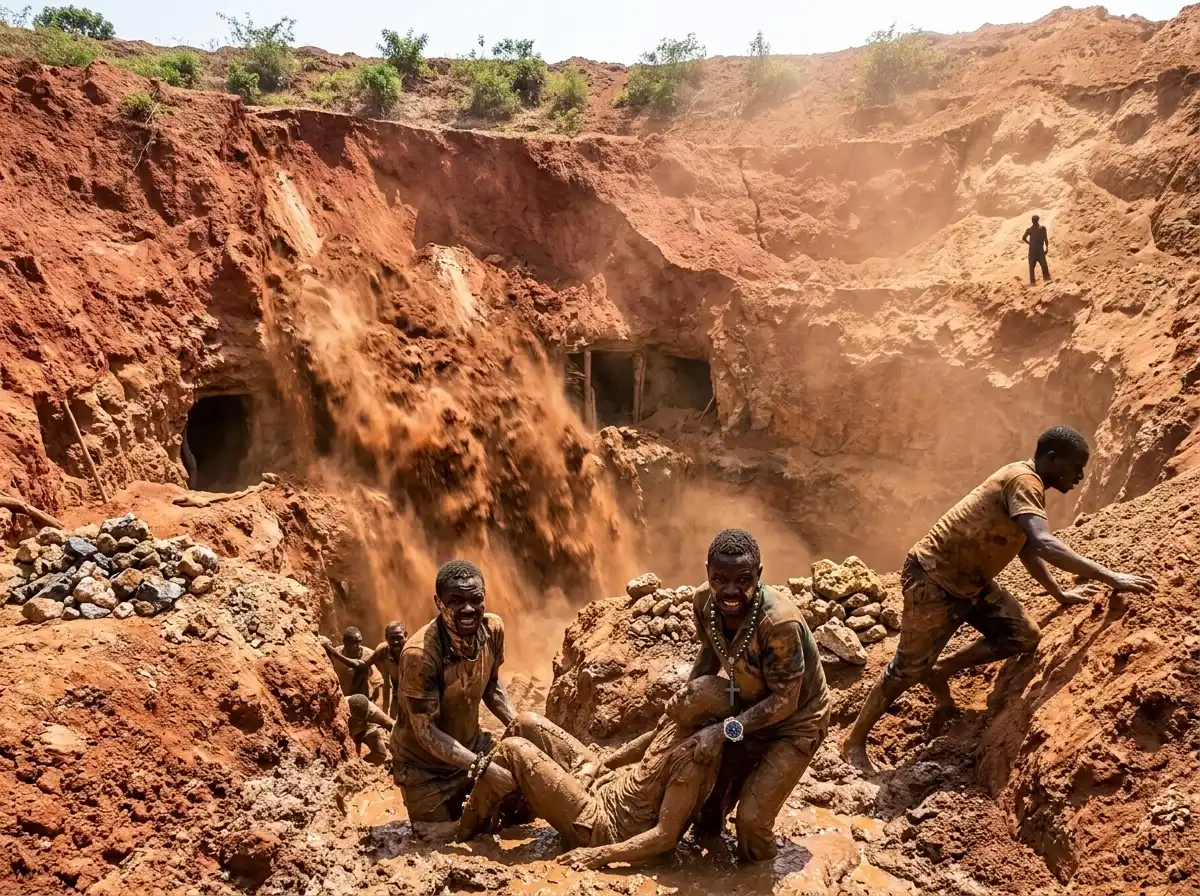
More than 100 people died when underground tunnels collapsed at an artisanal gold mine in Zamboye village on August 18, 2026, burying miners under earth and mud in western Central African Republic near the Cameroon border. Search teams were still pulling bodies from the open-pit site two days later, and local officials said the toll would climb.
Gervais Ganagoroh, a Red Cross volunteer on the relief effort, told agencies that more than 100 bodies had already been recovered. Survivors reached hospital in Baboua in critical condition. At least four of the dead were Cameroonian nationals.
The disaster struck a corridor where artisanal pits, cross-border labor and armed control of gold already overlapped. Rescue work, medical offers from Cameroon and a prosecutor’s inquiry opened at once. None of those steps changed the conditions that had drawn hundreds of people into unshored tunnels in the first place.
Tunnels Gave Way Under Hundreds of Miners
The low-tech site sits in Nana-Mambere prefecture, about 50 km from Baboua. Hundreds of men and women worked the vast open pit without heavy equipment or protective gear. Social media video captured the ground giving way in a sudden slide that buried people where they stood.
Cedric Mbango, a miner who was there, described it simply: “The ground completely collapsed and buried people.” Bertrand Be Yangué of the Zamboye youth council said finding anyone still alive under the rubble “would be a miracle.” He added that the dead had come to the mines “to save their families from despair.”
Finding them alive would be a miracle. We are saddened and heartbroken to see young men and women perish after coming to the mines to save their families from despair.
Bertrand Be Yangué, Zamboye youth council member
The Baboua public prosecutor said several underground tunnels failed. An investigation is open to fix the cause, identify victims and decide criminal liability. Laurent Ngon Baba, a Baboua elected official, said on August 19 that a formal toll remained impossible while rescue work continued. Cameroon’s eastern regional governor Gregoire Mvongo said his side was coordinating with Central African authorities and stood ready to treat injured people who crossed the border.
Hand recovery continued into a third day. Bodies still lay under mud and collapsed shafts. Families waited in Baboua and in villages on both sides of the border for names that papers may never fully confirm.
The Prefects Where Armed Networks Took the Pits
Zamboye lies in the same western corridor that Russian-linked forces moved into years earlier. In 2023 Wagner Group units seized artisanal gold mines in the Yidéré-Baboua area through a military operation that local accounts described as marked by killings and expulsions of independent miners. Production and profits at those sites are not monitored by the state. Negligible taxes are paid; the bulk of the gold moves through opaque channels.
Ndassima, the country’s largest industrial gold site farther east, has been under the same network’s control since 2020. Official records show no declared output or exports even as satellite images document expansion of pits and tailings. Analysts put its annual generation near $100 million. The same pattern of seizure, intimidation of inspectors and smuggling runs through the artisanal belt that feeds both local dealers and overseas buyers.
One miner expelled from a Yidéré site told researchers the treatment was inhumane, with killings and bodies left decapitated. That control structure sits on top of the same unregulated pits where safety equipment is scarce and tunnels are dug by hand. The August collapse fits the extraction model rather than interrupting it.
Once armed actors hold a pit, routine inspection becomes rare and capital for timbering or drainage is not spent. Miners keep entering because the alternative is deeper poverty. The model rewards output volume and speed of removal, not the stability of the ground underfoot.
How Much Gold Leaves and Who Counts It
Artisanal and small-scale mining is the backbone of the sector. Estimates put 150,000 to 300,000 people working in artisanal mining across the Central African Republic, a principal livelihood in a country of roughly 5 million. Annual gold output from these sites has long been pegged between 2 and 5 metric tons.
Analysts tracking Wagner-linked interests say those networks alone now produce about 5 metric tons of gold each year. At export values that can run $250 million to $500 million on international markets. Official gold exports climbed from 1.7 tons in 2023 toward figures that hit as high as 7 tons by the end of 2025, well above pure artisanal capacity and pointing to industrial output entering formal channels or undeclared flows.
- ASM workforce: 150,000-300,000 people
- Long-standing gold estimate: 2-5 metric tons per year
- Wagner-linked production: ~5 metric tons annually
- 2024 export share: gold 25.7 percent of goods exports by value
| Measure | Figure already on record |
|---|---|
| Long-standing ASM output range | 2-5 metric tons per year |
| Wagner-linked annual production | ~5 metric tons |
| Official gold exports, 2023 | 1.7 tons |
| Official gold exports, end 2025 | as high as 7 tons |
| Implied export value band | $250 million to $500 million |
| Ndassima annual generation (analysts) | near $100 million |
According to U.S. Geological Survey figures for 2024, diamond and gold together made up 36.3 percent of the country’s total goods exports, with gold representing 25.7 percent of goods exports. A new Mining Code took effect that year. Enforcement on the ground at unlicensed open pits remains thin. Much of the metal still reaches buyers in the United Arab Emirates and elsewhere through routes that bypass full declaration.
The gap between declared tons and the higher production attributed to controlled networks is the space in which smuggling, under-reporting and inspector exclusion operate. Zamboye’s output before the slide belongs in that uncounted flow.
Four Collapses Already This Year in CAR
Mine failures are routine. Protective gear is rare. Accidents kill with little lasting change in practice.
- February 2026: 20 killed at Gordi in the north-east.
- Mid-March 2026: landslide at Ngourroum in the west kills 7.
- June 2026: several dozen dead at Be-Mbari gold site on the Cameroon border.
- August 18 2026: Zamboye tunnels collapse, more than 100 recovered so far.
Aicha Pemboura, a researcher with the Central Africa Observatory on Organised Crime and Violence Project, noted in March that many miners and traders work without permits or outside official channels even though the sector is formally regulated. Opposition figure Martin Ziguele said the government carries direct responsibility. Cameroonian opposition leader Maurice Kamto called the pattern proof of “the inhumanity of those who grow rich from the illegal exploitation of minerals” and the complete absence of safety measures for people driven by destitution.
| Site | Date | Reported deaths | Border / notes |
|---|---|---|---|
| Gordi | February 2026 | 20 | North-east |
| Ngourroum | March 2026 | 7 | West |
| Be-Mbari | June 2026 | Several dozen | Cameroon border |
| Zamboye | August 18 2026 | 100+ | Nana-Mambere, Cameroon border |
Cameroon itself tightened gold controls after finding large gaps between declared exports and imports recorded by receiving countries, notably the UAE. More than 200 companies were said to be mining there without permits. The same porous border that carries people and gold also carries the risk.
Two of the four CAR failures this year struck near that border. Labor, injured survivors and metal all move across it. Formal tolls lag because many miners lack papers and because rescue itself is slow when pits sit outside daily state reach.
Across the Region the Pattern Holds
In January 2026 more than 220 artisanal miners died in successive landslides at the Luwowo coltan site in Rubaya, eastern Democratic Republic of the Congo. Heavy rain had loosened the ground. The site produces roughly 15 percent of the world’s coltan and has been under M23 armed-group control since 2024, complicating any oversight or rescue. Civil society tallies ran higher than rebel figures in some reports.
Artisanal mining employs tens of millions across sub-Saharan Africa. It fills gaps left by weak formal economies. The same poverty that pushes people into unlicensed tunnels and open pits also guarantees that safety spending comes last. Governments from Mali to the DRC announce tighter rules after every large death toll. Enforcement routinely falls short once attention moves on.
- Rubaya/Luwowo (DRC, Jan 2026): 220+ dead, M23-controlled coltan pits
- Multiple CAR border sites in 2026 alone: dozens then 100+
- Common drivers: rain-soaked ground, hand-dug tunnels, no PPE, armed or informal control
- Common outcome: brief inquiry, limited lasting regulation, gold or coltan still moves
Crowd discussion on the latest CAR disaster quickly noted that the extraction system itself treats the workforce as disposable. Rainy-season ground failure plus absent safety rules produce the default result: more bodies, temporary aid, and the metal continuing to leave the country. An inquiry that actually closes dangerous sites remains the less likely path.
How the Border Shapes Rescue and Risk
Zamboye’s location near Cameroon turned a local collapse into a bilateral event within hours. At least four of the dead were Cameroonian. Survivors crossed for care. Governor Gregoire Mvongo said eastern Cameroon was coordinating with Central African authorities and stood ready to treat the injured.
That same border already carries undeclared gold toward buyers in the United Arab Emirates and elsewhere. Cameroon tightened its own controls after large gaps appeared between declared exports and imports recorded by receiving countries. More than 200 companies were said to be mining on the Cameroonian side without permits.
- Dead and injured with Cameroonian nationality among the Zamboye toll
- Medical offer and coordination stated by Cameroon’s eastern regional governor
- Prior Cameroon crackdown on undeclared gold and unpermitted firms
- Shared corridor with Be-Mbari, another 2026 border-site failure
Porous crossings speed both aid and smuggling. Families on either side wait for identification that may never be complete. Metal that left the pit before August 18 does not wait with them.
What Destitution and Control Leave Unprotected
Hundreds worked the Zamboye pit without heavy equipment or protective gear. Tunnels were dug by hand. Bertrand Be Yangué said the dead had come “to save their families from despair.” Maurice Kamto pointed to “the complete absence of safety measures for people driven by destitution.”
Aicha Pemboura noted in March that many miners and traders work without permits or outside official channels even though the sector is formally regulated. A new Mining Code took effect in 2024. Enforcement at unlicensed open pits remains thin. Armed seizure of western pits since 2023 and control of Ndassima since 2020 further distance daily practice from the code’s text.
When networks intimidate inspectors, pay negligible taxes and move gold through opaque channels, timbering, drainage and PPE do not appear on the cost sheet. Output still reaches local dealers and overseas buyers. The workforce absorbs the ground failure.
Each 2026 collapse repeated the sequence: sudden slide, body recovery, statements of sorrow, no durable change in how pits are held or dug. Zamboye is the largest toll so far this year inside that sequence.
What the Inquiry Can Reach and What It Cannot
The Baboua prosecutor’s office will try to name the immediate cause and any operators of the Zamboye pit. Survivors and families need that process. Identifying every victim will take time; many worked without papers.
What we know
- More than 100 bodies recovered by August 20; missing still under rubble
- Cause cited as collapse of several underground tunnels
- Site is artisanal, low-tech, largely outside daily state control
- Prefecture has history of armed seizure of gold pits since 2023
What remains unconfirmed
- Final death toll and full list of nationalities
- Exact ownership or licensing status of the Zamboye pit on the day of the collapse
- Whether any criminal charges will reach beyond local operators
- Volume of gold that left the site in the weeks before the slide
Structural control of the wider gold economy sits with networks that have blocked inspectors, paid minimal taxes and moved metal through undeclared routes for years. Local elites and foreign security partners have co-opted the resource flows that once sustained rebels. The result is a conflict economy that continues even as the government consolidates formal power. Miners keep dying in the pits that feed it.
Cameroonian authorities offered medical help across the border. Red Cross volunteers worked the rubble by hand. The ground at Zamboye is still being searched. The gold that came out of those tunnels before August 18 is already somewhere else.

-
 TECH1 year ago
Where Garmin Watches are Made and How They are Assembled
-

 AUTO2 months ago
Tesla’s Roadster Is ‘a Few Weeks Away,’ Says Its Chief Designer
-
 NEWS10 years ago
Samsung Releases Galaxy Note7 TV Ad as Reddit AMA Leaks Specs
-
 NEWS10 years ago
Android 7.0 Nougat Rolls Out To Nexus Devices With New Emoji, Features
-
 FINANCE9 years ago
Cardano Price Surges as ADA Enters the Crypto Top Ten List
-
 NEWS10 years ago
Pre-Order the First Camera Made for Facebook Live Streaming Video
-
 FINANCE1 year ago
Binance Suspends Trading and Withdrawals for a System Upgrade
-
 FINANCE9 years ago
RChain Price Jumps Nearly 150% to a New All-Time High of $2.03