
NEWS
Constelli’s Radar Test Tools Quietly Speed India’s EW Buildout
Hyderabad’s Constelli supplies DRDO labs with radar simulators and EW processors, turning private RF signal work into faster indigenous defence electronics.

Hyderabad startup Constelli supplies the radar signal processors, ELINT receivers and lab simulators that DRDO labs already use to test high-performance electronic-warfare systems. A fresh $20 million Series A led by General Catalyst in February 2026 now funds faster production of those same tools plus counter-drone and multi-platform payloads.
The company sits in the quiet middle of India’s defence electronics push: not the finished fighter radar or shipboard jammer, but the hardware and software that let engineers create synthetic battle signals and prove a system works before any aircraft leaves the ground.
From National Instruments Benches to a Named Company
Satya Gopal Panigrahi spent a decade at National Instruments watching Indian defence labs struggle with imported electronic-warfare tools. Avinash Chenreddy was already deep in advanced signal-processing work. The two met through an NGO, began late-night whiteboard sessions on unsolved RF problems, and formalised Constelli in 2017.
Early years stayed capital-efficient and close to end users. Only in the last three to four years did the firm shift hard into commercial scale. Today multiple DRDO labs treat Constelli as a co-development partner rather than a simple vendor. The same edge-AI architecture that classifies threats in real time also underpins the simulators sold into those labs.
That partner role matters because the labs already know the tool chain. Feedback on synthetic emitters and receiver behaviour flows straight back into product design instead of stopping at a purchase order.
General Catalyst’s investment note frames the pair’s conviction simply: India’s resilience needs world-class defence electronics built at home. That note also flags the expansion into counter-drone systems where demand is rising across military and critical infrastructure.
What the Product Bench Holds
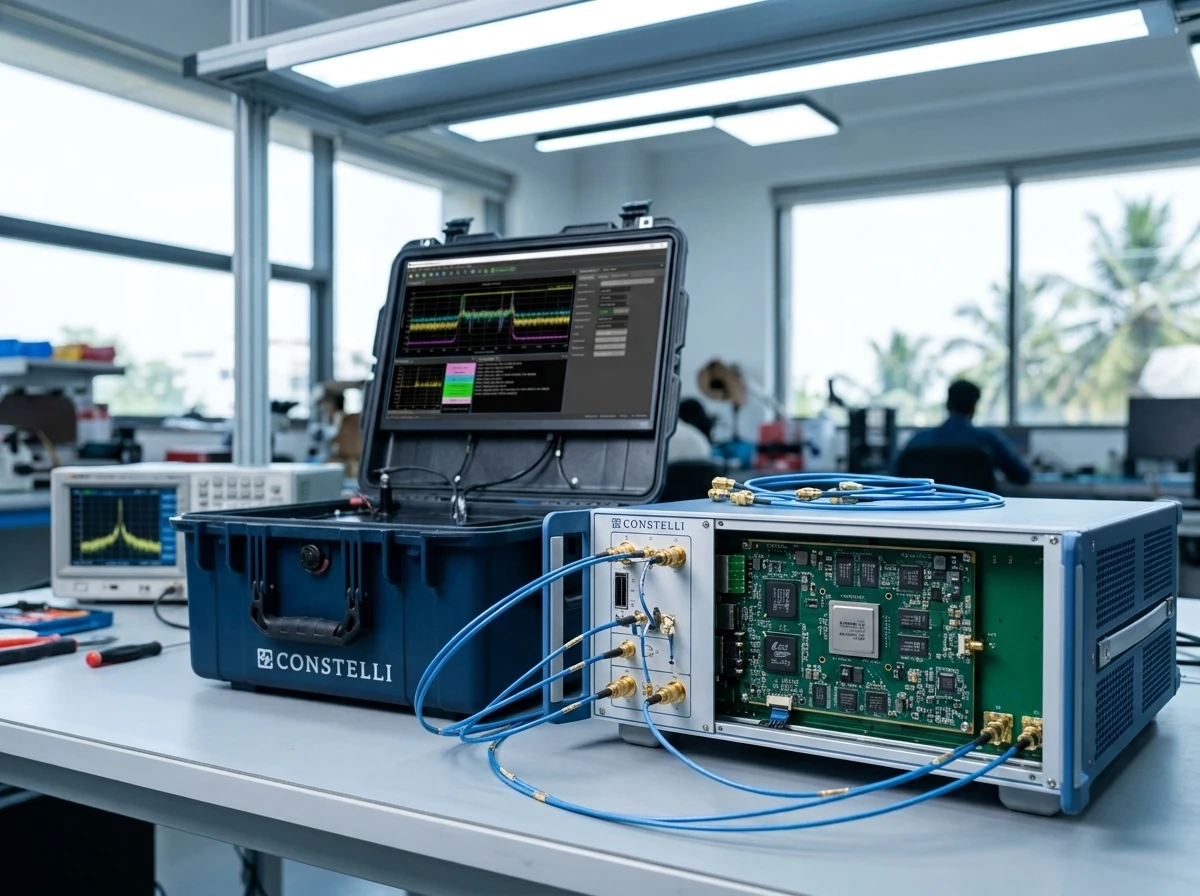
Constelli’s catalogue spans the full test-to-deploy loop. Engineers load synthetic radar returns or emitter libraries, run the system under test through operating modes, and read out behaviour without a single flight hour.
| Category | Key items | Primary use |
|---|---|---|
| Radar | Target and echo simulators, radar processors, short-range systems, LabVIEW toolkit, drone payloads, RTS, decoys | Validation, training, tactical surveillance |
| Electronic Warfare | ELINT simulators (ESM, RWR, RFPS), COMINT simulator, ELINT receiver processor, EW Sphere, drone jammer, PMDA | Mission planning, real-time track formation, post-mission analysis |
| Telemetry | India’s first IRIG-standard digital receiver (2U/3U), compact, satellite, onboard, drone telemetry, decommutator | High-fidelity data capture across full mission lifecycle |
The firm also ships high-speed radar processing chips and sub-systems for airborne and sea-borne situational awareness. Modern platforms need to classify counter-signals in real time; Constelli’s FPGA-based and software-defined blocks are built for exactly that speed.
- Radar signal processors (RSPs) for detection and tracking
- ELINT and ESM equipment for emitter intelligence
- RTA and RIA simulators for receiver and antenna behaviour
- Full EW test solutions that generate synthetic battle signals
That last capability is the sleeper layer. Flight testing is expensive and schedule-bound. Lab simulation compresses the loop, raises robustness, and lets DRDO teams iterate without waiting for airframes or ships.
How the Lab Simulation Loop Runs
An engineer builds a synthetic RF environment that matches a target operating mode. The radar or EW unit under test receives those signals through the simulator. Behaviour is logged, classified and scored. Failures surface in hours instead of months of range time.
Constelli’s own site describes the approach as end-to-end radar and EW solutions that cover planning, execution and post-mission analysis. The same stack now feeds deployable drone-based radar payloads and short-range systems for quick-response work.
Software-defined architecture and digital signal processing sit at the core. As India’s electronics industry absorbs more RF and FPGA talent, these tools become the shared language between private startups and government labs.
Once that language is common, a lab can swap a software-defined block without rewriting the entire test harness. The modelling layer stays stable even as the hardware under test changes.
$23 Million Total and a Production Line on the Drawing Board
The February 2026 round brought $20 million (about ₹182 crore) led by General Catalyst, with 360 ONE Asset and existing backer Pravega Ventures. That followed an earlier $3 million pre-Series A round in January 2025, taking cumulative capital to $23 million.
Stats snapshot
- $20 million Series A led by General Catalyst, February 2026
- $3 million pre-Series A led by Pravega, January 2025
- $23 million total raised to date
- Funds earmarked for EW and communications payloads on drones, ground systems, naval vessels and satellites, plus rapid-prototyping infrastructure
CEO Satya Gopal Panigrahi said the capital supports scaling and a production line that was already in planning. CTO Avinash Chenreddy pointed to new product development plus sales expansion, leaning on hardware, software, modelling, simulation and distributed computing.
- 2017 – Constelli formalised in Hyderabad after whiteboard work on RF gaps
- January 2025 – $3 million pre-Series A led by Pravega Ventures
- February 2026 – $20 million Series A led by General Catalyst with 360 ONE and Pravega
Constelli is a leading innovator in the Radar and EW domain. We are impressed with the company’s strong team and their consistent growth over the years.
A Pravega spokesperson offered that assessment at the earlier round. General Catalyst’s later note added the strategic layer: control of the electromagnetic spectrum now decides conflicts as much as kinetic hardware.
DRDO Labs, iDEX Pressure and a Growing Market
Constelli already works with DRDO, the Indian Air Force, HAL and BEL. Export licences reach defence contractors in Turkey, South Korea, Australia and Singapore. The firm is expanding that footprint while the domestic pipeline thickens.
India’s defence electronics market sits near $7.5 billion in the mid-2020s with mid-single-digit CAGRs in some forecasts. Electronic-warfare specific estimates vary more widely, from roughly $740 million to over $2 billion depending on scope, yet every projection points upward on the back of Atmanirbhar Bharat, Make in India and iDEX.
| Segment | Scale cited | Signal |
|---|---|---|
| Defence electronics (India) | Near $7.5 billion, mid-2020s | Mid-single-digit CAGRs in some forecasts |
| Electronic warfare (scope varies) | Roughly $740 million to over $2 billion | Every projection points upward |
| Defence-tech startup inflow | $247 million in 2025 | Highest yearly total on record |
The iDEX radar and simulation challenges alone list dozens of open problems and dozens of startups already working the domain. Simulation systems form their own track. Constelli’s tools map directly onto that demand: labs need reliable ways to generate and analyse signals before they commit to expensive integration on real platforms.
Private capital is noticing. Defence-tech startups recorded their highest yearly inflow of $247 million in 2025. Non-combat systems such as drones, anti-drone, AI and secure communications took the bulk of that money. Signal-processing pure-plays sit underneath those headlines.
Why Simulation Quietly Changes the Calendar
Every major radar or EW program once burned calendar months on flight tests or shipboard trials simply to collect enough signal data. Synthetic environments reverse that order. Designers first prove behaviour in the lab, then fly only the residual risk cases.
That compression is the second-order payoff. Faster iteration means DRDO can field software-defined updates more often. It also lowers the barrier for smaller private firms to contribute validated sub-systems. The same logic appears in other sensor domains: sensor-fusion field experiments and recent large radar production orders both depend on earlier ground truth that only robust test infrastructure can supply.
India still imports large volumes of finished defence electronics. The gap that Constelli and peers close is the validation layer itself. When that layer is indigenous, the finished system becomes easier to certify, modify and export under national control.
Exports, Counter-Drone and the Next Platforms
Licensed sales already run to four overseas markets. The new capital explicitly targets payloads for drones, ground vehicles, naval vessels and satellites. Counter-drone systems form a fast-growing adjacent line as both military units and critical infrastructure operators seek spectrum dominance against small UAVs.
Edge-AI for real-time threat classification cannot be fully transferred from foreign vendors under export controls. Constelli’s architecture therefore carries dual value: it keeps capability inside India and creates a product that foreign partners may still license for their own non-sensitive use.
Hyderabad’s deep-tech density helps. The city now hosts multiple RF, semiconductor and aerospace firms that share talent and suppliers. Constelli’s production-line plans sit inside that cluster rather than in isolation.
The larger pattern is clear. Private Indian firms no longer only assemble under licence. They own the modelling, simulation and processing tools that let government labs move faster. Constelli is one of the quieter examples, and the $20 million cheque suggests the market has noticed.
The Same Stack Moves From Lab to Platform
What begins as a lab simulator does not stay there. The identical edge-AI blocks that score synthetic emitters also fly on short-range radar payloads and counter-drone jammers once the behaviour is proven.
That reuse cuts duplicate design work. A classification model trained against an ELINT library in the simulator can ship inside a drone payload without a full rewrite. FPGA and software-defined cores travel the same path.
- Lab simulators generate and score synthetic battle signals
- Radar signal processors and ELINT receivers move onto airborne and sea-borne platforms
- Drone jammer and radar payloads inherit the same real-time classification stack
- Telemetry receivers capture high-fidelity data across the full mission lifecycle
Multi-platform funding now covers drones, ground systems, naval vessels and satellites. Each new host still needs the same core: fast classification, clean telemetry, and a way to rehearse the RF environment before the first live sortie.
What Co-Development Changes for Export Control
When a DRDO lab treats Constelli as a co-development partner, the validation layer stays under national control from the first whiteboard sketch. Finished boxes from abroad cannot offer that continuity.
Export licences already reach Turkey, South Korea, Australia and Singapore. Those sales can cover non-sensitive configurations while the deepest threat libraries and edge-AI weights remain inside India. Foreign partners gain a working product; domestic programs keep the sovereign core.
General Catalyst’s note put the strategic point plainly: control of the electromagnetic spectrum now decides conflicts as much as kinetic hardware. An indigenous simulation and processing stack is one practical way to hold that control without waiting on foreign test gear or export-licence cycles for every software update.
Production-line plans in Hyderabad’s RF and semiconductor cluster give the model a physical home. Shared talent and suppliers lower the cost of moving from prototype runs to volume, which is exactly what the Series A capital is meant to accelerate.
Frequently Asked Questions
What does Constelli actually build for radar and electronic warfare?
The firm builds both lab tools and deployable hardware: radar target/echo simulators, high-speed radar signal processors, ELINT and ESM receivers, full EW test suites that generate synthetic battle signals, India’s first IRIG-standard digital telemetry receivers, drone jammer and radar payloads, plus edge-AI software for real-time threat classification.
Who founded Constelli and when?
Satya Gopal Panigrahi and Avinash Chenreddy founded the company in Hyderabad in 2017 after years of informal collaboration on unsolved RF problems drawn from Indian defence labs; Panigrahi previously spent a decade at National Instruments.
How much funding has Constelli raised in total?
Cumulative capital stands at $23 million after the $20 million Series A in February 2026 (General Catalyst led, 360 ONE and Pravega participated) and the $3 million pre-Series A in January 2025 led by Pravega Ventures.
How does Constelli work with DRDO?
Multiple DRDO labs already use Constelli radio-frequency simulators, telemetry systems and precision test equipment; the company also acts as a co-development partner on electronic-warfare systems rather than a pure supplier of finished boxes.
Why do test and simulation tools matter for India’s self-reliance goals?
They let engineers generate and analyse complex RF environments in the laboratory, cutting the number of expensive flight or sea trials required, shortening development calendars, and keeping the validation layer itself under Indian control instead of relying on foreign test gear.

-
 TECH1 year ago
Where Garmin Watches are Made and How They are Assembled
-

 AUTO2 months ago
Tesla’s Roadster Is ‘a Few Weeks Away,’ Says Its Chief Designer
-
 NEWS10 years ago
Samsung Releases Galaxy Note7 TV Ad as Reddit AMA Leaks Specs
-
 NEWS10 years ago
Android 7.0 Nougat Rolls Out To Nexus Devices With New Emoji, Features
-
 FINANCE9 years ago
Cardano Price Surges as ADA Enters the Crypto Top Ten List
-
 NEWS10 years ago
Pre-Order the First Camera Made for Facebook Live Streaming Video
-
 FINANCE1 year ago
Binance Suspends Trading and Withdrawals for a System Upgrade
-
 FINANCE9 years ago
RChain Price Jumps Nearly 150% to a New All-Time High of $2.03