
NEWS
Raytheon Lands 120 SharpSight Radar Order From Blue Raven

Raytheon will build 120 SharpSight surveillance radars for Blue Raven Solutions under a contract announced May 6, 2026 from McKinney, Texas, the largest single order yet for a system that only entered initial production seven months ago. The deal hands the global resale and distribution rights to a private-equity-backed aftermarket specialist that was, until 2023, known as Crestwood Technology Group. RTX is in effect outsourcing the sales reach for one of its newest export-cleared radars to a third party that already moves parts for the Defense Logistics Agency, the U.S. Navy and the U.S. Army.
The headline number tells one story. The contracting structure tells another. Raytheon produces and sustains. Blue Raven Solutions, an AE Industrial Partners portfolio company, sells. That split is unusual for a flagship Raytheon radar and reads as a direct response to pressure CEO Chris Calio took head-on in January after President Donald Trump publicly criticized Raytheon for slow deliveries.
What Raytheon and Blue Raven Just Signed
The contract covers 120 production radars plus sustainment from Raytheon’s May 6, 2026 announcement. Neither company disclosed contract value. Blue Raven, headquartered in Morristown, New Jersey, takes the international resale lane while Raytheon handles production at McKinney and life-of-system support.
Dan Theisen, president of Advanced Products and Solutions at Raytheon, framed the deal as bulk-buying access for smaller militaries that historically priced themselves out of top-tier surveillance radar. “By partnering with Blue Raven, we’re making it easier and more affordable for customers to field this capability at the scale that fits their mission, whether that’s a small fleet or a larger enterprise deployment,” he said.
Paul Elefonte, Chief Growth Officer at Blue Raven, pointed at the operational pitch. Speed and price stability are the levers, not raw capability. “This collaboration will help improve accessibility, reduce lead times and maintain price stability, creating a stronger path to field this advanced capability at scale,” Elefonte said.
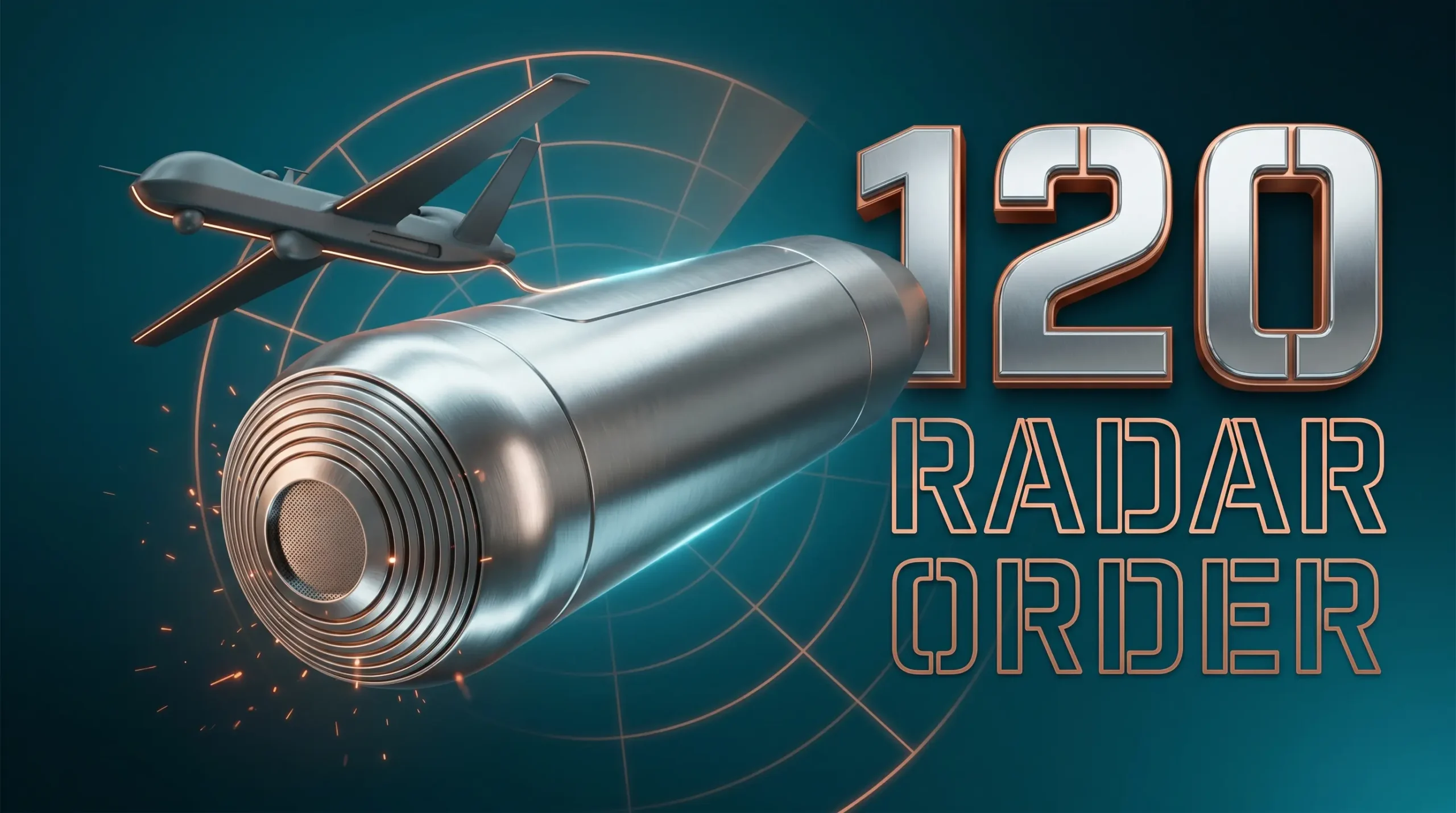
The 320-Mile Eye That Replaced Two Cold-War Workhorses
SharpSight is not a clean-sheet design. It folds together two long-running Raytheon families, the Highly Integrated Synthetic Aperture Radar and the SeaVue Multi-Role Radar. SeaVue traces back to 1992 and ships flying on Hawker 800s, ATR-42s and Embraer EMB-145s for buyers including Japan’s Air Self-Defense Force and Australia’s CoastWatch program.
The new system is software-defined and platform-agnostic. It already flies on the MQ-9B SeaGuardian from General Atomics Aeronautical Systems’ SeaGuardian product page, the maritime variant operated or contracted by Belgium, Canada, Germany, India, Japan, Poland, Taiwan and the United Kingdom. The export pitch leans on that pedigree.
SharpSight Versus Its Predecessors
The lift over the older systems is in target capacity, weight and the open-architecture upgrade path. Below are the headline specs Raytheon has confirmed publicly.
| Specification | SharpSight | SeaVue Heritage |
|---|---|---|
| Maximum range | 320 nautical miles | 200 nautical miles class |
| Total weight | 129 kg (284 lb) | Heavier, multi-LRU |
| Simultaneous targets | 1,000+ via radar plus AIS | Hundreds class |
| Architecture | Open, software-defined | Modular, three LRU |
| Initial production | October 2025 | 1992 IOC |
The 1,000-target figure pairs raw radar returns with Automatic Identification System data, the same maritime transponder feed civilian shipping uses. That fusion is what lets a single SharpSight-equipped aircraft sort fishing boats from go-fast smugglers from a destroyer screening a carrier strike group, all on one screen.
Mission Set
Raytheon lists five primary mission profiles for SharpSight. Each maps to an active export buyer segment in 2026.
- Anti-surface warfare, driven by Indo-Pacific naval modernization
- Border protection and coastal monitoring, the U.S. Customs and Border Protection use case that ran on SeaVue XMC for years
- Search and rescue, a Japan Coast Guard mission line confirmed in 2020 SeaGuardian flight tests
- Long-range surveillance, aimed at high-altitude, long-endurance unmanned platforms
- Anti-piracy and exclusive-economic-zone enforcement, increasingly funded out of Gulf and South Asian budgets
Why The Distributor Matters More Than The Number
Blue Raven is not a household name in defense circles, but its plumbing is deep. The company was formed in December 2021 by combining Crestwood Technology Group, Triman Industries and Brighton Cromwell, then rebranded in May 2023. It runs more than 10 offices, 120,000 square feet of facility space and roughly 200 employees, with 85-plus formal OEM partnerships.
The financial backing got significantly heavier this year. Fortress Investment Group led a $500 million senior secured credit facility for Blue Raven in January 2026, with AE Industrial Partners as the equity sponsor. Charlie Compton, Managing Partner at AE Industrial Partners, said at the time the credit lines would “support Blue Raven’s mission of improving military and commercial fleet readiness.”
Five months later, Raytheon hands Blue Raven 120 radars to sell. The connection is not coincidence.
What this means in practice: a country that wants SharpSight no longer has to wait through a Raytheon foreign military sales channel built for $50 billion Patriot umbrella contracts. It can buy through an aftermarket distributor capitalized with half a billion dollars in working credit, on a price stabilized by bulk pre-purchase. That is build-to-stock, defense-style, even if no one inside Arlington uses that phrase out loud.
It is also a structural answer to the criticism Calio fielded in January. RTX is not just promising to deliver faster. It is buying speed by bypassing its own legacy sales pipeline.
The Calio Pressure Cooker
Trump posted criticism of slow defense contractor deliveries on January 7 and 8, naming Raytheon. On the company’s January 27 earnings call where RTX announced 2025 results and 2026 outlook, Calio said RTX feels “the responsibility and urgency to deliver more and to deliver it faster.” He repeated the word urgency three more times that morning.
We enter 2026 with great momentum and are well positioned to deliver our 2026 financial outlook. We remain focused on investing in new capabilities, expanding production capacity, and executing on our backlog to meet the growing needs of our customers.
The numbers behind the rhetoric are real. Raytheon ended 2025 with a record $75 billion segment backlog and a 1.43 full-year book-to-bill ratio. Munition deliveries were up more than 40% year-over-year in Q1 2026, Calio told analysts in April.
Inside The McKinney Production Floor
SharpSight is built at Raytheon’s McKinney, Texas campus, north of Dallas. The site is the headquarters of Raytheon’s Space and Airborne Systems division and the company’s top-employer footprint in McKinney with more than 3,000 staff.
The relevant building is the 200,000-square-foot McKinney Consolidated Manufacturing Center, which combines 130,000 square feet of manufacturing and test space with 50,000 square feet of office and support. Raytheon also opened a 178,000-square-foot Advanced Integration and Manufacturing center in 2021 that designed material flow to travel 80% less than legacy layouts. A seven-story, $200 million expansion building dedicated to lasers, radars and advanced sensors is under construction.
Stats Snapshot, McKinney And RTX
- $4.8 billion, Raytheon’s annual contribution to the Texas economy from North Texas operations
- 3,000+ employees, Raytheon’s McKinney workforce
- $268 billion, RTX’s total backlog at the end of 2025, with $107 billion tied to defense
- $3.1 billion, RTX’s 2026 capital expansion budget
- $88.6 billion, RTX’s 2025 sales, up 10% year over year
The Bulk-Build Question
Raytheon said it is “building radar systems in bulk” to enable larger monthly output and shorten contract-to-delivery timelines. That phrasing is rare for the company. Defense radar manufacturing typically follows build-to-order or low-rate initial production tied to specific government contracts. Raytheon’s own LTAMDS line is a textbook example, with a planned low-rate lot of about 10 radars for the U.S. Army.
SharpSight is moving in the opposite direction. Bulk inventory, distributor-led sales, price stability written into the press release. The 120-unit Blue Raven order is the volume floor that makes the manufacturing economics work.
Where The Radars Are Likely To Land
Blue Raven did not name end customers. The likely demand pool is visible in market data. Global Market Insights values the marine radar market at $1.98 billion in 2025, growing at 5.8% annually through 2035, with Asia-Pacific the lead region. The broader Intelligence, Surveillance and Reconnaissance market is projected to climb from $13.26 billion in 2026 to $24.17 billion by 2035.
Demand for compact lightweight radar units for unmanned and autonomous vessels jumped 29% between 2022 and 2024. Saudi Arabia and the United Arab Emirates have launched more than 30 ISR modernization projects since 2023, focused on unmanned systems and fixed-wing surveillance aircraft. The Middle East and the Indo-Pacific are the obvious initial targets for a 129-kilogram, 320-nautical-mile, software-defined radar that already integrates with the SeaGuardian.
Smaller European coast guards are the second tier. Greece, Romania and the Baltic states have all increased maritime ISR procurement budgets in the last two years. SharpSight’s compliance with current U.S. export policy guidance, which Raytheon flagged when initial production began in October 2025, was the prerequisite for any of that activity.
The Competitive Set Tightens
SharpSight enters a market segment where Leonardo’s Seaspray 7500E V2, Thales’s Searchwater family and Saab’s PS-46/A all compete on similar mission profiles. The Seaspray already flies on the MQ-9B alongside SharpSight, depending on customer choice. Echodyne and OPTIMARE Systems target the lighter unmanned end.
Bulk pre-build with private-equity-backed distribution is a play none of those competitors has matched at this scale. The closest analog is the commercial-electronics manufacturing approach MACOM has championed for scalable planar array tiles, leveraging consumer-electronics fab techniques to drive radar costs down.
Raytheon’s pitch on SharpSight reads adjacent. Use bulk volume to amortize unit cost. Use a distributor to compress sales cycles. Use export pre-clearance to skip the FMS bottleneck. The Pentagon’s broader integration push, including Army Secretary Driscoll’s Right to Integrate hackathon at Fort Carson, signals the same direction of travel: faster, cheaper, more interoperable.
What 120 Radars Actually Buys
One hundred twenty SharpSight radars is enough to outfit roughly six MQ-9B SeaGuardian squadrons, or to refit a mid-sized country’s entire maritime patrol fleet, or to seed inventory across a dozen smaller buyers. The exact mix is Blue Raven’s call to make.
Raytheon’s parallel push to scale McKinney suggests the company expects this is the first of multiple bulk orders, not a one-off. The Fortress credit facility, the AE Industrial sponsorship and the export pre-clearance all point the same way. Watch the next twelve months for follow-on bulk contracts, additional platform integrations beyond the SeaGuardian, and the first named end-customer disclosures from Blue Raven’s resale book. The radar that absorbed two Cold War-era families is becoming the test case for whether American defense electronics can be sold the way commercial hardware is sold, and that is the bigger story the press release does not tell.

-
 TECH1 year ago
Where Garmin Watches are Made and How They are Assembled
-

 AUTO3 months ago
Tesla’s Roadster Is ‘a Few Weeks Away,’ Says Its Chief Designer
-
 NEWS10 years ago
Samsung Releases Galaxy Note7 TV Ad as Reddit AMA Leaks Specs
-
 NEWS10 years ago
Android 7.0 Nougat Rolls Out To Nexus Devices With New Emoji, Features
-
 FINANCE9 years ago
Cardano Price Surges as ADA Enters the Crypto Top Ten List
-
 NEWS10 years ago
Pre-Order the First Camera Made for Facebook Live Streaming Video
-
 FINANCE1 year ago
Binance Suspends Trading and Withdrawals for a System Upgrade
-
 FINANCE9 years ago
RChain Price Jumps Nearly 150% to a New All-Time High of $2.03