
BUSINESS
Mecca Pact Expansion Echoes the Old CENTO Trap
Saudi Turkey Pakistan defence pact signed in Mecca seeks new members, reviving Baghdad Pact patterns of collective deterrence that once collapsed under vague.

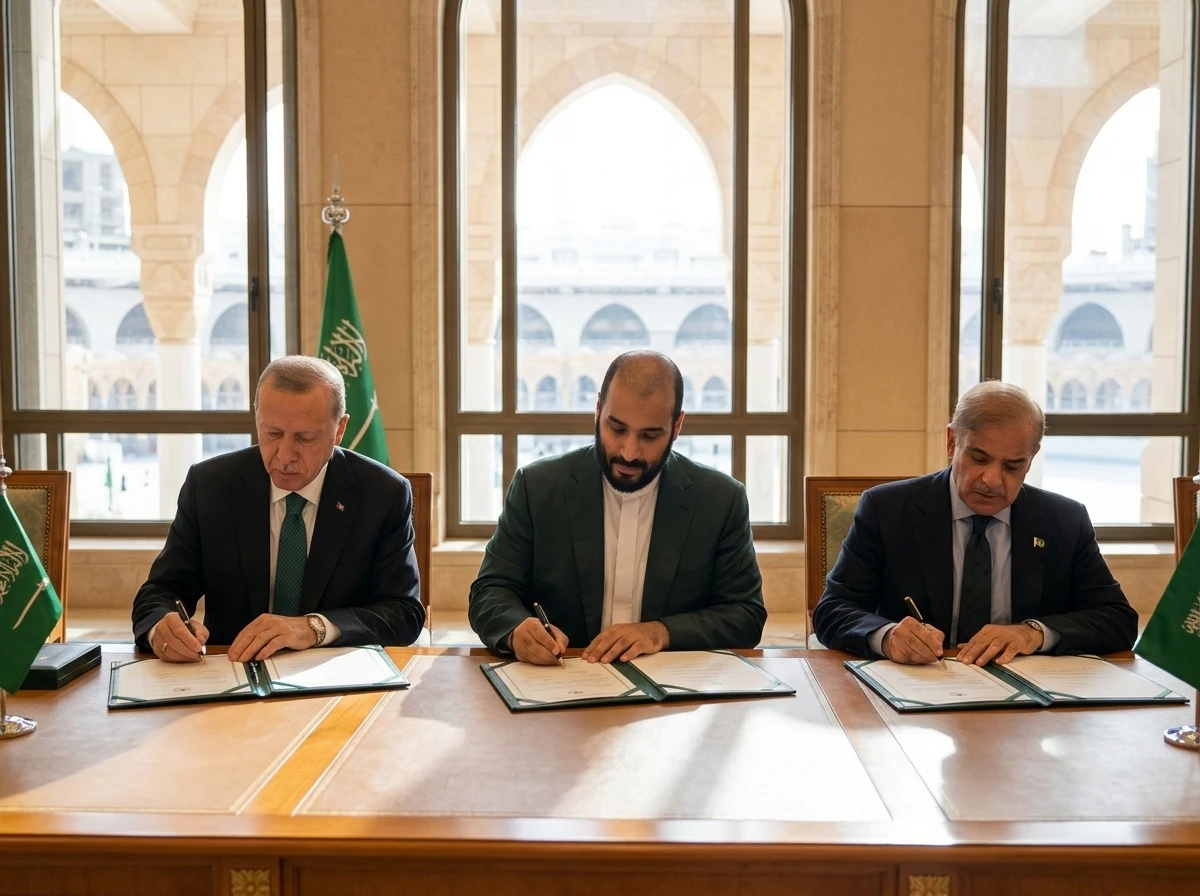
Saudi Arabia, Turkey and Pakistan signed the Mecca Joint Defence Agreement on 7 August 2026, declaring that an armed attack on any one counts as an attack on all three. Turkish Foreign Minister Hakan Fidan has already named Egypt a natural partner and invited more Islamic states under the same umbrella.
The move lands amid Iranian missile and drone strikes on Gulf states and US bases, and it immediately drew claims that President Donald Trump helped broker it. The pattern feels familiar to anyone who watched earlier Muslim-power defence pacts rise and dissolve.
Four days on, the text still reads as a political signal first and a military plan second. The founders stress defence and openness. The open questions sit in the gaps the statement left blank.
Three Leaders Signed at Al-Safa Palace
Crown Prince Mohammed bin Salman, President Recep Tayyip Erdogan and Prime Minister Shehbaz Sharif met at Al-Safa Palace in Mecca after an invitation from King Salman. The joint statement from the Makkah summit framed the deal in language of Islamic solidarity and longstanding defence cooperation.
It states the agreement will strengthen collective deterrence against any act of aggression and that any armed attack against one of the three shall be regarded as an attack against them all. It also calls for broader defence cooperation across all aspects.
The agreement is intended to strengthen collective deterrence against any act of aggression, and stipulates that any armed attack against any one of the three states shall be regarded as an attack against them all.
The Saudi Press Agency carried that exact wording. Turkish officials stressed the pact is purely defensive, targets no country and leaves existing alliances intact, including Turkey’s NATO membership. Pakistan’s foreign minister later repeated that the deal remains open to others willing to uphold its principles.
Reuters reported the statement gave no specifics on actual military commitments or how the three would decide the form of support. Negotiations had run nearly a year. That long lead-in produced a short public text. The ceremony at Al-Safa Palace therefore carried more weight than the operational detail released beside it.
Officials in all three capitals have repeated the same defensive line since the signing. They treat the absence of named adversaries as a feature, not an omission. The invitation to further members rests on that same framing.
Iran War Exposed the Old Security Umbrella
US and Israeli strikes on Iran began 28 February. Tehran answered with waves of missiles and drones that hit Gulf energy sites, airports, ports and bases hosting American forces. The UAE took especially heavy damage. Some threats slipped past air defences.
Shipping through the Strait of Hormuz faced disruption. Gulf capitals that once treated the US presence as a full shield discovered gaps. Turkey and Pakistan, though less directly hit, watched fuel prices and regional stability slide.
Saudi Arabia already kept Pakistani troops, jets and air defences on its soil. The kingdom had signed a bilateral mutual-defence understanding with Islamabad a year earlier. Adding Turkey’s NATO-trained forces and defence industry created a three-way hedge when confidence in Washington’s reliability fell.
The sequence matters. Bilateral cover with Pakistan was already in place before the wider strikes tested Gulf air defences. The Mecca step folded that existing tie into a larger frame and brought Turkish industry and manpower into the same picture. The hedge is therefore layered rather than brand new.
US Representative Joe Wilson called the pact another achievement of President Trump that promotes stability and isolates Iran. Pakistani Shia clerics countered that it dragged Islamabad into a US-Arab design against Tehran. Both readings circulate freely. The founders themselves insist the arrangement is defensive and non-sectarian.
Money, Nukes and Factories in One Frame
Each founder supplies what the others lack. Saudi Arabia brings finance, strategic geography and a modern air force. Turkey supplies a large Nato-standard military and a growing defence manufacturing base that already sells drones to Riyadh. Pakistan fields one of the world’s largest armies and remains the only nuclear-armed Muslim-majority state.
Analysts on X and in print keep reducing it to the same three assets: Saudi money, Pakistani nuclear deterrence, Turkish industry. The combination looks potent on paper. Whether the nuclear piece ever extends beyond Pakistan’s own borders stays carefully unspoken in official text.
- Saudi Arabia: finance, geography, modern air power, and the symbolic weight of the holy sites.
- Turkey: Nato-trained forces, a defence industry already linked to Riyadh through drone sales, and rank as the region’s top conventional power on the 2026 list.
- Pakistan: a large standing army and the only nuclear arsenal among Muslim-majority states, paired with troops and air defences already hosted on Saudi soil.
The division of labour is easy to state and hard to test. Money can move faster than doctrine. Factory output can fill inventories without settling who commands a joint response. Nuclear deterrence, left unspoken in the Mecca text, remains the most sensitive of the three assets precisely because no public formula assigns it a role outside Pakistan’s own borders.
| Country | 2026 GFP Global Rank | Middle East Rank | Core Contribution Named |
|---|---|---|---|
| Turkey | 9 | 1 | Nato-trained forces, defence industry |
| Pakistan | 14 | – | Large army, nuclear arsenal |
| Egypt (potential) | 19 | 4 | Standing army, Suez location, Arab diplomacy |
| Saudi Arabia | ~25 | 5 | Finance, air power, holy sites |
The 2026 Global Firepower military rankings place Turkey first in the Middle East and ninth worldwide. Egypt sits nineteenth globally and fourth regionally. Adding Cairo would lift the group’s conventional weight overnight.
Egypt First, Then the Gulf Watch List
Fidan told Anadolu Agency he expects Egypt to join once a few technical issues are resolved. “I believe that at the next stage, Egypt will also be among us in the alliance. We already act toward one another as if we were alliance members,” he said. He called Cairo a natural partner on all issues and said the founders already work together unofficially.
Egypt fields more than 440,000 active personnel, thousands of tanks and substantial air and naval forces. Its location astride the Suez Canal and its established role in Arab diplomacy would give the pact new reach. Yet Chatham House analysts told Al Jazeera that Cairo remains wary of binding obligations that could complicate its US aid relationship or its peace treaty with Israel.
Other names surface quickly:
- Qatar and Kuwait appear most often as the next Gulf candidates; both felt exposed during the recent Iran exchanges and keep close ties to all three founders.
- Former Qatari Prime Minister Sheikh Hamad bin Jassim Al Thani publicly hoped every GCC member would eventually sign.
- Jordan, Azerbaijan and Syria have been floated for geographic extension into the Levant and Caucasus.
- Fidan said several unnamed countries have already expressed interest and that the alliance should grow, if necessary bringing all countries under the umbrella.
Karim Elgendy of Chatham House described the likely path as a coalition of the willing that expands case by case according to each capital’s risk calculus, not a sudden bloc.
That case-by-case path matches the technical caution around Egypt. Unofficial habits of cooperation already exist, Fidan said. Formal signature would convert habit into obligation. Gulf candidates that felt exposed during the Iran exchanges face a similar calculation: closer cover versus tighter binding ties.
Baghdad Pact Rose the Same Way and Then Vanished
In 1955 Turkey, Iraq, Britain, Pakistan and Iran formed the Baghdad Pact to deter Soviet pressure and coordinate defence. The United States never joined as a full member but signed bilateral deals and sat on committees. After Iraq’s 1958 revolution the arrangement relocated and became the Central Treaty Organization.
A US State Department historical summary notes that Baghdad Pact became CENTO after Iraq left. CENTO never built a permanent military command or integrated forces. It functioned better as a channel for economic and technical aid than as a fighting alliance. Iran withdrew after the 1979 revolution; Pakistan followed; the organisation dissolved the same year.
- 1955, Turkey, Iraq, UK, Pakistan and Iran sign the Baghdad Pact for mutual defence against outside aggression.
- 1958-59, Iraqi revolution; Iraq exits; headquarters move to Ankara; name changes to CENTO; US remains associate.
- 1971, Pakistan’s territorial losses and lack of collective response erode confidence inside the group.
- 1979, Iranian Revolution ends Tehran’s membership; Pakistan leaves; CENTO formally ends.
The Mecca text uses almost identical collective-defence language. It also lacks, so far, an integrated command, automatic response mechanisms or standing institutions. Indian Army veteran General Shashi Asthana called it a Sunni Nato in style, not structure. That gap is the same one that hollowed CENTO.
The 1971 episode inside the older pact still echoes. When a member took territorial losses and saw no collective response, confidence drained even before the final collapses of 1979. Paper language without a working command left each capital free to redefine its interest when pressure arrived.
Collective Language Outruns the Command Structure
The Mecca statement and the old Baghdad text share more than a solidarity tone. Both promise that an attack on one counts against all. Both stopped short, at launch, of spelling out who decides, how fast, and with what forces.
Reuters noted the absence of specifics on military commitments and on the method for choosing the form of support. Turkish officials underlined that existing alliances, including NATO membership, remain untouched. Those two facts together describe a political roof built before the internal walls.
| Feature | Baghdad Pact / CENTO | Mecca Agreement |
|---|---|---|
| Core pledge | Mutual defence against outside aggression | Armed attack on one regarded as attack on all |
| Integrated command | Never built | Not established so far |
| Automatic response rules | Absent | Not specified in the public text |
| Standing institutions | Weak; stronger on aid than combat | Not yet formed |
| Outside ties | US as associate, not full member | Turkey’s NATO membership left intact |
| Membership path | Fixed set that later shrank | Open invitation; Egypt named first |
Style without structure is the risk General Asthana flagged. CENTO could channel economic and technical aid and still fail as a fighting alliance. The Mecca founders can repeat defensive and non-sectarian language for months and still face the same test when one capital wants help another would rather delay.
Negotiations that already ran nearly a year produced the political signal. Building the shared threat picture and decision rules that CENTO never managed would take a second, harder phase. Until that phase starts, the collective sentence does more work than the machinery behind it.
Leverage Shifts Even Before the First Test
If the pact stays a political signal, members gain diplomatic weight and a cheaper hedge against Iranian missiles or Israeli strikes. If it hardens into real obligations, the founders must decide whether Saudi money or Turkish industry will actually flow when Pakistan faces a crisis on its eastern border, or when Egypt refuses to be pulled into a Levant fight.
Outside capitals are already adjusting to the symbolism:
- India watches a nuclear-armed neighbour enter a defence understanding with two major Sunni powers; officials in New Delhi are following the file closely.
- China faces a more complicated nuclear triangle on its western flank.
- The United States still holds partners who host American bases yet no longer treat those bases as the sole answer.
The untested deterrence layer the founders just built will face its first serious call when one member wants help the others would rather avoid. Until then the expansion talk itself delivers status. Fidan’s open invitation keeps the door swinging while technical talks with Egypt continue.
The same capitals that once joined CENTO later discovered that paper guarantees dissolve when interests diverge and institutions never form. The Mecca signatories have chosen almost the same starting architecture. Whether they now build the command structure and shared threat picture that CENTO never managed will decide if this version lasts longer than its predecessor. The bandwidth and India crowding effects already noted on this site show how quickly secondary theatres feel the pressure.
Egypt’s technical issues remain unresolved. Gulf sheikhdoms have not signed. The founders still describe the pact as defensive and open. That is where the story stands four days after the Mecca ceremony.

-
 TECH1 year ago
Where Garmin Watches are Made and How They are Assembled
-

 AUTO2 months ago
Tesla’s Roadster Is ‘a Few Weeks Away,’ Says Its Chief Designer
-
 NEWS10 years ago
Samsung Releases Galaxy Note7 TV Ad as Reddit AMA Leaks Specs
-
 NEWS10 years ago
Android 7.0 Nougat Rolls Out To Nexus Devices With New Emoji, Features
-
 FINANCE9 years ago
Cardano Price Surges as ADA Enters the Crypto Top Ten List
-
 NEWS10 years ago
Pre-Order the First Camera Made for Facebook Live Streaming Video
-
 FINANCE1 year ago
Binance Suspends Trading and Withdrawals for a System Upgrade
-
 FINANCE9 years ago
RChain Price Jumps Nearly 150% to a New All-Time High of $2.03