
NEWS
Astronomers Confirm the Wind From the Milky Way’s Black Hole
Northwestern astronomers confirmed that Sagittarius A*, the Milky Way’s black hole, is blowing an active wind, ending a 50-year observational gap in astrophysics.

Astronomers have confirmed that Sagittarius A* (Sgr A*), the supermassive black hole at the center of the Milky Way, is blowing an active wind outward through the galaxy’s core, ending a search that persisted in astrophysics for more than 50 years. The study, published June 4, 2026, in The Astrophysical Journal Letters by Mark D. Gorski and Lena Murchikova, assistant professor of physics and astronomy at Northwestern University’s Weinberg College of Arts and Sciences and a member of CIERA (Center for Interdisciplinary Exploration and Research in Astrophysics), rests on five years of ALMA (Atacama Large Millimeter/Submillimeter Array) observations and cross-validation from NASA’s Chandra X-ray Observatory. Sgr A* carries roughly 4 million times the mass of the sun and sits about 26,000 light-years from Earth.
Most supermassive black holes spend the bulk of their cosmic lives feeding slowly on sparse gas, producing modest outflows rather than the spectacular jets that define the AGN (active galactic nucleus) phase. Those quiet black holes are too faint to study at any distance beyond our own galaxy. For the first time, there is direct observational evidence of what their feedback looks like.
A Cone in the Cold Gas
Building the Map
As described in the Northwestern University announcement of the finding, Gorski and Murchikova accumulated more than 100 hours of ALMA observations over five years, tuned to 1.3-millimeter wavelengths that trace carbon monoxide (CO) molecules, a reliable marker of cold molecular gas, within roughly three light-years of the black hole. ALMA’s 66 radio-telescope antennas, spread across up to 16 kilometers of Chile’s Atacama Desert, combine signals to synthesize the resolving power of a dish as wide as the array.
The critical technical step was removing the black hole’s own rapidly varying radio emission from the data. The team built a time-resolved visibility-subtraction pipeline that modeled and subtracted that variable emission from each short measurement window separately, rather than co-adding all observations into a single deep image where the fluctuating signal would smear out the surrounding structure. The result was a survey 100 times more sensitive than any prior galactic-center map at these wavelengths.
The Cavity and Its Confirmation
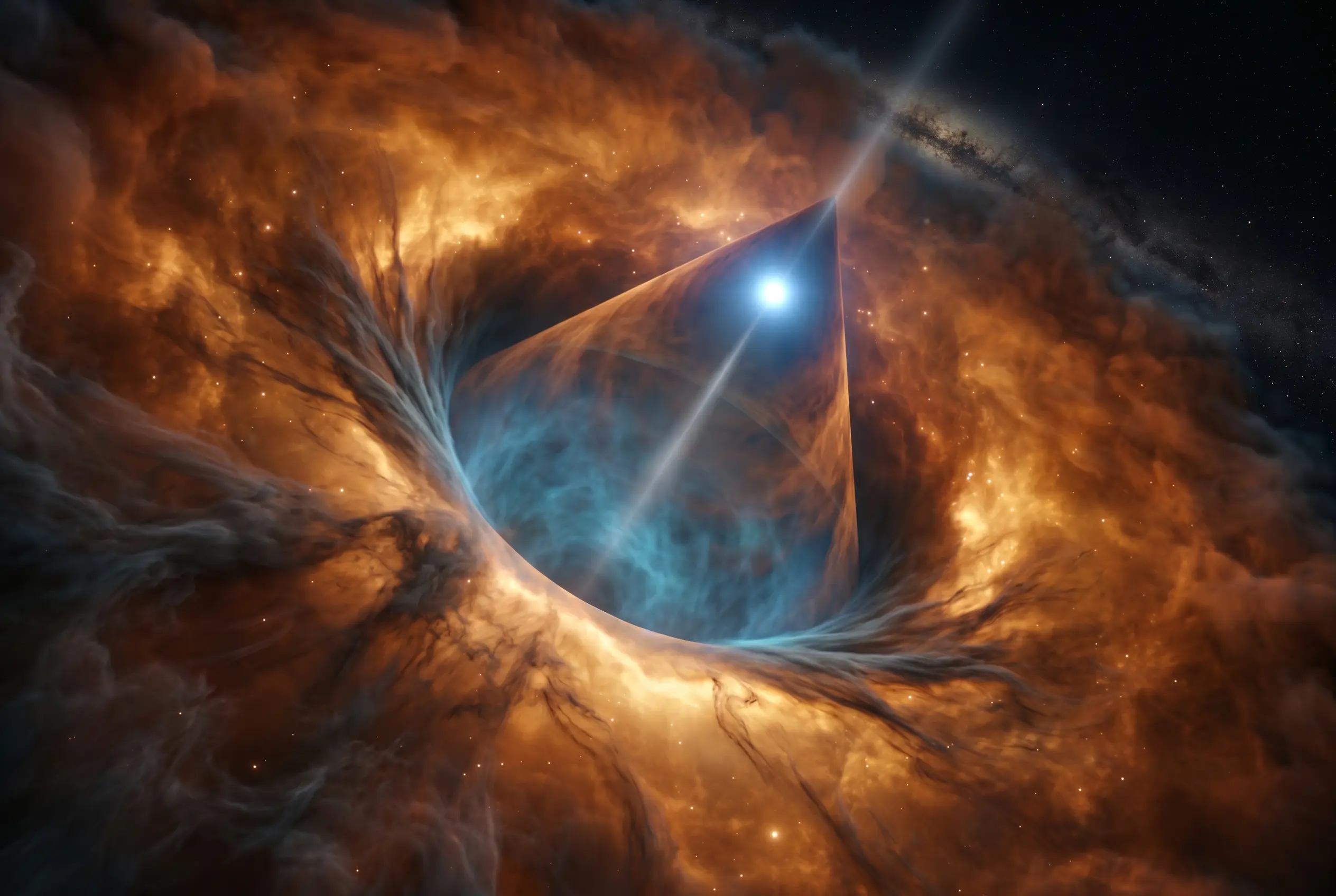
The team’s published measurements of the cold-gas cavity show a conical clearing extending at least 1 parsec (roughly 3.26 light-years) from the black hole, opening at approximately a 45-degree angle. A hot wind from the black hole sweeping or heating the cold molecular gas outward would carve exactly that geometry.
To cross-check the result, the researchers turned to NASA’s Chandra X-ray Observatory. X-ray data showed hot, ionized plasma filling the same cavity, consistent with a black hole-powered outflow and inconsistent with what the dense cluster of massive young stars near the galactic center could produce on its own. “Exceptional claims require exceptional evidence,” Gorski said. “We wanted to make sure that we weren’t just looking at some sort of imaging artifact. Then, the X-ray image from Chandra just slotted in perfectly. The molecular features lined up.”
Rebecca Diesing, a postdoctoral astrophysicist at Columbia University and the Institute for Advanced Study who was not involved in the research, called the detection “a big deal,” noting it would demonstrate that the Milky Way’s central black hole is not unique among supermassive black holes.
- 100+ hours: observation time collected over five years at 1.3-millimeter wavelengths
- 100x: sensitivity improvement over prior galactic-center surveys at this wavelength
- 1 parsec: minimum length of the conical void in the surrounding cold molecular gas
- 26,000 light-years: distance from Earth to the Milky Way’s galactic center
How a Black Hole Blows Wind
As material spirals inward toward any black hole, gravity accelerates it progressively faster until it approaches the speed of light near the event horizon. The kinetic energy and magnetic pressure generated there can fling some of that incoming material back outward, producing jets or broader outflows called winds. Theorists predicted decades ago that this process operates even in slowly feeding black holes, at a rate proportionate to how much gas is coming in.
From very near the event horizon, where temperatures are highest, the hot wind expands outward and collides with the cooler molecular gas in the CND (circumnuclear disk), a ring of gas and dust roughly five light-years in radius orbiting the black hole. That collision carves a recognizable path: a clearing in the cold gas visible in millimeter radio data. “Unless a black hole exists in a perfect vacuum, it must blow a wind somehow,” Gorski said. “And there is no perfect vacuum in the universe.”
Sgr A*’s wind is gentle by galactic standards. Murchikova calls it a “gentle breeze.” The paper estimates it has blown continuously for at least 20,000 years, though its pointing direction shifts over cosmic time. Its existence confirms that even a barely feeding black hole is channeling energy from accretion back into the surrounding gas, a form of feedback with no direct observational grounding before this measurement.
Half a Century Without a Signal
The prediction that feeding black holes must produce winds or jets dates to foundational accretion theory from the 1970s and 1980s. Astronomers confirmed outflows and powerful jets from supermassive black holes in distant active galaxies across that period. Those objects were in their AGN phases, however, bright enough to observe across billions of light-years.
The galactic center’s status as the site of the nearest supermassive black hole made it the obvious candidate for finding the quiet version. Its failure to produce a detectable wind became an increasingly prominent gap in the observational record. Earlier surveys had turned up hints: radio images from prior decades showed bow-shock structures near the galactic center consistent with an outflowing wind, and curved magnetic field structures in the surrounding gas pointed toward an outflow source. None of those could rule out the cluster of massive young stars packed within a few light-years of the black hole. Those stars produce their own strong stellar winds, and every observational hint carried a plausible stellar explanation.
The 100-hour survey changed that by reaching a sensitivity no prior observation had achieved. Still, the moment of recognition came late.
When you find something that no one has seen before, the first thought that runs through your mind is not ‘Oh my god, we made a discovery.’ It’s ‘Oh my god, what’s wrong with my analysis?’ But when we overlaid our image with the X-ray image, it started to make sense.
Murchikova described the verification process that followed. Overlaying the Chandra data on the molecular gas map converted a candidate structure into a defensible claim.
Peering Through the Galaxy’s Core
Earth’s location inside the Milky Way’s disk creates a sight-line problem that doesn’t arise in any other major black hole study. Observing the galactic center means looking along the full thickness of the galactic plane, through dense interstellar gas, dust clouds, and ionized structures that absorb or scatter radiation across most wavelengths. “To observe our own black hole, we have to look through the plane of our galaxy,” she said. “That means we have to peer through gas, dust and ionized structures, and you can’t really see through all of that easily.”
ALMA’s millimeter wavelengths cut through much of that obscuration. The black hole’s own variable radio emission still overwhelmed faint surrounding structure in earlier surveys, flickering on timescales of minutes and swamping the signal the team was hunting. The pipeline treated each short time window as its own measurement, modeling out the variable component before combining data across the full five-year baseline, a step no previous survey had taken at this depth.
Layers of interference the survey had to work around:
- Galactic dust and gas blocks optical and ultraviolet wavelengths entirely along this sight line, ruling out most conventional imaging approaches
- The black hole’s bright, rapidly varying radio emission overwhelmed fainter surrounding structure in all earlier millimeter surveys
- Nearby massive young stars produce strong stellar winds of their own, creating an ambiguous background signal in prior studies
- The wind’s signature is a cold-gas void: a cavity defined by absence rather than emission, harder to identify than a conventional bright source
The composite image that resulted, with CO data shown in orange alongside X-ray data in blue, shows a coherent cone-shaped void where cold gas should be, the bright white point of the black hole sitting at its apex.
The Quiet Majority
The Normal State of a Black Hole
Supermassive black holes visible in their AGN phases, those luminous enough to appear as quasars across billions of light-years, represent a thin slice of the total population at any moment. Most large galaxies today host central black holes operating at sparse accretion rates, far below the Eddington limit (the theoretical maximum accretion rate for a given black hole mass). Sparse accretion like this is the dominant state for most supermassive black holes, with the AGN phase representing only a brief passage in a galaxy’s history.
“The majority of other galaxies spend most of their lives in a state where they are not particularly active,” she said. “But we can only see them when they are in a fireworks stage. It is very attractive to study black holes when they are in the fireworks stage, but that’s not actually their dominant state.” The team’s detection at the galactic center now provides the window into that quiet state that astrophysicists have lacked.
Even modest feedback sustained over billions of years shapes a galaxy’s gas reservoir and star-formation rate. Black hole winds at low intensity, channeling energy into surrounding gas across cosmic timescales, can suppress gas cooling and slow the formation of new stars in ways that accumulate significantly. Galaxy evolution models have long carried assumptions about what black holes do in their quiet phase; those assumptions were untestable, since quiet black holes are invisible beyond the Milky Way.
| Property | Sgr A* (Quiescent) | Typical AGN (Active Phase) |
|---|---|---|
| Accretion rate | Extremely low; far below the Eddington limit | High; can approach the Eddington limit |
| Luminosity | About 300 times that of the sun | Millions to trillions of times solar luminosity |
| Wind or jet visibility | Visible only after five years of deep radio mapping at 100x prior survey depth | Directly observable at cosmological distances |
| Share of cosmic time in this state | Dominant; the norm for most large galaxies today | A brief phase in a galaxy’s history |
| Direct study possible beyond the Milky Way | No; too faint at any extragalactic distance | Yes; the basis of most black hole astrophysics to date |
The Next Proof
The current detection rests on morphology and energetics. The cone-shaped clearing’s size, shape, and the hot plasma filling it match what an active wind from the black hole would produce. Diesing identified the next confirmation step as a direct velocity measurement: follow-up radio campaigns watching the cavity walls for motion between observation windows. If those edges shift at speeds consistent with a black hole-driven outflow, the inferred wind becomes a measured one, with an actual velocity attached.
“The wind is not powerful, and its direction probably wanders with time,” she said. “It shows that our black hole is not unique, and our place in the universe is not unique.”
The cavity has probably been carved in the gas surrounding the galactic center for at least 20,000 years. Measuring how fast its walls are moving is the step that remains.

-
 TECH1 year ago
Where Garmin Watches are Made and How They are Assembled
-

 AUTO2 months ago
Tesla’s Roadster Is ‘a Few Weeks Away,’ Says Its Chief Designer
-
 NEWS10 years ago
Samsung Releases Galaxy Note7 TV Ad as Reddit AMA Leaks Specs
-
 NEWS10 years ago
Android 7.0 Nougat Rolls Out To Nexus Devices With New Emoji, Features
-
 FINANCE9 years ago
Cardano Price Surges as ADA Enters the Crypto Top Ten List
-
 NEWS10 years ago
Pre-Order the First Camera Made for Facebook Live Streaming Video
-
 FINANCE1 year ago
Binance Suspends Trading and Withdrawals for a System Upgrade
-
 FINANCE9 years ago
RChain Price Jumps Nearly 150% to a New All-Time High of $2.03