
NEWS
Span Is Installing Mini AI Data Centers on House Walls
Span mounts Nvidia AI compute nodes on homes to bypass grid queues, but infrastructure costs and physical security at 80,000 nodes remain untested at scale.

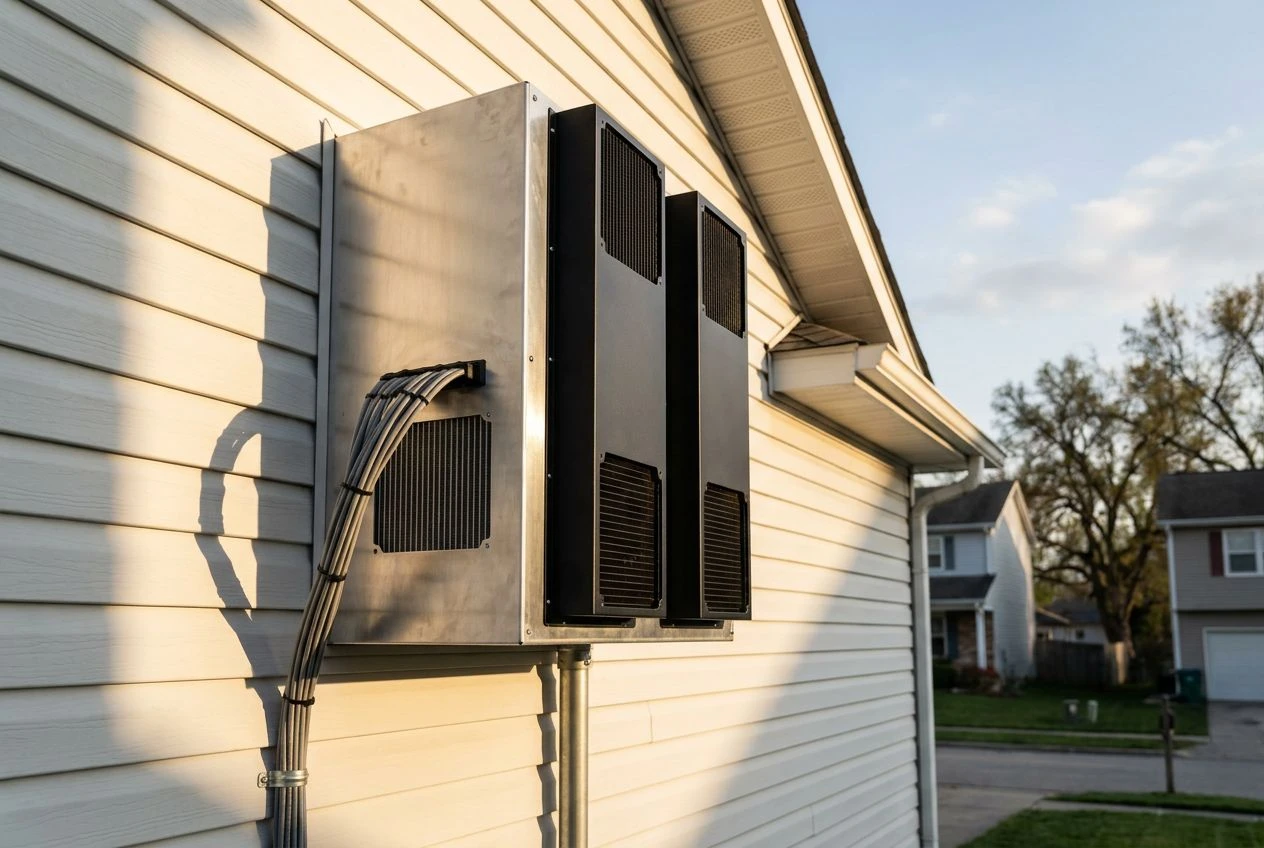
Span, a San Francisco electrical panel startup backed by Nvidia, announced in April 2026 a plan to put mini AI data centers on the sides of American houses, bypassing the grid-interconnection queue that has stalled conventional data center construction for two or more years. The product, called XFRA, packages 16 Nvidia RTX Pro 6000 Blackwell graphics processing units (GPUs, the chips powering most AI inference and training) into a liquid-cooled unit roughly the size of an air conditioner and connects it to a home’s existing electrical service. Homeowners get subsidized utility bills and free hardware. AI cloud providers get compute capacity in months rather than years. The neighborhood grid gets a sustained new load it wasn’t designed to carry.
Span’s pitch treats suburban power infrastructure as an untapped asset. The 100-home pilot launching later this year will show whether that asset can carry the weight.
A Server Rack Beside the Sprinklers
Each XFRA node packs 16 Nvidia RTX Pro 6000 Blackwell Server Edition GPUs, four AMD EPYC server processors and three terabytes of memory into a single liquid-cooled enclosure built for outdoor installation. Span’s orchestration platform, XFRA Cloud, schedules workloads for the unit (AI inferencing, cloud gaming and high-performance simulation) while its smart electrical panel manages draw so the node doesn’t trip the household circuit.
- 16 Nvidia RTX Pro 6000 Blackwell Server Edition GPUs per node, liquid-cooled
- 4 AMD EPYC server processors and 3 terabytes of memory per node
- 100-home pilot scheduled for late 2026, targeting 80,000 nodes across the U.S. by 2027
- 1+ gigawatt total distributed compute capacity at full deployment
- Deploys 6x faster and at 1/5 the cost of a comparable 100 MW conventional data center, per Span’s white paper
PulteGroup, one of the country’s largest residential homebuilders, confirmed it has already deployed XFRA units in multiple new-construction communities. Prototype testing has taken place with paying customers, per Span, though detailed performance data from those deployments has not been published. Span’s April 2026 XFRA launch announcement says the company has a pipeline targeting gigawatt-scale deployment in 2027, “enabled by XFRA’s highly distributed structure and low-friction scaling requirements.”
“Fundamentally, it’s an infrastructure play,” Arch Rao, founder and CEO of Span, told CNBC. “We’re uniquely positioned to build infrastructure that can simultaneously help us meet what is clearly an insatiable demand for more compute, much more cost effectively.”
The Problem That Made a Backyard Server Sound Reasonable
A typical hyperscale data center consumes as much electricity as 100,000 households, per the International Energy Agency. Meta’s Hyperion project in Louisiana is planned at a minimum of 5 gigawatts, three times New Orleans’s entire power consumption. Data centers already account for about 4.4% of U.S. electricity use, and the Department of Energy projects that share rising to between 6.7% and 12% by 2028. Wholesale electricity costs in areas near existing data center clusters rose by as much as 267% over five years, per a Bloomberg analysis of 25,000 grid pricing nodes published in 2025.
Political resistance has solidified alongside those numbers. Seven in 10 Americans oppose having an AI data center built close to their home, according to a Gallup poll released in May 2026, with energy costs as the leading objection. Roughly 69 jurisdictions have passed moratoriums on data center construction. Microsoft has publicly acknowledged GPU clusters sitting idle, waiting on power connections that may not arrive for years.
Span’s framing targets exactly that bottleneck. Rather than requiring a new substation or a new transmission easement, the XFRA model deploys compute nodes on homes already wired into the existing residential grid, as Scientific American described in its coverage of the launch. No permit hearing, no zoning board, no multi-year interconnection queue. The company estimates it can deploy 8,000 nodes in roughly the time it takes to break ground on a comparable conventional facility.
The Homeowner Deal
Span installs all hardware at no upfront cost: the XFRA unit, a smart electrical panel, a 16 kWh (kilowatt-hour) backup battery and optional solar. In exchange, homeowners pay a flat monthly fee of around $15 while Span subsidizes electricity and internet bills, with the net result being lower overall utility costs. Viral social-media posts claiming residents get “paid” to host the nodes misread the model; the compensation reduces existing bills rather than producing net income beyond them, and exact terms are still being finalized per location and usage.
Brian Jamison, VP of Strategic Sourcing and Procurement at PulteGroup, described the bundle as delivering “homes with lower operating cost” while using “a home’s underutilized power infrastructure to benefit the grid overall.”
What a participating homeowner receives:
- A Span smart electrical panel, installed at no upfront cost
- A 16 kWh backup battery, free
- Optional rooftop solar integration
- Fixed, discounted electricity and internet rates
The question underneath those terms is whether Span’s contracts, which had not been publicly defined in full at launch, clearly allocate liability for hardware worth roughly $160,000 mounted to the exterior of a house.
The Orchestration Problem at Scale
XFRA Cloud has to schedule AI workloads across tens of thousands of homes drawing power at different moments in the day while keeping each node’s draw below the thermal limits of its neighborhood’s distribution transformer. Unlike a conventional data center, where one dedicated high-voltage feed powers the whole facility, each XFRA node competes for headroom with the house’s own air conditioning, appliances and EV charger. Span says XFRA targets inferencing workloads rather than compute-intensive training jobs, which require consistent, high-throughput connections that residential feeds can’t guarantee. Distributed power generation has existed for years; it has never been harnessed at the scale needed to serve data-center-class inferencing loads, as The Arizona Republic noted in its June 2026 analysis of the sector.
| Attribute | Centralized Data Center | XFRA Distributed Model |
|---|---|---|
| Grid connection | One dedicated high-voltage feed | Thousands of standard residential feeds |
| Power management | Purpose-built UPS (uninterruptible power supply) systems and cooling | Span smart panel per home |
| Load predictability | Constant, plannable 24/7 draw | Variable, subject to household competition |
| Deployment timeline | 2+ years for permits and construction | Months, via homebuilder partnerships |
| Physical security perimeter | Access-controlled server rooms, on-site guards | Residential exterior, HOA oversight |
Fast Company’s May 2026 analysis flagged the transformer problem: every time sustained current passes through distribution equipment, it generates heat and wear, and whether compute is centralized or distributed, the “risk of higher costs, perhaps because of transformers and other infrastructure running hotter and degrading more quickly, could arguably be the same,” the outlet noted. The 100-home XFRA pilot beginning later in 2026 is the first controlled environment where those coordination and thermal-wear claims will face real data rather than white-paper projections.
Who Pays for the Transformers
The electricity-cost fight around conventional data centers is loud enough to be producing state legislation, and XFRA doesn’t dissolve it. Residential electricity prices in the United States rose 36% between 2020 and February 2026, from 12.76 cents per kilowatt-hour to 17.44 cents, according to U.S. Energy Information Administration figures cited in a March 2026 investigation into how AI electricity demand reaches residential rate bills. Residential prices jumped 7.1% in 2025 alone, more than double the inflation rate that year, per Consumer Reports citing federal data.
Maryland’s Office of People’s Counsel put a concrete number on how infrastructure cost transfer works: the state faces a $2 billion transmission upgrade bill driven largely by AI data centers in neighboring states, flowing through PJM Interconnection (the largest electricity transmission company in the United States, covering 13 states and Washington, D.C.). “Without FERC action, Maryland customers face paying billions for transmission infrastructure that PJM is advancing to benefit data centers,” said Maryland People’s Counsel David S. Lapp in a formal complaint to federal energy regulators. FERC is the Federal Energy Regulatory Commission, the agency overseeing wholesale electricity markets.
XFRA’s distributed model uses existing residential feeds, avoiding new transmission lines. But its nodes add sustained load to the same distribution infrastructure, wires, transformers and switching equipment, that neighborhood electricity bills already fund. Ari Peskoe, director of Harvard Law School’s Electricity Law Initiative, told Consumer Reports in 2026: “Utilities are building infrastructure, and then we all pay for it because that’s how the utility business model has always worked.”
SemiAnalysis, a semiconductor research firm, argued in a March 2026 study that grid market design plays as large a role as AI infrastructure in recent price increases, specifically an auction mechanism in the PJM grid that forces consumers to prepay anticipated electricity costs two years out. Whether distributed residential compute changes that cost trajectory or simply spreads it across more meters is an open question the current pilot isn’t large enough to answer.
The Hardware on Your Fence Is Worth $160,000
Each Nvidia RTX Pro 6000 Blackwell GPU sells for roughly $10,000. A single XFRA node holds 16 of them. That’s approximately $160,000 in GPU hardware on the exterior wall of a house, in a unit designed to blend in with HVAC equipment and visible to anyone walking by.
Data center security works because access is centralized: one building, physical guards, access-controlled server rooms, defined perimeters and regular audits. Distribute 80,000 nodes across suburban subdivisions and the threat surface shifts. Security researchers noted in commentary on the XFRA launch, as reported by technology.org and The Outpost AI, that side-channel attacks, where an adversary infers sensitive compute data by monitoring power fluctuations or electromagnetic patterns on nearby hardware, “require physical proximity to the machine, which data centers can guard against,” while “distributed GPUs in individual homes are much more difficult to protect.” Physical theft is the more immediate risk: Reddit commentary on the announcement speculated about the hardware’s appeal as a target, with commenters noting that a node on a residential fence is considerably more accessible than a server in a locked cage.
Cloud News flagged in April 2026 that XFRA needs clear liability protocols for hardware damage, insurance coverage and procedures for emergency equipment removal, none of which had been publicly defined at launch. Standard homeowner’s insurance covers the structure and its contents; commercial-grade hardware installed on the exterior by a third party is a different category, and whether Span’s contract obligates the company to carry that coverage, or whether liability falls to the homeowner in the event of fire or theft, hadn’t been clarified publicly. Homeowners associations (HOAs, private governance bodies that regulate exterior appearance in most new residential developments) add another layer. PulteGroup is the initial rollout partner, meaning XFRA is being tested in communities where Span may have influence over HOA rules from the start. Scaling to established neighborhoods with existing CC&R documents (covenants, conditions and restrictions, the legal governance frameworks for HOA communities) is a separate challenge the pilot isn’t designed to address.
Span’s 100-home trial, scheduled to begin later this year, is when the coordination model, the infrastructure cost claims and the physical security story will face conditions outside a company white paper.

-
 TECH1 year ago
Where Garmin Watches are Made and How They are Assembled
-

 AUTO3 months ago
Tesla’s Roadster Is ‘a Few Weeks Away,’ Says Its Chief Designer
-
 NEWS10 years ago
Samsung Releases Galaxy Note7 TV Ad as Reddit AMA Leaks Specs
-
 NEWS10 years ago
Android 7.0 Nougat Rolls Out To Nexus Devices With New Emoji, Features
-
 FINANCE9 years ago
Cardano Price Surges as ADA Enters the Crypto Top Ten List
-
 NEWS10 years ago
Pre-Order the First Camera Made for Facebook Live Streaming Video
-
 FINANCE1 year ago
Binance Suspends Trading and Withdrawals for a System Upgrade
-
 FINANCE9 years ago
RChain Price Jumps Nearly 150% to a New All-Time High of $2.03