
BUSINESS
Google Cloud Soars 63% as Alphabet Triples Cloud Margin

Alphabet posted its strongest quarter in years on Tuesday, April 29, reporting $109.9 billion in Q1 2026 revenue, up 22% year-over-year, with Google Cloud sales surging 63% to $20.03 billion and cloud operating margin nearly doubling to 32.9%. CEO Sundar Pichai told analysts the company is ‘compute constrained,’ and CFO Anat Ashkenazi lifted full-year 2026 capital expenditure guidance to $180 to $190 billion. Shares climbed close to 10% in extended trading and opened Wednesday at an all-time high.
By the Wednesday close, Alphabet’s market value had crossed $4.4 trillion, roughly double where it sat a year ago. The stock pop was the morning story. The cloud backlog of $462 billion, sitting on the balance sheet like deferred jet fuel, is the longer one.
Cloud Becomes the Center of Gravity
Google Cloud is the segment that flipped Alphabet’s narrative. Revenue of $20.03 billion beat the $18.05 billion Wall Street had penciled in. Operating income leapt to $6.6 billion from $2.2 billion a year ago, a tripling that landed inside one fiscal quarter.
Pichai said enterprise AI solutions had become the cloud unit’s primary growth driver for the first time, with that line growing close to 800% year-over-year. Gemini Enterprise paid monthly active users grew 40% from the prior quarter alone.
The print made Google Cloud the fastest-growing of the three major hyperscalers in Q1 2026, ahead of Azure at 40% and AWS at 28%. It also moved the cloud unit from a perpetual margin laggard to a credible profit engine.
- $20.03B. Google Cloud Q1 2026 revenue, up 63% year-over-year and ahead of the $18.05 billion consensus.
- 32.9%. Cloud operating margin in Q1 2026, up from 17.8% a year ago.
- ~800%. Year-over-year growth in Google Cloud’s AI Solutions line.
- $462B. Google Cloud’s contracted backlog at quarter-end, nearly double the prior quarter.
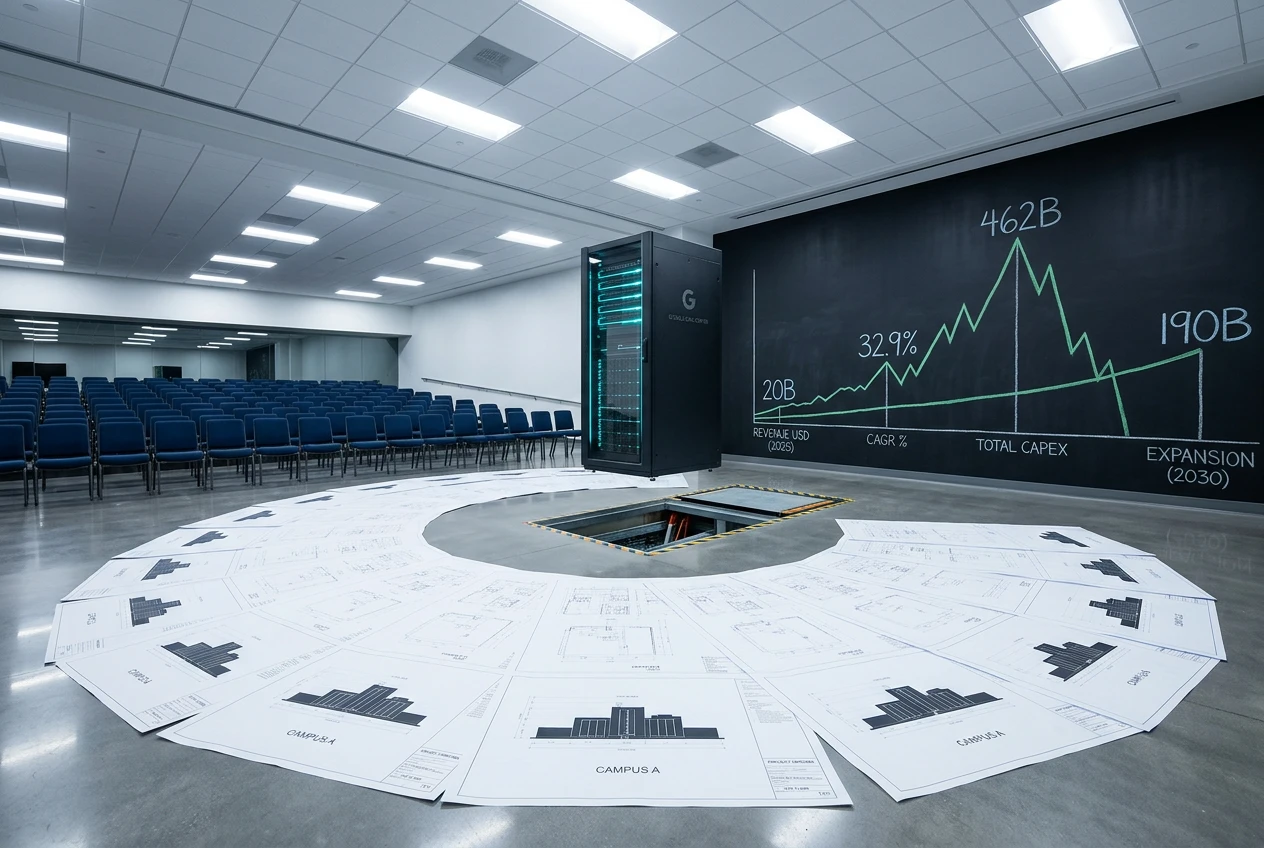
The $460 Billion Backlog Behind the Stock Surge
Alphabet’s headline numbers grabbed the morning. The line that quietly rerated the stock was the cloud backlog: $462 billion of contracted future revenue at the end of Q1, nearly double the prior quarter, per the figures detailed in Alphabet’s Q1 2026 SEC exhibit.
Ashkenazi told analysts that just over half of the backlog is expected to convert to revenue inside the next 24 months, with the inclusion of TPU hardware sales pushing the bulk of recognition into 2027. The figure dwarfs Alphabet’s entire 2025 cloud revenue of roughly $43 billion, and it gives the company forward billing visibility no rival can match on signed paper.
Why Pichai Keeps Saying Google Is ‘Compute Constrained’
Pichai used a phrase on the call that landed harder than any chart slide. He told analysts the company is ‘compute constrained in the near term’ and that cloud revenue ‘would have been higher if we were able to meet the demand.’ That admission, from a CEO sitting on $35.7 billion of quarterly capex, told Wall Street something specific: the bottleneck is supply, not demand.
“We are compute constrained in the near term. Our cloud revenue would have been higher if we were able to meet the demand,” Sundar Pichai, CEO, Alphabet, on the Q1 2026 earnings call.
Across Q1, Alphabet more than doubled the property and equipment spend it booked in the same period of 2025, when capex was $17.2 billion. Roughly 60% of technical infrastructure went into servers, with the remaining 40% flowing into data centers and networking gear, Ashkenazi said on the same call.
The shortage is real enough that Pichai used Google’s official earnings post to argue Alphabet’s combination of in-house TPUs, Gemini models and a fully-owned cloud stack gives it ‘a unique advantage’ in serving AI workloads. The pitch was directed less at customers than at investors trying to figure out whether the capex bill is recoverable.
It also helps explain why Alphabet kept raising guidance instead of trimming. The unfilled cloud backlog already covers years of forward billings. Building faster is the only way to monetize it. Full audio of the discussion sits on the company’s investor relations Q1 2026 event page.
How Google Cloud Closed the Margin Gap on AWS
Google Cloud’s operating margin landing at 32.9% put it within striking distance of AWS, which has run between 35% and 38% in recent quarters. Twelve months ago, that comparison wasn’t close. Cloud margin then was 17.8%, less than half of where AWS was printing.
Independent SaaS analyst Tomasz Tunguz wrote in his Q1 readout that vertical integration on silicon is the main reason. Google designs its own TPUs, runs its own networking, trains Gemini on those chips, serves Gemini on those chips, and bills cloud customers at retail. Microsoft and Amazon, by contrast, pay Nvidia retail on most of their training fleets and resell large blocks of capacity to OpenAI and Anthropic respectively.
That cost-per-token gap, invisible in any press release, is what tripled Google Cloud’s operating margin in twelve months. The TPU advantage was a slide in every Cloud Next keynote since 2024. It is now showing up in the income statement.
| Hyperscaler | Q1 2026 revenue | YoY growth | Operating margin | Custom silicon |
|---|---|---|---|---|
| Google Cloud | $20.03B | 63% | 32.9% | TPU (in-house) |
| Microsoft Azure | n/a (segment) | 40% | ~36% (commercial cloud) | Maia (early) |
| Amazon AWS | ~$30B | 28% | 35-38% | Trainium / Inferentia |
A $190 Billion Capex Bet, and Why Investors Cheered
Most quarters, a $5 billion increase to a multinational’s annual capex range causes the stock to fall. Alphabet’s 2026 range moved from $175 to $185 billion up to $180 to $190 billion. Shares jumped 10% anyway.
The contrast with Meta and Microsoft was immediate. Both companies also raised AI capital spending in their Q1 prints the same week. Meta’s stock fell. Microsoft’s traded sideways. Only Alphabet’s investor base rewarded the new spend.
The reason, repeated by analysts in notes published Wednesday, was the backlog. A $462 billion forward order book backed by signed contracts gave investors confidence the capex will earn its return. Meta has no equivalent customer-facing backlog.
Ashkenazi added that 2027 capex will ‘significantly increase’ from the 2026 range, citing ‘unprecedented internal and external demand for AI compute resources.’ The 2027 number, when Alphabet eventually prints it, will most likely cross $200 billion.
Across the four largest US hyperscalers, combined AI capex for 2026 is tracking toward $715 billion based on consolidated Q1 guidance, with Alphabet alone accounting for roughly 27% of that pool. Pichai’s Cloud Next 2026 keynote in April had previewed seven new TPU campuses, three of them outside the United States. The capex line is now setting the second-half 2026 calendar for the entire power-utility and high-bandwidth-memory supply chain.
- TD Cowen raised its price target to $450 from $375, the largest absolute jump on the day.
- Susquehanna moved to $460 from $400, the highest target on the Street.
- Canaccord Genuity lifted to $450 from $415, citing cloud margin durability.
Search, YouTube and the Quieter Wins
While the cloud headline ate the spotlight, the rest of Alphabet had a strong quarter. Google Services revenue grew 16% to $89.6 billion. Google Search and other ad revenue grew 19%, with Pichai noting that search queries hit an all-time high during the quarter, even as AI Overviews and AI Mode were live across the United States and a growing list of international markets.
YouTube ad revenue rose 11% year-over-year to $9.88 billion, just shy of the $10 billion mark. Subscriptions, platforms and devices grew 19%, helped by paid YouTube subscriber additions that pushed Alphabet past 350 million paid subscriptions across YouTube Premium, Music, Family and TV plans.
- Google Services: $89.6 billion, up 16% year-over-year.
- Google Cloud: $20.03 billion, up 63% year-over-year.
- Google Search and other ads: 19% growth.
- YouTube ads: $9.88 billion, up 11% year-over-year.
- Other Bets (incl. Waymo): $411 million, down from $450 million a year ago.
Frequently Asked Questions
How much did Google Cloud grow in Q1 2026?
Google Cloud revenue grew 63% year-over-year to $20.03 billion in Q1 2026, beating the Wall Street consensus of $18.05 billion. Operating income for the segment more than tripled to $6.6 billion, lifting the operating margin from 17.8% a year earlier to 32.9%, the highest in the unit’s history.
Why is Alphabet raising its capex guidance for 2026?
Alphabet raised 2026 capital expenditure guidance to $180 to $190 billion, up from $175 to $185 billion, because Google Cloud is capacity-constrained. CEO Sundar Pichai said cloud revenue ‘would have been higher if we were able to meet the demand,’ and CFO Anat Ashkenazi cited ‘unprecedented internal and external demand for AI compute resources’ as the driver.
What is Google Cloud’s backlog and why does it matter?
Google Cloud’s contracted backlog reached $462 billion at the end of Q1 2026, nearly doubling from the prior quarter. The backlog represents signed but undelivered cloud and AI commitments. Just over half is expected to convert to revenue within 24 months, giving Alphabet the largest forward order book of any hyperscaler and underwriting its capex spend.
How does Google Cloud’s operating margin compare to AWS?
Google Cloud posted a 32.9% operating margin in Q1 2026, closing in on AWS, which has run between 35% and 38% in recent quarters. Twelve months earlier, Google Cloud’s margin was 17.8%, less than half of AWS. The gap closed mainly because Google trains and serves Gemini on its own TPU silicon, lowering cost-per-token versus rivals paying Nvidia retail.
Did Alphabet raise its 2027 capex guidance?
Alphabet did not give a specific 2027 capex number on the Q1 2026 call. CFO Anat Ashkenazi said only that 2027 capex would ‘significantly increase’ from the 2026 range of $180 to $190 billion. Analysts modeling the company expect 2027 spend to cross $200 billion when Alphabet eventually prints the figure later in the year.
How did Alphabet stock react to Q1 2026 earnings?
Alphabet shares jumped close to 10% in extended trading on April 29, 2026, and opened the next session at an all-time high, taking the company’s market capitalization above $4.4 trillion. By April 30, at least six Wall Street firms had raised price targets, including Susquehanna lifting to $460 from $400 and TD Cowen to $450 from $375.
The quarter changed the question Wall Street is asking about Alphabet. The debate moved off whether AI capex will earn its return and onto how fast Google can pour concrete and rack chips. Pichai’s job in the next two earnings calls is to keep that backlog growing faster than the data centers come online.

-
 TECH1 year ago
Where Garmin Watches are Made and How They are Assembled
-

 AUTO2 months ago
Tesla’s Roadster Is ‘a Few Weeks Away,’ Says Its Chief Designer
-
 NEWS10 years ago
Samsung Releases Galaxy Note7 TV Ad as Reddit AMA Leaks Specs
-
 NEWS10 years ago
Android 7.0 Nougat Rolls Out To Nexus Devices With New Emoji, Features
-
 FINANCE9 years ago
Cardano Price Surges as ADA Enters the Crypto Top Ten List
-
 NEWS10 years ago
Pre-Order the First Camera Made for Facebook Live Streaming Video
-
 FINANCE1 year ago
Binance Suspends Trading and Withdrawals for a System Upgrade
-
 FINANCE9 years ago
RChain Price Jumps Nearly 150% to a New All-Time High of $2.03