
NEWS
CSP Capex Pushes Toward $700B in 2026 as ASIC Timing Slips

The four largest US cloud service providers have now committed to roughly $715 billion in 2026 capital spending, almost double 2025 levels, as the AI buildout races forward. But the timing of custom chip shipments, the kind meant to break Nvidia’s grip on margins, remains uncertain. That gap, between the cash going out and the silicon coming in, is the story behind the headline number.
Amazon, Alphabet, Microsoft and Meta closed Q1 2026 earnings season in the last week of April with capex guidance that even Wall Street bulls did not fully expect. Microsoft pushed its 2026 calendar-year forecast to $190 billion. Alphabet lifted its range to $180 billion to $190 billion. Meta widened its band to $125 billion to $145 billion. Amazon held the line at about $200 billion. Add Oracle’s $50 billion target and the five-CSP pile climbs above $760 billion.
What none of them said clearly: how much of that money will land on shelves as working ASIC capacity in 2026 versus 2027.
- $715B. Aggregate 2026 capex commitment from Amazon, Alphabet, Microsoft and Meta, up 77% on 2025 (Tom’s Hardware compilation of Q1 2026 guidance).
- $364B. AWS Q1 2026 backlog, before the new $100 billion Anthropic deal is added.
- $462B. Google Cloud commitments backlog, nearly double the prior quarter.
- $175B. Forecast 2026 hyperscaler debt issuance, 6x the average of the prior five years.
How the Big Four Stack Up on Spending and Returns
The surface story is symmetry: every hyperscaler is raising. The deeper story is that only one of them, Alphabet, came out of earnings with investors cheering. Alphabet shares jumped roughly 7% after hours on April 29, while Meta’s stock fell about 6% on the same day after it raised its capex ceiling by another $10 billion.
Compare the four CSPs against the metrics that matter: spend, growth, backlog, and custom silicon traction.
| Company | 2026 Capex Guide | Cloud Growth (Q1) | Cloud Backlog | Custom Chip Status |
|---|---|---|---|---|
| Amazon (AWS) | ~$200B | 28% YoY | $364B + $100B Anthropic | Trainium2 sold out; Trainium3 ramping Q2 2026 |
| Alphabet (Google Cloud) | $180-190B | 63% YoY | $462B | TPU v7 Ironwood shipping; TPU v8 in late 2027 |
| Microsoft (Azure) | $190B (CY) | 38% CC | $80B unfulfilled (power-bound) | Maia v2 H1 2026; Maia v3 delayed |
| Meta | $125-145B | n/a (services) | $107B added in one quarter | MTIA v3 in 2026, optimization issues |
The Maia Delay That Quietly Reshapes the ASIC Race
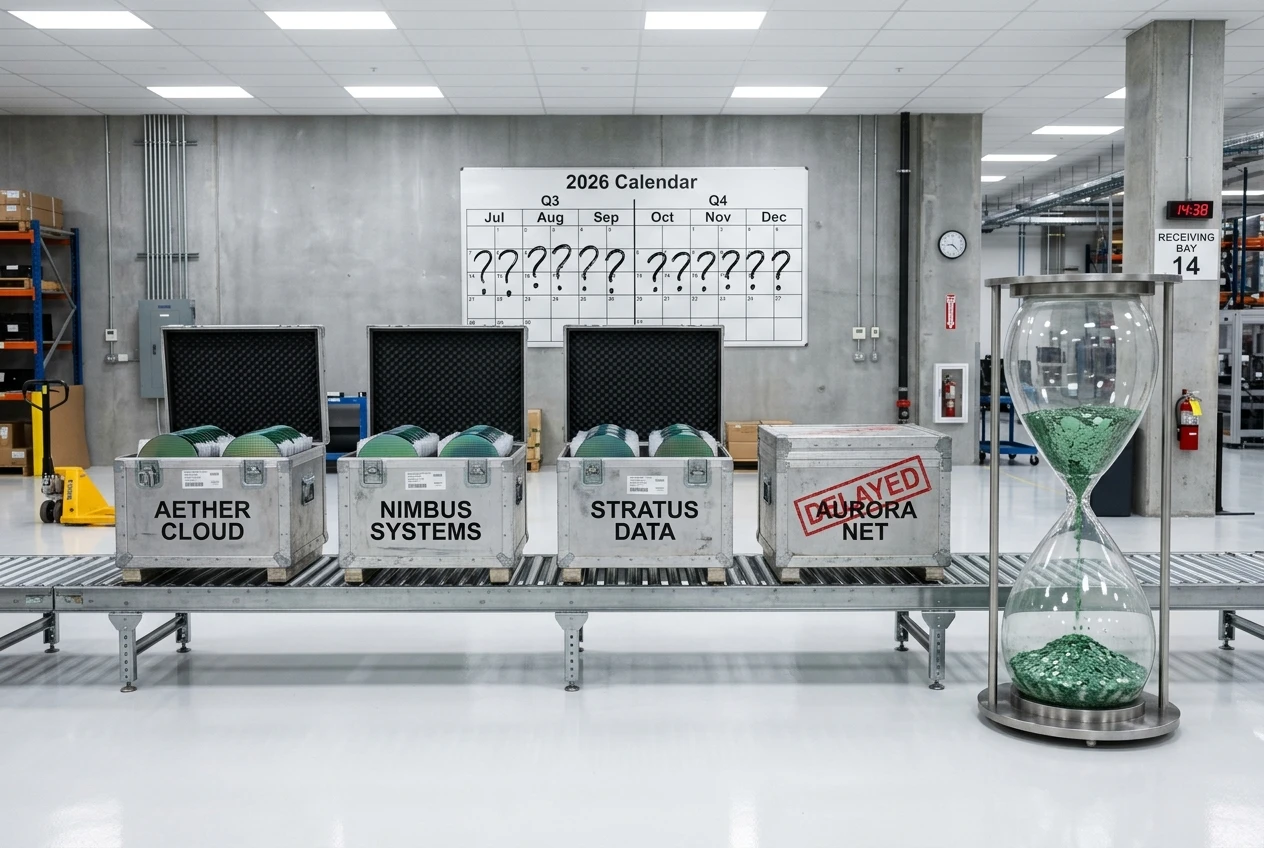
Microsoft’s Maia v3 has slipped. According to a January report from DIGITIMES on cloud ASIC shipments, the next-generation Maia design hit changes that pushed mass production out, leaving Microsoft with limited custom-silicon volume in 2026. That puts Azure further behind AWS and Google on the metric every hyperscaler quietly tracks: cost per inference token on a chip you own.
Microsoft is closing the gap with cash. CFO Amy Hood told analysts on the company’s FY2026 Q3 conference call that roughly two-thirds of capex now goes to short-lived assets, mostly GPUs and CPUs. Translation: Azure is buying more Nvidia silicon to cover for its own slipping ASIC roadmap.
The $80 billion of Azure orders Microsoft cannot fulfill because of power constraints tells the same story from another angle. Demand is real. Supply is not the chip alone, it’s the chip plus the megawatt plus the cooled rack. Maia v3 was supposed to relieve part of that.
“Of the AWS CapEx the company intends to spend in 2026, we have high confidence this will be monetized well, as we already have customer commitments for a substantial portion of it,” said Andy Jassy, CEO of Amazon, on the company’s Q1 2026 earnings call transcript.
Nvidia Still Owns the Bottleneck Hyperscalers Cannot Build Around
Every custom ASIC story runs into the same wall: TSMC’s CoWoS advanced packaging line. Nvidia has booked more than half of TSMC’s CoWoS capacity for 2026 and 2027, with Broadcom and AMD splitting the next two slots. Hyperscalers designing their own chips line up behind that allocation.
The packaging crunch is being attacked, not solved. TSMC plans to take CoWoS capacity from about 35,000 wafers a month at the end of 2024 to roughly 130,000 wafers a month by late 2026. Demand is still running 1.4x to 1.6x ahead of supply. Even with the world’s most aggressive packaging build-out, hyperscaler ASIC programs in 2026 will be capacity-rationed, not demand-rationed.
The downstream squeezes are easy to enumerate but hard to fix:
- HBM3E memory. SK Hynix, Samsung and Micron are fully booked on 2026 capacity. Custom ASICs need it as much as GPUs do.
- 3 nm logic. TSMC’s N3 family is at 100% utilization. Every CSP wants more.
- Substrate and ABF film. Lead times remain stretched well into the second half of 2026.
- Liquid cooling. Direct-to-chip plumbing is a separate bottleneck on top of the silicon one.
The Custom Chip Roadmaps That Will Decide 2027
The next eighteen months are the proving ground. Each hyperscaler now has a stated cadence, and each cadence comes with a slip risk. The order matters because the first chip to land at scale resets the cost-per-token math for every cloud customer above it.
The known timeline:
- H1 2026. Microsoft mass-produces Maia v2 with GUC; AWS continues Trainium2 deployments past 500,000 units already in production.
- Q2 2026. AWS Trainium3 ramps, with $225 billion in customer revenue commitments already booked against it, per Amazon’s Q1 call.
- Mid-2026. Meta’s MTIA v3 enters production on TSMC N3 with HBM3E, the first MTIA part fabbed at the leading edge.
- H2 2026. Google ramps TPU v7 Ironwood at scale; total TPU shipments projected at 4.3 million units for the year.
- Late 2027. Broadcom delivers TPU v8 (“Sunfish”) on TSMC 2 nm; Microsoft’s Maia v3 reaches volume only after design fix, by current schedule.
The Cash Flow Reckoning Investors Are Quietly Pricing In
The capex line is brutal once it leaves the slide deck. Bank of America’s free cash flow model, summarized in CNBC’s February analysis of hyperscaler cash impact, has Amazon’s free cash flow turning negative this year by as much as $28 billion. Alphabet’s FCF is on track to fall close to 90%, from $73.3 billion in 2025 to about $8.2 billion in 2026.
Meta priced a $25 billion investment-grade bond on May 1, the same week it raised the capex ceiling. Bond markets absorbed it. Equity markets did not.
Bank of America projects total hyperscaler debt issuance hitting $175 billion in 2026, against an average of just $28 billion across the prior five years. Meta, Alphabet, Amazon and Oracle’s combined weight in the Bloomberg US Corporate IG Index has nearly doubled in twelve months, from 2.2% to 4.1%.
Andy Jassy framed the lag in plain English on the AWS call: cash for land, power, buildings, chips and networking gear has to go out the door 6 to 24 months before the customer is billed. That is the gap investors are now staring into.
For CFOs, the 2026 question is no longer whether to spend. It is whether the custom chip that was supposed to replace Nvidia in the rack will arrive before the bond coupon is due.
Why Broadcom and Marvell Quietly Win Either Way
The cleanest beneficiaries of the timing uncertainty are not the CSPs themselves. They are the two companies that turn hyperscaler designs into production silicon. Broadcom’s AI semiconductor revenue surged 106% to $8.4 billion in its most recent quarter, anchored by Google TPU and Meta MTIA programs.
Marvell is now also on Google’s TPU bench, ending Broadcom’s perceived monopoly there, as The Next Web reported on Google’s expanded chip supply chain. Counterpoint expects Broadcom to hold roughly 60% of the custom AI accelerator market by 2027 and Marvell about 25%, with the remainder split among smaller design houses.
Whether Maia slips or Trainium3 ramps on schedule, the design service revenue is already booked. The custom-silicon arms dealers get paid in 2026 even if the hyperscalers’ own chips don’t ship at full volume until 2027.
Frequently Asked Questions
How much will the top cloud providers spend on AI in 2026?
Amazon, Alphabet, Microsoft and Meta have collectively guided to about $715 billion in 2026 capital expenditure, with Oracle adding roughly $50 billion. The total across the five largest US AI infrastructure providers sits between $660 billion and $760 billion depending on which company-issued range is used, almost double 2025’s $410 billion.
Why is ASIC demand timing uncertain in 2026?
Custom chip programs are running into design slips and packaging shortages. Microsoft’s Maia v3 has been pushed because of design changes. Meta’s MTIA faces software-hardware optimization issues. Every program competes for TSMC CoWoS packaging capacity that Nvidia has already booked more than half of for 2026 and 2027.
Which hyperscaler is furthest ahead on custom silicon?
Google leads on maturity, with TPU now in its seventh generation (Ironwood) and projected 2026 shipments of about 4.3 million units. AWS leads on revenue commitments tied to a single chip, with Amazon disclosing more than $225 billion in customer commitments for Trainium and Trainium2 already deployed at over 500,000 units in production.
Will hyperscalers issue more debt to fund AI capex?
Yes. Bank of America forecasts hyperscaler debt issuance of $175 billion in 2026, six times the prior five-year average. Meta priced a $25 billion bond on May 1, 2026, the same week it raised its capex ceiling. Combined IG index weighting for Meta, Alphabet, Amazon and Oracle has nearly doubled in twelve months.
Does record capex mean Nvidia loses share in 2026?
No, at least not this year. Microsoft told analysts roughly two-thirds of its capex still goes to short-lived assets dominated by GPUs and CPUs. With custom chip ramps slipping, Nvidia keeps the lion’s share of new dollars in 2026, with meaningful CSP-silicon substitution more likely in 2027 once Trainium3, MTIA v3 and TPU v8 reach volume.
The $700 billion line is no longer the surprise. The surprise is how little of it will translate into hyperscaler-owned silicon racked, powered, and earning revenue inside 2026. That gap, between the press release and the production line, is where the next twelve months will be won or lost.

-
 TECH1 year ago
Where Garmin Watches are Made and How They are Assembled
-
 AUTO3 months ago
Tesla’s Roadster Is ‘a Few Weeks Away,’ Says Its Chief Designer
-
 NEWS10 years ago
Samsung Releases Galaxy Note7 TV Ad as Reddit AMA Leaks Specs
-
 NEWS10 years ago
Android 7.0 Nougat Rolls Out To Nexus Devices With New Emoji, Features
-
 FINANCE9 years ago
Cardano Price Surges as ADA Enters the Crypto Top Ten List
-
 NEWS10 years ago
Pre-Order the First Camera Made for Facebook Live Streaming Video
-
 FINANCE1 year ago
Binance Suspends Trading and Withdrawals for a System Upgrade
-
 FINANCE9 years ago
RChain Price Jumps Nearly 150% to a New All-Time High of $2.03