
NEWS
Bexar County Deputies Get AI Body Cameras That Translate 60 Languages

Bexar County deputies began carrying real-time AI translators on their chests this month, becoming one of the first major Texas patrol agencies to push Axon’s Real-Time Translation feature into routine traffic stops, welfare checks, and human-smuggling response calls. Sheriff Javier Salazar said the Translate Assistant, embedded in the Axon Body 4 camera, can auto-detect a speaker’s language and produce a two-way audible translation within seconds, replacing a wait that often stretched 20 to 30 minutes for a Spanish or Vietnamese-speaking deputy to arrive. As of April 2026, the technology is live with the most recent patrol class and will roll out to the full Bexar County Sheriff’s Office over the coming months.
The agency’s rollout puts a frontline test on a tool Axon only made generally available on August 1, 2025, and it lands in a county where roughly one in three residents speaks Spanish at home and several thousand more speak Vietnamese, Tagalog, Arabic, or Urdu. It also lands in the middle of an unresolved fight over how much of police work should be handed to generative AI.
What the Translate Assistant Actually Does on a Traffic Stop
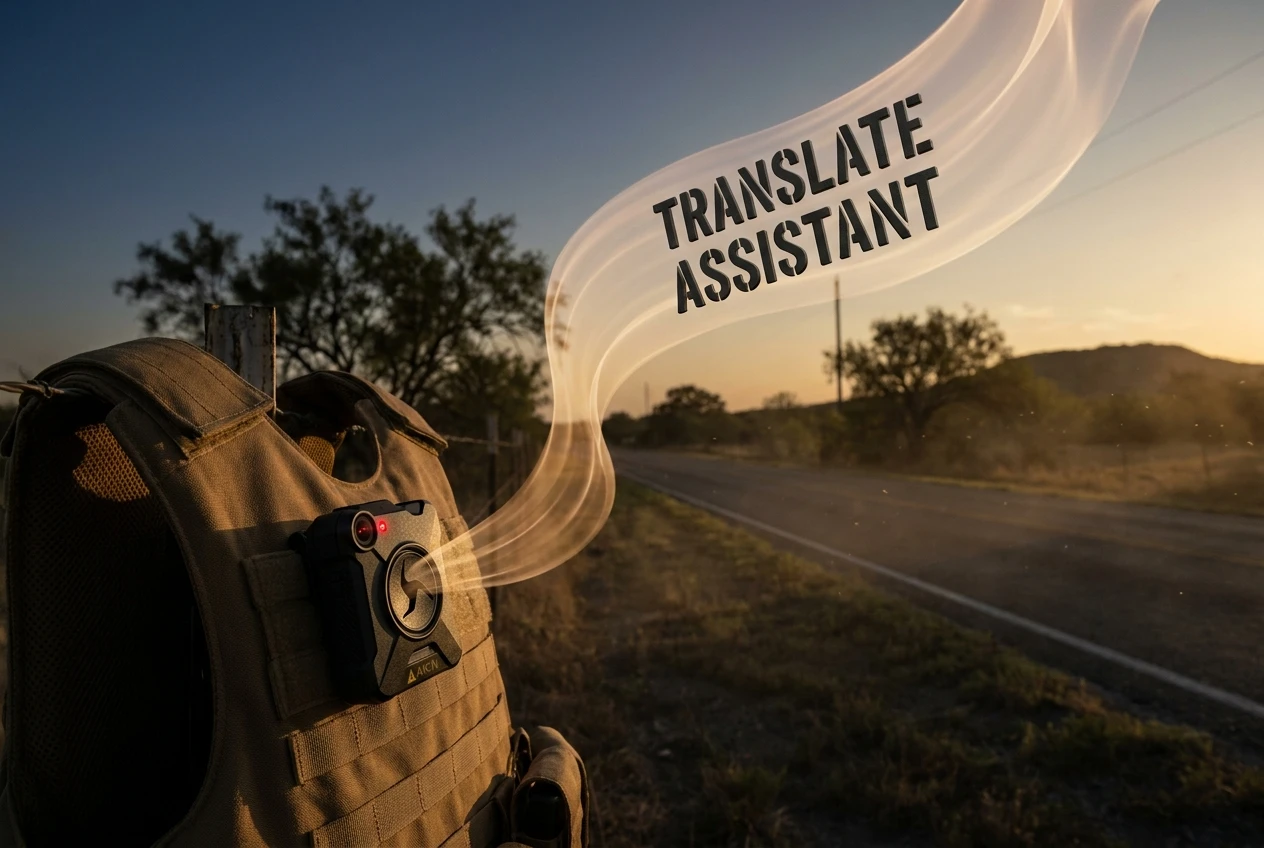
The feature is triggered by a deliberate double-press of a programmable button on the Axon Body 4. An audible prompt asks the deputy to either pick a target language or let the camera identify it. Once the camera locks on a language, the deputy speaks into the device, and the translated speech plays back through the camera’s external speaker. The civilian’s reply is then translated back into English for the deputy.
According to Axon’s Body 4 product documentation, the supported set covers more than 50 languages, including Mandarin, Hindi, Vietnamese, Tagalog, Arabic, Urdu, Persian, Korean, Tamil, Marathi, and Swahili. Salazar told reporters his deputies have access to 60 and counting; Axon’s published list confirms 50-plus, with new languages added through software updates.
Every translated exchange is captured in the body-worn video and the written transcript, meaning a human translator can later verify whether the AI got it right. That audit trail is the part Salazar leans on when asked about reliability.
Why a Few Seconds of Lag Beats a 30-Minute Wait
Salazar said the most consequential change is time. “We usually call a deputy that speaks the language that person speaks, and that could take 20 or 30 minutes, especially out in unincorporated Bexar County,” he said. The county’s patrol footprint stretches across roughly 1,240 square miles, much of it rural, and a Spanish-speaking deputy two precincts away cannot meaningfully help a domestic violence victim bleeding on a kitchen floor.
The sheriff was blunt about the use case he cares most about: human smuggling. Bexar County sits along the I-35 smuggling corridor north of the border, and deputies regularly encounter survivors who speak Pashto, Dari, Mandarin, or one of several West African languages. “They may be from an Arab country or an Asian country, and absolutely having this technology at our fingertips that allows us to not just communicate with this person, but figure out exactly what it is that they’ve been through,” Salazar said.
The Demographics That Made This Inevitable
Bexar County is the most language-diverse jurisdiction in South Texas. U.S. Census Bureau QuickFacts place the population north of 2 million, with about 60% of residents identifying as Hispanic or Latino. Roughly 34% of households speak Spanish at home, and another 4% speak a non-English, non-Spanish language. That second slice, often invisible in policy debates, is the slice the Translate Assistant is built for.
The Bexar County Sheriff’s Office employs Spanish-speaking deputies in meaningful numbers. It does not employ Pashto, Hmong, or Tigrinya speakers in any meaningful numbers. Salazar’s bet is that the camera closes that gap.
How a $9 Million Axon Deal Got the County Here
The Translate Assistant did not arrive for free. Bexar County’s body-worn camera program runs on a multi-year Axon contract that commissioners expanded in 2022 with a $3 million extension and again in subsequent budget cycles, ultimately approaching a $9 million package that bundles cameras, Tasers, cloud storage in Axon Evidence, and software upgrades. The Translate Assistant rides on top of that hardware as a software skill activated through Axon’s Axon Assistant platform, which Axon began rolling out to U.S. agencies in August 2025.
That history matters because Bexar County’s first body camera attempt, with Georgia-based Utility Associates, collapsed almost a decade ago after the agency deployed only 42 of more than 300 purchased cameras. The Axon contract is the second life of body-worn cameras in this county, and the Translate Assistant is the most ambitious feature it has tested.
The Reliability Question Most Coverage Is Skipping
Real-time machine translation is not flawless, and the literature is unkind to assumptions that it is. Recent benchmarks of large-language-model translation show error rates that climb sharply for low-resource languages, code-switched speech, and emotionally distressed speakers, exactly the populations a sheriff’s deputy is most likely to encounter on a smuggling call.
Axon publishes the safeguard language plainly. “Real-Time Translation is not a replacement for a human translator,” the company writes in its official product brief, which positions the tool for “quick, low-risk communication” only. The brief urges agencies to fall back on certified human interpreters for Mirandized statements, custodial interviews, and any high-stakes exchange.
That carve-out is the part deputies will be trained on. Salazar said patrol officers were prioritized for training because they generate the most public contact, and only after that group is fluent with the tool will the agency expand training to detention and investigations.
What Civil Liberties Groups Are Watching
Translation is the least controversial slice of Axon’s AI suite. The more contentious tools are the ones Salazar hinted at when he described future features: an AI that values damaged property in incident reports and a policy-chat system that lets deputies ask the body camera questions about department policy instead of pulling out the manual.
The American Civil Liberties Union has flagged Axon’s Draft One report-writing tool as “prone to making up facts” and warned that AI-drafted reports can paper over what an officer actually saw. The Electronic Frontier Foundation went further in a July 2025 analysis, arguing in a public records investigation that Draft One “appears deliberately designed to avoid audits” because it does not retain a record of which sentences were AI-generated and which were edited by an officer.
“Six of the seven police departments that responded to public records requests had turned off features that required officers to review AI-generated reports,” the Electronic Frontier Foundation wrote, calling the trend a quiet erosion of human oversight.
The Translate Assistant does not generate reports, but the policy-chat feature Salazar mentioned uses the same retrieval-augmented generation architecture the ACLU has questioned. That is the next test for Bexar County.
The Quiet Operational Change
Beyond translation, the bigger shift is cultural. Deputies who once radioed dispatch to call out a Spanish-speaker, or who flagged down a bilingual neighbor at a scene, are being asked to trust a vest-mounted device with the first contact. That is a real change in how a deputy decides whether a person in front of them is a victim, a witness, or a suspect.
Salazar framed it as a training problem, not a philosophical one. “It’s absolutely vital that we’re able to communicate with as many people as effectively as we can,” he said. The agency’s command staff page lists the patrol division as the largest in the office, and that is where the Translate Assistant gets its first real-world test.
Readers following Texas governance trends may recognize the broader pattern from earlier reporting on how Texas divides executive authority across elected officials, including county sheriffs who set their own technology priorities. Salazar’s office has used that latitude aggressively, layering AI features faster than most Texas peers.
What Comes Next on Patrol Roads
The next milestones are concrete. All Bexar County deputies will be trained on the Translate Assistant in the coming months, the policy-chat skill is being prepared for rollout, and the AI damage-valuation tool is in early evaluation. Each new skill will require its own internal policy and, if the ACLU’s track record holds, its own public-records fight.
For now, the change civilians will notice is small and significant: the next time a deputy steps to the window of a car and the driver does not speak English, the deputy will press a button on a camera and a Vietnamese, Pashto, or Tagalog sentence will play out of the deputy’s chest.
Axon’s official demonstration of the feature shows how the audible prompt and translated playback work in a controlled environment.
Frequently Asked Questions
How Many Languages Does the Bexar County Body Camera Translator Support?
Sheriff Javier Salazar said the Translate Assistant supports 60 languages and counting. Axon’s official product documentation, as of April 2026, confirms support for more than 50 languages, including Spanish, Vietnamese, Mandarin, Hindi, Arabic, Urdu, Tagalog, and Pashto, with new languages added through software updates.
Is the AI Translation Recorded as Evidence?
Yes. Every translated exchange is captured in the body-worn video and a written transcript inside Axon Evidence. A certified human translator can later review the audio to verify accuracy, which is the safeguard Axon lists as central to the product.
Can the Translate Assistant Replace a Human Interpreter in Court?
No. Axon explicitly states the tool is designed for quick, low-risk communication and is not a replacement for human translators. Bexar County deputies are still expected to use certified interpreters for custodial interviews, Mirandized statements, and any high-stakes legal exchange.
Which Bexar County Deputies Are Using It First?
Patrol deputies who graduated from the most recent academy class were trained first, because patrol generates the highest volume of public contact. The sheriff’s office plans to extend training to all divisions, including detention and investigations, in subsequent phases.
What Other AI Features Are Coming to Bexar County Body Cameras?
Salazar said deputies will soon be trained to use AI to estimate the value of property damaged in incidents and to ask the body camera questions about department policy without consulting a paper manual. Both features run on Axon Assistant, the same platform that powers the Translate Assistant.

-
 TECH1 year ago
Where Garmin Watches are Made and How They are Assembled
-

 AUTO2 months ago
Tesla’s Roadster Is ‘a Few Weeks Away,’ Says Its Chief Designer
-
 NEWS10 years ago
Samsung Releases Galaxy Note7 TV Ad as Reddit AMA Leaks Specs
-
 NEWS10 years ago
Android 7.0 Nougat Rolls Out To Nexus Devices With New Emoji, Features
-
 FINANCE9 years ago
Cardano Price Surges as ADA Enters the Crypto Top Ten List
-
 NEWS10 years ago
Pre-Order the First Camera Made for Facebook Live Streaming Video
-
 FINANCE1 year ago
Binance Suspends Trading and Withdrawals for a System Upgrade
-
 FINANCE9 years ago
RChain Price Jumps Nearly 150% to a New All-Time High of $2.03