
FINANCE
Sensex Swings 493 Points, Then Closes Almost Exactly Flat
Sensex gained just 1.44 points and Nifty slipped 0.02% on July 16 after a 493-point swing tied to Hormuz tensions and a 6.37% Kospi rout.

India’s Sensex closed up a mere 1.44 points on Thursday, settling at 77,186.87 after a 493-point round trip during the trading day. The Nifty 50 slipped 5.75 points, or 0.02%, to 24,072.75. Underneath that calm print, blue-chip banks sold off, IT stocks rallied, and South Korea’s Kospi cratered 6.37% on the same tape.
The Sensex swung nearly 500 points top to bottom before landing almost exactly where it started. That gap opened on a naval standoff over the Strait of Hormuz, fresh profit-taking in HDFC Bank and Reliance Industries, and a regional selloff that left India looking like the calmest market in Asia.
A 493-Point Round Trip to Nowhere
The 30-share BSE Sensex opened firm and kept climbing through the morning, touching an intraday high of 77,579.69, a gain of 394.26 points, or 0.51%, from Wednesday’s close. Then it gave almost all of it back.
By the afternoon session, the index had slipped to an intraday low of 77,086.42, briefly turning negative, before a late recovery dragged it back to a net gain of 1.44 points. The Nifty told the same story on a smaller scale, touching an intraday high of 24,186.50 before falling to 24,050 and closing down 5.75 points.
| Index | Previous Close | Intraday High | Intraday Low | Close |
|---|---|---|---|---|
| Sensex | 77,185.43 | 77,579.69 | 77,086.42 | 77,186.87 |
| Nifty 50 | 24,078.50 | 24,186.50 | 24,050.00 | 24,072.75 |
Sixteen of the Sensex’s 30 stocks finished higher, but the moves underneath the index were sharper than the headline number suggests.
- Eternal fell 3.05%, the steepest drop on the Sensex, pulling the broader consumer and financial pack down with it.
- HDFC Bank, Axis Bank, Bajaj Finserv and Bharat Electronics also closed lower as profit-taking hit banking and defense names after recent gains.
- HCL Technologies, Bajaj Finance, InterGlobe Aviation (IndiGo) and Maruti Suzuki gained as much as 1.84%, led by a rally in IT and auto stocks.
Exchanges log that tug of war every session. Combined FII and DII trading data across three exchanges is collated daily by the National Stock Exchange, giving traders a same-day read on who is buying and who is heading for the door.
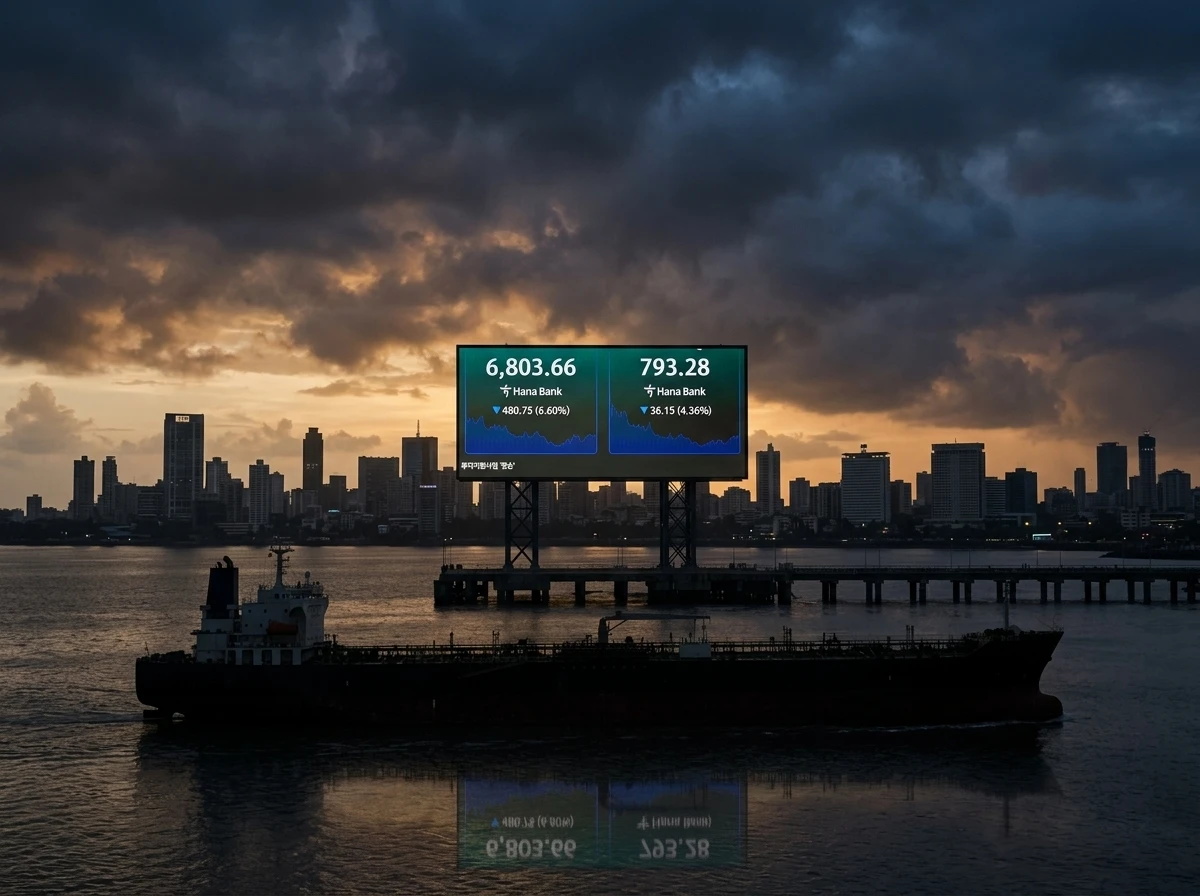
Why Is Everyone Watching the Strait of Hormuz?
Brent crude has stayed choppy since Washington moved to reimpose a naval blockade on Iranian shipping and add a 20% transit fee through the Strait of Hormuz, a channel that carries close to a fifth of the world’s oil and gas. Every dollar move in that price now feeds straight into Indian inflation, the rupee and import bills.
Indian equities concluded largely subdued as investors remained cautious amid geopolitical uncertainties, fluctuating oil prices, and weak Asian market trends.
Vinod Nair, head of research at Geojit Investments, a Kochi-based brokerage, said cooling U.S. inflation data offered some downside support even as the geopolitical mood stayed tense. Markets in Europe were trading lower Thursday, while U.S. markets, which set the overnight tone, had ended higher on Wednesday.
Brent settled at $84.62 a barrel Thursday, down 0.39% on the day, after trading above $86 earlier in the week. The rupee has slipped past 96 to the dollar, and India’s wholesale price index accelerated to 9.87% in June, driven by a 27.4% jump in fuel and power costs.
Kospi Craters, Dalal Street Barely Blinks
South Korea’s Kospi tanked 6.37% Thursday, one of the sharpest single-day drops among major Asian markets this year. Japan’s Nikkei 225 and Shanghai’s SSE Composite also settled lower. Hong Kong’s Hang Seng was the outlier, ending higher.
Chipmakers across the region retreated ahead of earnings from Taiwan’s TSMC, a bellwether for the sector, adding pressure to tech-heavy Asian indices even as Wall Street’s overnight gains offered some cushion. India’s benchmarks moved the other way. HCL Technologies and Tech Mahindra were both among Thursday’s Sensex gainers even as the broader region sold off.
HDFC Bank and Axis Lead the Banking Retreat
Profit-taking hit two of India’s biggest names, HDFC Bank and Reliance Industries, even as gains in IT shares kept the overall index afloat. Among the session’s steepest Sensex decliners were Eternal, Bharat Electronics, Bajaj Finserv, HDFC Bank and Axis Bank.
Foreign institutional investors sold a net ₹735.83 crore (roughly $76 million) of Indian equities on Wednesday, according to exchange data. Domestic institutions more than made up for it: domestic funds bought a net ₹704.93 crore the same day, cushioning the outflow.
From an 8% Rally to a Stalled Summer
This week’s jumpiness follows a long stretch of calm. Between an April ceasefire and July 10, the Sensex and Nifty each advanced about 8%, while broader midcap and smallcap gauges ran even further ahead.
- Up about 8%: Sensex and Nifty gains between the April ceasefire and July 10, with the BSE MidCap 150 up nearly 20% and the BSE SmallCap 250 up 23%.
- Down 32% and 56%: how far Brent crude and India’s VIX fell over that same stretch, the clearest sign geopolitical risk had drained out of the market.
- Since July 10: benchmarks have slipped roughly 0.5%, Brent has climbed about 12%, and the VIX has jumped 13%, tracing the swing back the other way.
The mood had already turned tense by midweek. “The global financial landscape is bracing for a highly volatile and tense trading session today,” said Ajay Bagga, a banking and market expert, on Tuesday, hours before the Sensex slid 524 points that session.
Just nine days earlier, on July 7, foreign investors had net-bought ₹393.19 crore of Indian shares while domestic funds sold ₹383.43 crore, a flow that flipped within days once tensions resurfaced.
Earnings and the Monsoon Now Carry the Market
Traders are now pricing in three separate variables: how the June-quarter earnings season lands, whether the monsoon keeps pace, and what happens next in West Asia, according to analysts cited by the Indo-Asian News Service.
Earnings have already produced surprises. Bharat Heavy Electricals swung to a ₹376.71 crore profit for the quarter ended June 30, compared with a year-ago loss, as its power segment turned around.
Even so, J.P. Morgan Global Research still sees Brent averaging near $60 a barrel this year, well below Thursday’s $84.62 print, betting the current spike will not last. Natasha Kaneva, the bank’s head of Global Commodities Strategy, has said war-driven crude rallies in the region tend to be brief before fundamentals reassert themselves.
Thursday’s scoreboard read a gain of 1.44 points. Getting there took a 493-point round trip, a naval blockade half a world away, and a 6.37% rout next door in Seoul.
Disclaimer: This article is for informational purposes only and does not constitute investment advice. Equity markets carry risk, including loss of principal. Consult a qualified financial advisor before making investment decisions. Figures are accurate as of publication on July 16, 2026.

-
 TECH1 year ago
Where Garmin Watches are Made and How They are Assembled
-

 AUTO3 months ago
Tesla’s Roadster Is ‘a Few Weeks Away,’ Says Its Chief Designer
-
 NEWS10 years ago
Samsung Releases Galaxy Note7 TV Ad as Reddit AMA Leaks Specs
-
 NEWS10 years ago
Android 7.0 Nougat Rolls Out To Nexus Devices With New Emoji, Features
-
 FINANCE9 years ago
Cardano Price Surges as ADA Enters the Crypto Top Ten List
-
 NEWS10 years ago
Pre-Order the First Camera Made for Facebook Live Streaming Video
-
 FINANCE1 year ago
Binance Suspends Trading and Withdrawals for a System Upgrade
-
 FINANCE9 years ago
RChain Price Jumps Nearly 150% to a New All-Time High of $2.03