
NEWS
Palit’s New RTX 3060 12GB Reveals Why Budget GPUs Are Stuck
Palit has launched the GeForce RTX 3060 Infinity 2 OC, reviving 2021’s 12GB chip as Nvidia’s budget GPU lineup stalls under a global memory shortage.

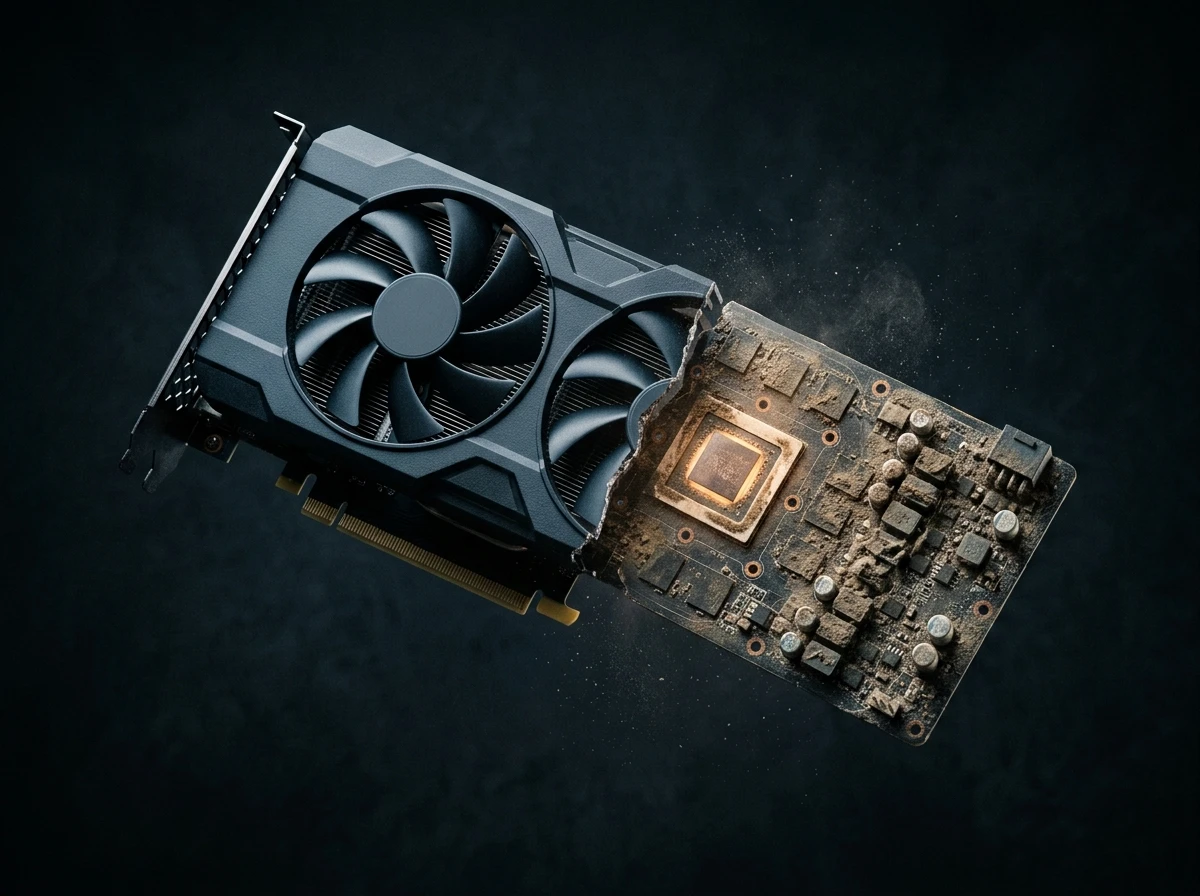
Palit officially relaunched the GeForce RTX 3060 with 12GB of memory on July 15, 2026, wrapping a chip Nvidia first sold in 2021 inside a brand-new cooler. The GA106 silicon inside hasn’t changed. What changed is where Nvidia can still build it.
Samsung’s older 8-nanometer line, left untouched by the AI industry’s scramble for advanced-node capacity, is the reason a five-year-old budget GPU can exist as new retail stock in 2026. It may be the only new silicon budget gamers see for years.
Palit’s Infinity 2 OC Wears a New Shell on Old Silicon
Palit Microsystems, the Taiwan-based board partner behind the card, calls it the GeForce RTX 3060 Infinity 2 OC. It ships in two versions: a standard model and an overclocked one that boosts to 1,792MHz, a gain of less than 1% over Nvidia’s reference clock.
Under the shroud, nothing has moved. The chip still carries 3,584 CUDA cores, a 192-bit memory bus and 360GB/s of bandwidth, the same numbers Nvidia published in 2021.
What’s new sits on the outside.
- A dual-fan, all-black cooler shroud replacing Palit’s older reference-style designs
- A ventilated metal backplate meant to stop the board from flexing under its own weight
- A flow-through channel behind the heatsink that lets air pass directly across the fins
- Palit’s 0dB fan mode, which stops both fans completely during desktop use and light workloads
Palit’s own launch materials describe the extra memory as an affordable productivity ticket for students, video editors and creators dabbling in local AI work. That pitch only works because the RTX 3060 still has something the newest budget Nvidia cards don’t: room to spare.
A Samsung Fab Line Nvidia Never Needed for AI
Samsung Foundry restarted production of the GA106 chip, the RTX 3060’s silicon core, on its 8-nanometer DUV node in March 2026, according to Tech Times, which cited the Korean outlet Hankyung. That node is a dead end for Nvidia’s newest chips. Ada Lovelace and Blackwell GPUs, including the entire RTX 50 series, are built on TSMC’s 4N process instead.
The separation is what makes the whole relaunch possible. Nvidia doesn’t have to pull a single wafer away from the advanced-node lines it needs for AI accelerators in order to keep building RTX 3060s. Inven Global reported the same dynamic: the older chip lets Nvidia sidestep any competition for capacity with its AI hardware entirely.
Board partners lined up quickly once that became clear. Asus, MSI, Colorful and GALAX, a brand recently folded into Palit’s own corporate group, were all confirmed as production participants, per Tech Times. Gigabyte and Manli have quietly listed their own renewed variants in different regions, according to Tom’s Hardware.
The scale of the demand pulling capacity away from ordinary DRAM in the first place is on track to spend $650 billion this year on AI infrastructure, according to Bloomberg’s supply-chain analysis, up roughly 80% from last year’s record. None of that money competes for Samsung’s older 8-nanometer line, which is exactly why Nvidia can still build RTX 3060s there.
Does 12GB of GDDR6 Beat 8GB of GDDR7?
Raw speed goes to the RTX 5060. Nvidia’s newer 8GB card renders nearly double the frame rate at native 1080p in independent testing, and its GDDR7 memory runs roughly 25% faster than the RTX 3060’s GDDR6. But the extra 4GB decides which games and which local AI models load at all, regardless of speed.
NoobFeed’s side-by-side testing found the RTX 5060 delivering close to twice the frame rate of the RTX 3060 12GB at native 1080p, climbing past 120fps once DLSS upscaling kicked in. The gap flips in Indiana Jones and the Great Circle. With ray tracing on and settings maxed, the RTX 3060 12GB used nearly all 12GB of memory at 1080p, running at 30 to 40fps. The RTX 5060 couldn’t even enable those same settings; its 8GB ceiling blocked them outright.
The same math shows up in local AI work. CraftRigs’ benchmarking found the RTX 3060 12GB can run 14B-parameter models at 28 to 32 tokens per second entirely in VRAM. The RTX 5060 can’t load a 14B model into its 8GB buffer at all; it spills into system memory and drops to 2 to 5 tokens per second.
| Graphics Card | VRAM | Memory Bus | 2026 Street Price |
|---|---|---|---|
| RTX 3060 12GB (new stock) | 12GB GDDR6 | 192-bit | $329.99 to $339.99 |
| RTX 5060 8GB | 8GB GDDR7 | 128-bit | $349 to $359 |
| RTX 5060 Ti 8GB | 8GB GDDR7 | 128-bit | $369 |
At this price band, the RTX 3060 12GB is the only card that avoids a hard VRAM ceiling, even though it’s slower almost everywhere else.
The Reigning Champion Has Company
Valve’s own numbers back Palit’s marketing, mostly. The RTX 3060 has led Valve’s Steam Hardware and Software Survey in most months over the past year, reaching 4.15% in April 2026 before slipping to 3.88% in the most recent published tally, per Valve’s live monthly GPU market share tracker.
Palit’s launch materials lean into that record, calling the RTX 3060 “a reigning champion on the Steam Hardware Survey.” Industry press has taken to calling it the people’s graphics card, per Inven Global, a nod to how rarely Steam’s most common GPU actually changes.
Tech Insider’s analysis of that same June 2026 survey data found a laptop chip, the RTX 4060 Laptop GPU, in first place at 3.81%, with the desktop RTX 3060 second at 3.73%, the first time a mobile GPU has ever topped Steam’s chart. Valve’s own published table lists the desktop 3060 higher, at 3.88%. The two reads of the same month don’t agree.
Enthusiast reaction has run skeptical regardless of the ranking. One commenter on Tom’s Hardware’s forums called the relaunch “one of the worst component resurrections ever,” arguing there is no value at this price.
Jensen Huang Already Called This a Good Idea
Back at CES 2026, Nvidia’s chief executive, Jensen Huang, said reviving older RTX cards on trailing-edge nodes was “a good idea,” addressing pricing and availability concerns around the RTX 50 series, according to Tom’s Hardware. Six months later, that idea has become a staggered rollout.
Chinese Board Channels first reported that allocation would reach board partners in June 2026, per TweakTown. MSI’s Ventus RTX 3060 12GB became the first new card to hit US shelves, listed on Newegg in early July at $329.99. Gigabyte’s Windforce, carrying a telltale Rev2.0 suffix, followed at $339.99, just $10 above the card’s original 2021 price.
Colorful added its iGame RTX 3060 12GB to its own lineup in the same window. Palit’s Infinity 2 OC, announced July 15, is the first version built around genuinely new PCB engineering rather than a reused 2021 board layout, Tech Times reported.
The Budget Tier Won’t See New Silicon Before 2028
Everything above the RTX 3060 in Nvidia’s lineup is stuck too. PC Game Check reported that Nvidia’s RTX 50 Super refresh, once expected around CES 2026, has been delayed indefinitely, with the company deprioritizing it to preserve memory and wafer supply for its AI business. Nvidia hasn’t confirmed a timeline, and PC Game Check itself cautions the delay is an unverified leak.
The knock-on effect, per that same report, would make 2026 the first year in roughly three decades without a new Nvidia gaming GPU architecture, pushing the RTX 60 series from a late-2027 target to 2028.
The rumored RTX 5050 9GB, once expected to slot in below the RTX 3060 12GB, appears headed for a similar fate. TweakTown reported industry expectations that the RTX 3060 12GB would simply take its place instead.
Prices aren’t waiting for any of this to resolve. TrendForce-cited reporting has Nvidia’s flagship RTX 5090 potentially reaching as high as $5,000 later this year, up from its $1,999 launch price, as VRAM alone climbs past 80% of a graphics card’s total bill of materials.
PC vendors are already passing costs along. IDC’s own analysis shows Lenovo, Dell, HP, Acer and Asus have warned clients of 15 to 20 percent hikes as memory contracts reset through the second half of 2026.
What We Know:
- Samsung restarted GA106 production on its 8nm DUV node in March 2026, separate from the TSMC lines building Nvidia’s newest chips
- MSI’s Ventus and Gigabyte’s Windforce Rev2.0 are already selling in the US for $329.99 to $339.99
- Nvidia’s RTX 50 Super refresh has missed every window analysts expected it in during 2026
What’s Unconfirmed:
- Palit hasn’t disclosed pricing or regional availability for the Infinity 2 OC
- Whether the rumored RTX 5050 9GB is cancelled outright or merely delayed
- When DRAM supply actually loosens; estimates range from late 2027 to 2028
Analysts at Jefferies expect DRAM prices to keep climbing through the rest of 2026, and most memory-market forecasts don’t place meaningful relief before late 2027 at the earliest.
Frequently Asked Questions
Is the RTX 3060 12GB Worth Buying in 2026?
For 1080p gaming alone, a newer RTX 5060 or RTX 5060 Ti outperforms the RTX 3060 in most titles. The calculation changes for local AI work or heavy video editing, where the extra 4GB matters more than raw speed. Used RTX 3060 12GB cards have also become popular on secondary markets, commanding around $210, nearly $90 less than a new RTX 5060, according to NoobFeed’s testing notes.
How Much VRAM Do You Actually Need in 2026?
For 1080p gaming, 8GB to 12GB is typically enough. 1440p benefits from 12GB to 16GB, and 4K or heavy creative workloads justify 16GB or more, per guidance widely shared across PC-building communities. Buying more VRAM than a workload actually requires, purely as insurance, is part of what has pushed demand, and prices, higher industry-wide this year.
Why Is Nvidia Reviving a 2021 Chip Instead of Building a New One?
Jon Peddie Research expects desktop add-in-board shipments to fall nearly 10% in 2026 as memory costs rise, giving Nvidia a financial reason to keep an existing, already-amortized production line running rather than fund a new one during a supply crunch.
What Happened to the RTX 5050 9GB?
It was expected to launch beneath the RTX 3060 12GB as Nvidia’s cheapest current-generation card. Multiple reports, including TweakTown, indicate it has been delayed or shelved, with industry expectations shifting toward the revived RTX 3060 12GB filling that slot instead.
When Will Graphics Card Prices Come Down?
Not soon, according to most memory-market analysts. IDC estimates 2026 DRAM supply will grow only about 16%, well below historical norms, one reason forecasts from Jefferies and others don’t expect meaningful relief before late 2027 or 2028.
Does the RTX 3060 12GB Support DLSS 4 or Frame Generation?
No. The card runs Nvidia’s 2021 Ampere architecture, which supports standard DLSS upscaling but not the DLSS 4.5 suite or Multi Frame Generation introduced with the Blackwell-based RTX 50 series, a gap that shows up most in ray-traced titles rather than rasterized ones.

-
 TECH1 year ago
Where Garmin Watches are Made and How They are Assembled
-

 AUTO3 months ago
Tesla’s Roadster Is ‘a Few Weeks Away,’ Says Its Chief Designer
-
 NEWS10 years ago
Samsung Releases Galaxy Note7 TV Ad as Reddit AMA Leaks Specs
-
 NEWS10 years ago
Android 7.0 Nougat Rolls Out To Nexus Devices With New Emoji, Features
-
 FINANCE9 years ago
Cardano Price Surges as ADA Enters the Crypto Top Ten List
-
 NEWS10 years ago
Pre-Order the First Camera Made for Facebook Live Streaming Video
-
 FINANCE1 year ago
Binance Suspends Trading and Withdrawals for a System Upgrade
-
 FINANCE9 years ago
RChain Price Jumps Nearly 150% to a New All-Time High of $2.03