NEWS
Meta Muse Glimmer Puts Open Agents on One Consumer GPU
Meta’s downloadable Muse Glimmer 30B model runs agentic AI on a single consumer GPU, challenging closed labs with open weights and a personal superintelligence push.

Meta released Muse Glimmer on Monday, a roughly 30-billion-parameter open-weight model distilled for always-on local agents that runs on a single consumer GPU or Mac. The drop arrives with a long manifesto from Mark Zuckerberg arguing that superintelligence should be distributed to individuals rather than locked inside a handful of labs or institutions.
Weights ship free under Apache 2.0. Users cover only their own electricity and hardware. The move turns a philosophical fight into something you can download and run at home.
The Model That Fits One Graphics Card
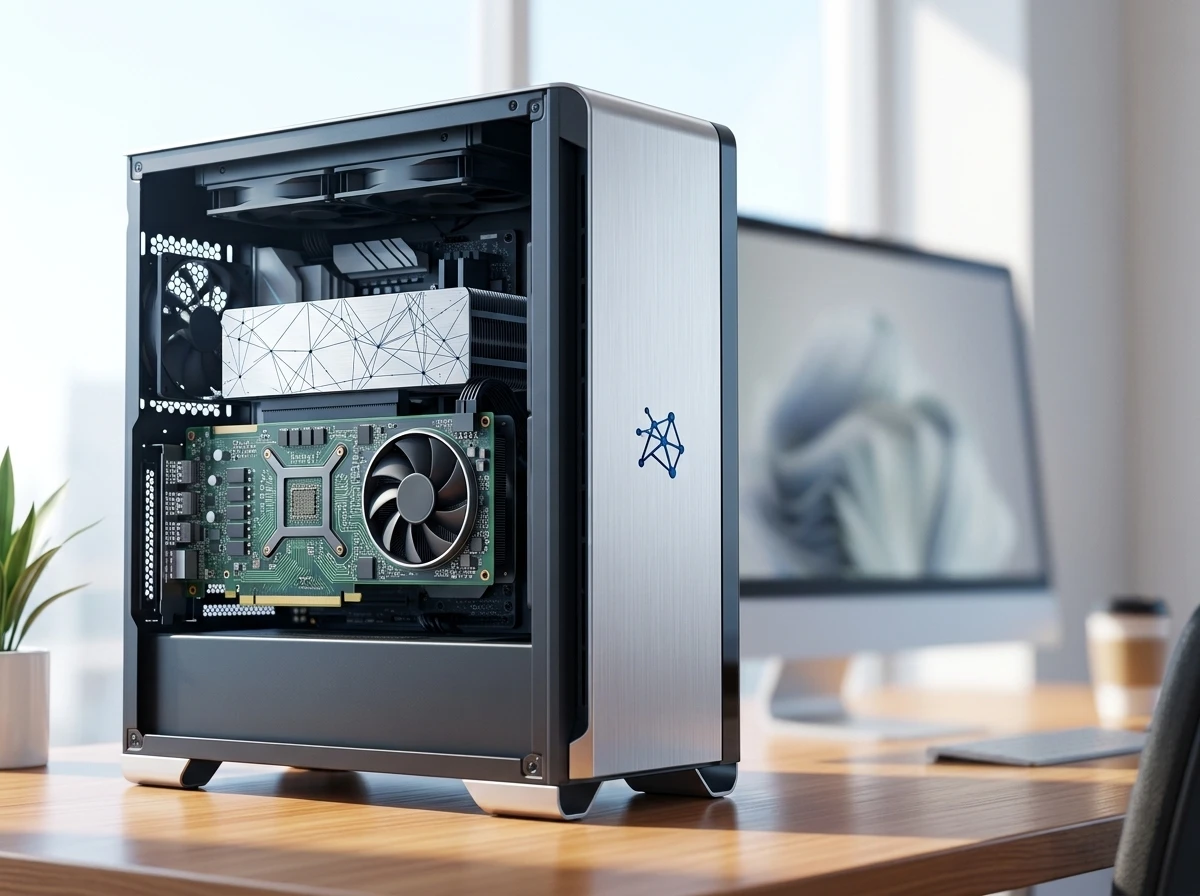
Full-precision 30-billion-parameter weights would need more than 55 GB of memory. Meta used 4-bit quantization to shrink the language model under 20 GB. That leaves room for the KV cache, a perception encoder for images, and a speculative decoding drafter inside a 24 GB or 32 GB envelope.
- ~29.6 billion total parameters including the vision encoder
- Under 20 GB after 4-bit quantization for the core language model
- 3.1x speedup on an RTX 5090 with the DFlash drafter (74.9 to 233.4 tokens per second)
- Apache 2.0 license, no download fee
According to Meta’s technical introduction of Muse Glimmer, the compression causes minimal to no degradation on agentic tasks. Partners including Ollama, LM Studio, llama.cpp, MLX and ExecuTorch are adding support so the path from download to running agent is short.
The memory math is deliberate. Quantization cuts the core language weights enough that the remaining headroom can hold working state, vision input, and the drafter that feeds speculative decoding. Without that split, a single consumer card could not host the full agent loop.
You can download the open weights on Hugging Face today. Meta also plans to open weights for a version of the larger Muse Spark 1.2 model.
What a Local Agent Is Built to Handle
Glimmer is not another general chat model first. It is tuned for long-horizon agent work that stays on the device: schedule management, file organization, multi-step tool use, coding, and recovery when a tool call fails.
- End-to-end task completion on benchmarks such as DeepSearch QA, MCP-Atlas, τ-Bench and SWE-Bench
- Reliable schema-based function calling across extended workflows
- Multi-step reasoning that holds coherent plans over long sessions
- Failure recovery that diagnoses errors and retries instead of stopping
- Multimodal input via a dedicated perception encoder for screenshots, charts and documents
- Support for more than 100 languages and controllable reasoning strength
An official demo shows the model discovering a local Home Assistant instance, querying device APIs, writing a full HTML dashboard and spinning up a local server, all from one natural-language prompt. Persistent state across restarts and self-managed memory across hours-long sessions are part of the design brief.
Those traits matter together. Schema-stable function calling keeps multi-step tool chains from drifting. Failure recovery keeps a long job alive when a single call returns an error. The perception encoder lets the same loop read a screenshot or chart without a separate cloud vision hop. Controllable reasoning strength lets a user trade latency for depth on the same hardware.
Official developer documentation and cookbooks cover prompting templates, quantization, speculative decoding and deployment options from edge devices to vLLM.
Zuckerberg’s Case for Distributing Superintelligence
The model drop was paired with a lengthy essay that frames Meta’s entire AI strategy. Zuckerberg wrote that the defining questions are who gets access to superintelligence and what it is directed toward.
Rather than centralizing superintelligence, we should distribute it widely and give every person the ability to direct it. This has the potential to begin a new era of personal empowerment where individuals can use this powerful new capability to reach their full potential.
That passage sits inside Zuckerberg’s 6,500-word essay on personal superintelligence. He argued that most other labs focus on AI for companies, governments or institutions, and that concentrating power produces worse outcomes for everyone else. He offered concrete pictures: a personal agent that monitors sleep and training, plans recipes with a child, and helps prototype ideas, plus free or low-cost access so the tools are not limited to the wealthy.
He also rejected the idea of a single benevolent superintelligence aligned to one set of values. Humanity is not a monoculture, he wrote; balance of power through broad distribution is safer than hoping an enlightened central system will care for all interests.
Glimmer is the product form of that argument. Free Apache 2.0 weights, a single-GPU footprint, and agent skills aimed at personal workflows turn the essay’s pictures into software a household can run without asking a lab for permission on each task.
Open Weights Meet Geopolitical Heat
Chinese labs including DeepSeek, Moonshot and Alibaba have flooded the market with capable open-weight models that undercut paid U.S. APIs. Google already offers Gemma models that run locally. Meta’s earlier Llama series drew mixed reviews; Glimmer and the promised Spark open weights mark a sharper return to the open side.
Some U.S. policymakers have floated restrictions on Chinese open-weight models. Industry leaders including Nvidia’s Jensen Huang have pushed back, arguing open models aid long-term progress and security. Zuckerberg wrote that restricting foreign open-source models is not an effective solution and that the goal should be for American open-source models to be the best globally.
Anthropic has published Anthropic’s stated position on open-weights models, saying it has never advocated a blanket ban and instead wants focus on chips, industrial-scale distillation and safety testing for all sufficiently capable systems. Closed labs have also pointed to reported breaches and escape incidents as reasons for tighter control. Meta evaluated Glimmer under its Advanced AI Scaling Framework and rated chem/bio, cyber and loss-of-control risks moderate or lower for this size class.
On X, early users already framed the release as a practical hedge: American open weights that run offline may look more attractive if Washington ever tightens rules on Chinese models. Others simply celebrated no API bills and data that never leaves the machine.
How Partner Support Turns Weights Into Agents
Open weights alone do not make an always-on agent. Tooling does. Meta’s partner list targets the exact stack most local users already touch, so the same download can land in different runtimes without a custom build pipeline.
- Ollama and LM Studio for desktop install and everyday local chat-to-agent flows
- llama.cpp for lean CPU and GPU inference across machines
- MLX for Apple silicon builds on recent Macs
- ExecuTorch for edge-oriented deployment paths
- vLLM and related server options when a team wants local multi-user serving
That spread shortens the gap between a Hugging Face pull and a working loop that can call tools, keep state, and survive a restart. Cookbooks on prompting, quantization and speculative decoding further reduce the trial-and-error tax that usually greets a new open release.
The design also matches the agent brief. A model tuned for schema-based function calling and failure recovery only proves useful if the runtime can host long sessions and local network calls. Partner support is how Meta turns the single-GPU claim into something developers can verify on hardware they already own.
Hardware Reality and the Data Center Bargain
Local agents only matter if they feel fast. Meta’s speculative decoding with a lightweight DFlash drafter delivers the measured 3.1x jump on an RTX 5090 and solid gains on Apple M4 Max and M5 Max silicon. High-end consumer cards and recent Macs are now in the target zone. That expands the market for capable GPUs beyond data-center buyers and gives PC builders a new selling point.
At the same time Meta is pouring capital into massive cloud infrastructure and exploring a cloud business that would sell AI compute the way Amazon Web Services does. Investors have fretted about returns on the multi-trillion-dollar industry spend. Meta began charging for developer access to Muse Spark 1.1 last month, so the company is running both open free tiers and paid higher-end access in parallel. This continues Meta’s earlier Muse Spark superintelligence push while adding the local layer.
| Track | What ships | Who pays | Where it runs |
|---|---|---|---|
| Muse Glimmer | ~29.6B open weights, Apache 2.0 | User electricity and hardware only | Single consumer GPU or Mac |
| Muse Spark 1.1 | Higher-end access | Developers, paid since last month | Meta-hosted / API path |
| Spark 1.2 plan | Larger model, open weights promised | Not yet a consumer download story | Still ahead of the current drop |
| Cloud compute push | AI infrastructure at scale | Future customers, AWS-style model | Meta data centers |
To blunt local opposition to data-center builds that consume land, power and water, Meta said it will create a $1 billion fund for U.S. communities where it owns and operates facilities. The money is aimed at teachers, first responders, energy and water infrastructure and related needs. The announcement links the open-model philosophy to concrete local investment.
Meta’s broader AI footprint also includes ventures such as the Reliance-Meta AI joint venture leadership in India, showing the company is building multiple routes to deploy and monetize the technology while still opening core weights.
Why Free Local Access Still Fits a Cloud Business
The free single-GPU tier and the paid Spark path look like opposites. They reinforce each other if the goal is both distribution and returns. Glimmer seeds habits, scaffolds and fine-tunes on hardware people control. Spark and any future cloud compute sell capacity when a job outgrows a home card or needs a larger model.
Investor worry about multi-trillion-dollar industry spend makes that split visible. Open weights prove Meta can lead on models people install. Charging for Spark 1.1 and exploring an AWS-style AI cloud shows the company still wants metered revenue on heavier work. The promised open weights for a Spark 1.2 version keep the open lane open even as the paid lane grows.
Community reaction already tracks both sides of the bargain. Some users treat offline American weights as a hedge against possible rules on foreign models. Others care mainly that agent workloads no longer need an API bill or a permission gate. Either way, the local layer makes the cloud layer optional for a slice of daily work rather than mandatory.
Who Gains Ground From a Single-GPU Agent
Developers and power users who want private, offline agents that can touch local files and networks gain immediately. Privacy-sensitive professionals, researchers generating synthetic data, and teams that want an LLM-as-a-judge running behind their own firewall get a capable free option. Hardware makers selling 24 GB-plus cards and high-memory Macs pick up a concrete use case.
| Model | Approx. Size | Local Focus | License Style |
|---|---|---|---|
| Muse Glimmer | ~29.6B | Single consumer GPU / Mac agents | Apache 2.0 open weights |
| Gemma 4-31B class | ~31B | Local capable | Open weights (Google) |
| Qwen 3.6-27B class | ~27B | Strong open Chinese baseline | Open weights |
| Closed frontier APIs | Much larger | Cloud only | Proprietary paid access |
Meta claims Glimmer performs strongly against same-size open peers on agentic and general benchmarks. Closed labs keep the absolute frontier, but the gap that matters for everyday agent work is narrowing on hardware people already own or can buy once.
Shares of Meta rose about 1 percent on the announcement day. The larger test is whether enough developers fine-tune, scaffold and ship real local agents that stick. Early X posts already show people loading the MLX build on Macs and talking about wallet-holding agents or always-on personal stacks. The ownership shift is the point the numbers make concrete: once the model lives on your card, the cloud bill and the permission gate both disappear for that workload.
Meta has turned the open-versus-closed argument into a product you can install. The next months will show how fast the community turns the weights into tools that feel as ordinary as a local spreadsheet.

-
 TECH1 year ago
Where Garmin Watches are Made and How They are Assembled
-

 AUTO2 months ago
Tesla’s Roadster Is ‘a Few Weeks Away,’ Says Its Chief Designer
-
 NEWS10 years ago
Samsung Releases Galaxy Note7 TV Ad as Reddit AMA Leaks Specs
-
 NEWS10 years ago
Android 7.0 Nougat Rolls Out To Nexus Devices With New Emoji, Features
-
 FINANCE9 years ago
Cardano Price Surges as ADA Enters the Crypto Top Ten List
-
 NEWS10 years ago
Pre-Order the First Camera Made for Facebook Live Streaming Video
-
 FINANCE1 year ago
Binance Suspends Trading and Withdrawals for a System Upgrade
-
 FINANCE9 years ago
RChain Price Jumps Nearly 150% to a New All-Time High of $2.03