
NEWS
Meta Unveils Muse Spark AI in Bold Superintelligence Push

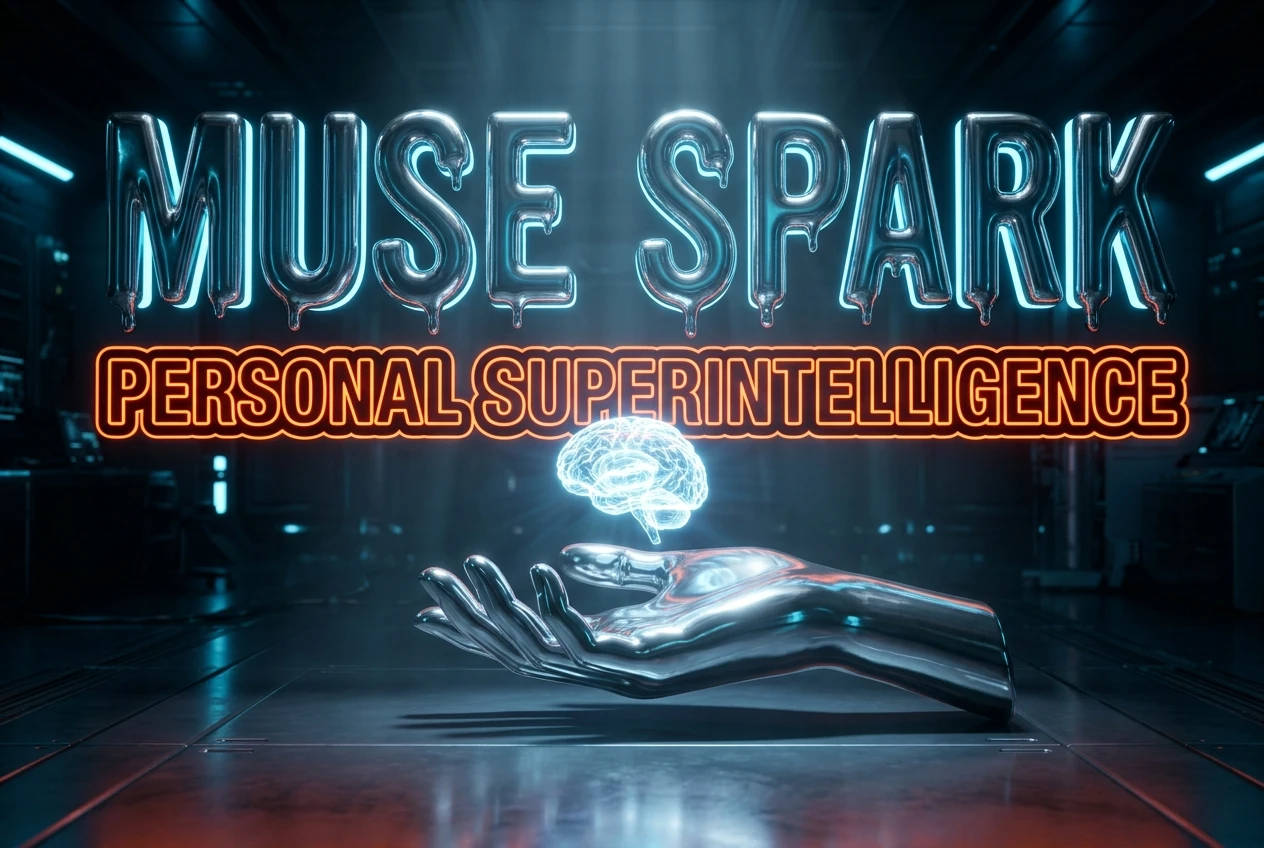
Meta just fired its loudest shot in the artificial intelligence race. The company unveiled Muse Spark, its first model from Meta Superintelligence Labs, powering a faster, smarter Meta AI assistant that can see images, plan in parallel and answer health questions. It lands as Mark Zuckerberg chases what he calls “personal superintelligence.” One detail stands out: Meta rebuilt its entire AI stack from scratch in nine months.
At a Glance:
- Muse Spark debuts as Meta Superintelligence Labs’ first model, code-named Avocado.
- Meta poured $14.3 billion into Scale AI to hire chief AI officer Alexandr Wang.
- Rolling out to WhatsApp, Instagram, Facebook, Messenger and AI glasses in coming weeks.
- Model scored 42.8% on HealthBench Hard, beating GPT-5.4, Gemini 3.1 Pro and Claude Opus 4.6.
What Meta’s Muse Spark actually is
Muse Spark is the first in a new series of large language models built by Meta Superintelligence Labs. It powers the Meta AI app and meta.ai website right now.
The model, code-named Avocado and built over the past nine months by a team led by Alexandr Wang, is a major upgrade over its Llama 4 models. It accepts voice, text and image inputs, but produces text-only output.
Meta describes the system as small and fast by design. The company calls it “small and fast by design, yet capable enough to reason through complex questions in science, math, and health,” and describes it as the first in a series of new models, with Muse Spark being used to validate the architecture and training regime before the company scales up to larger and more powerful models in the same family. You can read the full technical breakdown in the Meta Superintelligence Labs blog post.
How the new Instant and Thinking modes work
The revamped Meta AI runs in two gears. Instant fires off quick answers. Thinking, sometimes called Contemplating mode, handles harder problems.
Meta is also releasing Contemplating mode, which orchestrates multiple agents that reason in parallel. This allows Muse Spark to compete with the extreme reasoning modes of frontier models such as Gemini Deep Think and GPT Pro.
The parallel agent trick is the real twist. The company has integrated Muse Spark into product flows that launch parallel subagents to draft itineraries, compare options, and fetch supporting evidence concurrently.
Think of planning a family trip to Florida. One agent drafts the schedule, another compares Orlando to the Keys, and a third hunts for kid-friendly stops. You get a fuller answer, faster.
Zuckerberg has pitched this shift clearly. “Looking ahead, we plan to release increasingly advanced models that push the frontier of intelligence and capabilities, including new open source models,” Zuckerberg wrote on Threads. “We are building products that don’t just answer your questions but act as agents that do things for you.”
Health, vision and a shopping mode built for Meta’s apps
Meta leaned hard into health. According to Meta’s AI blog, the company worked with more than 1,000 physicians to help train the model, with the goal of delivering more accurate, reliable responses to health-related questions.
The health results give Meta a rare bragging right. On a leading health benchmark, HealthBench Hard, Muse Spark beat all rival models with a score of 42.8%, far better than either Opus 4.6 or Gemini 3.1 Pro, and slightly better than GPT-5.4.
Muse Spark can also generate visual, interactive displays to make information easier to understand, like charts breaking down the nutritional value of your meals or diagrams showing which muscles are activated during a workout.
“We are building toward personal superintelligence, an AI that does not just answer your questions but truly understands your world because it is built on it.”
Shopping is the other big swing. Meta AI can now help you discover what to wear, how to style a room, or what to buy for someone you know. Shopping mode draws from the styling inspiration and brand storytelling already happening across Meta’s apps, surfacing ideas from the creators and communities people already follow. Details are laid out in the company’s official Meta newsroom announcement.
The visual side matters for AI glasses. When Muse Spark reaches that hardware, the assistant can read your surroundings in real time without a phone.
How it stacks up against OpenAI, Anthropic and Google
The benchmarks tell a mixed story. Muse Spark scores 52 on the Intelligence Index, trailing leaders such as Gemini 3.1 Pro and GPT-5.4 (both at 57) and Claude Opus 4.6 (53).
On reasoning, it lands close but not on top. On the GPQA Diamond benchmark, which tests PhD-level reasoning skill, Muse Spark scored 89.5%, slightly trailing Gemini 3.1 Pro’s 94.3% as well as the 92.7% and 92.8% scored by Anthropic’s Claude Opus 4.6 and OpenAI’s GPT-5.4 respectively.
Key takeaway: Muse Spark is not the smartest model on paper, but it is the most tightly woven into daily apps used by billions.
Meta knows where the gaps are. The company acknowledged the performance gaps, saying in its technical blog that it continues “to invest in areas with current performance gaps, specifically long-horizon agentic systems and coding workflows.”
The money, the stakes and what comes next
The bill for this pivot is huge. In January, the company told Wall Street it plans to pour between $115 billion and $135 billion this year into capital expenditures, nearly double its 2025 capex figure.
Andrew Boone, an analyst at Citizens, said Meta’s clear advantage is the more than 3 billion people who use Facebook, Instagram and WhatsApp every month.
Wall Street cheered the launch. For savvy investors, the 10% stock pop over five trading days signals renewed confidence in Meta Platforms’ AI roadmap.
One analyst framed the bigger picture bluntly. “It’s been a year of basically no releases and a lot of hiring, and then the capex worries for this year are pronounced,” said Morningstar analyst Malik Ahmed Khan. “I think Meta had to show investors and operators they have been working on something of substance. That’s the first step.” More context on the business side is available via CNBC’s reporting on Meta’s monetization challenge.
Privacy questions and the road ahead
Muse Spark is not a free-for-all. Users will need to log in with an existing Meta account such as Facebook or Instagram in order to use it.
That login rule has set off fresh privacy alarms among researchers. Meta doesn’t explicitly say that personal information from a Facebook or Instagram account will be used by the AI. But it is likely, considering that Meta generally trains on public user data and the company has positioned Muse Spark as a personal superintelligence product.
Access beyond consumers is coming in stages. Meta is also opening access to the underlying technology. It will be available in private preview via API to select partners, and Meta hopes to open-source future versions of the model.
Zuckerberg’s long-term vision sits on Meta’s personal superintelligence page, where he argues the approach is distinct from others in the industry who believe superintelligence should be directed centrally towards automating all valuable work. You can also dig into Fortune’s deeper benchmark analysis for a rival comparison.
Frequently Asked Questions
What is Muse Spark?
Muse Spark is Meta’s first foundational AI model built by Meta Superintelligence Labs, designed to power the Meta AI assistant across apps, glasses and the web.
Where can I use Muse Spark right now?
It currently powers the Meta AI app and meta.ai website in the United States, with rollouts to WhatsApp, Instagram, Facebook, Messenger and AI glasses in the coming weeks.
How does Muse Spark compare to GPT-5.4 or Gemini 3.1 Pro?
It scores 52 on the Intelligence Index, behind GPT-5.4 and Gemini 3.1 Pro at 57, but it beats every rival on the HealthBench Hard medical benchmark with 42.8%.
Is Muse Spark free to use?
Yes, all flavors of the model are free to use through Meta AI, though Meta may impose rate limits and API access is limited to select partners for now.
What is personal superintelligence?
It is Mark Zuckerberg’s vision for AI that knows you deeply, understands your goals and helps you achieve them, contrasting with rivals who aim to automate all work centrally.
Muse Spark may not top every leaderboard, but it puts Meta back in the personal superintelligence conversation after a rough stretch with Llama 4. With a $14.3 billion Scale AI deal, over 3 billion monthly users and a 10% stock jump in five days, the stakes for Zuckerberg’s bet are enormous. The next model is already in the works, and what happens inside your phone, glasses and feed may never feel the same. Share your thoughts in the comments.

-
 TECH1 year ago
Where Garmin Watches are Made and How They are Assembled
-

 AUTO3 months ago
Tesla’s Roadster Is ‘a Few Weeks Away,’ Says Its Chief Designer
-
 NEWS10 years ago
Samsung Releases Galaxy Note7 TV Ad as Reddit AMA Leaks Specs
-
 NEWS10 years ago
Android 7.0 Nougat Rolls Out To Nexus Devices With New Emoji, Features
-
 FINANCE9 years ago
Cardano Price Surges as ADA Enters the Crypto Top Ten List
-
 NEWS10 years ago
Pre-Order the First Camera Made for Facebook Live Streaming Video
-
 FINANCE1 year ago
Binance Suspends Trading and Withdrawals for a System Upgrade
-
 FINANCE9 years ago
RChain Price Jumps Nearly 150% to a New All-Time High of $2.03