
NEWS
Dolphin’s Inland March Replays Doksuri’s Path Toward Beijing
After landfall in Zhejiang with 151 km/h winds and over a million evacuated, Tropical Storm Dolphin pushes moisture north, testing flood defenses like Doksuri did.

Tropical Storm Dolphin swept inland across eastern China on Monday after making landfall as a typhoon with 151 km/h winds in Zhejiang province, soaking provinces with torrential rain and leaving more than a million people evacuated as moisture pushed toward Beijing.
Authorities kept flood and landslide warnings active while the system, the strongest typhoon to hit China this year, lost energy but continued dumping rain from Anhui to Shandong.
Landfall Near Yuhuan Then a Rapid Weakening
Dolphin came ashore late Sunday near Yuhuan in Zhejiang with maximum sustained winds of 151 kilometres per hour, equal to a Category 1 hurricane. China’s National Meteorological Center had issued its highest red typhoon alert. By Monday the storm had dropped to tropical storm strength as it moved west-northwest and lost energy over land.
Gusts earlier hit 167 km/h at Yueqing station. The system had already covered roughly 6,000 km and lasted three times longer than a typical typhoon, making it one of the easternmost landfalls on record in China since 1951.
- 151 km/h sustained winds at Zhejiang landfall
- 250-500 mm rain possible in central and eastern Zhejiang
- Force 9-12 winds forecast along the East China Sea coast through Tuesday
- Level II national emergency response for severe meteorological disasters
NMC chief forecaster Wang Haiping said the alert stayed high because of rainfall intensity, wide impact range and long duration. “A typhoon landfall does not mean its impact is over. After Dolphin makes landfall, it will push further inland,” he told state media.
More Than a Million Relocated Across Three Provinces
Evacuations began days earlier and peaked as the core neared the coast. Wenzhou alone moved more than 900,000 residents and opened over 1,000 emergency shelters. Shanghai relocated nearly 100,000 from riskier zones. Fujian shifted another 99,000 from high-risk areas.
| Area | People Relocated | Notes |
|---|---|---|
| Wenzhou, Zhejiang | More than 900,000 | Over 1,000 shelters opened |
| Shanghai | Nearly 100,000 | Plus earlier 30,000+ from risk zones |
| Fujian province | 99,000 / 98,900 | High-risk coastal and inland spots |
| Taizhou, Zhejiang | About 390,000 | Pre-landfall Saturday evening |
Overall tallies exceeded one million. Offshore workers were brought ashore, vessels ordered to port, and checks stepped up at reservoirs, mountain streams and construction sites. Fujian suspended 55 coastal ferry routes and halted 115 offshore projects.
Shanghai Flooding Grounded Hundreds of Flights
Shanghai’s two airports cancelled 943 flights on Monday, cutting capacity by nearly 40 percent, CCTV reported. Earlier tallies had run higher as the storm approached. China Eastern Airlines said it was resuming services in orderly fashion to Shanghai, Zhejiang and other points.
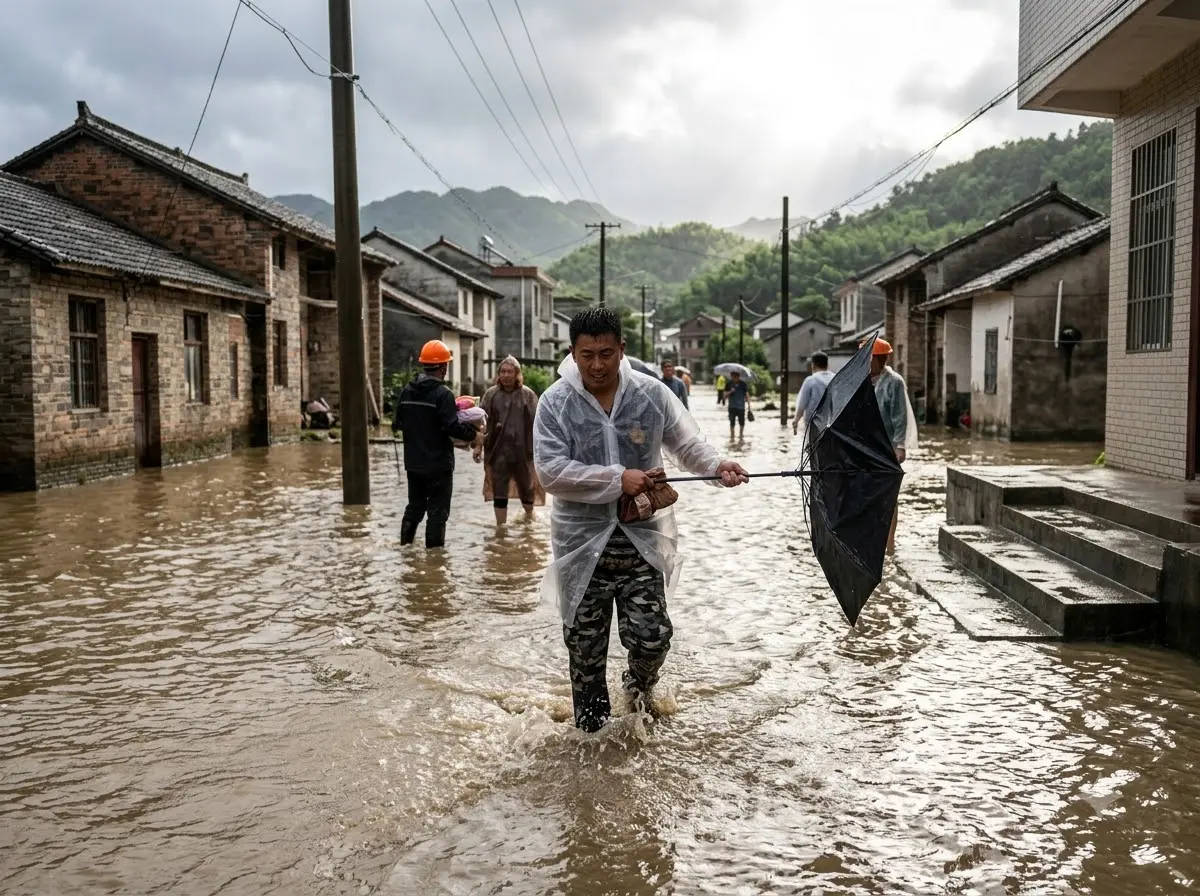
Streets flooded in commercial centres and suburban districts including Jiading and Qingpu. Residents shared live video of knee-deep murky water. Hou Lina, a 39-year-old sales worker in Jiading, told Reuters she had lived in the city ten years and never seen such widespread flooding after overnight rain.
Jinshan district allowed non-essential businesses to halt operations, classes and outdoor events. Yangshan port cleared berths and sheltered more than 500 small and medium vessels. In Zhejiang a video showed powerful winds flipping a truck in Wenzhou.
- 943 flights cancelled at Shanghai airports, ~40% capacity cut
- 74 rivers in the Taihu Lake basin and eastern Zhejiang coastal areas already above warning levels
- Power crews clearing fallen trees and restringing lines in Yongjia county
- Shanghai Tower’s 1,000-tonne tuned mass damper on the 125th floor swung about 50 cm to counter building sway
The damper, suspended by steel cables, moved opposite the tower’s motion as winds hit the 632-metre skyscraper, a visible engineering response that circulated widely.
Search Continues for Boy Swept Off Causeway
Search and rescue crews in Wenling kept looking for a nine-year-old boy swept into the sea. The incident happened Friday afternoon in Shitang town while a typhoon warning was already active, well before landfall. Video showed two adults and two children sprinting across a stone-and-cement causeway to a rocky island when a several-metre wave smashed over the path.
Three scrambled up; the boy disappeared. A bystander shouted that he had already warned them it was dangerous. Local officials said primary access roads were sealed and temporary fences up, yet the group entered through a small passageway. Ten other people trapped on the island were evacuated. Turbulent seas limited rescuers to high ground with telescopes. The footage drew sharp criticism online of the guardians for ignoring barriers.
I already warned you it was dangerous and not to go out there!
The bystander’s shout, captured on the circulating video, underscored how official closures worked only when followed.
Inland Track and the Doksuri Parallel
Dolphin is forecast to move deeper into Hubei and Henan while pushing moisture north. After Wednesday the remnant vortex is expected to turn northward. From Thursday to Sunday the Beijing-Tianjin-Hebei region, northern Shandong and Liaoning face heavy to severe torrential rain.
The path invites direct comparison with Typhoon Doksuri in 2023. That storm hit southeastern Fujian, crossed the country and unleashed record-breaking rainfall on Beijing and northern China. Dolphin’s long life cycle and ultra-large cloud system already enveloping the east set up a similar moisture plume meeting colder northern air.
- Friday 7 Aug: Ministry of Water Resources activates Level-IV flood emergency for six provincial regions ahead of Dolphin.
- Sunday 9 Aug afternoon: NMC upgrades to red alert; landfall near Yuhuan/Yueqing around 5:30 pm local with 151 km/h winds.
- Sunday evening: Second landfall notes around Wenzhou/Yueqing; evacuations exceed one million.
- Monday 10 Aug: Weakens to tropical storm; Shanghai floods and 943 cancellations; rivers over warning; Beijing rain warnings raised.
- Tuesday-Thursday: Significant rainfall expected in Beijing area with flash-flood and landslide risk; flood control response ready for activation Tuesday morning.
Wang Haiping and water officials flagged high risks of mountain torrents, geological disasters and urban waterlogging in Zhejiang, Anhui, Henan and Hebei. The NMC red alert and inland forecast details stressed that secondary disasters from prolonged rain remain the larger threat after winds drop.
Beijing Flood Controls Ready as Moisture Heads North
Beijing authorities raised torrential-rain warnings and said the city was prepared to activate its flood control response Tuesday morning. Significant rainfall is expected from Tuesday until Thursday, with flash-flood risk in the city and landslides in surrounding mountains.
The same moisture is linked to extreme heat farther south. Hong Kong recorded its hottest day on record Sunday at 36.9 °C, the highest since 1884, as Dolphin’s circulation influenced the region. Tropical Storm Risk expects the 2026 northwest Pacific season to rank among the most active on record, with 28 tropical storms, 20 typhoons and 13 intense typhoons, driven by a strong El Niño, high early activity and weaker trade winds.
China’s water ministry had already flagged extremely heavy rains reaching eastern, central and northern regions. The Ministry of Water Resources flood emergency activation days earlier targeted mountain torrents, small-river flooding and urban waterlogging. Patterns in recent active seasons also feed broader discussion of how climate models and extreme weather patterns handle long-track systems and moisture transport.
As of Monday afternoon the core continued westward while rain bands soaked Anhui, Jiangsu and Shandong. Power restoration and drainage work were under way in hardest-hit Zhejiang counties. The boy’s search remained open. Further north, flood gates and emergency teams stood ready for the moisture that Doksuri once delivered in force.

-
 TECH1 year ago
Where Garmin Watches are Made and How They are Assembled
-

 AUTO2 months ago
Tesla’s Roadster Is ‘a Few Weeks Away,’ Says Its Chief Designer
-
 NEWS10 years ago
Samsung Releases Galaxy Note7 TV Ad as Reddit AMA Leaks Specs
-
 NEWS10 years ago
Android 7.0 Nougat Rolls Out To Nexus Devices With New Emoji, Features
-
 FINANCE9 years ago
Cardano Price Surges as ADA Enters the Crypto Top Ten List
-
 NEWS10 years ago
Pre-Order the First Camera Made for Facebook Live Streaming Video
-
 FINANCE1 year ago
Binance Suspends Trading and Withdrawals for a System Upgrade
-
 FINANCE9 years ago
RChain Price Jumps Nearly 150% to a New All-Time High of $2.03