
NEWS
Mecca Pact Hands US Pacific Bandwidth While Crowding India
Pakistan Saudi Turkey defence deal signed August 7 boosts Islamabad prestige but its second-order effect may let Washington shift resources toward Indo-Pacific.

Saudi Arabia, Pakistan and Turkey signed the Mecca Joint Defence Agreement on August 7, pledging that an armed attack on any one counts as an attack on all three. The move hands Pakistan new prestige as a security partner while giving the United States potential room to shift attention east toward China.
India’s foreign ministry said it is closely following the development. Former foreign secretary Kanwal Sibal called it a very negative development for Indian interests. The deeper ripple runs further: a self-reliant Gulf triad could ease American burdens in West Asia and free capacity for the Indo-Pacific.
The accord arrives after years of overlapping crises that tested old assumptions about external guarantees. Each signatory brings different assets and different vulnerabilities. Together they create a framework that is still thin on paper yet dense with regional signals.
Three Leaders Sealed the Deal in Mecca
Crown Prince Mohammed bin Salman, President Recep Tayyip Erdogan and Prime Minister Shehbaz Sharif put their names to the accord at Al-Safa Palace. The joint statement details on collective deterrence state the pact strengthens defence cooperation and treats any armed attack against one as an attack against them all.
No binding force levels, command structure or nuclear sharing appear in the public text. Turkish officials stressed it is purely defensive, open to other nations and not aimed at any country, including Iran. It builds on a September 2025 Saudi-Pakistan mutual defence deal and long-standing training and equipment ties.
- Saudi Arabia supplies oil wealth and Gulf basing access
- Turkey brings NATO’s second-largest army and a growing drone and defence industry
- Pakistan offers nuclear status, manpower and Chinese-origin systems familiarity
Pakistan has already deployed about 8,000 troops, jets, drones and air defences to Saudi Arabia during the Iran conflict. The new framework adds Turkey’s industrial weight.
That earlier deployment showed Islamabad could move forces quickly when Riyadh asked. The Mecca text now wraps those bilateral habits inside a trilateral political cover. Turkey’s entry adds production capacity that neither Saudi Arabia nor Pakistan can match alone. The absence of fixed troop numbers or a joint headquarters keeps the arrangement flexible, and also keeps its real weight untested.
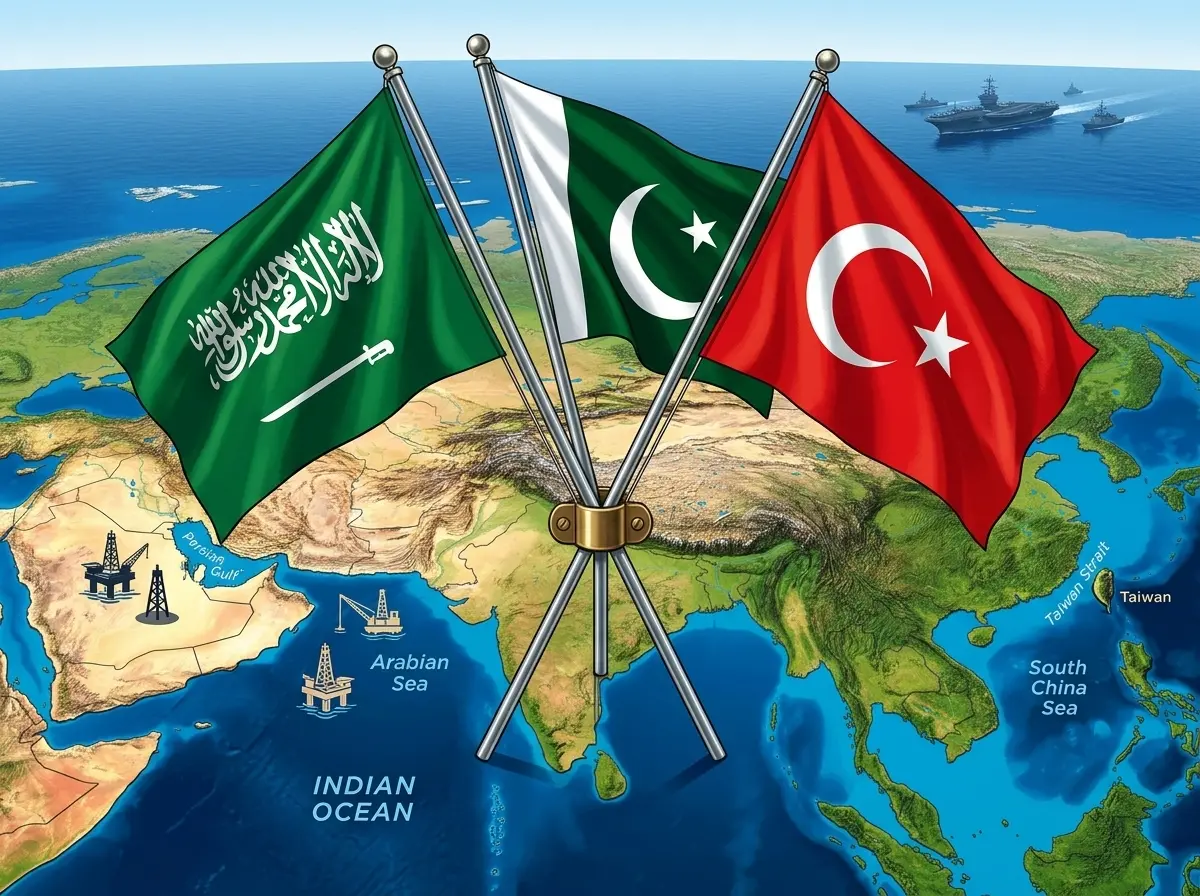
India’s Western Flank Just Got Crowded
New Delhi has expanded energy, investment and strategic ties with Riyadh in recent years. That relationship remains intact. Yet any defence framework that elevates Pakistan as a net security provider forces Indian planners to recalculate.
a very negative development for Indian interests
Kanwal Sibal wrote that line on X. Even if Saudi Arabia stays out of any future India-Pakistan clash, Islamabad can still draw intelligence sharing, weapons flows, diplomatic cover or financing. Turkey’s support for Pakistan was already visible during Operation Sindoor in May 2025, when India struck militant targets after the Pahalgam attack.
The risk is emboldenment. A more backed Pakistan may test Indian red lines with less fear of isolation in the Gulf. India’s test case is whether Riyadh lets the new framework internationalise future bilateral crises. For more on the immediate framing, see this site’s earlier breakdown of the untested deterrence layer.
Indian officials must now track three separate channels that once moved more slowly. Saudi financing decisions, Turkish equipment exports and Pakistani operational confidence can reinforce one another. None of those channels is new. Their formal linkage is. The practical question for New Delhi is whether the pact stays rhetorical during the next spike or whether it supplies Islamabad with faster diplomatic and material backing.
Beijing Sees Both an Opening and a Trap
China has armed Pakistan, bought Iranian oil, courted Saudi Arabia and Turkey, and traded with the UAE without choosing sides. Pakistani crews already know Chinese platforms. That familiarity could ease Chinese systems into Gulf inventories through joint projects or transfers.
Commercial upside exists. Strategic downside follows. The pact matches what Washington wants from partners: greater burden-sharing. Michael Kugelman of the Atlantic Council noted the focus on collective regional deterrence with an eye to Iran will sit well in Washington.
| Dimension | Potential Chinese Gain | Potential Chinese Cost |
|---|---|---|
| Arms markets | Wider Gulf entry via Pakistan | US retaliation via Taiwan arms |
| Diplomacy | Continued multi-friend approach | Stronger US Indo-Pacific focus |
| Regional posture | Stable energy and investment lanes | Harder Taiwan contingency |
Sibal warned China would be careful not to become a major arms supplier that undermines US interests, lest Washington step up deliveries to Taiwan. Beijing’s parallel efforts elsewhere, such as Beijing’s parallel push for tech coalitions outside the G7, show the same pattern of building alternative networks while facing counter-pressure.
The table above captures the core trade-off. Every commercial opening that runs through Pakistani familiarity with Chinese gear also advertises a pathway that Washington can punish elsewhere. Beijing therefore gains market access only if it keeps the political temperature low enough to avoid a sharper American response on Taiwan. That balancing act grows harder once the United States feels freer to move forces and attention toward the Pacific.
Washington Gains Bandwidth for the Pacific
The United States still treats China as its principal long-term competitor. Years of Middle East fire have stretched American attention and stocks. A more self-reliant Saudi-Turkey-Pakistan grouping reduces the need for constant US military focus on West Asia.
Atlantic Council experts break down the motives of each capital. Allison Minor noted Riyadh is abandoning hopes of a pure Article 5 guarantee from Washington and moving toward a web of partnerships. That shift aligns with US desires to become an integrator rather than sole guarantor.
Extra leeway could flow into Indo-Pacific deployments, critical minerals, advanced technology, supply-chain work and alliances ringing China. The pact itself need not name Beijing to produce that effect.
American planners have long sought partners willing to carry more of the local load. The Mecca framework supplies political cover for exactly that transfer. If the three capitals begin to handle routine deterrence tasks among themselves, Washington can thin some of its standing commitments without appearing to abandon the Gulf. The capacity freed by that thinning is the resource Beijing must now price into its own timelines.
Modern Wars Refuse Clean Endings
The larger lesson for China sits in Ukraine and the Iran theatre. Russia’s larger forces have not delivered decisive victory after years. US and Israeli strikes have damaged Iran heavily yet failed to force submission or stop Tehran from imposing costs on Gulf energy routes.
Military superiority and alliances no longer guarantee quick wins against determined weaker foes. That reality lands hardest on Taiwan planning. Xi Jinping has set reunification as a core goal and directed the PLA to be ready for contingency by 2027. Prolonged, costly wars elsewhere make forced unification look riskier.
- 2022 onward: Russia-Ukraine war shows attrition and Western support can blunt larger powers
- 2025-2026: India-Pakistan clash and Iran escalations reveal limited war dynamics and proxy depth
- 2026: Gulf states hedge with new pacts as US reliability questions grow
Japan is accelerating its own build-up and treating a Taiwan fight as relevant to its security. China’s wolf-warrior pressure has produced the opposite of accommodation in several neighbours.
Each entry on the timeline above undercuts the hope of a short, decisive campaign. Attrition in Europe, limited war dynamics in South Asia and proxy depth around the Gulf all point the same way. A Taiwan contingency planned against a 2027 readiness mark now collides with evidence that modern conflicts stretch, escalate sideways and invite outside support for the weaker side. Neighbours watching that evidence have begun to arm and align more quickly than before.
Whether the Pact Hardens Into Integration
Political signalling is cheap. Real capability requires joint exercises, intelligence links, command arrangements, defence-industrial partnerships, technology transfers and shared procurement. None of those are locked in yet.
Crowd analysis on X treats the deal as a strategic hedge rather than a finished NATO clone. It lacks integrated command or standing forces. An aggression-exclusion idea appears in some commentary: protection may not cover a member that starts a fight. That keeps it defensive on paper.
For India the practical gauge is Saudi behaviour in any new India-Pakistan spike. For China the gauge is measurable US force posture change in the Pacific. Both will watch procurement choices: Turkish systems may crowd Chinese ones, or the reverse.
Until exercises and shared procurement appear, the pact remains a statement of intent. The aggression-exclusion concept further limits automaticity. A member that initiates a crisis may find the other two slow to respond. That ambiguity preserves political room for Riyadh and Ankara, yet it also caps the deterrent value Islamabad can claim. Watchers in New Delhi and Beijing will therefore measure deeds, not communiqués.
Complementary Strengths Define the New Grouping
The three parties do not duplicate one another. Their assets fit together in ways that bilateral deals could not fully capture. Saudi resources and basing, Turkish industry and NATO experience, and Pakistani manpower plus nuclear status form a rough division of labour already visible in earlier deployments and training ties.
| Partner | Core Contribution | Immediate Limit |
|---|---|---|
| Saudi Arabia | Oil wealth and Gulf basing access | Depends on external trainers and equipment |
| Turkey | NATO-scale army and drone industry | No permanent Gulf force posture yet |
| Pakistan | Nuclear status, troops and Chinese systems knowledge | Economic strain and two-front pressures |
The September 2025 Saudi-Pakistan deal supplied the bilateral base. Turkey’s addition layers industrial depth onto that base. The 8,000 Pakistani personnel already sent during the Iran conflict demonstrated that manpower can move. What remains missing is the connective tissue of joint command and shared logistics. Until those appear, the complementary strengths stay potential rather than operational.
Openness to other nations, stressed by Turkish officials, keeps the door ajar for later expansion. That same openness also dilutes exclusivity. A pact that can admit new members tomorrow is harder to turn into a tight, automatic alliance today. The design therefore favours flexibility over depth, at least in its opening phase.
Regional Hedges Multiply as Guarantees Fray
Riyadh’s move toward a web of partnerships, as Allison Minor described, reflects a wider pattern. States that once waited for a single external protector now collect overlapping assurances. The Mecca text is one more strand in that web. It does not replace American power. It reduces the political cost of American distraction.
- Collective language raises the diplomatic price of attacking any single member
- Defensive framing and the aggression-exclusion idea limit automatic entanglement
- Industrial and training ties can grow even if formal command structures lag
- Procurement choices will reveal whether Turkish or Chinese systems gain ground
For Washington the multiplication of hedges is welcome so long as it produces real burden-sharing. For Beijing the same multiplication raises the cost of any future Taiwan move by freeing American attention. For New Delhi the risk is that Pakistan extracts more cover from the new strand than the other two intend to give. Each capital therefore reads the same document through a different threat lens.
The framework’s value will be settled by behaviour under stress, not by the ceremony at Al-Safa Palace. Joint exercises, intelligence links and procurement contracts remain the only durable proof that the hedge has substance. Until those proofs arrive, the pact functions mainly as a signal that old reliance patterns are under review.
The three capitals now own a framework that raises Pakistan’s regional standing and offers Riyadh and Ankara extra options. The second-order currents run toward a United States less tethered to the Gulf and a China that must price higher risks into any Taiwan timeline. How far the paper pledge turns into metal and data sharing will decide whether those currents strengthen or fade.

-
 TECH1 year ago
Where Garmin Watches are Made and How They are Assembled
-

 AUTO2 months ago
Tesla’s Roadster Is ‘a Few Weeks Away,’ Says Its Chief Designer
-
 NEWS10 years ago
Samsung Releases Galaxy Note7 TV Ad as Reddit AMA Leaks Specs
-
 NEWS10 years ago
Android 7.0 Nougat Rolls Out To Nexus Devices With New Emoji, Features
-
 FINANCE9 years ago
Cardano Price Surges as ADA Enters the Crypto Top Ten List
-
 NEWS10 years ago
Pre-Order the First Camera Made for Facebook Live Streaming Video
-
 FINANCE1 year ago
Binance Suspends Trading and Withdrawals for a System Upgrade
-
 FINANCE9 years ago
RChain Price Jumps Nearly 150% to a New All-Time High of $2.03