
NEWS
China’s New AI Alliance Signs 29 Nations, Not One From the G7
Xi Jinping launched a 29-nation AI alliance in Shanghai, but the G7 allies who defected to China’s 2015 bank instead joined a rival US bloc this time.

Chinese President Xi Jinping urged the world on Friday to build an artificial intelligence order that no single country controls. Twenty nine governments had already signed on to make that official one day earlier, in Shanghai. Zero of them came from the Group of Seven.
The new body, the World Artificial Intelligence Cooperation Organisation (WAICO), launched on July 16 with a roster heavy on Russia, Brazil, Pakistan, Indonesia and more than a dozen African and Southeast Asian states. Washington’s own answer, a separate bloc called Pax Silica, already counts the European Union, Germany, Japan, Britain and India. China has run a version of this play before. In 2015, its infrastructure bank pulled the United Kingdom, Germany and Australia away from Washington within weeks of launch. This time, none of them moved.
Xi Tells Summit AI Cannot Be a ‘Solo Performance’
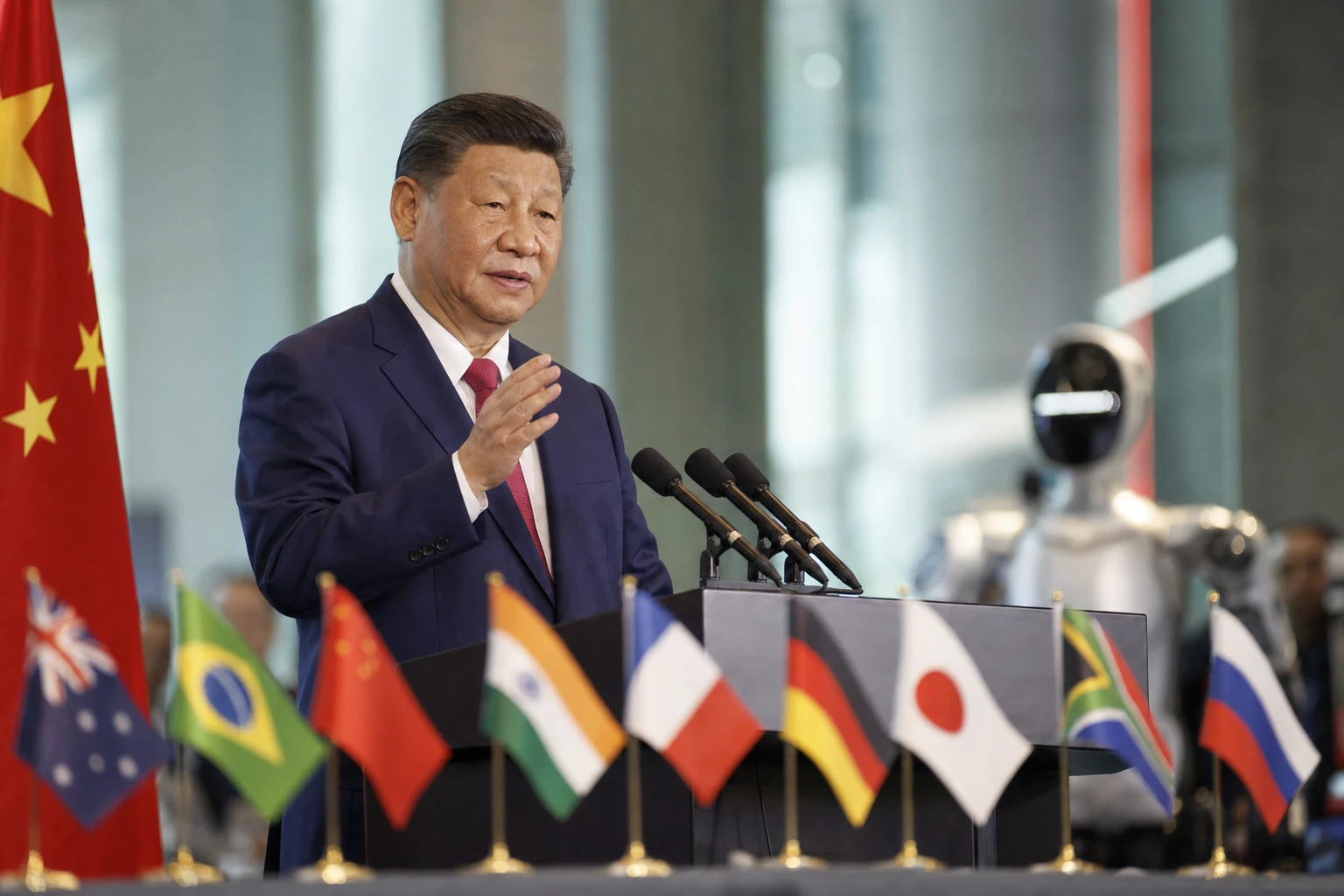
Xi addressed the World Artificial Intelligence Conference in person for the first time in the event’s nine year run, according to reporting from Tech Times coverage of the Shanghai summit. He called on countries to embrace open source AI as a way to help developing nations avoid what he described as fresh historical injustices.
“AI development should not be a solo performance by a single country, but a symphony of international cooperation,” Xi said. He added a warning aimed squarely at Washington’s export control regime: “We should jointly oppose overstretching the national security concept in the field of AI or placing one country’s security over that of others.”
He also pressed for a people centered approach, insisting AI stay “under human control” through regulation, monitoring and emergency response systems. On the exhibition floor below the keynote, a humanoid robot cooked meals for visitors and another kicked a football, part of a showcase China has run annually since 2018.
Who Actually Signed On to China’s AI Club?
Twenty nine countries became WAICO founding members on July 16, spanning Europe, Central Asia, Africa, Latin America and Asia, but including no government from North America, Western Europe or the wealthy democracies of East Asia. Chinese Foreign Minister Wang Yi signed the agreement in Shanghai on Beijing’s behalf, with UN Secretary General António Guterres in attendance.
- Europe and Eurasia: Russia, Belarus and Serbia
- Central Asia: Kazakhstan, Kyrgyzstan, Tajikistan and Uzbekistan
- Africa: ten states including South Africa, Kenya, Ethiopia and Senegal
- Latin America: Brazil, Cuba, Nicaragua and Venezuela
- Asia: Indonesia, Pakistan, Malaysia, Cambodia, Laos and Myanmar, alongside host nation China
Xi paired the launch with concrete offers rather than just principles. He pledged 5,000 AI training and seminar slots for developing countries over five years and promised to roll out China’s Mazu weather forecasting system across 30 nations, a detail state broadcaster Xinhua reported from the ceremony.
Beijing Already Ran This Play in 2015
The template is familiar to anyone who watched the Asian Infrastructure Investment Bank get built. Xi proposed that bank in 2013. By March 2015, Britain’s chancellor announced London would join over open objections from Washington, and the decision by key NATO allies to opt into the AIIB triggered a rush of applications from Germany, France and Italy within days.
Australia and South Korea followed despite what a US congressional research service later called American efforts to keep them out. A government report on the episode noted that neither the Obama nor Trump administrations saw joining the AIIB as in the US interest, yet dozens of Washington’s closest partners joined anyway. American commentators at the time called it an embarrassment for US diplomacy.
WAICO has not produced that moment. No European capital, no G7 government and no East Asian democracy has broken ranks to sign Beijing’s AI charter, even as the same trade tensions and export controls that pushed allies toward the AIIB in 2015 are visibly present again in the chip fight between Washington and Beijing.
Washington Built the Rival Club First
Part of the reason is that Washington did not wait this time. The State Department launched Pax Silica in December 2025 as its own supply chain and AI framework, led by Under Secretary of State for Economic Affairs Jacob Helberg. The State Department’s own framing of the initiative describes it as uniting economies that host advanced technology companies to build trusted digital infrastructure together.
India signed on as the tenth member in February 2026. By its second summit in June, the group had absorbed the European Union, Germany, the Netherlands, Greece, Argentina, Chile, Costa Rica, El Salvador, Panama and Kazakhstan, taking the declaration’s signatory count to 24 nations. A separate, broader Joint Statement on AI Opportunity at that same summit drew the United States plus 34 other countries, including Japan, Britain, South Korea and Australia.
| Detail | WAICO | Pax Silica |
|---|---|---|
| Launched | July 16, 2026, in Shanghai | December 2025, in Washington |
| Anchor government | China | United States |
| Core membership | 29 founding states | 24 declaration signatories |
| Notable members | Russia, Brazil, Indonesia, Pakistan, South Africa | European Union, Germany, Japan, Britain, India |
| Base | Permanent headquarters in Shanghai | Coordinated by the US State Department |
| Stated focus | AI governance and capacity building for developing nations | Securing chip, mineral and AI supply chains among partners |
One government hedged rather than picked a side. Kazakhstan is a WAICO founding member and also joined Pax Silica’s June expansion, making it the only country confirmed on both rosters. Kazakh President Kassym-Jomart Tokayev used his own WAIC speech to propose hosting a WAICO regional office for Central Asia while separately courting Washington’s bloc.
The Chips, Power and Minerals Underneath the Speeches
The diplomacy sits on top of a harder industrial contest. China lags the United States in access to the most advanced semiconductors, and Washington’s Commerce Department affirmed fresh restrictions in May on chip shipments to Chinese firms’ overseas subsidiaries. Beijing answered by curbing exports of dual use technology and critical minerals to American companies.
China still holds real advantages elsewhere. It generates more than twice the electricity the United States does, a gap state planners expect to widen, and it dominates the rare earth processing that chipmaking depends on. Its domestic AI industry has scaled fast enough to make the WAICO pitch credible to smaller economies.
- 176.6 billion dollars: value of China’s core AI industry in 2025, over 1.2 trillion yuan, per Xinhua’s account of Xi’s remarks
- 6,200-plus: AI enterprises now operating across the country
- 10 billion-plus: downloads logged by China’s open source AI models worldwide
- 71 billion dollars: DeepSeek’s reported valuation as it raises fresh capital toward a possible 2027 listing
Moonshot AI’s new Kimi K3 model now trading blows with Western frontier labs and Huawei’s homegrown Atlas 950 supercomputer are the kind of proof points Beijing points to when it argues the technology gap is closing. Washington, meanwhile, has its own worries about the relationship: a White House memo on Chinese AI distillation tactics landed weeks before a planned Trump Beijing summit, a reminder that the chip fight is running on its own track alongside the institutional one.
Guterres Attended a Body He Does Not Run
The UN Secretary General’s presence in Shanghai gave WAICO a stamp of global legitimacy that Pax Silica, built entirely outside the United Nations system, cannot claim. But attendance is not membership. Guterres used his remarks to press a different, harder question than the one about blocs.
The defining question is whether that transformation will reduce inequalities or reinforce them. Whether it will concentrate power or expand opportunity.
António Guterres, UN Secretary General, told the opening ceremony of the conference. He praised China’s open source model releases as valuable to the world and pushed governments to fund AI’s energy use with clean power, while stopping short of endorsing WAICO as a UN mechanism.
Arindrajit Basu, a governance researcher at the Carnegie Endowment for International Peace, a Washington based think tank, has argued Beijing is moving into space Washington is leaving empty. “With Washington rapidly retreating from global cyber and AI norms-setting processes and withdrawing its financial backing for cyber diplomacy more broadly, Beijing is keen to demonstrate its global leadership,” Basu wrote, adding that China hopes to win backing from the Global South for its state centered model of technology governance.
Frequently Asked Questions
Is the United States a member of either WAICO or Pax Silica?
The US belongs to neither China’s WAICO nor has it signed any rival Chinese AI declaration. It is instead the founder and lead signatory of Pax Silica, which it launched through the State Department in December 2025 as a non-binding framework for allied governments.
Which countries belong to both blocs?
Kazakhstan is the only government confirmed as a member of both WAICO and a Pax Silica signatory as of July 2026. Its president has also proposed hosting a WAICO regional office for Central Asia, positioning the country as a bridge rather than a partisan in the split.
Does the United Nations formally run WAICO?
No. WAICO operates as an independent intergovernmental body outside the UN system despite Guterres attending its signing. The UN runs its own parallel effort, a Global Network for Exchange and Cooperation on AI Capacity Building that Guterres said has already drawn more than 20 countries, including China, plus a proposed Global Fund for AI still awaiting formal recommendations.
What does the split mean for companies building AI products globally?
Firms operating across both blocs may end up managing two separate compliance tracks, since WAICO members are not bound to match standards set by the EU AI Act, the G7’s Hiroshima Process or Pax Silica’s supply chain rules, and vice versa. Multinational AI vendors will likely need separate testing and disclosure processes depending on which framework a given market has joined.
How many countries have joined neither bloc?
Roughly 140 of the UN’s members have signed on to neither framework, based on WAICO’s 29 members and Pax Silica’s 24 signatories minus Kazakhstan’s overlap. That leaves most of the world’s governments still uncommitted, which is precisely the constituency both Beijing and Washington are now competing to recruit.

-
 TECH1 year ago
Where Garmin Watches are Made and How They are Assembled
-
 AUTO3 months ago
Tesla’s Roadster Is ‘a Few Weeks Away,’ Says Its Chief Designer
-
 NEWS10 years ago
Samsung Releases Galaxy Note7 TV Ad as Reddit AMA Leaks Specs
-
 NEWS10 years ago
Android 7.0 Nougat Rolls Out To Nexus Devices With New Emoji, Features
-
 FINANCE9 years ago
Cardano Price Surges as ADA Enters the Crypto Top Ten List
-
 NEWS10 years ago
Pre-Order the First Camera Made for Facebook Live Streaming Video
-
 FINANCE1 year ago
Binance Suspends Trading and Withdrawals for a System Upgrade
-
 FINANCE9 years ago
RChain Price Jumps Nearly 150% to a New All-Time High of $2.03