
BUSINESS
Ethanol Fix Leaves Maharashtra Sugar Mills With Idle Capacity
Maharashtra sugar mills built distilleries for surplus cane only to see grain ethanol claim most OMC orders.

Maharashtra’s sugar mills installed 323 crore litres of ethanol capacity after the 2018 biofuels push, yet Oil Marketing Companies bought just 116 crore litres from them last year. Roughly 64 percent of that capacity sat idle while grain-based producers took the larger share of tenders.
The same policy that was meant to clear cane surplus and steady mill finances now leaves cooperative and private factories carrying maintenance costs on empty tanks. Public anger at E20 fuel has cast those mills as the winners. Their ledgers show the opposite.
Sixty-Four Percent of Distillery Capacity Goes Unused
One hundred nineteen of the state’s 210 sugar mills expanded distilleries after both state and Union governments offered interest subvention. Mills put the installed figure at 323 crore litres by 2026. Independent estimates run higher, between 396 and 424 crore litres.
Against the mills’ own 323 crore litre number, OMCs procured only 116 crore litres. That left about 207 crore litres, or 64 percent, earning nothing. Maintenance bills still rise every year.
| Measure | Crore Litres | Share of Stated Capacity |
|---|---|---|
| Installed capacity (mills’ figure) | 323 | 100% |
| OMC procurement last year | 116 | 36% |
| Idle capacity | 207 | 64% |
The gap is not a rounding error. Even if independent estimates near 396 to 424 crore litres prove closer to the truth, the offtake figure stays fixed at 116. Idle share would only look worse.
| Feedstock | OMC Rate (Rs per litre) | Notes |
|---|---|---|
| Sugar syrup / juice | 65.61 | Unchanged since 2023 |
| B-heavy molasses | 60.73 | Unchanged since 2023 |
| C-heavy molasses | 57.97 | Lowest sugar route |
| Maize (grain) | 71.86 | Highest among major routes |
| FCI surplus rice | 60.32 | Revised upward for ESY 2025-26 |
Fair and Remunerative Price for cane has risen twice in three years. Ethanol rates set by OMCs have not. Hemant Patil, an MLC from Eknath Shinde’s Shiv Sena, told the Maharashtra Legislative Council the mills cannot survive on 2023 prices.
Maize draws the top rate at 71.86 rupees a litre. Sugar syrup and juice, the routes mills built for, remain stuck at 65.61. B-heavy and C-heavy molasses sit lower still. The price ladder itself now tilts against the feedstock the 2018 push asked mills to use.
Grain Took the Share Sugar Once Held
In the early years after the National Policy on Biofuels, OMCs took nearly 60 percent of national ethanol from sugar mills. By 2026 that share had fallen to 26-27 percent.
For Ethanol Supply Year 2025-26, Cycle 1 offers told the story plainly. Manufacturers bid 1,776 crore litres against a requirement near 1,050 crore litres. Of those offers, sugarcane offers at 471 crore litres made up roughly 28 percent. Grain-based bids reached 1,304 crore litres.
Rice and maize stocks grew. Standalone grain distilleries expanded. Sugar mills that had poured capital into capacity found themselves second in line. The Cabinet had advanced the 20 percent blending target to ESY 2025-26 from 2030. The feedstock mix shifted faster than many mills expected.
- Early post-2018 years: sugar mills supplied nearly 60 percent of OMC ethanol
- ESY 2025-26 offers: sugarcane route down to about 28 percent of total bids
- Maharashtra last year: only 36 percent of stated capacity actually procured, per legislators
- National picture: grain now dominates new offtake
Over-subscription defines the new market. Bids of 1,776 crore litres for a requirement near 1,050 mean OMCs can choose. Grain volume of 1,304 crore litres alone exceeds the entire requirement. Sugarcane’s 471 crore litres cannot set the terms.
Satej Patil, Congress group leader in the Legislative Council, put the stakes simply in March 2026. “Increase in ethanol procurement is very much necessary to survive. Only 36 per cent of the State’s ethanol production capacity is being procured. Investment on distillery expansion has also not yet recovered. In such a situation, ultimately the farmer, who is a stakeholder in the cooperative sugar industry, will get hurt.”
Legislature Raises the Alarm, Delhi Stays Quiet
The crisis reached the Maharashtra Legislative Council in the Budget session. Members across parties pressed for higher procurement and better rates. Chief Minister Devendra Fadnavis promised to take it to the Centre. He chaired a meeting with mill owners, directors and the Sugar Commissioner. In April he met Union Home Minister and Cooperation Minister Amit Shah in Delhi and said he expected relief.
As of early August 2026 nothing had moved. Babasaheb Patil, the state Cooperation Minister, told Frontline on August 5 the government remained hopeful the next OMC tenders would lift the sugar mills’ quota. Those tenders usually appear between September and October.
- 2018: National biofuels push and interest subvention spur distillery expansion
- 2023: OMC ethanol rates for sugar routes freeze at current levels
- Cabinet decision: E20 target advanced to ESY 2025-26 from 2030
- March 2026: Satej Patil warns the Council that only 36 percent of capacity is procured
- Budget session 2026: Legislature presses for higher offtake and better rates
- April 2026: Fadnavis meets Amit Shah in Delhi and signals expected relief
- August 5, 2026: Babasaheb Patil says the state still hopes the next tenders will help
- September-October: OMC tenders typically open
- October 2026: Next crushing season begins
The problem is national. The Indian Sugar and Bio-Energy Manufacturers Association has gone to the Supreme Court over a Karnataka quota dispute. The Western India Sugar Mills Association met the Union Petroleum Minister seeking a larger share for sugar routes. A senior cooperative director in western Maharashtra, also a BJP member, told Frontline on condition of anonymity that the fear now runs the other way: further cuts to sugar quotas if public pressure on E20 forces the Centre to protect grain routes that matter in Punjab ahead of its polls.
State ministers can convene and travel. Quota and rate decisions still sit with OMCs and the Centre. The September and October tender window is the next practical test of whether those meetings changed anything.
Two Battles at Once: Money and Reputation
Hanmant Mohite, a Sangli journalist who has covered the industry for decades, described the bind. “Now the sugar industry is fighting two battles. One is the financial crisis from the ethanol policy mess. The second is a battle of perception. The middle class genuinely believes sugar mills have grown richer from ethanol blending. The cooperative sugar mill was already maligned for other reasons; ethanol has only added to that reputation.”
Now the sugar industry is fighting two battles. One is the financial crisis from the ethanol policy mess. The second is a battle of perception.
Mohite’s point lands hard on social media. Critics fix on Union Minister Nitin Gadkari’s long advocacy for blending and on his family’s sugar and agro links. Gadkari has filed a defamation suit in the Bombay High Court over posts and deepfakes. Crowds on X note that ownership of mills and distilleries runs across parties in Maharashtra and Karnataka. Pawar-linked interests, Congress and NCP families, and BJP figures all appear in the ownership tallies that circulate. The silence from many opposition voices tracks that multi-party stake. The public still sees only the enrichment story.
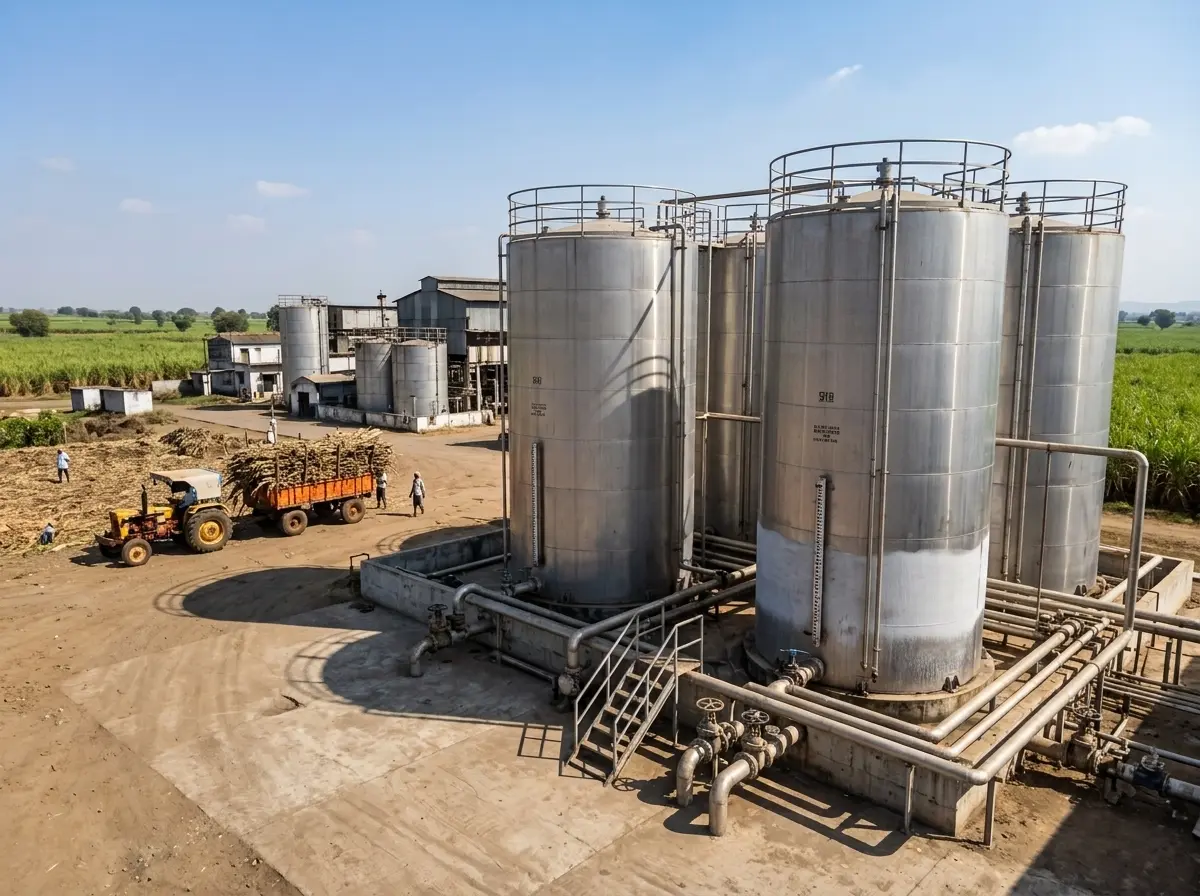
The irony is complete. Mills borrowed and built because governments told them ethanol would absorb surplus sugar and deliver steady cash. Those tanks now sit underutilised. The same tanks feed the narrative that barons are cashing in on car owners who complain of mileage drops and maintenance bills.
Idle steel does not read as distress on a feed of mileage complaints. The perception battle and the offtake battle reinforce each other. Each month of quiet tanks makes the enrichment story harder to dislodge, even as ledgers show the reverse.
Farmers Sit Inside the Cooperative Structure
Most of Maharashtra’s sugar sector remains cooperative. Cane growers are members and residual claimants. When mills cannot sell ethanol or recover distillery investments, cane payment delays lengthen. FRP rises that look good on paper become harder to meet when the second revenue stream stalls.
Private mills face the same offtake squeeze. Across the country the industry has invested tens of thousands of crores in capacity on the strength of the blending roadmap. The National Policy on Biofuels 2022 amendment widened feedstocks and brought the E20 date forward. Grain responded faster in many regions. Sugar mills that specialised in molasses and juice routes discovered their advantage was temporary.
Next crushing season begins in October 2026. Idle capacity carried into another year means higher fixed costs per tonne of cane crushed. Banks that financed the expansions watch the repayment schedules. Any further reduction in sugar-route quota would hit exactly when mills need cash for cane payments.
Cooperatives transmit stress downward. A mill that cannot clear ethanol inventory still owes FRP. Grower-members wait longer. The second product that was meant to stabilise cane dues now adds a fixed cost that must be spread across every tonne that enters the crush.
Ethanol Prices Stay Flat While Cane Costs Climb
The rate table freezes the core commercial problem in place. Sugar syrup and juice remain at 65.61 rupees a litre, B-heavy molasses at 60.73, and C-heavy at 57.97, all unchanged since 2023. FRP for cane has risen twice in the same three-year window.
Mills therefore buy dearer cane and sell ethanol at yesterday’s price. Grain routes do not face that bind in the same way. Maize commands 71.86 rupees a litre, the highest among major feedstocks. FCI surplus rice was revised upward for ESY 2025-26 to 60.32. The sugar routes that absorbed the early policy signal received no matching revision.
Hemant Patil’s warning in the Legislative Council follows directly from that gap. Survival on 2023 ethanol prices becomes harder each time FRP steps up. Interest subvention helped build the tanks. It does not pay for cane or for yearly maintenance on capacity that OMCs do not lift.
Until OMC rates move or sugar-route volumes rise, every FRP increase widens the squeeze. The policy sequence that once paired capacity support with offtake has left the price leg stuck while the cost leg keeps walking.
E20 Backlash Meets an Industry Already Cornered
Vehicle owners and Gen Z protesters have made ethanol-blended petrol a street issue. Arvind Kejriwal held a town hall against the policy. Youth Congress workers protested outside Gadkari’s Nagpur residence on August 3. After the NEET paper-leak demonstrations, the Centre has reason to move carefully.
Mill associations watch the politics with dread. A consumer-first response that trims blending or steers more volume to grain would deepen the financial hole they already report. A defence of current blending levels that still starves sugar-route offtake leaves the same hole. Either path keeps the perception problem alive.
The original bargain was simple. Divert cane juice and molasses to ethanol, clear sugar stocks, cut oil imports, and give mills a second product. For three or four years it worked. Then grain capacity scaled, rice and maize became available, and OMC tenders followed the cheaper or more plentiful feedstock. The mills that answered the 2018 call now carry the stranded assets.
Upcoming tenders will show whether Delhi intends to rebalance the mix. Until then the tanks stay quiet, the maintenance bills arrive, and the public argument continues to treat the owners of those tanks as the ones who won.

-
 TECH1 year ago
Where Garmin Watches are Made and How They are Assembled
-

 AUTO2 months ago
Tesla’s Roadster Is ‘a Few Weeks Away,’ Says Its Chief Designer
-
 NEWS10 years ago
Samsung Releases Galaxy Note7 TV Ad as Reddit AMA Leaks Specs
-
 NEWS10 years ago
Android 7.0 Nougat Rolls Out To Nexus Devices With New Emoji, Features
-
 FINANCE9 years ago
Cardano Price Surges as ADA Enters the Crypto Top Ten List
-
 NEWS10 years ago
Pre-Order the First Camera Made for Facebook Live Streaming Video
-
 FINANCE1 year ago
Binance Suspends Trading and Withdrawals for a System Upgrade
-
 FINANCE9 years ago
RChain Price Jumps Nearly 150% to a New All-Time High of $2.03